









IT infrastructure continues to evolve alongside technological developments, forcing us to find solutions to these complex problems. Cloud migration is one solution that not only helps businesses survive but also helps them thrive. According to Gartner research, more than 85% of organizations will adopt a cloud-first principle by 2025. For many organizations, this step aims to achieve a more responsive digital presence that can keep up with the demands of the modern market.
This transition is now supported by a clear national framework. The National Cloud Computing Policy (NCCP) serves as a major driver for Malaysia’s digital transformation, ensuring that the shift happens in a secure and sustainable manner. By aligning with these government standards, businesses can ensure their migration strategies are not only modern but also compliant with regional digital governance.
However, a successful transition is not simply a matter of moving files from one server to another. It involves many steps, such as how teams access data, reviewing data security, and reviewing how applications communicate. Addressing these issues will determine whether a business can find real competitive benefit or simply move its old operational problems to a newer environment.
Key Takeaways
|
Why Cloud Migration Drives Business Growth
Deciding to move your operations to a virtual environment and the first step toward making smarter investment choices. It helps your entire organization stay in sync with market changes while ensuring your teams can work together from any location without technical friction.
1. Scaling Without the Hardware Headache
One of the best things about the cloud is that it grows with you. You can add more computing power the moment your traffic spikes and scale back when things quiet down. This means you can test new ideas or enter new markets without having to buy expensive servers upfront.
This level of flexibility allows your business to stay light and fast. Instead of worrying about hardware limits, you can focus on grabbing new opportunities before they disappear.
2. Turning Fixed Costs into Smart Spending
Maintaining a physical data center is a massive drain on any budget. By moving to the cloud, you stop paying for idle hardware and switch to a model where you only pay for what you actually use.This shift allows companies to better balance their fixed cost and variable cost structures, turning heavy upfront investments into manageable monthly expenses.
3. Protecting Data with High-Level Tools
Cloud providers spend heavily on encryption and access tools that often exceed internal capabilities. Using their systems ensures you meet international standards like ISO and GDPR automatically. This protects sensitive data and builds customer trust without requiring constant manual updates from your internal team.
4. Moving Faster Than the Competition
Instead of waiting weeks to set up a testing environment, the cloud allows you to launch and experiment in minutes. You get instant access to advanced tools like big data to refine your products based on real-time feedback. This speed keeps your business agile and ensures you stay ahead of market shifts.
5. Keeping Teams in Sync Anywhere
Storing data in the cloud removes location barriers, letting teams access live documents from any device. This synchronization prevents errors from outdated files and removes the silos that usually slow down large projects. With routine tasks simplified, your staff can focus on work that drives growth.
Understanding the 6 Common Strategies (The 6 R’s)
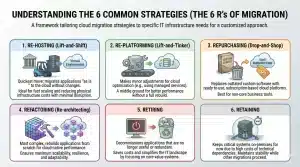
The popular “6 R’s of Migration” framework provides six common strategies tailored to the specific needs of each component of your IT infrastructure, ensuring a customized, practical approach.
Here is an in-depth explanation of each of the six strategies to guide your decision-making process.
1. Re-hosting (Lift-and-Shift)
Rehosting is the quickest way to move applications to the cloud without changing how they work. It is often called a lift-and-shift approach because you simply move your existing setup to a virtual environment as it is. This strategy is perfect for companies that need to scale their infrastructure fast and reduce physical server costs without causing major disruptions to their daily operations.
2. Re-platforming (Lift-and-Tinker)
This method involves making small adjustments to your applications so they can work better in a cloud environment. Rather than rebuilding everything, you might move your data to a managed service to save time on maintenance. It offers a smart middle ground for businesses that want better performance than a simple move-as-is approach but are not ready for a full redesign yet.
3. Repurchasing (Drop-and-Shop)
Repurchasing means moving away from old, custom software and switching to a ready-to-use cloud platform. You drop your outdated system and shop for a subscription-based solution that is already running in the cloud. This is often the best choice for non-core business tools that are becoming too expensive or difficult to keep running on your own servers.
4. Refactoring (Re-architecting)
As the most complex option, refactoring involves rebuilding your application from the ground up to fit a digital-first world. You break large systems into smaller, independent parts that can handle traffic spikes and recover from errors automatically. While it takes more time and effort, it provides the highest performance and makes your business far more adaptable to future changes.
5. Retiring
During a migration, you often find that some applications are no longer useful or have become redundant. The retiring strategy involves shutting down in systems to save money and simplify your digital landscape. By getting rid of these obsolete tools, your team can stop wasting time on maintenance and focus entirely on the core systems that actually bring value to the business.
6. Retaining
Sometimes, the best move is to keep certain applications right where they are for the time being. This usually applies to critical legacy systems that are too expensive to move or require specific local connections to function. Retaining these assets allows you to maintain stability while you focus on moving other parts of your business, with the option to revisit them later.
The Structured Process of Cloud Migration
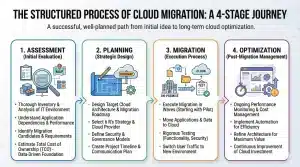
A successful cloud migration is not a single giant leap but rather a series of well-planned and structured steps. Here are the four main stages that form the foundation of any successful cloud migration initiative, guiding you from initial idea to long-term optimization.
1. Stage 1: Assessment (Initial Evaluation)
The assessment stage is the foundation of your entire migration strategy, where you conduct a thorough inventory and analysis of your current IT environment. The goal is to understand inter-application dependencies, evaluate performance, and identify the technical and business requirements for each workload.
In this phase, you will map your entire application portfolio, determine which applications are candidates for migration, and begin to formulate a business case by estimating the Total Cost of Ownership (TCO) in the cloud compared to on-premise. This data-driven analysis is critical for making informed decisions in the subsequent stages.
2. Stage 2: Planning (Strategic Design)
With a clear understanding from the assessment stage, the planning phase begins by designing the target cloud architecture and creating a detailed migration roadmap. Here, you will select the most appropriate migration strategy (from the 6 R’s) for each application, choose the cloud service provider, and design the security and governance models for the new environment.
This stage also involves creating a project timeline, allocating resources, and developing a communication plan to ensure all stakeholders are aligned and prepared for upcoming changes as industry leaders.
3. Stage 3: Migration (Execution Process)
This is the execution stage where the technical team begins moving applications and data to the cloud environment according to the established plan. The process is typically performed in waves, starting with low-risk or less critical applications to validate the process and build team expertise in a pilot migration.
During this phase, rigorous testing is essential to ensure that the application’s functionality, performance, and security are maintained after migration. Once testing is complete, the user traffic is finally switched over to the new cloud environment.
4. Stage 4: Optimization (Post-Migration Management)
The work does not end once an application is running in the cloud; in fact, this marks the beginning of a continuous optimization phase. At this stage, the focus shifts to ongoing performance monitoring, cost management, and security refinement.
You will use cloud analytics tools to identify underutilized resources, implement automation to improve efficiency, and continuously refine the architecture to ensure you are getting the maximum value from your cloud investment in the long run. This proactive management ensures that the benefits of the cloud are fully realized over time.
Common Challenges and How to Overcome Them
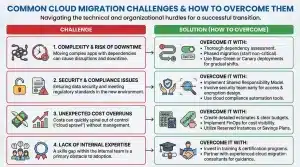
Despite its numerous benefits, the cloud migration journey is not always smooth and is often fraught with various technical and organizational challenges. Here are some of the most common challenges companies face during migration and practical ways to overcome them.
1. Complexity and risk of downtime
Moving complex applications, especially those with numerous dependencies on other systems, can pose significant technical challenges and risks, leading to service disruptions or downtime. To mitigate this, conduct a thorough dependency assessment during the planning phase and create a phased migration roadmap that starts with non-critical applications.
Utilize migration strategies like blue-green deployments or canary releases, which allow for gradual traffic shifting and quick rollbacks if issues arise, thereby minimizing the impact on end-users and maintaining business continuity.
2. Security and compliance issues
Ensuring data security and meeting regulatory compliance standards in a new cloud environment is a top priority. This challenge can be addressed by implementing a shared responsibility model from the outset, where you clearly understand which security aspects are the cloud provider’s responsibility and which are yours.
Involve your security team from the planning phase to design appropriate access controls, encryption protocols, and security policies. Furthermore, utilize the cloud platform’s compliance tools to automate monitoring and reporting, simplifying adherence to industry regulations.
3. Unexpected cost overruns
While cost efficiency is a significant draw of the cloud, costs can quickly spiral out of control without proper management, a phenomenon known as cloud sprawl. Prevent this by creating detailed cost estimates during planning, establishing clear budgets, and using cloud cost management tools to monitor spending in real-time.
Implement FinOps (Financial Operations) practices by providing cost visibility to development and operations teams. Also, utilize features like reserved instances or savings plans for predictable workloads to secure significant discounts and optimize spending.
4. Lack of internal expertise
A skills gap within the internal team is often a primary obstacle to cloud adoption. To overcome this, invest in training and certification programs for your IT team to build cloud-native competencies. Additionally, consider partnering with an experienced cloud migration consultant to gain expert guidance, accelerate the process, and ensure best practices are implemented.
Measuring Success with the Right KPIs
To justify the significant investment in cloud migration, business leaders must be able to measure its impact quantitatively. Establishing clear Key Performance Indicators (KPIs) from the project’s inception allows you to track progress, evaluate success, and demonstrate the Return on Investment (ROI) to stakeholders.
This measurement transforms the perception of migration from a purely technical project into a measurable, accountable strategic business initiative, as highlighted by consulting firms such as McKinsey. Effective KPIs should encompass a range of aspects, from financial metrics like cost savings to operational metrics such as performance improvements and uptime, and business metrics like the speed of innovation.
By regularly monitoring these KPIs, you can identify areas for further optimization and ensure the expected benefits of the migration are fully realized. This data-driven approach is crucial for making better decisions throughout your cloud transformation journey and proving its value to the entire organization.
The Critical Role of ERP System Integration
The ERP system is often to be complex. Because migrating the company’s heart requires effective project control to ensure that daily operations remain undisrupted during the data transfer. Managing everything from finance to inventory, any failure during its move can lead to severe disruptions. This makes careful planning and integration a central focus of any digital shift.
Choosing to move to a cloud-native platform can simplify this transition significantly. Modern systems are designed to operate effectively in a virtual environment, offering better scalability and accessibility compared to legacy hardware. With automated processes, business workflows become more efficient, while real-time reporting provides the visibility needed for leaders to make informed decisions and ensure the migration delivers real value.
Conclusion
Cloud migration is no longer a technological trend but a strategic imperative for companies aiming to stay agile, innovative, and competitive in the modern business landscape. With careful planning, the proper strategy selection, and structured execution, migrating to the cloud can unlock tremendous growth potential, drive operational efficiency, and strengthen your business resilience.
By aligning with frameworks like the National Cloud Computing Policy (NCCP) and carefully selecting the right migration path, Business in Malaysia can build a more resilient and agile digital foundation. Success is found in the balance between meticulous planning, continuous optimization, and the ability to maintain security throughout every stage of the process.
Ultimately, the goal of moving your infrastructure is to foster long-term innovation and efficiency. Whether you are rehosting simple applications or integrating complex systems at the core of your operations, staying focused on measurable outcomes and effective project control will ensure your investment translates into growth. As the digital landscape continues to evolve, those who embrace the cloud with a clear strategy will be best positioned to lead in the modern market.

Frequently Asked Questions: Cloud Migration
-
What are the most common hidden costs in cloud migration?
Beyond the monthly subscription, businesses often overlook expenses like data egress fees, which are charged for moving data out of the cloud. Other hidden costs include training your IT staff on new workflows and the temporary expense of running parallel systems to ensure stability during the transition phase.
-
Is my data fully secure once it moves to the cloud?
Security is a shared responsibility. While providers protect the physical infrastructure, you are responsible for securing the data itself through encryption and strict access controls. Establishing these protocols early on ensures your digital environment meets international safety standards and protects sensitive company information.
-
How long does the typical migration process take?
The timeline varies based on the volume of data and the complexity of your current applications. A simple move-as-is approach might take a few weeks, while a full digital transformation involving complex systems like an ERP can span several months. A phased strategy is usually recommended to minimize operational downtime.
-
What happens to old applications that cannot be migrated?
Some legacy applications may be too complex or costly to move immediately. In these cases, a retaining strategy is used, where the application continues to run on-premises while other parts of the business move. This allows for stability while you plan for a future update or replacement when the time is right.