









In the rapidly evolving Malaysian market, business managers often struggle with fragmented data silos that hinder timely and accurate decision-making. This disconnect creates a critical need for a solution that transforms raw information into actionable strategic insights immediately, addressing the primary concern of staying competitive.
Recent studies indicate that Malaysian enterprises adopting cloud-based analytics experience a significant boost in operational efficiency and market responsiveness compared to their peers. These organizations successfully leverage data patterns to outpace competitors who rely on traditional, slower reporting methods and infrastructure.
HashMicro ERP Software offers a robust cloud analytics solution designed to bridge this gap effectively for modern businesses. By integrating disparate data sources into a unified platform, it empowers businesses to harness the full potential of their information for sustainable growth.
Key Takeaways
|
Understanding Cloud Analytics
Cloud analytics is the process of performing data analysis and manipulation using cloud computing resources rather than on-premise servers. It enables organizations to process vast datasets with scalable computational power and advanced algorithms provided by third-party vendors.
Unlike traditional analytics that demands significant upfront capital for hardware, cloud analytics operates on a flexible subscription model. This shift allows businesses to scale their processing capabilities up or down instantly based on immediate requirements.
The ecosystem comprises data sources, cloud warehousing for storage, and advanced visualization tools that work in unison. These components ensure that raw data is efficiently collected, processed, and presented as actionable business intelligence.
Why Cloud Analytics Is a Key to Modern Business Success
In today’s competitive landscape, the ability to make rapid, data-backed decisions is the primary differentiator between market leaders and followers. Adopting cloud analytics transforms data from a passive record into a dynamic asset that drives real-time strategic agility.
- Unlimited scalability and flexibility: Cloud platforms automatically adjust storage and processing power to match your fluctuating data volumes. This ensures you never pay for idle resources while always having the capacity to handle sudden growth spikes.
- Operational cost efficiency (OPEX vs. CAPEX): Shifting to an operational expenditure model eliminates the need for heavy upfront hardware investments. Companies can redirect these funds toward innovation and growth initiatives while paying only for what they use.
- Real-time data accessibility from anywhere: Decision-makers can access critical insights and dashboards from any device, ensuring business continuity regardless of location. This mobility empowers remote teams to act on the latest data without being tethered to the office.
- Enhanced collaboration across departments: A unified cloud platform breaks down silos by providing a single source of truth for all departments. This transparency allows marketing, sales, and finance teams to align their strategies based on consistent, shared data.
Benefits of Cloud Analytics
Adopting cloud analytics delivers transformative advantages that go beyond simple data processing, directly impacting the bottom line and operational agility. Here are the primary benefits that modern organizations gain from this technology.
- Lower Costs and Faster ROI: By eliminating physical infrastructure maintenance, companies significantly reduce IT overhead and deployment costs. This accelerates the return on investment as businesses can start deriving value from their data almost immediately.
- Power Remote and Hybrid Work: Cloud-based access ensures that employees can retrieve and analyze data from any location with an internet connection. This capability is essential for supporting modern hybrid work models and maintaining productivity outside the office.
- Easy Collaboration: Centralized data platforms allow multiple users to view, edit, and share insights simultaneously without version control issues. This fosters better teamwork and ensures everyone is aligned with the same business metrics.
- Up-to-Date Capabilities: Cloud providers automatically update their software with the latest features and security patches. This ensures your business always has access to cutting-edge analytics tools without manual upgrades.
- Flexible Performance: The system allows you to adjust computing resources based on current workload demands instantly. This flexibility prevents system bottlenecks during peak times and saves costs during low-activity periods.
- Reliability and Security: Leading cloud providers invest heavily in advanced encryption, redundancy, and disaster recovery protocols. This offers a level of data protection and uptime that is often superior to individual on-premise data centers.
- Centralized Data: Consolidating data from all departments into a single cloud repository eliminates fragmented information silos. This holistic view enables more accurate cross-functional analysis and better strategic decision-making.
Types of Cloud Analytics and Their Business Applications
Cloud analytics can be deployed in various environments, each offering distinct advantages depending on a company’s specific needs for control, cost, and security. Understanding these deployment models is crucial for aligning your infrastructure strategy with your business goals.
| Type | Definition | Best Fit For | Trade-Offs |
|---|---|---|---|
| Public Cloud | Analytics runs on shared infrastructure managed by a third-party provider (e.g., AWS, Azure), offering fast setup and elastic scaling. | Businesses with fluctuating workloads, faster deployment needs, and teams that want minimal infrastructure management. | Less direct control over infrastructure; security is strong but relies on the provider’s shared environment and policies. |
| Private Cloud | Dedicated infrastructure used by one organization only, hosted on-premise or by a vendor, with tighter control over data and access. | Organizations with strict governance needs and highly sensitive data (e.g., regulated industries). | Higher cost and greater responsibility for maintenance, configuration, and internal controls. |
| Hybrid Cloud | Combines private and public environments, keeping sensitive data private while using public cloud compute for heavy analysis. | Companies balancing compliance and cost, or migrating gradually from legacy/on-prem systems. | More complex integration and governance; requires clear data rules to avoid fragmentation. |
How Does Cloud Analytics Work in Practice?
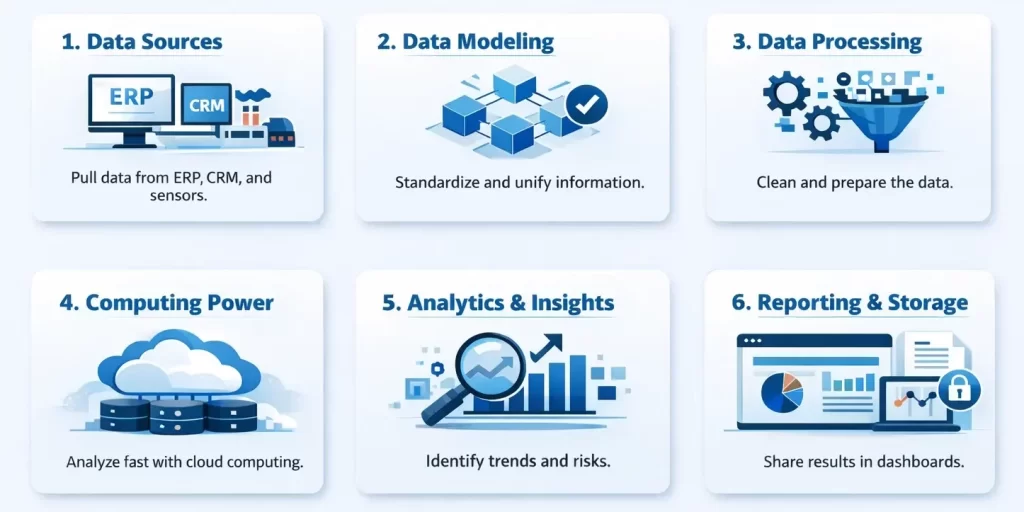 Cloud analytics functions as a digital factory where raw data is systematically ingested, processed, and transformed into valuable business insights. This sophisticated workflow automates the complexities of data handling, delivering clear results to decision-makers efficiently.
1. Data sources
The process begins with identifying and connecting various origin points of information, such as ERP systems, CRM platforms, and IoT devices. This stage ensures that the analytics engine has access to a comprehensive range of internal and external data inputs.
Modern cloud solutions can ingest structured data from databases alongside unstructured data like social media feeds. This diversity of sources is crucial for building a complete picture of business performance.
2. Data models
Once collected, data is organized into standardized structures or models that define how different data elements relate to one another. This structuring is essential for ensuring that the subsequent analysis is accurate and relevant to specific business questions.
Data models act as the blueprint for analysis, standardizing formats so that disparate information can be compared logically. Without robust modeling, the analysis would lack context and reliability.
3. Processing applications
Specialized applications within the cloud platform take the modeled data and perform necessary cleaning and transformation tasks. These applications ensure that the data is free from errors, duplicates, and inconsistencies before deep analysis begins.
This stage prepares the raw information for high-level computation, acting as a quality control filter. It guarantees that the insights generated are based on high-integrity data.
4. Computing power
Cloud analytics leverages massive, distributed computing power to execute complex queries and algorithms on large datasets. This capability allows businesses to process terabytes of data in seconds, a feat that would be impossible with standard on-premise servers.
The elasticity of cloud computing means that processing power scales automatically with the complexity of the task. This ensures consistent performance speeds even during intensive analytical operations.
5. Analytic models
Mathematical algorithms and statistical models are applied to the processed data to identify patterns, trends, and correlations. These models range from simple aggregations to complex machine learning predictions that forecast future outcomes.
This is the core intelligence engine where raw numbers are translated into meaningful business narratives. It enables the system to answer specific questions about past performance and future probabilities.
6. Data sharing and storage
The final insights are stored securely in a data warehouse and shared through interactive dashboards or reports. This accessibility ensures that stakeholders across the organization can view and utilize the findings immediately.
Cloud storage provides a secure, redundant environment where historical data is preserved for future reference. Efficient sharing mechanisms foster a collaborative environment where data drives collective action.
To streamline this complex workflow, HashMicro Inventory Software provides the necessary tools to manage data inputs and processing efficiently. This integration ensures that your inventory analytics are always accurate and ready for strategic application.
Case Studies: Cloud Analytics Implementation Across Industries
Real-world applications of cloud analytics demonstrate its versatility in solving industry-specific challenges and driving innovation. The following examples highlight how diverse sectors leverage this technology to achieve tangible operational improvements.
- Retail and e-commerce industry: Retailers increasingly rely on cloud analytics to unify online and in-store data, giving them a clearer view of customer behavior and inventory movement. According to McKinsey, data-driven personalization can lift conversion rates by 10–15%, while better demand visibility helps reduce stock imbalances across locations.
- Manufacturing sector: In manufacturing, cloud analytics is often paired with IoT data to move maintenance from reactive to predictive. A Deloitte study shows that predictive maintenance enabled by analytics can reduce unplanned downtime by up to 30–50%, while lowering maintenance costs.
- Financial services: Banks and financial institutions use cloud-based analytics and AI to monitor transactions in real time and identify abnormal patterns. According to IBM, AI-driven fraud detection systems can significantly improve detection accuracy while reducing false positives, helping protect customers without disrupting legitimate transactions.
Strategic Steps for Implementing Cloud Analytics in Your Company

Implementing cloud analytics is a transformative journey that requires a structured approach to ensure alignment with business goals. A careful, phased execution helps organizations maximize ROI while minimizing disruption to daily operations.
1. Define business objectives
Start by identifying the specific business problems you aim to solve, such as reducing churn or optimizing supply chains. Clear goals provide a roadmap for the implementation and a metric for measuring success.
Without defined objectives, analytics initiatives often lack focus and fail to deliver value. Ensure these goals are communicated across the organization to align all stakeholders.
2. Choose the right platform and tools
Evaluate cloud platforms based on their scalability, ease of integration, and user-friendliness for your specific team. Conduct pilot tests to ensure the chosen solution fits your technical ecosystem and budget.
Selecting the wrong tool can lead to adoption resistance and wasted resources. Prioritize platforms that offer support and growth potential.
3. Build a data-driven team and culture
Invest in training your current staff and hiring data specialists to bridge the skills gap effectively. A strong team is essential for interpreting complex data and translating it into business strategies.
Cultivate a culture where decisions are consistently backed by data evidence rather than intuition. This cultural shift is often the most critical factor in long-term analytics success.
4. Address security and data privacy challenges
Implement strict data governance policies and ensure your cloud provider complies with regulations like GDPR or local laws. Security must be a foundational element, not an afterthought, to protect sensitive business information.
Regular audits and encryption protocols help maintain trust with customers and stakeholders. Proactive security measures prevent costly breaches and reputational damage.
The Future of Cloud Analytics
As technology accelerates, cloud analytics is evolving to become more autonomous, accessible, and real-time. Staying ahead of these trends will allow businesses to leverage the next generation of data capabilities for a competitive edge.
- The role of AI and Machine Learning (ML): AI will increasingly automate complex data preparation and modeling tasks through AutoML. This allows analysts to focus on high-level strategy while the system handles the technical heavy lifting.
- Augmented analytics for non-technical users: Natural language processing will enable business users to query data simply by asking questions. This democratization reduces reliance on data scientists and speeds up decision-making across the company.
- Real-time analytics and edge computing: Processing data closer to the source (edge) will enable near-instantaneous insights for time-sensitive operations. This is crucial for industries requiring immediate responses, such as autonomous logistics and manufacturing.
Using an Integrated ERP & BI Platform for Better Analytics
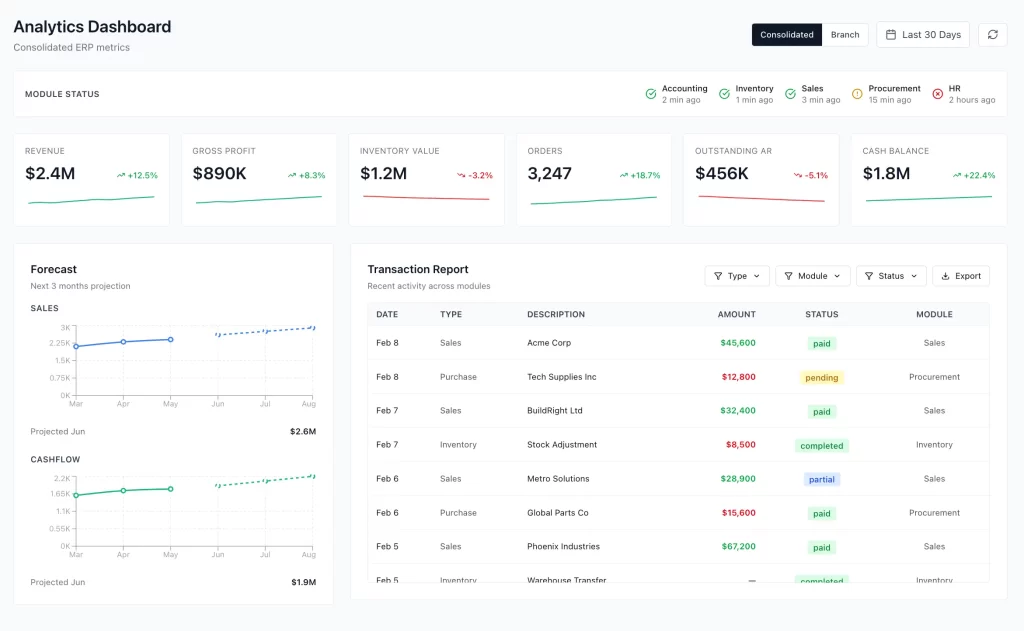
An ERP platform can help centralize data from core functions such as accounting, inventory, and sales, so teams are not pulling reports from multiple disconnected systems. When operational data lives in one place, reporting becomes more consistent and leaders can review performance with fewer manual checks.
With built-in Business Intelligence capabilities, the platform can also support faster reporting cycles by turning daily transactions into real-time dashboards and structured reports. This is especially useful for teams that need timely visibility for approvals, budgeting, and performance tracking across departments.
Common BI capabilities in an ERP environment include:
- Real-Time Dashboards: A live view of key metrics to monitor performance and spot changes early.
- In-Depth Reporting: Customizable reports that help teams drill into operational and financial data.
- Sales & Financial Forecasting: Forecasting based on historical patterns to support planning and resource allocation.
- ERP Integration: Data stays consistent across modules, reducing duplicate entries and mismatched reports.
- Multi-Branch Reporting: Consolidated visibility across branches or entities for easier comparison and oversight.
Conclusion
In Malaysia’s fast-moving business landscape, cloud analytics is becoming less about “nice-to-have reporting” and more about staying in control as operations scale. When data is accessible in real time and consistent across teams, leaders can move from reacting to issues after they happen to spotting risks and opportunities earlier.
For many companies, the practical next step is choosing a platform that can centralize core data and turn daily transactions into dashboards, reports, and forecasts that people actually use. Solutions in this space range from ERP-led options like HashMicro to broader ecosystems such as Microsoft Dynamics 365 or Oracle NetSuite, depending on your business complexity and integration needs.
The best approach is to start with one or two use cases that matter most, such as inventory visibility, financial performance tracking, or multi-branch reporting, then scale from there once the data and workflows are stable.

Frequently Asked Questions about Cloud Analytics
-
What is the main difference between Cloud Analytics and Business Intelligence (BI)?
Cloud Analytics is a broad term for analyzing data in the cloud, while Business Intelligence (BI) is a subset of it, primarily focusing on descriptive analysis (what happened) through reports and dashboards. Cloud analytics also includes advanced types like predictive and prescriptive analysis.
-
Is my company’s data secure if stored in the cloud?
Yes, security is a top priority for leading cloud providers, who often invest more in cybersecurity than individual companies can. With proper configuration, encryption, and access management, data in the cloud can be even more secure than on-premise servers.
-
What does it cost to implement cloud analytics?
The cost varies greatly, but the cloud’s pay-as-you-go model makes it highly accessible. You can start small with a pilot project for a relatively low monthly cost and scale your spending as you derive more value, avoiding large upfront investments.
-
How can cloud analytics integrate with my existing ERP system?
Modern cloud analytics platforms offer pre-built connectors and APIs for seamless integration with ERP systems. This allows for automatic and scheduled data extraction from your ERP, enabling you to combine it with other data sources for a complete 360-degree business view.
-
Do I need to hire a data scientist to use cloud analytics?
Not always. While data scientists are crucial for complex modeling, modern cloud analytics platforms are increasingly user-friendly. Features like augmented analytics and natural language queries empower business users to perform significant analysis without deep technical skills.