













Watching topsoil wash away during a heavy monsoon while fertilizer prices climb is an exhausting cycle for Malaysian plantation owners. Relying on heavy chemical inputs often leaves the land hardened and unable to hold moisture, turning every dry spell into a direct threat to your harvest. This forces you to spend more each year just to maintain yields, gradually turning a productive asset into a financial burden.
Research shows that healthy, aggregated soil acts as a sponge, where every 1% increase in organic matter allows an acre to hold an additional 20,000 gallons of water. As local standards shift toward tighter environmental oversight, this efficiency is now a business necessity to keep operational records ready for LHDN reviews and ensure SST compliance across your supply chain.
Shifting toward Smart-natural agriculture allows you to break free from these rising costs by letting the natural ecosystem handle nutrient cycling. By focusing on biological health rather than chemical volume, you can build a stable operation that resists weather extremes while securing better long-term returns. The following guide explores the practical steps and standard logic you need to move toward a more profitable, self-sustaining farm.
Key Takeaways
|
What is Regenerative Agriculture?
Regenerative agriculture is a farming approach that focuses on restoring the health of the soil and the surrounding ecosystem. Rather than following a strict set of rules, it is guided by principles and outcomes, with the goal of treating soil as a living ecosystem filled with microorganisms that support plant growth.
To understand regenerative agriculture, it helps to compare it with other farming approaches. Conventional farming often depletes the soil by relying heavily on synthetic inputs and intensive tillage. Sustainable agriculture aims to maintain balance, so the land is not degraded further. Regenerative agriculture goes one step beyond by actively rebuilding soil health, improving water cycles, and increasing biodiversity.
The Core Principles of Regenerative Farming

Applying restorative land logic to large-scale Malaysian plantations requires moving from a chemical-heavy focus to biological efficiency. This standard approach protects the soil microbiome, allowing natural processes to handle nutrient cycling and keep your long-term assets productive.
1. Minimize Soil Disturbance
Physical and chemical disruptions, such as heavy tilling or excessive synthetic inputs, destroy the fungal networks essential for nutrient and water transport. By reducing these disturbances, you allow the soil structure to aggregate and mature naturally. This keeps your field data consistent and ready for LHDN reviews, avoiding the need for constant manual intervention.
2. Maintain Continuous Soil Cover
In the Malaysian climate, bare soil is highly vulnerable to erosion and extreme heat. Armoring the soil with living plants or mulch acts as a buffer against monsoon rain and the baking sun. This layer maintains a hospitable microclimate for beneficial organisms, preventing the loss of topsoil that you have already invested in.
3. Maximize Crop Diversity
Relying on monocultures creates a high risk of pest outbreaks and forces a dependency on expensive chemicals. Planting diverse species stimulates a robust soil microbiome, as different root depths and nutrient needs build a more resilient land profile. This variety ensures your operations can withstand environmental shifts without requiring frequent, high-cost external fixes.
4. Keep Living Roots in the Soil Year-Round
Plants pump up to 40% of their carbon-rich sugars into the soil to feed essential microbes through photosynthesis. When land is left fallow, these microbial populations decline. Utilizing cover crops ensures that living roots are continuously building soil organic matter, improving your land’s water-holding capacity and overall asset value year-round.
5. Integrate Livestock
Managed grazing mimics natural biological cycles to accelerate nutrient return. Livestock trample plant matter and deposit manure, which stimulates growth and manages weeds naturally. This integration reduces the need for synthetic herbicides, keeping your business aligned with Malaysian SST rules and lowering long-term operational costs.
Managing these principles across thousands of hectares is complex and prone to manual error. To maintain oversight, modern operations use advanced field mapping tools to track crop health and soil variability. This data-driven logic ensures every intervention is targeted, keeping the transition from conventional to restorative practices both ecologically sound and financially viable.
Step-by-Step Implementation for Farmers
Transitioning a plantation to restorative farming logic requires a phased approach to prevent systemic shocks and financial strain. A successful shift follows these strategic steps to ensure operational stability and long-term land productivity.
Establish a Biological Baseline
Before altering your operations, conduct soil health tests that move beyond standard NPK. Measuring biological activity and water-holding capacity ensures your baseline data is ready for future LHDN environmental reporting and helps track asset value accurately.
Minimize Mechanical Disturbance
Phasing out deep plowing protects the delicate fungal networks that act as root extensions for your crops. Moving toward a complete no-till system preserves soil structure, ensuring your fields are ready for extreme weather without the need for constant manual correction.
Introduce Cover Crops
Bare soil is highly vulnerable to Malaysian monsoon erosion. Start with simple cover crops to armor the ground before introducing complex species “cocktails” that feed a diverse range of soil microbes and improve nutrient delivery.
Wean Off Synthetic Inputs
As natural nutrient cycling returns, incrementally reduce reliance on chemical fertilizers and pesticides. This controlled reduction helps manage operational costs under Malaysian SST rules while preventing sudden yield penalties during the transition.
Apply Compost and Biological Inoculants
Biological extracts and compost teas reintroduce beneficial organisms to rebuild the soil food web. Utilizing precise distribution logic allows you to target specific zones requiring the most support, maximizing the efficiency and impact of every application.
Integrate Livestock
Animals serve as a catalyst for rapid land recovery. Partnering with local producers to graze cover crops turns plant biomass into bio-available nutrients through natural trampling and manure, accelerating the restoration of your land’s health.
Overcoming Challenges in Implementation
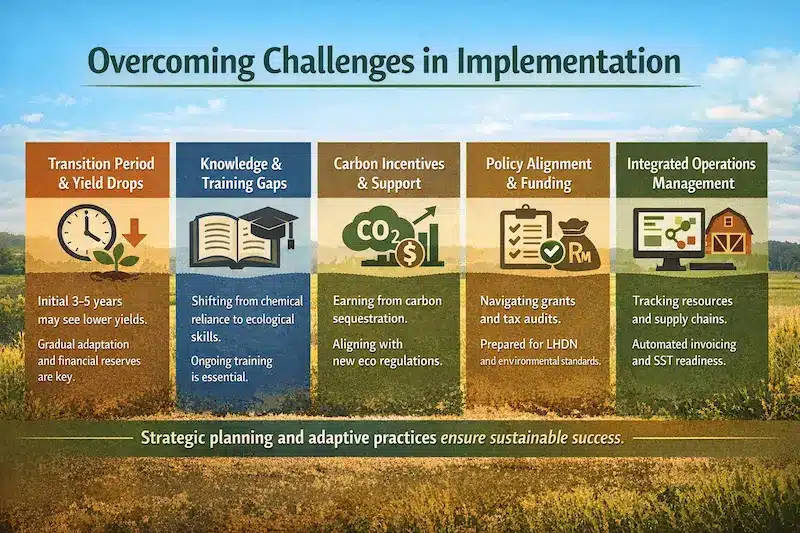
Adopting nature-led recovery involves biological and financial hurdles that require strategic planning to ensure operational continuity.
The Transition Period and Yield Dips
Soil biology typically takes three to five years to stabilize. Success during this “valley of death” depends on phased implementation and financial buffers to protect business liquidity while natural cycles replace synthetic inputs.
Knowledge Gaps and Paradigm Shifts
Effective transition requires moving from prescriptive chemical fixes to adaptive management. Professional training is essential to ensure staff can handle local ecological nuances and modern operational standards effectively.
Policy, Subsidies, and Financial Support
Carbon-market incentives offer new revenue streams for businesses sequestering carbon. Aligning with these emerging standards ensures your operations are prepared for future environmental regulations and LHDN reviews.
Operational Complexity and Management
Managing diverse species and livestock increases logistical demands. Progressive enterprises use an integrated business suite to track biological inputs and supply chains seamlessly. This keeps records ready for LHDN MyInvois requirements and ensures Malaysian SST compliance without the burden of manual tracking.
Environmental and Economic Benefits
Adopting nature-led land recovery generates value that reaches beyond the field, balancing environmental restoration with long-term fiscal resilience. This standard approach secures your operation’s future in an evolving regulatory landscape.
Carbon Sequestration and Climate Mitigation
Soils hold more carbon than the atmosphere and all plant life combined. By utilizing photosynthesis to pump liquid carbon into the ground, restorative land logic transforms fields into active carbon sinks. This process builds soil organic matter and positions your business to benefit from emerging agricultural carbon markets.
Enhanced Water Cycle and Drought Resilience
Compact, degraded soil causes runoff and flooding, whereas healthy soil acts as a sponge. Every 1% increase in organic matter allows an acre to retain an additional 20,000 gallons of water. This dramatically improves drought resistance, ensuring crops have access to moisture during dry spells and reducing the risk of total harvest failure.
Biodiversity Restoration
Creating diverse habitats above and below ground naturally regulates pests and pathogens. Cover crops and polycultures provide shelter for beneficial insects and microbes that protect plant roots. This biological shield reduces the need for chemical insecticides, keeping your operations lean and efficient.
Economic Viability for Farmers
Traditional models often trap businesses in a cycle of rising costs for synthetic fertilizers and patented seeds. Adopting a restorative farming setup cuts these external input expenses significantly. By relying on natural nutrient cycling, you improve yield stability and gain access to premium markets driven by growing consumer demand for sustainably grown products.

The Role of Technology in Regenerative Agriculture
Nature-led land recovery is a sophisticated, data-driven strategy. Modern technology scales these ecological processes, bridging biological wisdom with the demands of large-scale production.
Soil Sensors and the Internet of Things (IoT)
IoT networks monitor soil moisture, temperature, and carbon levels in real-time. This setup allows for informed decisions on irrigation and grazing, ensuring your standard operations directly support soil health without the stress of manual tracking.
Drones and Satellite Imagery
Managing thousands of acres effectively requires multispectral imagery. Drones identify crop stress and monitor cover crop establishment across diverse landscapes. This macro-level view is essential for maintaining oversight of complex plantation assets without high manual costs.
Farm Management Software and Data Analytics
Shifting to multi-species systems requires precise record-keeping. Advanced platforms aggregate sensor data and crop rotations into a centralized dashboard. This keeps all operational data ready for LHDN reviews and ensures your business stays aligned with Malaysian SST rules.
Robotics and Automation
Autonomous robots manage weed pressure mechanically, reducing the dependency on broad-spectrum chemicals. Using automated agricultural systems also prevents soil compaction compared to traditional heavy machinery, preserving the soil structure needed for long-term land productivity.
Real-World Industry Use Cases
Nature-led land recovery is successfully operating at scale across diverse sectors, proving that profitability and environmental care are compatible goals. Implementing these standards ensures that land productivity remains high while keeping your business documentation ready for LHDN reviews.
Viticulture and Orchards
Managers are replacing bare soil with perennial covers to improve water infiltration and manage irrigation costs effectively. This practice enhances the soil microbiome, leading to higher-quality yields with fewer synthetic herbicides. Reducing these external inputs helps lower taxable operational expenses and ensures your setup remains aligned with Malaysian SST rules.
Large-Scale Row Crops
Commodity producers are utilizing no-till setups and year-round cover crops to combat rising fertilizer costs and severe erosion. Continuous biological activity fixes natural nitrogen and unlocks trapped phosphorus, allowing for competitive yields while significantly slashing chemical overhead. This efficiency keeps your operations lean and your financial records organized for standard reporting.
Dairy and Livestock Operations
The livestock sector uses Adaptive Multi-Paddock (AMP) grazing to mimic natural herd movements and distribute manure evenly. This prevents overgrazing and leads to deeper topsoil, accelerating land recovery without intensive manual labor. This approach turns pastures into high-value assets, improving long-term resilience and ensuring your business meets the rigorous standards required for local market support.
Conclusion
Nature-led land recovery is a vital shift from resource extraction to active ecosystem restoration. Rebuilding soil health and water cycles is a practical necessity for securing future food production and protecting land value.
The transition to restorative land logic succeeds through a phased mindset shift and the use of efficient oversight tools. This approach keeps your operations aligned with Malaysian SST rules and ready for LHDN reviews while maintaining yield stability.
Rising chemical costs and soil erosion often drain profit margins before the damage is even noticed. You can request a free consultation to see how a professional strategy can protect your land and business assets.
FAQ About Regenerative Agriculture
-
How does land recovery affect asset valuation?
High biological health converts land into a de-risked asset. Improved soil structure and water retention preserve long-term property value, ensuring the land remains a stable productive asset on the balance sheet and a strong candidate for banking collateral.
-
Do these principles meet global trade requirements?
Yes. Nature-led recovery provides the verifiable data required for Scope 3 emission targets and emerging global transparency standards. This alignment is critical for securing access to premium international markets and maintaining export competitiveness.
-
What is the role of digital tools in the transition?
Managing thousands of hectares requires an integrated business suite to eliminate manual tracking errors. This digital logic ensures all operational data is ready for LHDN reviews and standard audits, providing a clear audit trail while reducing administrative stress.
-
How do these practices hedge against price volatility?
By restoring natural nutrient cycles, a plantation reduces its dependency on expensive external chemicals. This shift toward biological self-sufficiency acts as a financial hedge against fluctuating fertilizer costs, stabilizing margins and protecting the bottom line from global market shocks.