












Every accounts payable team hits the same pressure point sooner or later. You place an order, the goods arrive, then an invoice shows up and you have to decide fast whether it is safe to pay.
If you skip a proper check, you risk paying for items that never landed, accepting a price that was never approved, or clearing a bill that does not belong to your company. Those mistakes rarely look huge on one invoice, but they add up quietly and they always surface at the worst time.
This guide walks you through the exact checks you should run, the messy spots that usually slow teams down, and the practical fixes that make approvals quicker without losing control, so keep reading because the later sections include simple habits you can apply right away to cut exceptions, protect your cash, and keep your vendor payments clean.
Key Takeaways
|
The Three Documents That Keep Your Payments Honest
This verification method cross checks three documents before you approve a supplier invoice for payment. Those three documents are:
- The Purchase Order PO: an internal document that authorises the purchase of specific goods or services at an agreed price and quantity.
- The Goods Receipt Note GRN: a record that confirms your receiving team actually received and inspected the items tied to the PO.
- The Supplier Invoice: the bill from your vendor requesting payment for what they delivered.
Your goal stays simple. All three documents should agree. The quantities, unit prices, and line item descriptions on the supplier bill should match what you ordered on the PO and what you received based on the GRN. When they match, you can approve payment with confidence. When they do not, you pause and investigate before money leaves your account.
This differs from 2 way matching, which compares the supplier bill against the PO only. It also differs from 4 way matching, which adds a quality or inspection acceptance document. If you purchase physical goods, this three document check usually gives you the right balance: strong control without extra admin friction.
It also supports audit expectations in COSO and SOX aligned environments because it creates a clear record of how you verified spend before payment. In Malaysia, it fits the push toward stronger traceability as e Invoice Malaysia becomes more common across vendors. When suppliers submit structured data through LHDN IRBM channels such as MyInvois, you can reconcile transactions faster, but only if your PO and GRN records stay complete, consistent, and easy to retrieve.
How Your Invoice Gets Cleared Without Guesswork
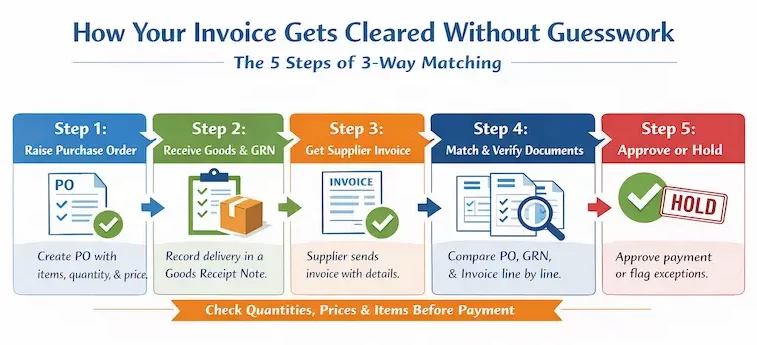
You understand the workflow faster when you walk through it in order. You will touch procurement, receiving, and accounts payable, and each team produces one piece of proof you need.
Step 1: Your PO Sets the Ground Rules
Your process starts in procurement. When you need goods or services from a vendor, your team raises a purchase order. Your PO should state what you order, how many units you want, the agreed unit price, delivery terms, and payment terms. You also need internal approval based on your spend limits, then you send the PO to the supplier.
Your PO acts like the anchor for the whole check. If your PO looks vague, misses quantities, or carries unconfirmed pricing, you will feel the pain later. If you want fewer holds, you need clean PO discipline from day one, not after the invoice arrives.
Step 2: Your Receiving Team Records Reality With a GRN
When the supplier delivers the order, your receiving team counts and inspects the goods. They confirm quantities and condition, then they record the result in a Goods Receipt Note. Some teams call it a receiving report or delivery receipt.
Your GRN should capture the receipt date, the related PO number, items received, quantities received, and any damage or short shipment notes. This document matters because it proves what your business actually received. It also gives you leverage when a supplier claims everything was delivered but your warehouse recorded a short shipment or damaged items.
Step 3: Your Supplier Invoice Arrives in the Queue
Next, your supplier sends an invoice. It usually references the PO number, lists delivered items, shows quantities and prices, and gives a total with payment terms and a due date.
Once the invoice hits your AP workflow, do not approve it just because it looks familiar. This is where teams get burned, especially when month end pressure pushes everyone to clear the queue fast.
Step 4: You Compare the PO, GRN, and Invoice Line by Line
This step is the core of the verification. You compare the supplier bill, the PO, and the GRN across a few checks:
- Quantities: Does the billed quantity match what your GRN shows, and does it still align with what you ordered?
- Unit prices: Does the billed unit price match the price on your PO?
- Line items: Do descriptions and item codes refer to the same items across all documents?
- Totals: Do the extended amounts calculate correctly, and does the final total add up?
Most teams also set tolerance thresholds so tiny differences do not trigger constant holds. You might allow a 1 to 2% variance on invoice value to handle rounding or minor charges. The key is consistency: define tolerance rules once, document them, then apply them the same way every time. If you change the rule depending on who is chasing payment, you create audit risk and repeat disputes.
Step 5: You Approve Fast or You Hold With a Clear Reason
If everything aligns within tolerance, you approve the invoice for payment and schedule it according to the agreed terms.
If you spot a mismatch, you put the invoice on hold and raise an exception. You then resolve the root cause before you pay. That might mean asking for a corrected invoice, clarifying pricing, or fixing receiving records. In real operations, this is the part where invoices get stuck for days if the GRN is late or if procurement confirms a price change that never made it into a PO update.

A Real Numbers Example You Can Copy Into Training
Imagine this scenario:
Your business issues Purchase Order 4421 to a stationery supplier for:
- 100 units of A4 paper reams at RM 12.00 each equals RM 1,200.00
- 50 units of ballpoint pen boxes at RM 8.00 each equals RM 400.00
PO total equals RM 1,600.00
Your warehouse receives the delivery and records GRN 8801:
- A4 paper reams received: 95 units because 5 units are missing
- Ballpoint pen boxes received: 50 units
Your supplier sends Invoice INV 20260601:
- 100 units of A4 paper reams at RM 12.00 equals RM 1,200.00
- 50 units of ballpoint pen boxes at RM 8.00 equals RM 400.00
Invoice total equals RM 1,600.00
When you run the three document check, you spot the issue immediately. The supplier bill claims 100 reams, but your GRN shows 95 received. Your payable amount should be RM 1,540.00, calculated as 95 times RM 12 plus 50 times RM 8. You hold the invoice and ask the supplier for a credit note of RM 60.00 or delivery of the missing 5 reams before you release payment.
Without this verification, you would have paid RM 60.00 for goods you did not receive.
When Matching Fails, Here Is What You Do Next
A failed match, often called a matching exception, does not automatically mean fraud. Most exceptions happen because of admin mistakes: partial deliveries billed as complete, pricing changed without a formal PO update, or invoice lines that do not reflect what your receiving team recorded.
Still, treat every exception seriously because it can also signal duplicate invoices, inflated quantities, or billing for items that never arrived.
When you flag an exception, use a simple resolution path:
- Identify the discrepancy type: quantity, price, or line item mismatch.
- Find the source document that carries the error: supplier bill, PO, or GRN.
- Escalate to the right owner: procurement for pricing, receiving for quantity, supplier for billing.
- Resolve and document: corrected invoice, credit note, or PO amendment, plus a recorded reason.
- Re check and approve once the documents align.
Track your exception rate. A healthy process often sits around 5 to 15% of invoices. If yours runs higher, the problem usually starts upstream with weak PO discipline, inconsistent receiving practices, or suppliers that invoice inaccurately.
Why This Control Pays You Back Every Month
This control protects your business through four benefits: financial accuracy, fraud prevention, audit readiness, and smoother vendor relationships.
Financial accuracy comes first. If you skip verification, you will overpay over time, even without intentional fraud. Small errors compound, especially when you process high invoice volumes.
Audit readiness matters just as much. Auditors want proof that you control spend approvals and that you verify payment decisions. A documented workflow gives you that proof, including clear evidence of holds and resolutions. In Malaysia, that record becomes even more valuable because structured e invoicing makes transactions easier to trace, so your internal evidence needs to be just as organised when questions come up.
Supplier relationships also improve when your process stays consistent. You catch issues early, you explain holds with documentation, and you resolve disputes before they spiral into bigger payment delays.
How Matching Helps You Shut Down Common Fraud Plays
Fraud shows up more often than many teams expect, especially when controls feel loose or inconsistent. A three document check helps you block several common patterns.
Fictitious vendor fraud happens when someone creates a fake supplier and submits invoices for goods or services that were never ordered or received. Your process stops that immediately because you cannot verify a bill without a valid PO and GRN.
Duplicate invoice fraud happens when the same invoice gets submitted twice, whether by mistake or with intent. When you link bills to PO and GRN records, you make duplicates easier to catch and harder to approve, especially when your system enforces unique references and keeps a clean approval history.
Inflated invoice fraud happens when a supplier bills higher quantities or higher prices than you agreed. Your process exposes it because you compare quantities to the GRN and prices to the PO.
Internal procurement abuse also becomes harder when your PO approvals follow clear authorisation rules. Even if someone tries to push a questionable order, they still need receiving confirmation before the bill can clear, and that extra step is often what prevents silent leakage.
Why Manual Matching Starts to Hurt When Volume Grows
This process sounds simple on paper. Manual execution is where things fall apart, especially when invoices pile up.
1. Time Cost Per Invoice When You Do It Manually
Manual checks force your team to pull the PO, locate the GRN, then compare each invoice line item against both. In practice, this can take 10 to 20 minutes per invoice. If you process 200 invoices a month, that becomes 33 to 67 staff hours spent on verification alone.
2. Error Rate Rises When You Rush
When your team races through a backlog, mistakes creep in. You can miss a subtle price difference, match the wrong PO, or overlook a quantity mismatch. High volume repetitive work drains attention fast, and month end pressure makes it worse.
3. Late Payments Become the Default
Slow checks lead to late approvals. Late approvals lead to late payments. You lose early payment discounts, risk late payment penalties, and strain supplier trust.
4. Your Team Wastes Time Chasing Documents
Manual checks often turn into document chasing. Procurement holds the PO, receiving holds the GRN, AP holds the invoice. When each document lives in a different place, your team spends too much time messaging, emailing, and waiting.
5. You Lose a Clean Audit Trail
Spreadsheets and email chains do not give you a reliable approval history. You cannot easily prove who verified what, when they did it, what they found, and why they approved or held a bill. That gap creates audit risk, especially if you need to explain old payments months later. If you operate in Malaysia and deal with structured submissions, that gap becomes more visible because external records look clean while your internal story looks fragmented.
Best Practices That Make Matching Smooth Instead of Painful
Whether you run checks manually or with software, these practices help you cut exceptions, speed up approvals, and reduce overpayment risk.
- Standardise PO creation and require a PO before purchasing. The biggest reason matching fails is buying outside the PO process. A clear policy reduces chaos immediately.
- Train receiving staff to record accurate GRNs. Your GRN drives quantity verification. If receiving records look sloppy, your AP work becomes guesswork.
- Define and document tolerance thresholds. Decide what variance you accept, such as 1 to 2% on value or a flat RM amount per line, then apply it consistently.
- Centralise document storage and link records by PO number. When you store PO, GRN, and invoice in one system, you eliminate document chasing and speed up approvals.
- Set a clear exception workflow with owners and deadlines. Every exception needs an owner, a target resolution time, and a recorded outcome so bills do not sit on hold forever.
- Review exception patterns monthly. If one supplier triggers repeat mismatches, address it directly. If one category or team creates constant errors, fix the upstream process.
- Consider automation once volume climbs. Automated checks apply your rules instantly, route exceptions to the right owner, and preserve a clean audit trail without extra admin load.
- Align your control with Malaysia e invoice obligations. As structured invoice formats become more common through MyInvois and other LHDN IRBM linked flows, your PO and GRN data needs to stay structured too. Treat the shift as a chance to tighten your end to end verification, not just a compliance task.
Conclusion
Three way matching helps you keep vendor payments clean because it forces one simple reality check before money leaves your account. When your PO, GRN, and supplier invoice line up, you can approve payment with confidence. When they do not, you catch problems early, avoid overpaying, and reduce the kind of disputes that drain time and damage supplier relationships.
As your invoice volume grows, this control becomes even more valuable. It keeps approvals consistent, protects your audit trail, and prevents manual chaos from turning into late payments and repeated exceptions. In Malaysia, structured e invoicing also raises the bar for traceability, so clean PO and GRN records make reconciliation smoother and help you stay organised when reviews or questions come up.
Frequently Asked Questions About Three Way Matching
-
What is three way matching, and why do you need it before paying a supplier invoice?
Three way matching is a payment control that checks one transaction across three documents: the Purchase Order, the Goods Receipt Note, and the supplier invoice. You use it to confirm you ordered the items, you actually received them, and the supplier billed you correctly, before money leaves your account.
-
What do you check first when an invoice arrives in your AP queue?
Start by confirming the invoice ties back to a valid PO, then verify billed quantities against the GRN and billed prices against the PO. If anything does not align, hold the invoice and resolve the mismatch before you approve payment.
-
Why do invoices get stuck during three way matching?
Most delays happen when the GRN is posted late, the PO details are incomplete, or the supplier invoices a partial delivery as if it was complete. Any of these creates an exception that needs follow up before you can clear the invoice.
-
How can you reduce three way matching exceptions without losing control?
Keep PO creation disciplined, train receiving teams to record GRNs accurately and on time, define tolerance thresholds that your team applies consistently, and store PO, GRN, and invoices in one system so your team stops chasing documents across departments.