














When a loading dock operates poorly, the ripple effects spread across the entire supply chain, such as delayed shipments, damaged goods, safety incidents, and frustrated drivers waiting in long queues. In today’s modern industries, especially retail and manufacturing, loading docks are essential hubs for material flow. Optimizing this area is key to keeping the supply chain well-coordinated and ensuring business profitability.
Whether managing a single distribution center or multiple warehouse sites, where Malaysia’s logistics sector has boomed post-pandemic amid oversupply risks, you gain a competitive edge by mastering loading docks. Key areas include types, equipment, layouts, safety standards, and best practices. This guide covers everything for peak performance.
Physical infrastructure alone cannot prevent dock bottlenecks. Without advance visibility into arriving cargo, delays are inevitable. Backing your daily operations with an integrated warehouse management system gives managers the foresight to pre-allocate labor and space, replacing daily firefighting with predictable throughput.
Key Takeaways
|
Synchronizing these physical dock movements seamlessly depends on a reliable warehouse management software to connect yard activity with daily inventory data.

Why Loading Dock and How Important Is It?

A Loading Dock is a specialized platform at warehouses, distribution centers, and manufacturing plants designed for the efficient loading and unloading of cargo. Serving as the primary link between road transport and internal storage, these bays are usually elevated to align with truck trailer heights. This design allows forklifts and pallet jacks to transfer goods safely and quickly, eliminating the need for steep ramps.
Loading docks are not simply a flat surface with a door. A fully operational dock includes a combination of mechanical, safety, and logistical systems working together. These include levelling equipment to bridge height gaps, sealing systems to protect cargo from weather, restraint systems to prevent trucks from moving during loading, and lighting to support safe working conditions.
The dock area includes the staging zone inside the warehouse door, where goods are temporarily held before storage or shipment. This staging process directly affects dock to stock time, a key warehouse KPI measuring how fast goods move from dock to storage. A shorter dock to stock cycle means higher throughput and better overall logistics performance.
Loading Bay vs Loading Dock: What the Difference Is and When Each Term Applies
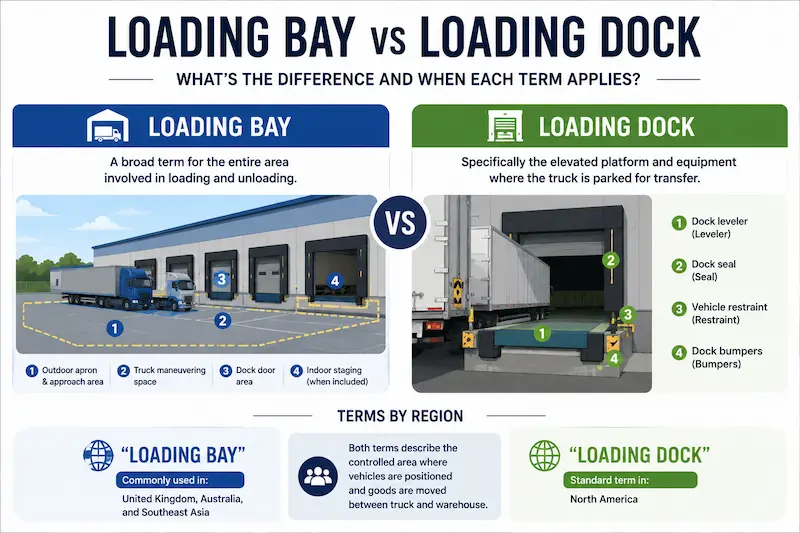
These two terms are often used interchangeably, but they do describe slightly different things depending on the context and the industry or region you are working in.
- Loading Dock typically refers to the elevated platform and associated equipment (leveler, seal, restraint, bumpers) at which a truck parks and goods are transferred.
- Loading Bay is a broader term that refers to the entire area including the outdoor apron, the truck maneuvering space, the dock door, and sometimes the indoor staging area as well.
In practical warehouse operations, loading bay is more commonly used in the United Kingdom, Australia, and Southeast Asia, while loading dock is the standard term in North America. To keep your internal SOPs and safety audits clear, it is best practice to standardize your terminology. For clear SOPs, simply adopt regional norms: use loading bay for Malaysian facilities, and reserve ‘loading dock’ for North American standards.
Types of Loading Docks
Not all loading docks are designed the same way. The right dock configuration depends on your facility size, truck traffic volume, building layout, climate, and the type of goods being handled. Here are the six main types used in commercial and industrial settings.
1. Flush Dock
A flush dock is the most common dock configuration in modern warehouses. In this design, the dock door is built flush with the exterior wall of the building. Trucks back directly up to the wall, and dock seals or shelters close the gap between the trailer and the building.
Key characteristics:
- Clean and compact exterior appearance
- Compatible with dock seals and dock levelers
- Best suited for facilities with high truck frequency
- Provides good weather protection for cargo
This is the standard choice for distribution center and large warehouses where efficiency and volume are the primary drivers.
2. Enclosed Dock
An enclosed dock features an interior or covered area where trucks can pull fully inside the building before loading or unloading begins. The entire docking operation happens within a controlled indoor environment.
Key characteristics:
- Full weather protection for both cargo and personnel
- Required for temperature-sensitive goods (pharmaceuticals, frozen foods)
- Higher construction cost due to expanded building footprint
- Provides enhanced security, as goods never pass through an open exterior
Cold chain operations and high-value goods handlers often prefer enclosed docks for the environmental control they offer.
3. Sawtooth Dock
A sawtooth dock uses an angled configuration where dock bays are positioned at angles (typically 30°, 45°, or 60°) to the building wall rather than perpendicular. This angled layout allows trucks to pull in and out without needing to make full 90-degree reversals.
Key characteristics:
- Reduces the turning radius required for truck maneuvering
- Ideal for sites with limited apron depth or constrained yard space
- Allows more dock doors in a given wall length
- Slightly less efficient for cargo transfer compared to flush docks
Sawtooth docks are common in urban distribution center where the available yard space is restricted.
4. Open Dock
An open dock is an exposed platform without walls or weather protection on the truck-facing side. It is the simplest and least expensive dock type to construct. Trucks back up to the platform edge, and loading or unloading is conducted in the open air.
Key characteristics:
- Low construction and installation cost
- Suitable for dry climates where weather exposure is not a significant concern
- Not suitable for temperature-sensitive cargo
- Higher exposure to wind, rain, dust, and pests
Open docks are still found in certain agricultural, construction materials, and outdoor goods handling facilities where the product type tolerates environmental exposure.
5. Depressed Dock
A depressed dock (also called a pit dock or sunken dock) is built into a recessed area of the floor, allowing the dock platform to be lower than the surrounding ground level. This allows ground-level truck beds to align with the interior floor without the need for elevated platforms.
Key characteristics:
- Allows standard box trucks and smaller vehicles to dock without height mismatches
- Useful in older buildings where raising the floor or platform is not feasible
- Requires drainage solutions to prevent water pooling in the recessed pit
- More expensive to retrofit than standard flush dock systems
This dock type is often found in urban delivery facilities and grocery distribution center that receive shipments from a variety of vehicle sizes.
6. Drive-In Dock
A drive-in dock allows a truck to drive fully inside the warehouse, where it is surrounded by racking or storage systems on multiple sides. This configuration allows fork trucks to access the trailer from inside the building without the typical dock platform setup.
Key characteristics:
-
- Full protection from weather and temperature fluctuations
- Allows direct access to trailer interior for staged loading
- Requires significant interior floor space
- Common in refrigerated warehouses and specialty storage facilities
Essential Equipment for a Loading Dock Area
Loading Dock type sets the structural foundation, but it is the equipment installed at each dock bay that determines operational capability. Below is a breakdown of the core and supporting equipment that every efficient loading dock should have.
1. Dock Leveler
A dock leveler is a mechanical or hydraulic platform installed at the dock door that bridges the height difference between the warehouse floor and the truck trailer bed. Trailer heights vary depending on vehicle type, load weight, and manufacturer, but without a leveler, safe forklift or pallet jack entry into the trailer is extremely difficult.
Types of dock levelers:
- Mechanical levelers: Operated manually using a pull chain, lowest cost, requires physical effort.
- Hydraulic levelers: Operated via push button, smooth, consistent operation, best for high-volume docks
- Air-powered levelers: Uses compressed air, fast cycling time, suitable for cold storage where minimizing air exchange matters.
- Vertical-storing levelers: Stores vertically against the door when not in use, provides superior weather seal and pest barrier.
Dock levelers should be inspected monthly for hydraulic leaks, worn lip plates, and corroded hinges. A failed leveler during peak operations can halt an entire dock bay.
2. Dock Seal and Dock Shelter
A dock seal is a foam-padded frame installed around the dock door opening. When a truck backs in, the trailer compresses against the seal, closing the gap between the trailer and the building wall. This prevents weather, dust, pests, and temperature fluctuations from entering the warehouse.
A dock shelter works differently, it uses flexible side and head curtains that enclose around the trailer without direct compression. Shelters accommodate a wider range of trailer sizes and shapes, making them more versatile but generally offering less weather resistance than seals.
Choosing between seal and shelter depends on:
- Consistency of truck sizes at your facility (seals work better with uniform trailer sizes).
- Climate conditions (seals provide tighter protection in cold or wet environments).
- Frequency of different vehicle types using the same dock.
3. Vehicle Restraint System
A vehicle restraint system prevents a truck from accidentally pulling away from the dock while loading or unloading is in progress. This is one of the most critical safety devices on a loading dock. The most dangerous scenario is “trailer creep”, where a trailer slowly rolls forward due to forklift vibration, or sudden driver departure before the dock is cleared.
Types of vehicle restraints:
- ICC bar hooks (RIG hooks): Mechanical hooks that lock onto the truck’s rear impact guard.
- Wheel chocks: Wedge-shaped blocks placed under the truck’s rear wheels, a low tech but effective.
- Automatic restraint systems: Sensor-triggered devices that lock automatically when a truck parks at the dock.
Vehicle restraint systems should always be paired with visual and audible interlock signals — typically traffic light systems on both the interior and exterior of the dock door — to ensure clear communication between dock workers and truck drivers.
4. Dock Bumper
A dock bumper is a heavy-duty rubber or laminated block mounted on the dock face to absorb the impact of trucks backing into the dock. Without bumpers, repeated truck contact causes structural damage to the dock wall, door frame, and leveller.
Dock bumpers should be:
- Sized to project the correct distance (typically 4–6 inches) from the dock face.
- Made from moulded rubber or steel-reinforced laminated rubber for high-impact applications.
- Inspected regularly for compression fatigue and replaced before they lose protective depth.
5. Supporting Equipment
Beyond the core dock hardware, efficient dock operations depend on a set of supporting equipment:
- Forklift: Moving palletised goods between the trailer and the staging area, counterbalance and reach truck variants are most common in dock environments
- Pallet jack: Manual or electric, used for short-distance pallet movement when forklifts are unavailable or space is tight.
- Conveyor systems: Fixed or portable belt conveyors that allow continuous product flow from trailer to staging, especially effective for carton-level unloading.
- Dock lights (trailer lights): Articulating light fixtures that extend into the trailer interior, eliminating shadows and reducing miss-picks and safety risks inside the trailer.
- Safety barriers and dock gates: Prevent pedestrian access to the dock opening when the leveler is raised or no truck is present.
For facilities operating high inbound volumes, integrating dock operations with a warehouse management system provides real-time visibility into which bays are occupied, estimated unloading times, and dock appointment scheduling. This reduces idle time significantly and supports better stock replenishment planning across the facility.
How to Design a Loading Dock Layout That Works
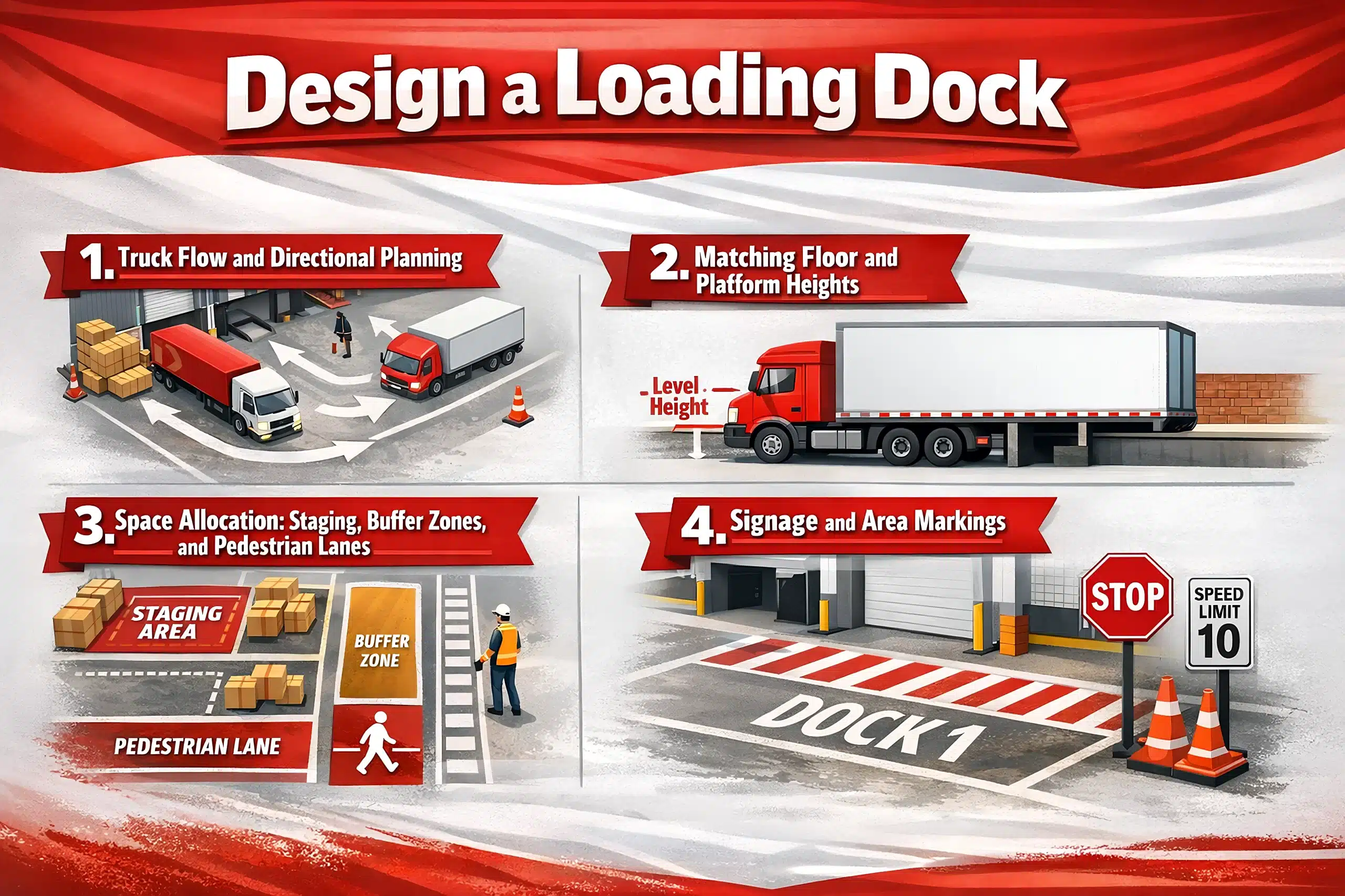 Even the best equipment cannot compensate for poor layout planning. The physical design of your loading dock area directly determines whether trucks can access bays efficiently, whether goods can flow quickly into your internal warehouse storage system, and whether workers can do their jobs safely.
1. Truck Flow and Directional Planning
The truck approach and departure pattern must be planned before the dock is built or reconfigured. One-way traffic flow is strongly preferred to avoid congestion and collision risk. Key principles include:
- Design approach lanes wide enough for standard semi-trailers (typically 12–14 meters clearance)
- Provide a minimum apron depth of 30 meters in front of dock doors to allow full trailer back-in
- Separate inbound and outbound lanes where possible to avoid conflicts
- Mark truck lanes, holding areas, and pedestrian zones clearly on the apron surface
2. Matching Floor and Platform Heights
Platform height should be set based on the primary vehicle types serving your facility. In most cases, platform height is set at 1,200 mm to 1,300 mm above the apron surface — this aligns with the majority of standard refrigerated and dry freight trailers. However, if your facility receives both large semi-trailers and smaller parcel delivery vans, consider a combination of dock levelers with extended range and a separate lower-height bay for smaller vehicles.
3. Space Allocation: Staging, Buffer Zones, and Pedestrian Lanes
The area immediately inside the dock door is the staging zone. Proper space allocation here prevents bottlenecks from propagating into the rest of the warehouse. Recommended layout elements include:
- Staging area: at least 6–9 meters of clear floor depth directly behind each dock door for temporary pallet storage during unloading
- Buffer zone: a secondary area 9–15 meters deep where sorted or checked cargo waits for putaway storage or dispatch
- Pedestrian lanes: clearly marked walkways (minimum 900 mm wide) that run parallel to the dock wall, separated from forklift travel paths by floor markings or physical barriers
- Charging stations: if using electric forklifts or pallet jacks, provide dedicated charging bays that do not obstruct dock activity
4. Signage and Area Markings
Clear visual communication on the dock floor and walls reduces accidents and speeds up operations. Essential markings and signage include:
- Yellow striped floor markings at dock edge to indicate the drop-off hazard zone
- Traffic light interlock systems (green/red) inside and outside each dock bay
- Bay number identification on both the wall and the exterior face of the dock
- Speed limit and directional signage in the truck apron area
- Emergency exit markers visible from all dock positions
Safety Standards and Risk Management
Loading docks are consistently ranked among the highest-risk areas in warehouse and logistics facilities. According to safety research from industrial hygiene bodies, dock-related incidents including forklift falls, trailer separations, and pedestrian strikes account for a significant share of serious warehouse injuries.
Key safety standards and practices include:
- Fall protection: When no truck is present, dock safety nets or dock gates must block the open doorway at all times
- Forklift and pedestrian separation: Strict no-pedestrian zones must be enforced in active forklift travel paths during loading operations
- Vehicle restraint lockout: Loading must not commence until the vehicle restraint is confirmed engaged and the dock light system shows green
- Maximum load ratings: Dock levelers have rated load capacities; exceeding them risks structural failure and personnel injury
- Spill containment: Facilities handling liquid cargo, dock floors should have drainage channels and spill containment lips
- Visibility aids: Convex mirrors at dock corners and dock lights inside trailers reduce blind spots
- Personal Protective Equipment (PPE): High-visibility vests, steel-toed boots, and hearing protection are mandatory for dock workers in most jurisdictions
Regular safety audits should review equipment condition, procedure compliance, incident logs, and near-miss reports. Incident root cause analysis should feed directly into standard operating procedure updates.
Facilities pursuing formal safety certifications such as ISO 45001 should ensure their loading dock procedures are explicitly documented as part of the occupational health and safety management system.
Common Challenges in Loading Dock Operations
Even well-equipped docks face recurring operational problems. Understanding the root causes of these challenges helps operations managers intervene before they escalate into costly disruptions.
1. Truck Congestion and Long Wait Times
When more trucks arrive at the dock than available bays can service simultaneously, a queue forms in the yard. Long wait times frustrate carriers, increase detention charges, and create pressure on dock staff to rush operations, which increases error rates and safety risks.
Solutions:
- Implement a dock appointment scheduling system to stagger truck arrivals
- Track dock bay utilization in real time and dynamically assign bays based on load priority
- Designate a check-in area where drivers can wait while their bay is prepared
- Communicate expected wait times to carriers via SMS or portal updates
2. Goods Damaged During Loading and Unloading
Product damage at the dock is a major source of shrinkage and customer complaints. The primary causes include misaligned dock levelers, improper pallet stacking, unsecured loads in trailers, and rushed handling under time pressure.
Solutions:
- Pre-check dock leveler alignment before every load
- Use stretch wrapping stations adjacent to the dock for outbound pallets
- Conduct inbound damage inspection at the dock door before goods enter the staging area
- Train dock staff on correct forklift approach angles for trailer entry
3. Space Constraints in High-Volume Operations
During peak periods — promotions, seasonal spikes, or inbound surges — staging areas fill quickly, creating congestion that backs up into the dock and slows unloading. This is a capacity constraint problem that no amount of additional staff can solve without process intervention.
Solutions:
- Implement a cross-docking strategy where inbound cargo for known outbound orders bypasses putaway entirely. Learn more about how cross-dock operations reduce staging area congestion and improve throughput speed.
- Use time-slotted putaway processes so staging never accumulates beyond a defined threshold
- Pre-allocate floor zones with clear visual markings for each shipment or carrier
4. Vehicle Compatibility Issues with Dock Height
Not all trucks are the same height. Refrigerated trailers, flatbeds, step-deck trailers, and smaller delivery vans all have different bed heights. When a dock is set up for only one trailer height, other vehicle types either cannot use the dock efficiently or create safety risks when the leveler cannot bridge the gap.
Solutions:
- Install levelers with extended range lips (typically 400–600 mm range) that accommodate height variation
- Designate specific bays for small-vehicle or non-standard trailer delivery
- Use portable dock plates for infrequent, non-standard vehicle access
5. Poor Communication Between Warehouse and Transport Teams
Miscommunication between the inbound transport team and the warehouse receiving team leads to dock bay conflicts, incorrect cargo allocation, and missed receiving windows. This is often a systems problem rather than a people problem.
Solutions:
- Use a shared digital dock management or transportation management system visible to both teams
- Establish clear arrival notification protocols (minimum 2-hour advance notice required before a truck arrives)
- Assign a dock coordinator role responsible for real-time communication between drivers and warehouse staff
6. Limited Visibility into Inbound Shipments
When warehouse teams do not know what is arriving, when it is arriving, or how much of it is coming, they cannot prepare dock resources, staging space, or labor efficiently. This reactive mode leads to wasted time and misallocated resources.
Solutions:
- Require suppliers and carriers to provide Advance Shipping Notices (ASNs) at least 24 hours before delivery
- Integrate ASN data with your WMS (Warehouse Management System) for automated dock assignment and labor planning
- Use yard management software to track truck locations in real time as they approach the facility
Having a capable warehouse management system in place can significantly reduce the guesswork involved in inbound planning, giving dock coordinators the advance notice they need to pre-allocate bays and labor.
How to Improve Loading Dock Efficiency
Improving dock efficiency is not a single intervention, it is an ongoing process of measurement, adjustment, and investment. The following strategies are ranked by implementation complexity and impact.
1. Standardise Operating Procedures
Every dock activity should have a written standard operating procedure. Standardisation eliminates guesswork, reduces training time, and creates a baseline for performance measurement.
2. Measure Dock Performance Metrics
You cannot improve what you do not measure. Core dock KPIs include:
- Dock-to-stock time: Time from truck arrival to goods reaching storage location.
- Dock utilization rate: Percentage of available dock bay hours actually in use.
- Trailer turn time: Average time a trailer occupies a dock bay.
- Damage rate: Percentage of shipments received with damage.
- On-time departure rate: Percentage of outbound trucks departing within the scheduled window.
3. Implement Dock Scheduling and Appointment Systems
Dock appointment systems allow inbound and outbound carriers to book time slots in advance. This prevents arrival clustering, reduces yard congestion, and allows the warehouse to pre-stage labor and equipment. Many modern WMS platforms include dock scheduling as a native module.
4. Invest in Powered Equipment
Manual pallet jacks are slower and more labor-intensive than electric equivalents. Where volumes justify the investment, upgrading to electric pallet jacks or ride-on forklifts for dock operations can cut unloading time significantly. For high-frequency dock lanes, automated conveyor systems offer the greatest throughput gains.
5. Improve Dock Equipment Condition
Preventive maintenance on dock levelers, seals, and restraints reduces unplanned downtime. A dock leveler failure or a torn seal during a busy shift can halt an entire bay for hours. Schedule quarterly inspections and maintain a parts inventory for common wear items.
6. Train Dock Staff Consistently
Dock workers should receive structured onboarding covering safety procedures, equipment operation, cargo handling techniques, and communication protocols. Annual refresher training and toolbox talks keep skills current and safety culture strong.
7. Leverage Technology for Visibility
Beyond the WMS, technologies such as dock sensors, RFID gates at dock doors, and yard cameras give operations managers real-time data on dock activity. This visibility enables faster decision-making during peak periods and provides data for post-shift performance reviews.
Future Trends in Loading Dock Operations: 2026 and Beyond
As supply chains evolve, loading dock technology and operations are also being transformed. Several trends are shaping the next generation of dock facilities.
- Automated Dock Equipment: Automated dock levelers, restraints, and door systems that respond to truck sensors are eliminating the manual steps in dock preparation. These systems reduce dock cycle time and lower the risk of procedural errors by automating the safety interlock sequence.
- IoT Sensors and Dock Telemetry: Dock equipment embedded with Internet of Things sensors can transmit real-time data on leveler position, restraint engagement status, temperature at the dock seal, and door open/close cycles. This data feeds predictive maintenance systems that identify equipment wear before it causes failure.
- Autonomous Guided Vehicles at the Dock: Autonomous mobile robots and automated guided vehicles are increasingly being deployed for the first and last segment of internal dock logistics, moving pallets from the dock floor to staging areas without human drivers. These systems are particularly effective in high-frequency, repetitive dock environments.
- Dock Management Software Integration: Dock management is moving from standalone scheduling tools to fully integrated platforms that connect transport management, yard management, and warehouse management in a single data environment. Real-time dock status, carrier ETA integration, and automated bay assignment are becoming standard features in mature logistics technology stacks.
- Sustainable Dock Design: Energy efficiency is increasingly a design priority. Dock doors with better insulation values, LED dock lighting with motion sensing, and solar-powered dock lighting systems reduce the energy footprint of dock operations, an important consideration as logistics facilities face increasing pressure to reduce carbon emissions.
Conclusion
A loading dock is far more than a door in a wall. It is a complex operational system that determines how efficiently goods enter and exit your facility. Getting the dock type right, investing in the correct equipment, designing a logical layout, and enforcing disciplined safety and operational procedures are all decisions that compound over time into significant competitive advantage.
In this modern era, the combination of better equipment, smarter technology, and driven management will redefine the loading dock as the ultimate hub of supply chain intelligence. By transitioning from a static entry point to a dynamic, tech-enabled gateway, companies can eliminate costly bottlenecks and ensure a fluid movement of goods that keeps pace with modern demand.
Ultimately, operational excellence begins where the trailer meets the bay. Before committing to major physical facility upgrades, visualizing your logistics flow through a free demo ensures that every change genuinely improves safety and long-term profitability.

FAQ about Loading Dock
-
What safety measures should be in place at a loading dock?
Safety measures at a loading dock should include proper signage, training for personnel, use of personal protective equipment (PPE), regular maintenance of equipment, and ensuring that the area is kept clear of obstructions to prevent accidents.
-
What are some key features of an effective loading dock?
Key features of an effective loading dock include sufficient space for maneuvering large vehicles, proper height alignment with trucks, safety barriers, and equipment such as dock levelers and lifts to facilitate the smooth transfer of goods. Additionally, good lighting and signage are important for safety and efficiency.
-
How can I improve efficiency at my loading dock?
To improve efficiency at a loading dock, consider implementing a well-organized layout, utilizing technology for tracking shipments, training staff on best practices, and scheduling deliveries and pickups to minimize wait times.
-
How do loading docks improve warehouse efficiency?
Loading docks improve warehouse efficiency by ensuring a smooth transition for warehouse personnel and cargo handling equipment. This allows them to move efficiently while loading and unloading goods between the facility and the vehicle.
-
Why are loading docks important for ecommerce businesses?
Loading docks serve as an important hub of warehouse receiving and shipping activities for ecommerce businesses. If the loading dock area is optimized, it can ensure better efficiency while maintaining safety.