








Key Takeaways
|
Defining the Returns Management Process
Returns management is a supply chain process that handles product returns, reverse logistics, and cross-department coordination. It manages both product movement and financial reconciliation when goods flow back from customers to the business.
At its core, the process ensures returned items are inspected, recorded, and properly reintegrated into inventory or routed for disposal through operational automation. This helps maintain operational efficiency and inventory accuracy across the organization.
When implemented effectively, returns management connects warehouse operations with customer service, finance, and inventory teams. It also generates actionable insights to reduce return rates and improve overall supply chain performance.
Forward vs. Reverse Logistics: A Critical Distinction
Forward and reverse logistics play different but complementary roles in the supply chain. Forward logistics focuses on delivering goods from manufacturers to customers through predictable routes, planned quantities, and standardized packaging.
Reverse logistics, on the other hand, handles products returned by customers as they move back through the supply chain. Unlike outbound shipments, returns often come in unpredictable volumes, varying conditions, and inconsistent packaging, increasing operational complexity.
Due to this variability, reverse logistics requires flexible workflows, responsive labor planning, and systems that quickly determine whether items should be restocked, repaired, recycled, or discarded. Proper management helps maintain operational control while reducing costs and delays.
The Five Pillars of an Effective Returns Process
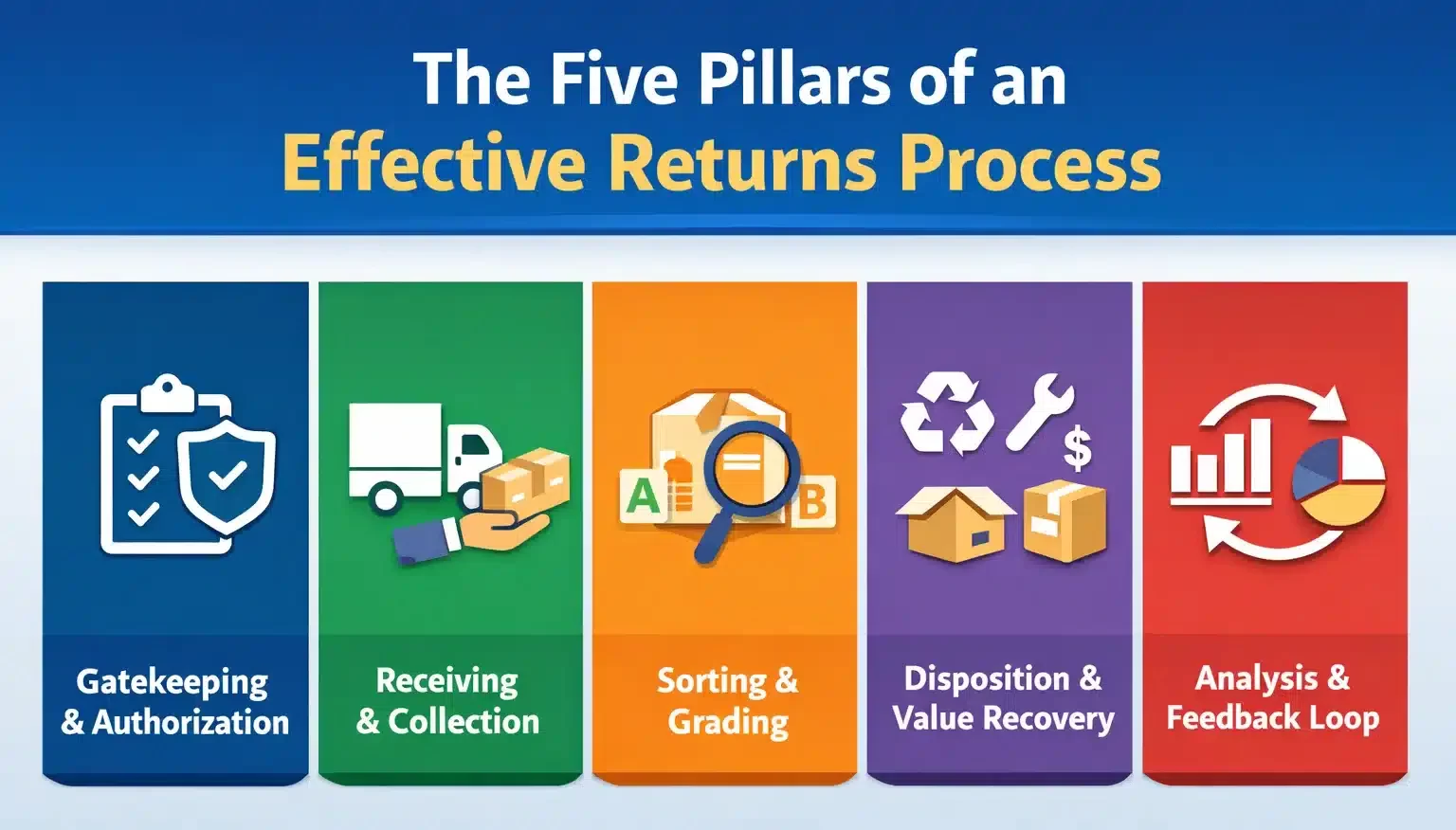
To bring order to the chaos of reverse logistics, successful organizations build their strategy around five core pillars. These stages ensure that every item is accounted for and processed with the goal of maximum value recovery.
Gatekeeping and Authorization
Gatekeeping prevents unnecessary returns from entering the supply chain, reducing operational and logistics costs. When a customer submits a Return Merchandise Authorization (RMA), the request is validated against return policies such as time limits, product condition, and proof of purchase to determine eligibility.
Effective gatekeeping lowers warehouse workload and sets clear customer expectations. In some cases, troubleshooting resolves the issue without requiring the product to be returned.
Receiving and Collection
After authorization, the product is collected via in-store drop-off, courier pickup, or shipment to a returns center. Returned items must follow a separate receiving workflow to avoid mixing with new inventory.
Warehouse staff scan the RMA to link the item with its digital record and verify it matches the approved request. This ensures accurate tracking and prepares the item for inspection and disposition.
Sorting and Grading
Inspection and grading are critical steps that determine product condition and resale potential. Standardized criteria such as Grade A (new condition) or Grade B (opened but functional) ensure consistent evaluation.
With handheld scanners and integrated systems, grading results are recorded instantly, enabling automatic routing to restocking, repair, recycling, or disposal.
Disposition and Value Recovery
Based on grading, items are directed to the highest-value recovery channel. Common paths include restocking, refurbishment, secondary markets, recycling, or or proper disposal of unusable assets.
Fast decision-making maximizes value; for example, seasonal fashion items may be redirected to discount outlets instead of occupying prime warehouse space.
Analysis and Feedback Loop
Returns management should generate actionable insights, not just process products. Analyzing return reasons helps identify issues such as sizing inaccuracies, product defects, or supplier problems.
By sharing insights across teams, companies create a feedback loop that improves product quality, operational processes, and overall customer experience.
The Financial Impact: Visible and Hidden Costs
Most leaders focus only on refunded revenue and shipping fees, but the true cost of returns is often hidden beneath the surface like an iceberg. Direct operating costs extend far beyond the visible refund amount.
- Operational Handling Costs
Every step in the reverse logistics process adds cost, often exceeding the expense of outbound fulfillment. Returned items require inspection, testing, repacking, and restocking, increasing labor, warehousing expenses, and non-revenue-generating floor space usage. - Inventory Depreciation
Product value declines over time, especially for electronics and seasonal fashion. Slow returns processing can force businesses to discount heavily or liquidate inventory, eroding profit margins. - Customer Lifetime Value (CLV)
A complicated return process reduces Customer Lifetime Value (CLV) by driving customer churn. In contrast, a seamless and transparent returns policy builds trust, increases repeat purchases, and boosts average order value.
Optimizing Returns Workflows for Efficiency
Optimization starts with policy and ends with execution. To streamline the returns management process, businesses must look at reducing friction for the customer while increasing control for the operation.
- Automated RMA Workflows
Manual Return Merchandise Authorization (RMA) processes often cause delays and errors. A self-service portal allows customers to select items, choose reason codes, and generate labels, while the system validates eligibility and alerts the warehouse in advance.
- Dynamic Routing Logic
Advanced supply chains use dynamic routing to determine the optimal return destination before shipment. For example, seasonal items can be redirected to regions with higher demand instead of a central warehouse to maximize resale value.
- QR Codes and Label-Less Returns
QR code-based, label-less returns reduce friction and packaging waste. Customers scan a code at the carrier point, the label is printed on-site, and the system instantly notifies the merchant enabling faster processing and refund initiation.

The Role of Technology in Reverse Logistics
Managing returns on spreadsheets is a recipe for disaster. Scalable returns management requires an integrated technology stack that provides visibility and control.
Industry-Specific Challenges and Use Cases
While the fundamental principles remain the same, the execution of returns management varies significantly across different sectors.
Strategies for Reducing Return Rates
The most profitable return is the one that never happens. While you cannot eliminate returns entirely, you can significantly reduce avoidable returns through strategic interventions.
- Enhanced product information
A large percentage of returns occur because the product did not match the customer’s expectation. High-resolution images, 360-degree views, and detailed videos help bridge the gap between digital representation and physical reality. - Outbound quality control
Shipping damage and picking errors are self-inflicted wounds. Strengthening quality control processes in the outbound workflow prevents incorrect items from being shipped. Investing in better packaging materials saves significant money by reducing damage-related returns. - Proactive customer support
Sometimes a customer wants to return an item because they don’t know how to use it. Providing easy access to tutorials and live chat support can save the sale. If a customer initiates a return for “product not working,” an automated prompt offering a setup guide or a troubleshooting call can resolve the issue.
Future Trends in Returns Management (2026 and Beyond)
As we look toward the future, returns management is evolving alongside broader shifts in technology and consumer behavior.
- The circular economy and sustainability
Consumers are increasingly conscious of the environmental impact of returns. The carbon footprint of shipping an item back and forth is significant. We are seeing a shift towards “circular” supply chains where the goal is zero waste. - Hyper-local consolidation
To reduce shipping costs, logistics providers are establishing hyper-local drop-off points (like pharmacies or convenience stores) where returns are aggregated. Instead of shipping one box at a time, these locations consolidate hundreds of returns into a single pallet shipment. - Instant refunds via fintech
Fintech solutions are emerging that allow merchants to offer “instant refunds” or store credit immediately upon the carrier scan of the return label. This liquidity encourages the customer to spend that money again with the merchant immediately.
Industry-Specific Applications of Returns Management
While the fundamental concept of reverse logistics remains consistent, the operational execution varies wildly across different sectors. A “one-size-fits-all” approach to returns often leads to inefficiencies.
Instead, organizations must tailor their returns management process to the specific nuances of their industry, leveraging ERP capabilities to handle unique constraints and regulatory requirements visibility.
Implementation Steps and Critical KPIs
Deploying a sophisticated returns management process requires a structured approach that moves beyond simple software installation. It involves a fundamental shift in operational workflows.
Step 1: Define Gatekeeping Protocols
The first line of defense in returns management is gatekeeping—deciding what enters the reverse supply chain. Organizations must configure their ERP to enforce return policies strictly at the point of entry.
This involves setting up conditional logic for RMA (Return Merchandise Authorization) generation. For instance, the system should automatically reject returns requested outside the warranty window or flag high-frequency returners for manual review.
Step 2: Standardize Disposition Codes
Ambiguity is the enemy of efficiency. Warehouse staff should not have to guess the status of a returned item. Implement a standardized set of disposition codes within the system, such as “Resell-New,” “Resell-Open Box,” “Refurbish,” “Return-to-Vendor,” and “Scrap.”
These codes should trigger automated workflows. A “Resell-New” code should immediately make the inventory available on sales channels, while “Scrap” should trigger a write-off journal entry in the finance module.
Step 3: Integrate Financial Reconciliation
The disconnect between the warehouse receiving a return and finance issuing a credit is a common pain point. The implementation must automate this link. Once an item passes physical inspection and is scanned into the ERP, the credit memo should be auto-generated based on the original sales price.
Key Performance Indicators (KPIs)
To ensure the process delivers value, businesses must track specific metrics:
- Rate of Return: The percentage of sales units returned. A spike here indicates upstream product quality or description issues.
- Disposition Cycle Time: The average time elapsed between the item arriving at the dock and reaching its final disposition (shelf, scrap, or vendor). Reducing this time releases trapped capital.
- Recovery Rate: The percentage of the returned product’s cost that is recovered through resale or recycling. High-performing organizations aim to maximize this through efficient refurbishment.
- No Fault Found (NFF) Rate: The percentage of returns where the product is fully functional. High NFF rates suggest customers struggle with product usage, indicating a need for better user manuals or customer education.
Common Pitfalls and Mitigation Strategies
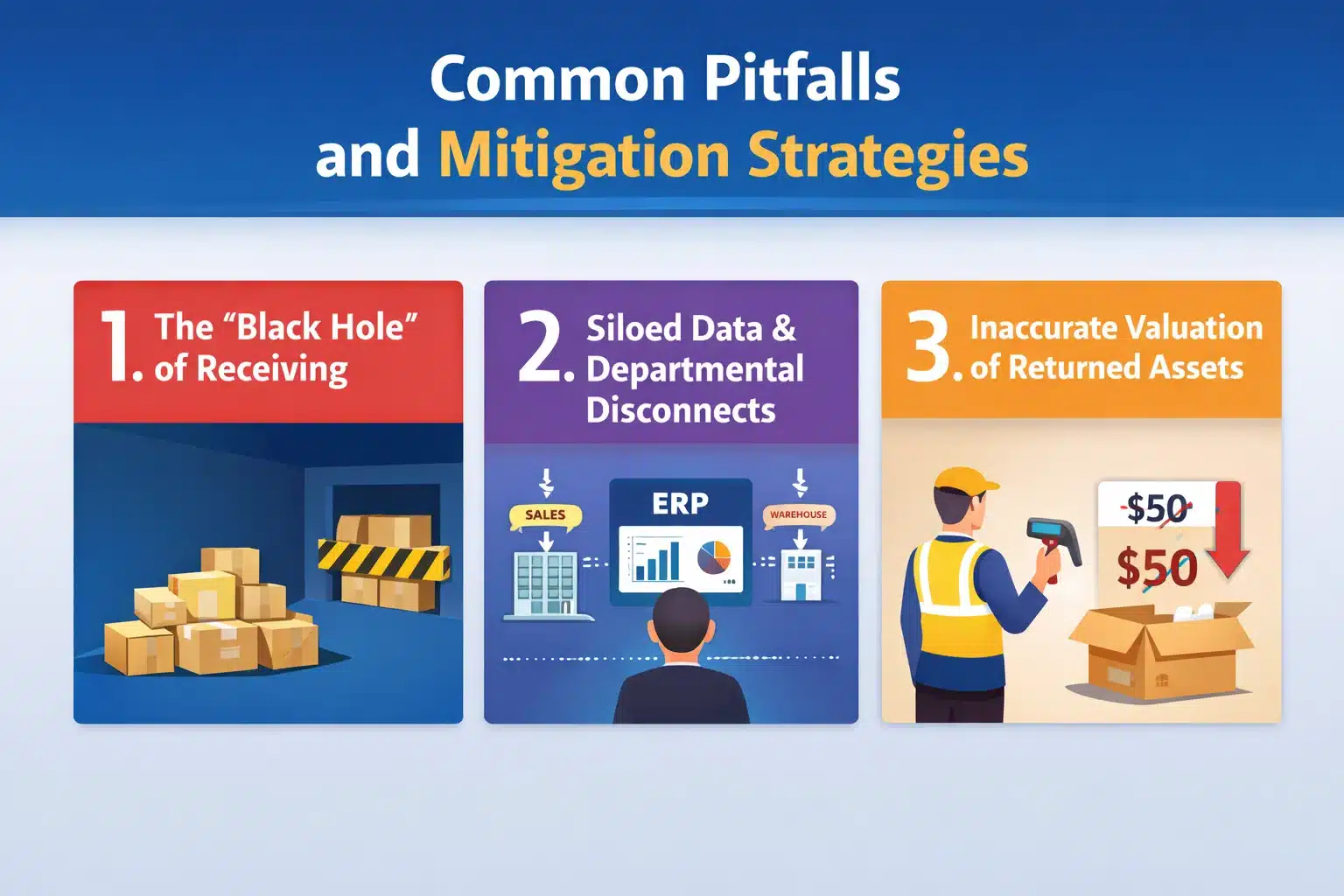
Even with robust software, returns management initiatives often fail due to process oversights. Recognizing these pitfalls early allows organizations to build resilience into their operations.
The “Black Hole” of receiving
Pitfall: Returned boxes often pile up in a corner of the warehouse known as the “quarantine area,” waiting for inspection “when there is time.” This leads to inventory obsolescence and customer frustration regarding delayed refunds.
Mitigation: Treat returns with the same priority as inbound purchase orders. Dedicate specific labor hours or shifts solely to processing returns. Configure the ERP to alert management if an RMA remains in “Received” status without disposition for more than 24 hours.
Siloed data and departmental disconnects
Pitfall: Sales teams continue to sell products that have high return rates because they lack visibility into the returns data managed by the warehouse and quality teams.
Mitigation: Establish a feedback loop where memory-based data storage is visualized on sales dashboards. If a specific SKU has a return rate exceeding a defined threshold (e.g., 15%), the ERP should automatically flag the item for review.
Inaccurate valuation of returned assets
Pitfall: Recording returned inventory at full cost when it is damaged or depreciated inflates the balance sheet and leads to inaccurate financial reporting.
Mitigation: Implement automated devaluation rules. When users mark an item as “Open Box,” the system automatically adjusts its inventory value to a pre-set percentage of the original cost.
Advanced Best Practices for Future-Proofing
Leading organizations are moving beyond basic processing to leverage returns as a strategic advantage. Advanced practices involve the integration of predictive analytics and sustainability goals into the reverse logistics framework.
Additionally, detailed tracking of “Scrap” dispositions allows companies to audit their waste streams, ensuring compliance with environmental regulations and identifying opportunities to sell scrap materials to recyclers, turning a disposal cost into a revenue stream.
Conclusion
Returns management is no longer just an operational task, it is a strategic function that directly impacts customer satisfaction and profitability. Businesses that manage returns with clear processes and coordination across departments can reduce delays.
By strengthening inspection workflows, improving visibility through technology, and analyzing return data, companies can transform reverse logistics into a source of operational insight.
As customer expectations continue to investing in structured returns processes and modern systems can help businesses stay competitive. Many solution providers now offer a free consultation to help organizations explore how returns management tools can streamline operations.
Frequently Asked Questions
-
What is the returns management process?
The returns management process, often called reverse logistics, involves the activities related to returns, reverse logistics, gatekeeping, and avoidance. It encompasses everything from the customer initiating a return to the final disposition of the product (restocking, repair, or disposal).
-
Why is returns management important in supply chain?
It is crucial because it directly impacts profitability, inventory levels, and customer satisfaction. Effective management recovers value from returned assets, reduces operational costs, and provides critical data to improve future product quality.
-
How can businesses reduce their return rates?
Businesses can reduce returns by improving product descriptions and images, implementing strict outbound quality control to prevent errors, and offering proactive customer support to help users utilizing the product correctly.
-
What are the 5 pillars of returns management?
The five pillars are: 1) Gatekeeping (authorization), 2) Receiving (collection), 3) Sorting and Grading, 4) Disposition (restock, repair, recycle), and 5) Analysis (feedback loop).