








Malaysia’s SST expansion took effect July 1, 2025, pulling six new service sectors into the tax net. The Ministry of Finance estimates this will generate an additional RM3 billion annually.
Construction, leasing, financial services, private healthcare, and education are now taxable at 6% or 8% depending on the category. If your business falls into these areas and you weren’t previously collecting SST, you now need to register, update your invoicing, and file returns.
The purpose of this article is to provide a clear, comprehensive, and actionable guide for business owners, finance managers, and CEOs. We will detail the specific changes, identify who is affected, and outline the strategic steps necessary to prepare your organization.
Key Takeaways
|
What Is The Expansion Of Service Tax In Malaysia?
The SST expansion is Malaysia extending its service tax to six new sectors starting July 1, 2025: leasing, construction sector, financial services, private healthcare, education, and wellness. Businesses in these sectors must now register, charge 6% or 8% tax depending on category, and file returns to Royal Malaysian Customs Department.
Registration threshold is RM500,000 annual revenue for most sectors. Leasing and rental has a higher bar at RM1,000,000. If you’re under the threshold, you’re exempt from registration but still need to monitor your revenue in case you cross it.
1. Why Malaysia Expanded SST in 2025
Malaysia needs more revenue. The previous SST framework missed large chunks of the service economy. This expansion closes that gap by taxing sectors that were previously exempt. The government projects an additional RM3 billion annually from this change.
2. Important Dates for Compliance
July 1, 2025 is the start date. But the government gave businesses a grace period until December 31, 2025. During this window, no penalties for late registration, filing delays, or documentation errors. After January 1, 2026, full enforcement begins.
3. What Changed From the Old SST Rules
Three main changes. First, six sectors that never paid service tax now must. Second, registration thresholds vary by sector instead of one flat number. Third, clearer rules on B2B exemptions so businesses don’t get taxed twice when services pass through multiple hands before reaching end customers.
Who Is Affected By The SST Expansion?
 If your business provides services in the six newly taxable sectors and earns above the registration threshold, you need to register with Royal Malaysian Customs Department, collect tax, and file returns. This applies whether you operate as sole proprietor, partnership, or Sdn Bhd.
1. Registration Thresholds By Sector
Most newly taxable services require registration at RM500,000 annual revenue. Leasing and rental is higher at RM1,000,000. Financial services and private healthcare also sit at RM1,000,000. Education follows a different rule where it is only taxable if fees exceed RM60,000 per student per academic year.
Track your revenue monthly. Once you cross the threshold, you have 30 days to register.
2. List of new taxable services
Leasing and rental covers equipment, vehicles, and commercial space. Residential property stays exempt. Construction services include residential projects on mixed development land. Financial services cover banking, insurance, and underwriting. Private healthcare includes medical, dental, and allied health services.
Education covers private schools and higher education for non-Malaysians. Wellness services include spa, massage, and slimming centres. Beauty services like salons and barbers were removed after public feedback.
3. Exemptions and non-taxable services
Malaysian citizens using private healthcare and education services are not charged SST. Government hospitals and public universities stay outside the tax net. Residential property rental is exempt. Core banking services like foreign exchange and remittance fees remain untaxed.
One exemption worth noting for business owners is B2B transactions. These have specific exemptions to prevent tax stacking. If you acquire services to deliver your own taxable services downstream, check if you qualify. Missing this means paying tax you could have avoided.
How To Prepare Your Business For The Service Tax Expansion?
Waiting until the last minute creates problems. Rushed system updates lead to invoicing errors. Late registration triggers penalties after the grace period ends. Start now while you still have room to fix mistakes without consequences.
1. Step 1: Evaluate financial and operational impact
List every service your business provides. Check which ones fall under the six newly taxable sectors. Calculate how much SST you will need to collect and whether your pricing can absorb it or needs adjustment.
Review your existing contracts. Some long-term agreements may not have accounted for SST. Decide early whether you renegotiate terms or absorb the cost yourself.
2. Step 2: Update accounting and invoicing systems
Your financial systems must be capable of handling the new tax rules, including applying correct rates, generating SST-compliant invoices, and ensuring accurate reporting. This is the perfect time to assess whether your current accounting software is flexible enough to be configured for the new regulations.
An advanced solution like an Accounting ERP for business can automate these adjustments, ensuring your system can automatically differentiate between taxable and non-taxable services to prevent calculation errors that could lead to severe penalties and audit complications.
3. Step 3: Complete registration and fulfill compliance obligations
Register through the MySST portal once you cross the revenue threshold. Approval takes time so do not wait until the deadline. Once registered, you file returns every two months and pay within 30 days after each taxable period ends.
The grace period runs until December 31, 2025. Use it to test your filing process and fix errors before penalties apply.
4. Step 4: Communicate price changes to customers
Transparency is vital for maintaining customer trust during this transition. Proactively inform your clients about any potential price adjustments resulting from the new SST charges on the services they use. Communicate clearly and honestly, explaining that these changes are a legal requirement.
Frame the communication to show how you are working to minimize the impact on them, which can help preserve loyalty and prevent misunderstandings that could damage business relationships.
Why Your Business Needs The Right System For SST Compliance
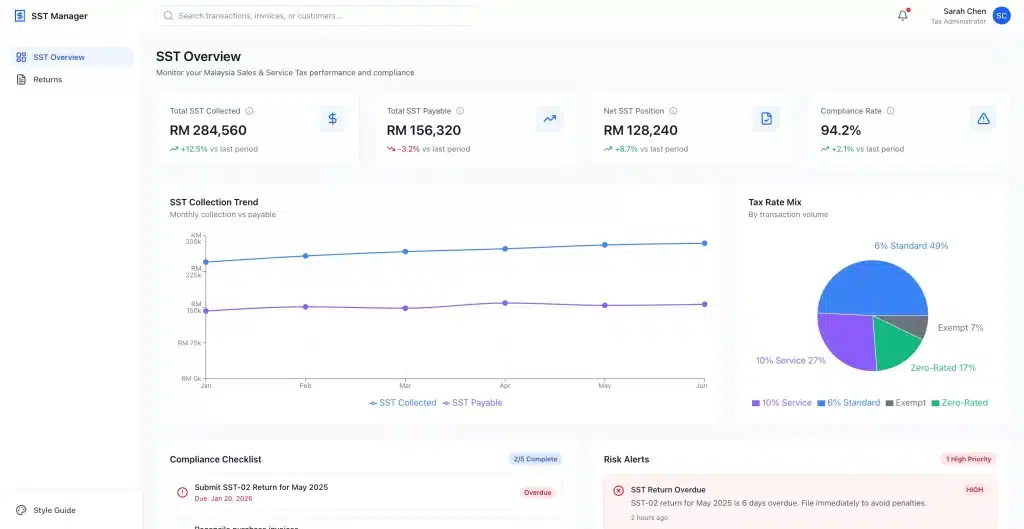
Managing six new taxable sectors with different rates manually takes time your finance team could spend elsewhere. The right system handles SST calculation, invoice generation, and filing reports automatically. Your team focuses on running the business instead of rechecking tax figures.
- What A Good SST System Does For You
Three things matter most. First, it applies the correct rate automatically. Construction at 6%, leasing at 8%, no manual selection needed. Second, it generates invoices that meet RMCD requirements without formatting adjustments. Third, it pulls your bi-monthly return data directly from recorded transactions. - Faster Audits, Less Stress
RMCD can request transaction records going back years. A system that tracks every invoice with correct classification gives you audit-ready documentation in minutes. You pull the report, hand it over, and move on. - Matching The Solution To Your Business Size
Small operations do not need a full ERP. Cloud accounting software with Malaysian SST support handles the basics well. Look for multiple tax rate handling, compliant invoice templates, and automated return summaries. - The Return On Getting This Right
Compliance is the minimum outcome. The real benefit is cleaner financial data, faster monthly closes, and a finance team that works on analysis instead of data entry. SST expansion is the trigger, but better systems pay off long after the transition ends.
Beyond SST compliance, making sure your business claims all eligible tax deductions is just as important for your bottom line. Here is what you need to know about tax deductions and how they can reduce your overall tax liability.
What Are The Potential Challenges And How To Overcome Them?
Every policy change brings implementation problems. Knowing what to expect helps you prepare before issues become costly.
1. System Configuration Errors
Your accounting software may not be set up for multiple SST rates. Invoices go out with wrong tax amounts. Returns show incorrect figures.
Fix this by testing your system before the grace period ends. Run sample invoices across different service categories. Verify the rates match what RMCD requires.
2. Cash Flow Pressure
You collect SST from customers but must remit it to RMCD every two months. If customers pay late, you still owe the tax on time.
Build a separate SST holding account. Do not mix collected tax with operating funds. This prevents shortfalls when payment deadlines arrive.
3. Unclear Service Classification
Some services fall into gray areas. You are unsure whether a specific offering is taxable or which rate applies.
Check the RMCD guidelines and FAQs first. If still unclear, submit a ruling request to RMCD for written confirmation. This protects you during audits.
4. Customer Pushback on Price Increases
Clients resist paying more for the same service. Some threaten to switch providers.
Communicate early and clearly. Show that SST is a regulatory requirement, not a price hike you chose. Provide itemized invoices so customers see exactly what they are paying for.
5. Staff Knowledge Gaps
Your finance team may not fully understand the new rules. Mistakes happen during invoice processing or filing.
Invest in training before enforcement begins. RMCD and professional accounting bodies offer briefings on SST compliance. One training session now saves multiple correction rounds later.
Conclusion
The 2025 Service Tax (SST) expansion is a pivotal regulatory change that demands proactive attention and strategic action from all businesses in Malaysia. By understanding the scope, preparing your systems, and anticipating challenges, your company can not only ensure full compliance but also strengthen its operational foundation.
The key is to view this change not as a burden, but as an opportunity for modernization and to enhance financial process efficiency through the adoption of appropriate technology.
Thorough preparation will provide peace of mind and ensure your business can continue to thrive amidst an evolving regulatory landscape. Begin your internal evaluation today and ensure every department is ready to embrace this new era of service taxation in Malaysia. A well-prepared business is a resilient one, capable of turning challenges into stepping stones for future growth.

FAQ
-
What is the new Service Tax rate after the expansion?
The standard Service Tax rate remains at 6%, although some specific services like F&B, telecommunications, and parking have different rates. The expansion primarily focuses on broadening the scope of taxable services, not a general rate change.
-
When should I register for SST if my business is affected?
You should register as soon as you can determine that your annual turnover from taxable services will exceed the prescribed threshold. The RMCD typically provides a specific registration period before the effective date to avoid a last-minute rush.
-
Are services provided to overseas clients also taxed?
Generally, services that are exported or provided to consumers outside Malaysia are not subject to SST. However, specific rules apply, especially for digital services, so it is crucial to verify the tax treatment for each type of export service.
-
How does this expansion affect existing long-term contracts?
Existing contracts may need to be reviewed. Transitional rules will usually dictate how SST applies to services rendered after the effective date, even if the contract was signed earlier. It is advisable to include a tax clause in new contracts to anticipate future changes.
-
What are the penalties for non-compliance with the new SST rules?
Penalties for non-compliance can be severe, including significant financial fines, late payment penalties, and even legal action in serious cases. Timely and accurate compliance is essential to avoid these risks.