









Many organisations struggle to maintain precise batch visibility when their lot tracking processes rely heavily on manual work. This lack of control often leads to compliance risks, product inconsistencies, and operational delays that directly impact customer trust.
These challenges escalate when teams are unable to trace affected batches promptly during audits, quality incidents, or recall situations. Without a reliable system, decision-makers face fragmented data that slows down responses and weakens overall supply chain governance.
By implementing an advanced software inventory, businesses can establish automated, real-time batch monitoring that strengthens accuracy and accountability. This solution enhances traceability, improves regulatory readiness, and enables organisations to manage their operations with greater confidence and precision.
Key Takeaways
|
What Is Lot Tracking and Why Is It Crucial?
Lot tracking is a fundamental inventory management method that allows companies to trace a group of products from origin to end-point within the supply chain. Every group of products, produced or received at the same time, is assigned a unique identification number known as a “lot number.” This number is the key to monitoring the movement, shelf life, and complete history of each batch, from raw materials to the final consumer’s hands. Implementing this system is no longer just an option; it is a strategic imperative for businesses aiming to ensure quality, safety, and operational efficiency.
Understanding the concept of lot tracking in depth is the first step to appreciating its significant impact on business operations. This system not only helps in emergency situations like product recalls but also serves as the backbone for daily inventory optimization, ensuring products with the nearest expiration dates are sold first. By understanding its essential differences from other tracking methods and the components that build it, you will see how lot tracking becomes the foundation for smarter, data-driven decision-making. Let’s explore the definition, key differences, and main components of a lot tracking system in more detail.
1. The fundamental definition of lot tracking
Essentially, lot tracking is the process of grouping and monitoring inventory items that share similar characteristics, such as production date, raw materials used, or manufacturing location. Each of these groups, called a “lot” or “batch,” is assigned a unique identification number that records its entire journey along the supply chain. With this number, a company can easily trace back the complete history of a product, from its origin as a raw material, through the production process, to its distribution to consumers. This traceability is vital for quality control, stock management, and compliance with strict industry regulations.
2. Key differences: Lot tracking vs. serial number tracking
Although often confused, lot tracking and serial number tracking have fundamental differences that are crucial for operations managers to understand. Lot tracking focuses on tracing a group (batch) of products, where a single lot number represents many identical units produced together. In contrast, serial number tracking assigns a unique identification number to each individual product unit, enabling item-level tracking. This distinction determines their application, where lot tracking is ideal for mass-consumed products like food or pharmaceuticals, while serial number tracking is better suited for high-value items like electronics or vehicles that require per-unit warranty and service history tracking.
3. Key components in a lot tracking system
An effective lot tracking system is built on several key components that work synergistically to ensure data is accurate and easily accessible. The first component is the lot number itself, a unique code that serves as the primary identifier for each product batch. The next component is the supporting data tied to that lot number, such as production date, expiration date, supplier number, and production location. Finally, supporting technology like barcode scanners, QR codes, or RFID is needed to automate data recording, along with centralized inventory management software capable of integrating and processing all this information into actionable reports.
Why Is Lot Tracking Important for Your Business?
In the modern, highly competitive, and strictly regulated business landscape, the importance of lot tracking has surpassed being merely a good inventory management practice. Today, it has become a strategic pillar that supports a company’s reputation, profitability, and sustainability. The ability to accurately track every product batch provides a significant competitive advantage, from ensuring compliance with increasingly complex government regulations to protecting a brand from a crisis caused by a product recall. Without this system, a company operates in uncertainty, vulnerable to inefficiencies, waste, and legal risks that can be financially detrimental.
The benefits derived from implementing lot tracking are multifaceted and directly impact various operational aspects, from the warehouse to the boardroom. The system not only enhances product safety and quality but also drastically optimizes how a company manages its inventory assets. With full visibility into the lifecycle of every product, managers can make more proactive and strategic decisions. Here is a detailed breakdown of the primary reasons why lot tracking is a critical investment for the growth and stability of your business.
1. Ensuring regulatory compliance and industry standards
Many industries, particularly food and beverage, pharmaceuticals, and medical devices, are governed by strict government regulations regarding product traceability. Regulations like those from the U.S. Food and Drug Administration (FDA) require companies to be able to fully trace product histories as a condition of consumer safety. A reliable lot tracking system ensures that a company can easily meet all audit and documentation requirements, avoiding hefty fines, legal sanctions, or even operational shutdowns due to non-compliance. This adherence to standards is not just about avoiding penalties, it is about demonstrating a commitment to consumer safety, which builds long-term trust.
2. Improving quality management and product safety
Quality control is at the heart of customer satisfaction and brand reputation, and lot tracking is a powerful tool to enforce it. If a quality issue is reported from a specific product batch, the company can quickly isolate the entire affected lot, identify the root cause from the raw materials or production process, and prevent other defective products from reaching the market. This proactive approach not only maintains consistently high-quality standards but also builds consumer confidence in the safety and reliability of the products you offer, turning quality assurance into a competitive advantage.
3. Facilitating fast and accurate product recalls
A product recall is one of the worst-case scenarios for a company, but with lot tracking, its impact can be drastically minimized. Without lot tracking, a company might be forced to pull an entire product line from the market, an action that is incredibly expensive and damaging to the brand’s image. With lot tracking, the company can target the recall to the specific batch identified as problematic, reducing financial losses, speeding up the process, and demonstrating to the public that the company has full control over its supply chain. This precise response helps preserve customer trust in the long run.
4. Optimizing stock rotation (FIFO/FEFO)
Waste from expired products is one of the most significant hidden sources of loss in inventory management, especially for goods with a limited shelf life. Lot tracking enables the systematic implementation of efficient stock rotation strategies like First-In, First-Out (FIFO) or First-Expired, First-Out (FEFO). By knowing exactly which lots arrived or will expire first, warehouse staff can ensure those products are sold or used first. This practice significantly reduces the amount of wasted stock and maximizes profitability, turning inventory into a more dynamic and less risky asset.
5. Increasing supply chain visibility
In the era of globalization, supply chains have become increasingly complex and dispersed, making visibility a major challenge for many companies. Lot tracking provides end-to-end transparency, allowing managers to see where every batch of product is at any given time, from the supplier’s warehouse, through production facilities and distribution centers, to the retailer. This visibility is invaluable for more accurate demand planning, identifying potential bottlenecks in the supply chain, and improving overall logistics efficiency. Ultimately, this leads to reduced costs and faster delivery times, directly impacting the bottom line and customer satisfaction.
How Does a Lot Tracking System Work?
Conceptually understanding how a lot tracking system works is essential for its successful implementation. The process is designed to create an unbroken digital trail for each product batch, ensuring that critical information is always recorded at every key point in the supply chain. This workflow begins the moment raw materials or finished goods first arrive at your facility and continues until the product leaves the warehouse to be shipped to a customer. Each step is supported by standard procedures and technology that ensure data integrity and accuracy.
The success of this system heavily relies on consistency in recording and the use of technology to minimize human error. From creating informative lot numbers to using barcodes or RFID for automated tracking, every element works together to create a reliable data ecosystem. By understanding this workflow, you can design internal processes that not only meet tracking needs but also integrate seamlessly into your daily operations. Let’s explore the main stages of how a lot tracking system works.
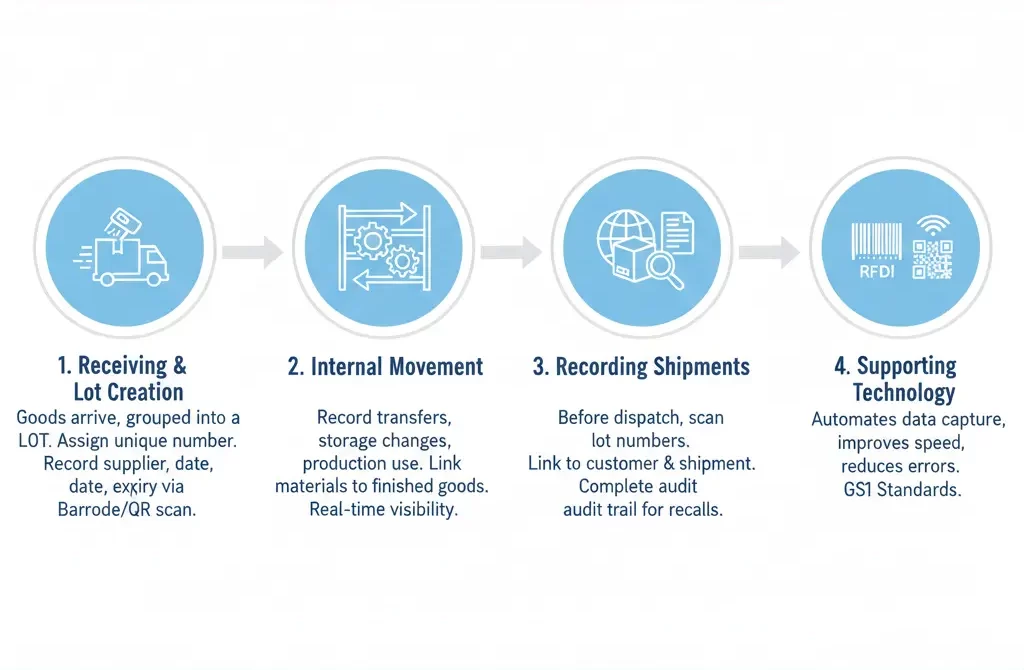
1. Stage 1: Receiving goods and creating a lot number
The tracking process begins at the earliest point: when raw materials or finished goods are received from a supplier. At this stage, a group of items received together is designated as a single lot and assigned a unique lot number. This number, along with other important information such as the receiving date, supplier name, and expiration date (if applicable), is immediately entered into the inventory management system. Using barcodes or QR codes affixed to each pallet or box in the lot helps speed up the recording process and reduces the risk of manual data entry errors.
2. Stage 2: Tracking internal movement (production and transfers)
Once a lot number is created, every movement of the lot within the company’s facilities must be carefully tracked and recorded. If the lot consists of raw materials, the system will record which lot is used to produce a specific batch of finished goods, creating a crucial data link between raw materials and the final product. If the lot is a finished good, every transfer between warehouses or storage racks must also be scanned and updated in the system. This internal tracking ensures full visibility of the location and status of each lot, which is vital for operational efficiency and accurate stock picking.
3. Stage 3: Recording shipments to customers
The final stage of the tracking cycle is when the product is shipped out of the warehouse to a customer or distributor. Before shipment, staff will scan the lot number of the products being sent, and the system will automatically record which lot was shipped, to whom, and the date of shipment. This data completes the product’s audit trail and becomes vital in the event of a recall, as the company can quickly identify which customers received products from the problematic batch. Accurate recording at this stage closes the traceability loop and protects both the company and the consumer.
4. Supporting technology: Barcodes, QR codes, and RFID
The effectiveness of a modern lot tracking system heavily depends on automatic identification technology to ensure data speed and accuracy. Barcodes are the most common and cost-effective technology, allowing for quick scanning with handheld scanners. QR codes offer an advantage by storing more information, such as URLs or more detailed product information. Meanwhile, Radio-Frequency Identification (RFID) is a more advanced technology that allows for scanning multiple items at once without direct line of sight, making it ideal for high-volume warehouse operations and significantly improving the efficiency of receiving and shipping processes. Utilizing standards from organizations like GS1 ensures global compatibility and best practices.
Common Challenges in Lot Tracking Implementation and Their Solutions
While the benefits of lot tracking are immense, its implementation process is not always smooth and often faces various operational and technical challenges. Many companies, especially those transitioning from manual systems, underestimate the complexity involved in creating a disciplined and integrated tracking system. These challenges can range from employee resistance to change and difficulty integrating new technology with existing systems, to the high initial investment cost. Ignoring these challenges can lead to a failed implementation, inaccurate data, and ultimately, a system that creates more problems than it solves.
However, with careful planning and the right strategy, each of these challenges can be effectively overcome. The key is a proactive approach, identifying potential issues early on and preparing solutions before they hinder the process. This involves not only selecting the right technology but also effective change management, comprehensive employee training, and commitment from all levels of the organization. By understanding these common challenges and how to address them, companies can ensure a smoother transition to a reliable, efficient, and value-generating lot tracking system.
1. High initial costs and resource allocation
The initial investment in software, hardware like scanners or RFID readers, and employee training can be a significant barrier for some businesses. To overcome this, it is important to view lot tracking not as a cost, but as an investment with a clear return. Develop a detailed business case that outlines the potential savings from reduced waste, lower recall costs, and improved efficiency. Additionally, consider a phased implementation, starting with the most critical product lines first, and explore cloud-based software solutions that often have lower upfront costs compared to on-premise systems.
2. Employee resistance and lack of training
Any change in workflow can be met with resistance from employees who are comfortable with existing processes. A lack of proper training can lead to incorrect data entry, which undermines the entire system. The solution is a robust change management and training program. Clearly communicate the benefits of the new system to all employees, highlighting how it will make their jobs easier and more effective. Provide hands-on, role-specific training and create easy-to-follow documentation. Involving key employees in the planning and selection process can also help create buy-in and turn potential critics into advocates for the new system.
3. Integration with existing systems
A lot tracking system that operates in a silo has limited value. The real power comes from its integration with other business systems like your ERP, accounting software, and warehouse management system. Integrating disparate systems can be technically complex. To solve this, prioritize software solutions that offer pre-built integrations or a robust API (Application Programming Interface). When selecting a system, involve your IT team early to assess its compatibility with your existing technology stack. A system like a comprehensive inventory management system is designed for seamless integration, ensuring data flows automatically across all your core business functions.
A Guide to Implementing Lot Tracking in Your Company
Implementing a lot tracking system is a strategic project that requires careful planning and execution. This process is more than just buying new software; it is about redesigning workflows, establishing new standards, and training your team to adopt a more disciplined, data-driven way of working. A structured approach will ensure that the transition goes smoothly, minimizes disruption to daily operations, and maximizes the benefits you will gain from the new system. Every step, from the initial evaluation to full integration, plays a critical role in the success of the implementation.
The purpose of this guide is to provide a step-by-step framework that any company, regardless of its size, can follow to implement a lot tracking system effectively. By following these stages, you can ensure that all important aspects are considered, from internal business processes to selecting the technology that best fits your unique needs. Let’s explore the practical steps to take your company’s inventory tracking capabilities to the next level.
1. Step 1: Evaluate your current inventory processes
The most crucial first step before making any changes is to understand and map your current inventory management processes in detail. Identify how goods are received, stored, moved, and shipped, and note where potential failure points or inefficiencies occur. Conduct a thorough analysis of existing workflows, document each step, and involve staff from various departments like warehouse, production, and sales to get a complete and accurate picture. This evaluation will serve as the foundation for designing a new lot tracking system that truly addresses the real problems in your company.
2. Step 2: Define your lot numbering standards
Consistency is key in lot tracking, and it starts with establishing a standard format for lot numbering across the entire organization. Decide what information each lot number should contain, for example, the production date, factory code, shift number, or product code, and create a logical and easy-to-understand structure. This standard must be clearly documented and communicated to all relevant parties, including suppliers if possible, to ensure that every lot entering and leaving your system follows a uniform format, facilitating tracking and data analysis later on.
3. Step 3: Choose the right lot tracking software
Selecting the right software is the most important decision in the implementation process, as it will be the heart of your entire tracking system. Look for a solution that not only offers robust lot tracking features but is also user-friendly, scalable with your business growth, and most importantly, can integrate with other systems you already use. Modern ERP software like HashMicro offers inventory management modules equipped with advanced lot tracking functionality, enabling seamless data integration between inventory, sales, accounting, and production on a single, centralized platform.
4. Step 4: Train your team and conduct a pilot test
Even the most advanced technology is useless without a team trained to use it correctly, making investment in comprehensive training essential. Conduct training sessions for all staff who will interact with the new system, from warehouse staff who will be scanning items to managers who will be analyzing reports. After training, conduct a pilot test phase on a single product line or warehouse area to identify potential workflow issues, refine processes, and build team confidence before the system is fully implemented across the entire company.
5. Step 5: Integrate with other systems (ERP, Accounting)
To maximize the value of your lot tracking system, the data it generates must flow smoothly into other critical business systems. Integration with an Enterprise Resource Planning (ERP) system will ensure that inventory data is always in sync with sales, procurement, and production planning data. Meanwhile, integration with accounting software allows for more accurate inventory valuation and a more precise calculation of the cost of goods sold (COGS). This solid integration breaks down data silos between departments and provides a holistic, 360-degree view of your company’s operational and financial health.
The Future of Lot Tracking: Innovations and Technological Trends
The world of supply chain management is constantly evolving, and lot tracking technology is no exception. What was once a manual or simple barcode-based recording process is now moving towards a smarter, more automated, and connected ecosystem. New technological innovations are pushing the boundaries of what is possible in terms of visibility, transparency, and efficiency. Companies that want to remain competitive must understand these trends and begin to consider how they can adopt future technologies to strengthen their operations.
From ensuring product authenticity using blockchain to demand forecasting powered by artificial intelligence, the future of lot tracking promises unprecedented levels of control and insight. These trends will not only improve internal efficiency but will also change how companies interact with suppliers and customers, creating a more responsive, resilient, and transparent supply chain. Understanding these innovations will help business leaders plan long-term technology investments and prepare their companies for future challenges.
1. Blockchain for enhanced transparency and security
Blockchain technology offers an immutable and decentralized ledger, making it a perfect fit for enhancing supply chain traceability. By recording every transaction and movement of a lot on a blockchain, companies can create a completely transparent and tamper-proof history of a product. This is particularly valuable for high-value goods or products where authenticity is critical, such as luxury items, pharmaceuticals, or organic foods. Consumers can simply scan a QR code to see the entire journey of the product, from farm to table, building an unparalleled level of trust.
2. Artificial intelligence (AI) and machine learning (ML) for predictive insights
AI and ML are transforming lot tracking from a reactive to a proactive tool. By analyzing historical data from lot movements, sales patterns, and external factors like weather or market trends, AI algorithms can predict future demand with incredible accuracy. This allows for smarter inventory management, helping businesses anticipate stock needs, optimize reorder points, and even identify potential quality issues before they become widespread. AI can also analyze sensor data to predict equipment failure or spoilage, further reducing waste and downtime.
3. Internet of Things (IoT) for real-time monitoring
IoT sensors are bringing real-time data collection to the next level. By placing small, low-cost sensors on pallets, containers, or even individual products, companies can monitor conditions like temperature, humidity, and location in real-time throughout the entire supply chain. For perishable goods like food or vaccines, this is a game-changer. If a shipment’s temperature goes outside the safe range, an alert is automatically triggered, allowing for immediate intervention. This continuous monitoring ensures product integrity and provides a rich stream of data that can be used to optimize logistics and routes.
Optimize Your Inventory Management with a Solution from HashMicro
HashMicro’s ERP provides an inventory system that automates stock tracking, minimizes manual errors, and ensures real-time visibility. It helps businesses monitor order status accurately and speed up reporting to improve operational efficiency.
The system offers automated approvals, shipment tracking, and integration with accounting to keep every inventory transaction recorded properly. With centralized data, companies gain tighter control over stock movements and better decision-making across the supply chain.
Features of HashMicro inventory management software:
- Lot & Serial Number Management: Provides complete traceability for every batch or individual item, crucial for quality control and recalls.
- Barcode Management System: Simplifies inventory tracking from receiving to shipping by integrating with barcode scanners for fast and accurate data entry.
- FIFO & FEFO Stock Control: Automates stock rotation by prioritizing the sale of older or soon-to-expire products, significantly reducing waste and spoilage.
- Real-Time Inventory Dashboard: Offers a visual and data-rich dashboard to help managers make faster and more accurate decisions regarding stock levels and movement.
- Stock Request & Transfer Management: Streamlines the process of requesting and transferring stock between multiple warehouses, ensuring optimal inventory levels across all locations.
With HashMicro, your company can enhance operational efficiency, data transparency, and business process automation. To see how our solution can concretely help your business, do not hesitate to try our free demo now!
Conclusion
Many organisations today face significant risks when their lot tracking still depends on manual processes, as this limits visibility and weakens operational control. These gaps create compliance challenges and reduce overall efficiency across the supply chain.
To address these issues, inventory system HashMicro provides a fully automated inventory and lot tracking solution that delivers real-time accuracy and complete traceability. Its integrated system helps businesses strengthen quality assurance, streamline audits, and operate with greater confidence.
Companies that are ready to improve their batch-level visibility can explore the system through a free demo to understand its full capabilities. This allows decision-makers to evaluate how automation can enhance compliance, efficiency, and long-term supply chain performance.
FAQ About Lot Tracking
-
What is the main difference between FIFO and FEFO in lot tracking?
FIFO (First-In, First-Out) ensures that the first products received are the first to be sold. FEFO (First-Expired, First-Out) is more specific, prioritizing products with the earliest expiration date, which is crucial for perishable goods.
-
Do small and medium enterprises (SMEs) also need a lot tracking system?
Absolutely. SMEs can benefit greatly from lot tracking to reduce waste, improve quality control, and build customer trust. Cloud-based systems now make it affordable and scalable for businesses of all sizes.
-
What information should ideally be in a lot number?
Ideally, a lot number should contain key information such as the production date, location or facility code, and a unique batch sequence number. This makes tracing the product’s origin and history much easier.
-
Are there industries where lot tracking is legally mandatory?
Yes, lot tracking is legally mandatory in many industries, most notably pharmaceuticals, medical devices, and the food and beverage sector. Regulatory bodies like the FDA require strict traceability to ensure consumer safety and enable rapid recalls.
-
Are there industries where lot tracking is legally mandatory?
Yes, lot tracking is legally mandatory in many industries, most notably pharmaceuticals, medical devices, and the food and beverage sector. Regulatory bodies like the FDA require strict traceability to ensure consumer safety and enable rapid recalls.
-
How does lot tracking specifically help reduce expired product waste?
By tracking the expiration date of each lot, the system can automatically alert staff to prioritize selling or using products that are nearing their expiry. This systematic approach ensures older stock is moved first, drastically minimizing spoilage.