














When a customer reaches checkout and the payment fails, the sale is gone. The payment gateway sitting behind that moment determines whether the transaction goes through or falls apart.
A payment gateway is software that authorises and processes online payments. It communicates between the customer’s bank, the merchant’s account, and the payment provider to confirm or decline a transaction in real time.
Not all gateways are built the same. The type you choose affects checkout speed, security compliance, and how much control you have over the customer experience. This blog will cover everything you need to know about payment gateways.
Key Takeaways
Understand the core mechanics and transaction flow of digital payments.
Explore hosted, self-hosted, API, and redirect gateway models.
Learn about crucial security, fraud prevention, and API capabilities.
Actionable advice for selecting and integrating the right payment system.
What Is a Payment Gateway?

A payment gateway is transaction software that authorises and processes online payments securely. It transmits payment data between customers, banks, and payment providers, then returns an approval or decline response.
Any business collecting payment online needs a gateway to move funds securely between the customer’s bank and its own. It protects cardholder data and returns a real-time approval or decline.

Types of Payment Gateways
Understanding the different types of payment gateways helps businesses select the one that best suits their needs.
1. Hosted Payment Gateway
A hosted gateway operates as a transaction processing system that handles payment authorisation on the provider’s secure platform. As a result, businesses reduce compliance effort while maintaining reliable and controlled transactions.
2. Self-Hosted Payment Gateway
With a self-hosted gateway, payments are processed directly on your website, giving you full control over the customer’s checkout experience. This option is highly customisable, allowing you to match the design and flow to your brand.
3. API-Hosted Payment Gateway
API-hosted gateways connect payments directly to your website or app via API, so customers never leave during checkout. This reduces drop-off, but requires development capacity and ongoing PCI DSS compliance management.
4. Redirect Payment Gateway
A redirect gateway sends customers to a third-party page to complete the payment process. This method is simple to implement and places the burden of PCI compliance on the provider.
The trade-off is a less controlled checkout experience, since customers leave your site to complete payment.
Key Features of a Payment Gateway
Security, integration quality, and reporting capability separate a reliable gateway from one that creates ongoing operational problems.
1. Security and PCI DSS Compliance
Top-tier gateways comply with PCI DSS standards and use tokenization to prevent cardholder data from being stored or exposed during a transaction.
2. Fraud Detection and Prevention
Advanced gateways include tools like risk scoring, device fingerprinting, and chargeback alerts to detect and prevent fraudulent activity.
3. Supported Payment Methods
Gateways must communicate smoothly with each transaction terminal used to capture card or wallet payments. This compatibility ensures customers can pay quickly while businesses avoid failed or delayed transactions.
4. Integration and API Capabilities
A gateway with seamless integration and robust API capabilities connects easily to your website, app, or other business tools. This ensures smooth transactions and minimises operational errors or disruptions during checkout.
5. Real-Time Reporting and Analytics
Dashboards and analytics tools give you real-time insights into transactions, revenue trends, and customer behaviour. These reports help businesses make data-driven decisions, optimise processes, and identify growth opportunities.
Payment Gateways Across Industries
Different industries have unique payment needs, and choosing the right gateway ensures smoother operations and a better customer experience:
- E-commerce: Requires high-volume transaction handling and fast checkout to reduce cart abandonment.
- Subscription services: Needs support for recurring billing and automated invoicing to manage ongoing payments efficiently.
- Travel and hospitality: Benefits from multi-currency support, easy refunds, and effective chargeback handling for international customers.
- Retail: Often connect online gateways with a web-based point of sale to manage in-store and online transactions from one system. This setup improves visibility across sales channels and reduces reconciliation work.
Selecting a payment gateway that aligns with your industry’s requirements can improve efficiency, security, and customer satisfaction.
Best Practices for Choosing a Payment Gateway
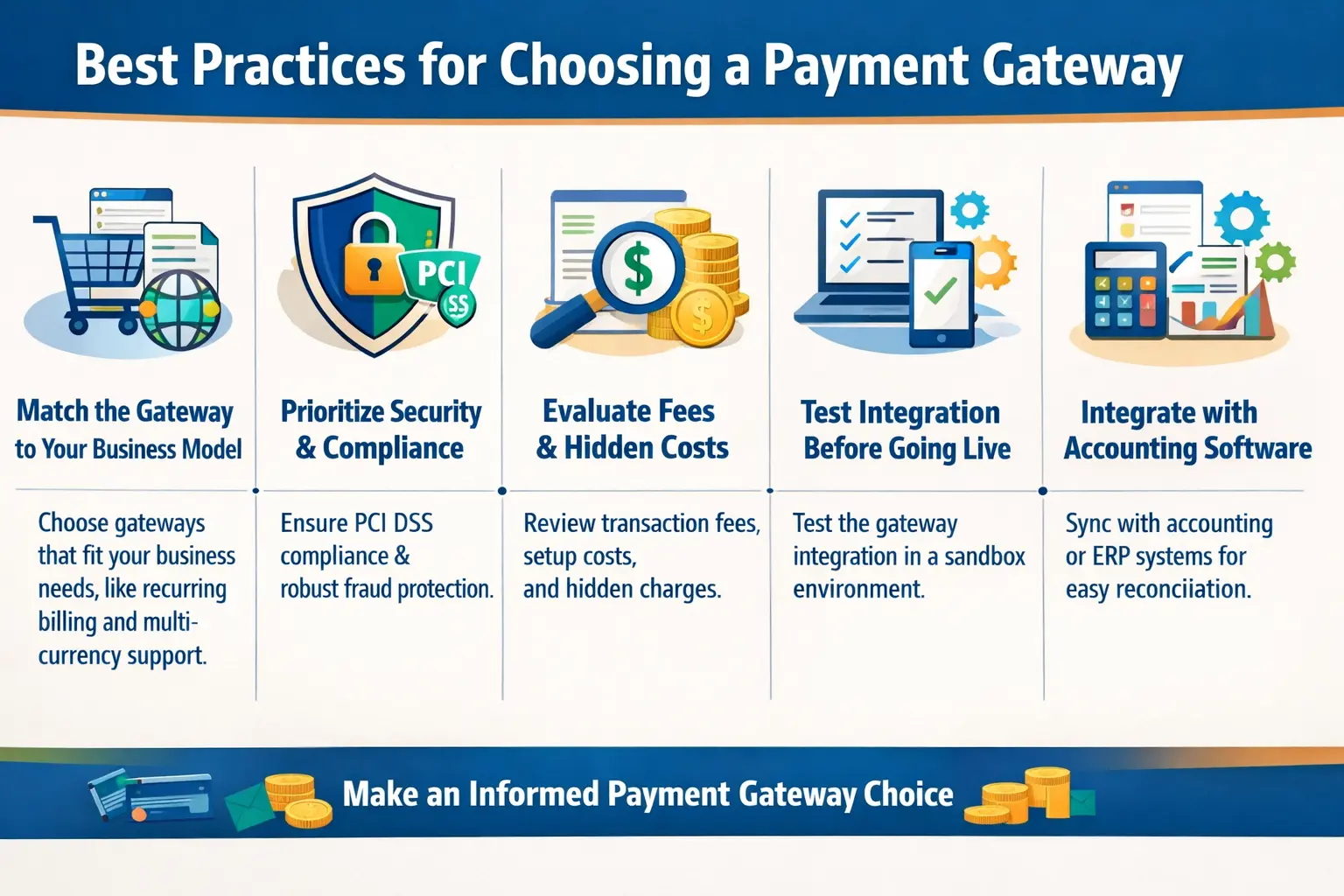
Choosing the right payment gateway is crucial for smooth operations and secure transactions. Here are some best practices to guide your decision:
1. Match the Gateway to Your Business Model
It’s important to select a gateway that aligns with how your business operates. Subscription-based businesses benefit from features like recurring billing and automated invoicing, while e-commerce stores often need gateways that support multi-currency payments and international transactions.
2. Prioritise Security and Compliance Standards
Make sure your gateway complies with PCI DSS standards and includes fraud detection tools. A non-compliant gateway puts your business at risk of fines and losing the ability to process card payments altogether.
3. Evaluate Transaction Fees and Hidden Costs
Before committing, carefully review the fees associated with each gateway. Look beyond transaction fees to include setup costs, cross-border charges, and potential hidden costs. Understanding the full pricing structure helps you choose a cost-effective solution that won’t eat into your revenue.
4. Test Integration Before Going Live
Use sandbox environments to check how the gateway integrates with your website or app, including all payment flows and connected business tools. Proper testing minimises errors and prevents disruptions when you go live.
5. Integrate Your Payment Gateway with Accounting Software
When linked correctly, a payment gateway becomes part of a broader POS solution for store manager oversight. It simplifies reconciliation, improves reporting accuracy, and supports better day-to-day payment control.
Payment Gateway Mistakes to Watch Out For
Even with careful planning, businesses can make mistakes when implementing a payment gateway. Key pitfalls include:
- Overlooking Mobile Optimisation: Mobile users need a smooth checkout. Avoid gateways that require zooming or redirects, and choose one that is fully responsive and supports biometric authentication.
- Ignoring Hidden Fees and Lock-in Contracts: Low advertised rates can hide setup fees, cross-border charges, or long-term contracts with penalties. Always review the total cost of ownership before committing.
- Poor Error Handling and Vague Declines: Generic messages like “Transaction Failed” frustrate customers. Use clear, actionable prompts to help users resolve issues quickly.
- Inadequate Fraud Protection Mechanisms: Weak fraud rules risk chargebacks, while overly strict rules reject legitimate customers. Continuously adjust checks to balance security and smooth checkout.
Conclusion
A poorly chosen gateway creates friction at the exact moment a customer is ready to pay. That friction has a direct cost in lost sales and reduced trust.
Understanding the types available, the features that matter, and the mistakes that are easy to avoid gives businesses a clear basis for making the right choice.
To learn more, book a free consultation with our expert immediately.
Frequently Asked Question
A payment gateway is a service that securely processes online payments. It connects your website or app with banks and payment providers, making transactions fast, safe, and seamless for your customers.
Look for a gateway that fits your business model, supports the payment methods your customers prefer, and meets security standards like PCI compliance. Also consider fees, integration options, and reliability.
Yes! Some gateways support both e-commerce and physical store transactions, allowing you to manage all payments in one system while keeping everything secure and consistent.