





Managing a warehouse in today’s fast-paced supply chain environment is akin to conducting a complex orchestra. Every movement, from the arrival of raw materials to the dispatch of finished goods, must be synchronized perfectly. In Malaysia, where the logistics sector is rapidly evolving due to the e-commerce boom and shifting trade routes, the margin for error is shrinking. Businesses are no longer just competing on product quality but on the speed and accuracy of their fulfillment.
However, many organizations struggle with invisible inefficiencies that bleed profit margins dry. These are not always obvious disasters; often, they are subtle process gaps—inventory that sits too long, pickers walking unnecessary miles, or data that doesn’t quite match physical stock. Recognizing these pitfalls is the first step toward operational excellence.
Key Takeaways
|
What is Warehouse Management?

At its core, warehouse management encompasses the principles and processes involved in running the day-to-day operations of a warehouse. It is far more than simply storing items on shelves. It is a strategic discipline that controls the movement and storage of materials within a warehouse and processes the associated transactions, including shipping, receiving, put-away, and picking.
Effective warehouse management creates a framework where inventory is optimized, space is utilized efficiently, and labor is deployed in the most productive manner possible. It serves as the bridge between supply and demand, ensuring that the right product reaches the right customer at the right time. In the modern context, this discipline has expanded to include the integration of technology, safety protocols, and data analytics to drive continuous improvement.
The scope of warehouse management extends beyond the four walls of the facility. It involves coordination with transport carriers, suppliers, and internal sales teams. It requires a deep understanding of inventory turnover rates, demand forecasting, and the physical limitations of the storage facility. When executed correctly, warehouse management transforms a storage facility from a cost center into a competitive advantage, enabling faster delivery times and higher customer satisfaction.
Why Warehouse Efficiency Matters for Malaysian Businesses
For Malaysian businesses, the stakes for warehouse efficiency have never been higher. The country acts as a critical logistics hub in Southeast Asia, and with the rise of the digital economy, customer expectations have shifted dramatically. The standard for delivery has moved from “within a week” to “next day” or even “same day” in major urban centers like the Klang Valley. This pressure forces warehouses to operate at unprecedented speeds.
Furthermore, operational overheads are climbing. With prime industrial real estate commanding premium rates and the implementation of Malaysia’s revised RM1,700 minimum wage fundamentally altering labor economics, inefficient use of space or manpower directly impacts the bottom line. A warehouse that operates inefficiently is essentially paying rent for air and wages for walking time. In a market where margins are often thin, these operational leaks can be the difference between profitability and loss.
Efficiency also plays a crucial role in supply chain resilience. As seen during recent global disruptions, businesses with agile and efficient warehouse operations were better equipped to handle fluctuations in supply and demand. They could pivot strategies, reroute inventory, and maintain continuity while competitors struggled with bottlenecks. For Malaysian enterprises looking to scale, mastering warehouse efficiency is a prerequisite for sustainable growth.
Advanced Practices: Moving Toward the Smart Warehouse

Once the foundational mistakes are corrected, businesses can look toward advanced practices to secure a competitive edge. The modern warehouse is increasingly becoming a “Smart Warehouse,” utilizing data to predict rather than react.
Predictive Analytics: Instead of waiting for inventory to run low, advanced systems analyze historical sales data, seasonality, and even weather patterns to predict demand surges. This allows managers to pre-position stock closer to dispatch areas before the orders even arrive.
Digital Twins: This involves creating a virtual replica of the physical warehouse. Managers can run simulations—such as “what happens if order volume doubles next week?”—to test stress points in the layout and staffing levels without disrupting actual operations.
By moving from reactive error correction to proactive optimization, warehouses transform from cost centers into growth engines. The journey requires patience, investment, and a willingness to continuously adapt to new supply chain realities.
9 Warehouse Management Challenges Most Businesses Don’t See Until It’s Too Late
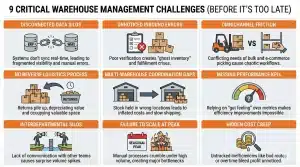
Many warehouse problems are insidious; they start small—a few mismatched numbers here, a delayed shipment there—and slowly compound until they threaten the entire operation. Identifying these issues requires a critical look at current processes.
1. Disconnected systems creating data silos
One of the most pervasive issues in modern warehousing is the existence of data silos. This occurs when the warehouse management system (or the spreadsheets used to manage the warehouse) does not communicate effectively with the company’s ERP, sales platforms, or procurement software. The result is a fragmented view of the business where the “truth” depends on which system you are looking at.
For example, the sales team might see 50 units of a product available in their system and close a deal, unaware that the warehouse team has already quarantined 20 of those units for quality control and another 20 are damaged. This disconnection leads to overselling, backorders, and frustrated customers. When data has to be manually re-entered from one system to another, the risk of human error skyrockets. A simple typo can lead to thousands of ringgit in lost stock or incorrect shipments.
Moreover, disconnected systems prevent real-time decision-making. Managers cannot optimize labor allocation or inventory levels if they are working with data that is days or even hours old. In a fast-moving market, this latency renders the business reactive rather than proactive, constantly putting out fires instead of preventing them.
2. Inbound receiving errors that go unnoticed for weeks
The receiving dock is the gatekeeper of the warehouse. If errors are allowed to pass through this point, they will propagate through every subsequent process. A common challenge is the lack of rigorous verification during the inbound process. When shipments arrive, rushed staff might sign off on the bill of lading without verifying the actual quantity or condition of the goods, assuming the supplier’s paperwork is accurate.
If a supplier sends 95 units instead of 100, and the receiver records 100, the inventory system is immediately corrupted. This “ghost inventory” remains in the system until a picker goes to the shelf weeks later to fulfill an order, only to find the bin empty. At that moment, the order is delayed, the customer is disappointed, and the warehouse team has to scramble to investigate the discrepancy.
These errors also affect financial reconciliation. The business ends up paying for goods it never received. Without a standardized, disciplined receiving process—such as blind receiving or immediate barcode scanning—these errors remain hidden until they cause a fulfillment crisis.
3. Multi-channel fulfilment pulling the warehouse in different directions
As businesses expand into omnichannel retail—selling via physical stores, their own websites, and marketplaces like Shopee or Lazada—the complexity of fulfillment increases exponentially. Each channel often has different requirements regarding packaging, labeling, and delivery times. A warehouse designed originally for bulk B2B shipments often struggles to adapt to the high-volume, low-unit nature of B2C e-commerce orders.
The challenge arises when inventory is not virtually pooled or segmented correctly. A business might inadvertently commit the same stock to a bulk wholesale order and an online flash sale simultaneously. Furthermore, the picking strategies required for these channels differ. B2B orders might benefit from pallet picking, while B2C orders require wave or batch picking of individual items.
Without a system to orchestrate these conflicting demands, the warehouse floor becomes chaotic. Pickers switch inefficiently between tasks, packing stations get clogged with different types of orders, and priority shipments get lost in the noise. This friction slows down overall throughput and increases the cost per order.
4. Returns piling up without a clear reverse logistics process
Returns, or reverse logistics, are often treated as an afterthought, yet they represent a significant operational challenge. In the era of e-commerce, return rates can be as high as 30% for certain categories like fashion. When these items come back to the warehouse, they often end up in a “pile of doom”—an undefined area where returns sit unprocessed for weeks.
The danger of ignoring returns is twofold. First, the value of the inventory depreciates the longer it sits. Seasonal items might miss their resale window, turning potential revenue into a write-off. Second, unprocessed returns take up valuable floor space that could be used for fast-moving active stock. The clutter creates physical bottlenecks and safety hazards.
Furthermore, without a clear process to grade returned items (e.g., restock, repair, recycle, or discard), inventory visibility is compromised. The system might show stock as “on hand” when it is actually damaged, or conversely, perfectly good stock might be sitting in the returns pile, unavailable for sale while customers are waiting.
5. Multi-warehouse coordination gaps
As businesses grow, they often expand into multiple storage facilities to be closer to customers or to handle overflow. While this reduces last-mile delivery costs, it introduces a new layer of complexity: inventory balancing. A common mistake is having stock in the wrong location—excess inventory in the Penang warehouse while the demand is surging in Johor.
Without centralized visibility, managers cannot easily transfer stock between locations to meet demand. They might end up ordering more stock from suppliers for one location while another location holds a surplus of the same item. This leads to inflated inventory holding costs and ties up working capital unnecessarily.
Coordination gaps also affect order routing. If the system doesn’t automatically route the order to the warehouse closest to the customer with available stock, the business incurs higher shipping costs and longer delivery times. Understanding the different types of warehouses and their specific roles in your network is essential to solving these coordination issues.
6. No real KPIs to measure warehouse performance
You cannot improve what you do not measure. Yet, many warehouses operate without defined Key Performance Indicators (KPIs). They rely on “gut feeling” or generic metrics like “total orders shipped,” which do not provide granular insight into operational efficiency. Without specific KPIs, it is impossible to identify bottlenecks or evaluate individual performance.
For instance, a warehouse might be shipping orders on time, but at what cost? Are overtime hours spiking? Is the error rate increasing? Without tracking metrics like “cost per order,” “order cycle time,” “picking accuracy,” or “inventory turnover,” management remains blind to the underlying health of the operation.
The lack of KPIs also affects employee motivation. When staff do not have clear targets or feedback on their performance, productivity tends to plateau. High performers go unrecognized, and underperformance goes uncorrected, leading to a culture of mediocrity that stifles growth.
7. Communication breakdowns between warehouse and other teams
The warehouse does not exist in a vacuum, yet it is often treated as one. Communication breakdowns between the warehouse floor and the procurement, sales, or customer service departments are a frequent source of friction. Sales teams might run a promotion without informing the warehouse, leading to a sudden spike in volume that the operations team is unprepared to handle.
Conversely, the warehouse might be aware of a delay in a specific shipment but fails to communicate this to customer service, who then continues to promise standard delivery times to customers. This lack of alignment damages the brand reputation and creates internal conflict.
These breakdowns often stem from using disparate communication channels—emails, phone calls, and sticky notes—rather than a unified platform. When information is not shared in real-time, the warehouse is constantly playing catch-up, reacting to decisions made by other departments rather than collaborating with them.
8. Operations that work at 500 orders but break at 5,000
Scalability is the ultimate test of warehouse management. Processes that work perfectly fine for a small business handling 50 orders a day often crumble under the pressure of 5,000 orders. Manual data entry, memory-based location tracking (where “Bob knows where the screws are”), and paper-based picking lists are simply not scalable.
When volume spikes—during seasonal peaks like Ramadan or 11.11 sales—these manual processes become bottlenecks. The warehouse becomes congested, errors multiply, and shipping deadlines are missed. The business is then forced to throw more labor at the problem, hiring temporary staff who are untrained and unfamiliar with the chaotic processes, which often makes the situation worse.
A scalable operation requires standardized processes and technology that can handle increased volume without a linear increase in complexity or cost. Businesses that fail to plan for this often find their growth capped by their logistical limitations. For those needing flexibility during peaks, exploring options like an on-demand warehouse strategy can provide the necessary elasticity without long-term capital commitment.
9. Rising operational costs with no clear source
Finally, a major challenge is the creeping increase in operational costs without a clear understanding of the root cause. The total cost of warehousing includes rent, utilities, labor, equipment maintenance, packing materials, and inventory carrying costs. When these costs rise disproportionately to revenue, it indicates inefficiency.
Often, the “leak” is hidden in small inefficiencies: forklifts taking inefficient routes due to poor layout, excessive use of premium packing materials, high overtime costs due to poor scheduling, or expedited shipping fees paid to correct picking errors. Without detailed cost tracking and activity-based costing, managers cannot pinpoint where the money is being wasted.
This financial opacity prevents the business from making strategic investments. Management might hesitate to upgrade equipment or software because they cannot calculate the ROI, trapping the warehouse in a cycle of high operational costs and low efficiency.
How to Solve These Warehouse Management Challenges Before They Cost You
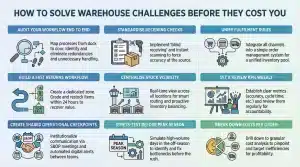
Identifying the challenges is only half the battle. The solution lies in implementing structured workflows, leveraging technology, and fostering a culture of continuous improvement.
1. Audit your current warehouse workflow end to end
Before implementing any new technology or hiring more staff, you must understand your current reality. Conduct a comprehensive audit of your warehouse workflow, from the moment a truck hits the dock to the moment a package leaves. Walk the floor and observe the physical movement of goods and people.
Map out the process flow and look for redundancies. Are items being handled more times than necessary? Are pickers crossing paths or backtracking frequently? Is the fast-moving inventory located near the shipping area, or is it buried in the back? This physical audit often reveals “low-hanging fruit”—simple layout changes or process tweaks that cost nothing but save significant time. For a deeper dive into optimizing your layout and flow, reviewing the fundamentals of warehouse setup is a critical first step.
2. Standardise receiving checks before stock enters the system
To stop errors at the source, you must fortify the receiving process. Implement a standardized checklist for all inbound shipments. This should include verifying the seal integrity, checking for external damage, and counting quantities against the purchase order—not the packing slip.
Consider implementing “blind receiving,” where the receiving staff is not given the expected quantity. They must count the items and enter the number into the system. If it matches the PO, the stock is accepted. If not, the system flags a discrepancy immediately. This forces accuracy and prevents the “lazy check” where staff simply tick off boxes without counting. Additionally, applying barcodes or RFID tags immediately upon arrival ensures that every subsequent movement of that item can be tracked digitally.
3. Unify fulfilment rules across all sales channels
To handle multi-channel complexity, you need a unified set of fulfillment rules. This involves integrating your sales channels (e-commerce, retail, wholesale) into a single order management system that feeds into your warehouse. This creates a single pool of inventory visibility.
Define logic for inventory allocation. For example, set rules that prioritize certain channels if stock is low, or reserve specific stock buffers for key B2B accounts. Standardize packaging where possible to reduce the number of box sizes pickers need to choose from. By treating inventory as a shared resource with governed rules of access, you eliminate the conflict between channels and maximize the sell-through rate of your stock.
4. Build a returns workflow that updates inventory automatically
Transform your reverse logistics from a cost center into a value recovery process. Create a dedicated zone for returns processing with its own team or specific hours of operation. The goal is speed: items should be processed within 24 hours of arrival.
Equip the returns team with a system that allows them to scan the item and immediately input its condition (Grade A: Resell, Grade B: Discount, Grade C: Recycle). If an item is Grade A, the system should instantly update the inventory count and make it available for sale on the website. This rapid turnaround prevents inventory from dying in the warehouse and recovers revenue that would otherwise be lost.
5. Centralise stock visibility across all locations in one dashboard
If you operate multiple warehouses, you need a control tower view. Implementing a centralized inventory management system allows you to see stock levels across all locations in real-time. This visibility enables “smart routing,” where orders are automatically assigned to the warehouse that can fulfill them most efficiently.
It also facilitates inventory balancing. If data shows that winter clothing is selling fast in one region but stagnating in another, you can proactively transfer stock to where the demand is. This reduces the need for heavy discounting later and ensures that your capital is invested in stock that actually moves.
6. Set warehouse KPIs and review them weekly
Establish a set of clear, measurable KPIs that align with your business goals. Common essential metrics include:
- Order Accuracy Rate: Percentage of orders shipped without error.
- Order Cycle Time: Time elapsed from order placement to shipment.
- Inventory Accuracy: Match between physical count and system data.
- Space Utilization: Percentage of warehouse capacity used.
However, setting them is not enough. You must review them weekly with your team. Post the results on a whiteboard or digital dashboard in the warehouse. Celebrate improvements and investigate declines. This creates a culture of accountability and performance.
7. Create shared operational checkpoints between departments
Break down silos by institutionalizing communication. Implement Sales and Operations Planning (S&OP) meetings where warehouse leaders meet with sales and procurement teams. These meetings should focus on upcoming demand, promotional calendars, and supplier constraints.
Create digital checkpoints as well. For instance, the sales system should not allow an order to be placed if the inventory system shows zero stock (unless backordering is explicitly enabled). Procurement should receive automated alerts from the warehouse when stock reaches reorder points. By automating these handshakes, you reduce the reliance on manual communication and minimize friction.
8. Stress-test your process before peak season, not during
Do not wait for the 11.11 or Christmas rush to find out if your processes are scalable. Conduct “stress tests” during quieter periods. Simulate a high-volume day by artificially increasing the order flow in your test environment or running a physical drill.
Identify where the bottlenecks occur. Does the packing area run out of space? Do the scanners lag? Is there a traffic jam at the loading dock? Use these insights to refine your layout and staffing plans. Scalability is built in the off-season. If you anticipate volume that exceeds your physical capacity, this is the time to secure third-party logistics partners or temporary storage.
9. Break down warehouse costs per order to find the real leaks
Move beyond looking at total monthly costs. Drill down to the “cost per order” or “cost per line item.” This granular analysis reveals the true efficiency of your operation. If your cost per order is increasing while your volume is stable, you have an efficiency problem.
Analyze the components of that cost. Is it labor? Is it packaging? Is it shipping surcharges? Once you identify the specific cost driver, you can target it. For example, if labor costs are high, look at travel time—are pickers walking too far? If packaging costs are high, are you using boxes that are too big for the items? This financial discipline ensures that your warehouse contributes to profitability, not just revenue.
Where Businesses Have to face Warehouse Management Challenges
Even with the right tools, businesses often fail because of their mindset. The philosophy behind how you view your warehouse dictates how you manage it.
1. Treating the warehouse as a cost centre instead of a performance driver
The biggest strategic mistake is viewing warehousing solely as an expense to be minimized. When you cut costs indiscriminately—reducing staff, delaying maintenance, buying cheap equipment—you degrade performance. A warehouse is a performance driver. Faster, more accurate fulfillment leads to higher customer retention and lifetime value. Investing in efficiency usually pays for itself through increased throughput and customer satisfaction.
2. Automating before standardising
There is a temptation to jump straight to robotics and high-end automation to solve efficiency problems. However, automating a bad process just makes you mess up faster. If your underlying workflows are chaotic, automation will only amplify that chaos. You must standardize your processes—clean up the data, optimize the layout, define the workflows—before you introduce automation. HashMicro often advises clients that technology is an accelerator, not a magic wand that fixes broken logic.
3. Scaling without fixing the process first
Growth masks many inefficiencies. When revenue is pouring in, it’s easy to ignore the fact that the warehouse is chaotic. But as mentioned earlier, processes that work at small scale break at large scale. Businesses often try to “muscle through” growth by hiring more people, which eventually leads to diminishing returns and a bloated payroll. The correct approach is to refine the process for scalability first, ensuring that the foundation is solid enough to support the weight of the expansion.

Conclusion
Warehouse management in Malaysia is shifting from a traditional, manual function to a sophisticated, data-driven operation. The challenges of data silos, inventory accuracy, and multi-channel fulfillment are significant, but they are solvable. By auditing workflows, enforcing strict inbound and outbound processes, and leveraging centralized visibility, businesses can transform their warehouses into engines of growth.
The key is to stop viewing these challenges as isolated incidents and start seeing them as symptoms of a systemic need for better management. Whether it is through better layout planning, rigorous KPI tracking, or integrated software solutions, the path to efficiency requires deliberate action. In 2026 and beyond, the businesses that win will be those that can move products faster, cheaper, and more accurately than the competition.
FAQ About Warehouse Management
-
What are the most common warehouse management mistakes?
The most common mistakes include relying on manual data entry which causes silos, failing to standardize receiving processes leading to inventory errors, lacking clear KPIs to measure performance, and treating the warehouse as a cost center rather than a strategic asset.
-
How can I improve warehouse efficiency in Malaysia?
To improve efficiency, start by auditing your current layout and workflows. Implement a standardized receiving process, use a centralized system to unify inventory data across all sales channels, and set specific KPIs like order accuracy and cycle time to track and improve performance.
-
Why is reverse logistics important for warehouse management?
Reverse logistics (returns management) is crucial because inefficient handling of returns leads to inventory tying up space, loss of value in seasonal goods, and poor customer experience. A streamlined process recovers value quickly and keeps inventory data accurate.
-
When should a business consider automating warehouse operations?
Businesses should consider automation only after they have standardized their manual processes and optimized their workflows. Automation is best used to scale efficient processes, not to fix broken ones. It is typically viable when order volume exceeds the capacity of manual handling without significantly increasing error rates.