


When production keeps moving but margins still feel tighter than expected, the real issue often sits in one place: no one has a clear view of how much each unit actually costs to make. Material usage shifts, overtime builds up, and overhead keeps accumulating, but without accurate tracking, those cost movements stay hidden until they start affecting pricing, profit, and day to day decisions.
That pressure is not theoretical. In Malaysia, the Federation of Malaysian Manufacturers said nearly half of manufacturers expected operating expenses to rise by 5% to 10% in 2025 because of higher wage related costs. When cost pressure is already rising, tracking production cost per unit becomes much more than a reporting exercise. It becomes a management tool for protecting margins, spotting leakage earlier, and deciding faster when pricing, production, or supplier costs start moving in the wrong direction.
This article breaks down what makes production cost per unit difficult to track, where manual costing usually falls short, and how a more connected system can give you better control over the numbers behind every unit produced. If cost visibility still feels fragmented across purchasing, production, and finance, this guide will help you see why that gap matters commercially and what stronger cost visibility allows management to do with more confidence.
Key Takeaways
|
When cost data is still slow to capture and harder to trust, production decisions become much more difficult to control. A more connected manufacturing system helps turn cost visibility into faster action before margin pressure gets worse.
Why Cost Per Unit Matters More When Margins Tighten
When margins tighten, production cost per unit becomes one of the clearest indicators of whether a product is still worth producing, repricing, or scaling. If this number is inaccurate, the business can keep pushing volume while actual profit continues to shrink. That is where manufacturers start making the wrong decisions, not because demand is weak, but because the real cost behind each unit is still unclear.
Higher output does not guarantee better margins
Higher output can look positive on paper, but it does not automatically improve margins. When scrap, overtime, utility usage, or rework increase along with production, volume can rise while profitability quietly weakens. Without accurate cost tracking, management may keep approving higher output that looks operationally strong but is already becoming commercially weaker.
Cost efficiency starts with better visibility
Better cost visibility helps teams track material, labor, and overhead more accurately for each unit produced. It also gives management a clearer basis for evaluating which work centers, product lines, or process changes are actually improving efficiency and which ones are only adding more cost without protecting margin.

Where Margin Leakage Starts
Margin leakage often starts from small cost shifts like scrap, rework, overtime, or excess material usage. Because these issues build quietly while production still looks stable, the impact is often only noticed after profit has already come under pressure.
Small cost shifts often go unnoticed at first
Margin leakage usually does not start from one major mistake. It often begins with smaller cost movements that seem manageable at first, such as rising scrap, repeated rework, overtime dependency, or material usage that slowly moves above expectation. Because these shifts build gradually, they are easy to miss while production is still running and output still looks stable on the surface.
The damage often appears too late in financial reports
The bigger problem is that these cost movements are rarely visible early enough for management to respond. By the time the impact shows up in margin reports or monthly financial reviews, the business may already be absorbing weaker profit across several orders, product lines, or customer accounts. That is why stronger cost visibility matters, because management needs to see where margin starts weakening before the damage becomes harder to reverse.
What Makes Production Cost Per Unit Hard to Track
Tracking production cost per unit sounds simple on paper, but it becomes much harder when material, labor, and overhead data come from different places. In many factories, each cost component is recorded by a different team, updated at a different time, and reviewed in a different format. That gap makes it difficult to see the real unit cost while production is still running.
The problem gets worse when procurement holds the latest material prices, while production still works with outdated assumptions on the floor. By the time those numbers are matched, the batch is already finished and the chance to respond has usually passed. Instead of guiding decisions while production is active, cost data ends up explaining the problem after margin has already been lost.
Material, labor, and overhead move separately
Materials are often issued to general storage or production areas instead of being tied directly to a specific work order. That makes it harder to know exactly how much material was used for each unit, especially when waste, substitutions, or rework happen during production.
Labor creates another problem because many factories still rely on manual timesheets or delayed entries. When rework time, idle hours, or shift differences are not recorded properly, labor cost per unit becomes much less reliable.
The same issue applies to production overhead costs. Allocating machine usage, utilities, and indirect production expenses fairly takes a consistent method, and that is difficult to maintain when the process still depends on manual tracking. As a result, management may believe certain products are still profitable when they are actually being supported by cost allocations that no longer reflect reality.
Cost data updates too slowly
Even when all cost components are recorded, the timing often creates another problem. Material prices may be updated after the stock has already been used, while overhead figures are often only finalized during monthly closing. That delay leaves teams working with numbers that no longer reflect what is happening in production.
When cost data moves too slowly, decisions also slow down. A manufacturer may continue quoting or producing based on old assumptions, even when input costs have already shifted. By the time the updated numbers appear, the margin loss has already happened and the room to adjust is much smaller.
This is why slow cost visibility creates a reactive way of working. Instead of identifying margin pressure early, management is forced to wait until the financial impact becomes visible in closing reports.
Where Manual Cost Tracking Usually Falls Short

Manual cost tracking often looks manageable at first, but it becomes unreliable once production data starts moving faster than spreadsheets can handle. Purchase records, usage logs, and costing updates may all exist, but when they sit in separate files, the real cost per unit becomes harder to track accurately.
What looks like a reporting issue often becomes a business issue, because weak cost visibility leads to slower pricing decisions, weaker margin control, and delayed response when costs begin to shift.
Spreadsheet based costing lags behind production
Spreadsheets are still common, but they are too slow for production environments where costs can shift every day. Formula errors, duplicate versions, and delayed updates make it harder to trust the numbers, especially when product variants keep increasing. For management, that means cost review becomes backward looking, when what is actually needed is earlier visibility before pricing or production decisions are locked in.
Disconnected data hides real cost movement
Manual tracking also makes it harder to catch supplier price changes, scrap spikes, or production inefficiencies at the right time. This is where an integrated manufacturing ERP system becomes more useful, because operational and financial data can move together in one view. When cost movements are visible sooner, management has more room to adjust pricing, review product profitability, or intervene before leakage spreads further.
When Growth Starts Exposing Weak Cost Control
Cost control often looks manageable when production volume is still relatively stable and product complexity is limited. The pressure usually starts to show when output grows, more orders need to be handled at once, and cost movements become harder to monitor with the same level of accuracy. At that point, weak cost control stops being a reporting issue and starts becoming a business risk.
More volume creates more room for cost leakage
As production grows, cost leakage becomes easier to miss because scrap, overtime, rework, and indirect costs start increasing across more batches at the same time. Without stronger visibility, the business may continue scaling output while margin control becomes weaker underneath.
Growth is harder to manage without reliable cost visibility
When cost data is delayed or fragmented, management has less confidence in which products are still profitable, which orders deserve more capacity, and where efficiency is actually improving. This is why growth often exposes weak cost control faster, because the business needs stronger visibility to scale without losing control over margins.
What Manufacturing ERP Helps You Capture
A manufacturing ERP helps bring material, labor, and financial data into one connected view. Instead of relying on separate updates from different teams, manufacturers can track unit cost based on what is actually happening on the shop floor. This gives management a stronger basis for pricing, planning, and margin review because the numbers reflect current production conditions rather than delayed reconciliations.
Material consumption by order or batch
ERP systems can link material usage directly to a specific order or batch, making unit cost tracking more precise. If usage goes above the planned material structure, the variance can be seen earlier and reviewed before it affects margin further. That visibility is especially useful when management needs to know which batches are still efficient, which ones are absorbing too much material, and where waste is starting to weaken profit.
Work in progress and production activity
ERP systems also help track work in progress by recording material and labor activity throughout production. This makes it easier to see how much cost is building up in each order, especially when production runs across several stages or over a longer period. For management, this makes it easier to review whether production is still moving in line with expected cost, inventory value, and cash flow exposure.
Standard vs actual cost
Comparing standard cost with actual production cost helps teams see where efficiency starts to slip. When the gap is visible early, it becomes easier to trace whether the issue comes from downtime, rework, or higher labor usage. This matters because management can respond before cost overruns become recurring margin problems or start affecting pricing accuracy.
Better visibility over material usage, WIP, and cost variance gives management a clearer basis for protecting margin before the impact gets harder to control.

ERP Features That Support Better Cost Control

How Better Cost Tracking Improves Decisions
FAQ About Production Cost Per Unit
-
Why is production cost per unit important for manufacturers?
Production cost per unit matters because it shows whether a product is still protecting margin, whether pricing is still realistic, and whether higher output is actually worth scaling. When this number is unclear, management can keep pushing volume while real profitability continues to weaken underneath.
-
What makes production cost per unit difficult to track accurately?
It usually becomes difficult when material, labor, overhead, and financial data are recorded in separate systems or updated at different times. That gap makes it harder to see real profitability by product, batch, or order while production is still running, which delays response and weakens cost control.
-
How can a manufacturing ERP system improve cost visibility?
A manufacturing ERP system improves cost visibility by connecting production activity and financial data in one flow. This makes it easier to track material usage, compare standard and actual costs, review variances earlier, and reduce delays caused by manual reconciliation.
-
How does better cost visibility help management protect margins?
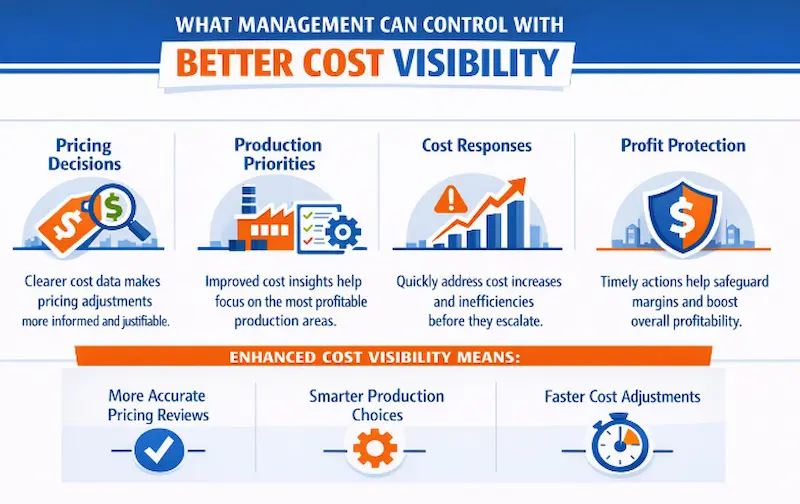
Better cost visibility helps management respond faster when costs begin to shift. It supports earlier pricing review, stronger control over waste and inefficiency, and better decisions on which products, orders, or production priorities still make commercial sense.