









Key Takeaways
|
What Are Manufacturing Operations?
The 5 Core Components of Manufacturing Operations
Effective manufacturing operations rely on five connected components that keep production stable, efficient, and profitable. When these pillars work together, leaders gain better control over cost, quality, and delivery performance.
- Supply chain management
Supply chain management keeps materials moving smoothly from suppliers to the factory and onward to customers. It focuses on reliable sourcing, risk mitigation, and logistics coordination so production avoids delays and shortages. - Production planning and control
Production planning and control turn demand into a workable schedule for machines, labor, and materials. It also monitors execution and adjusts quickly when disruptions happen to keep output on track. - Quality management
Quality management ensures products meet standards consistently by preventing manufacturing defect, not just catching them at the end. It uses clear benchmarks, inspections, and in-process controls to reduce rework and protect customer trust. - Maintenance management
Maintenance management prevents unplanned downtime by keeping equipment in optimal condition. Through preventive and predictive routines, it improves uptime, safety, and asset lifespan while lowering repair costs. - Inventory management
Inventory management balances raw materials, WIP, and finished goods so operations run without tying up too much cash in stock. With real-time tracking and improved forecasting, it reduces the risk of overstock and supports faster fulfillment.
Common Types of Manufacturing Processes
Manufacturing processes vary based on product complexity, volume, and the level of customization customers expect. Choosing the right model shapes your workflow, costs, and your ability to respond to changes in demand.
- Repetitive manufacturing
Repetitive manufacturing produces standardized products in high volumes using a consistent, continuous workflow. A typical example is an automotive assembly line making the same vehicle model at scale. - Discrete manufacturing
Discrete manufacturing makes countable, individual products and supports more variation through planned changeovers. Examples include producing smartphones, appliances, or furniture with different models on the same line. - Job shop manufacturing
Job shop manufacturing focuses on low-volume, high-mix production where each order follows a unique routing across specialized workstations. Examples include custom machine parts, specialized aerospace components, or made-to-order fabrication projects. - Process manufacturing (continuous & batch)
Process manufacturing creates goods by mixing or transforming ingredients according to a formula, resulting in products that can’t be separated into their original components. Examples include continuous oil refining or batch production of paint, beverages, and pharmaceuticals.
Challenges in Managing Manufacturing Operations
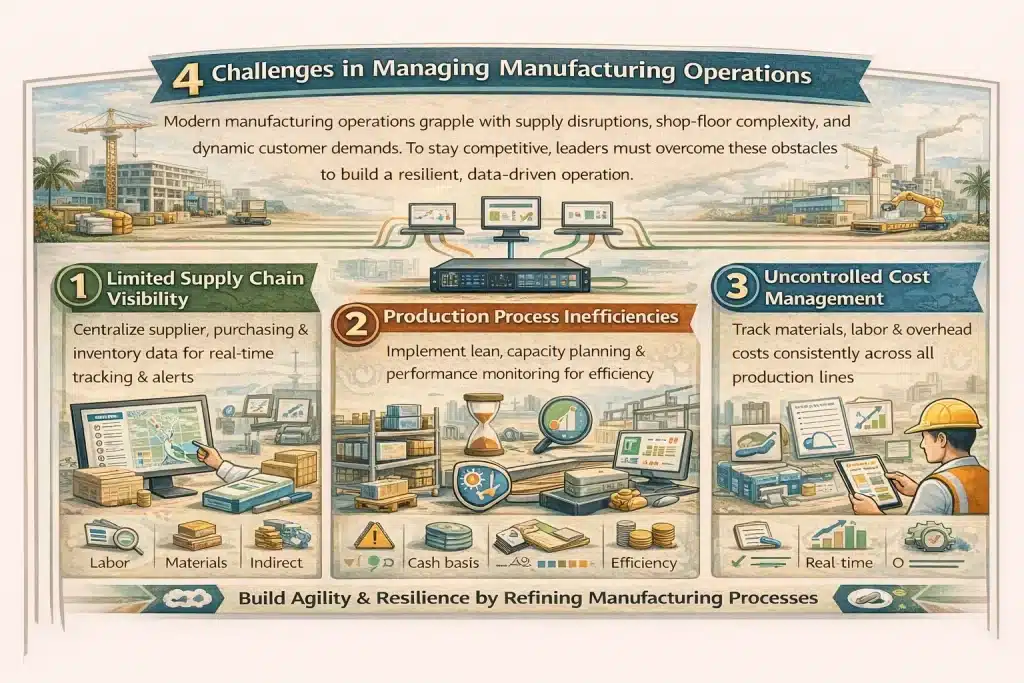
Modern manufacturing operations face constant disruption from supply networks, shop-floor complexity, and fast-changing customer expectations. To stay competitive, leaders need a resilient operating model supported by real-time data and disciplined execution.
- Limited supply chain visibility
When supply chain visibility is limited, teams can’t track materials, predict delays, or respond quickly to disruptions. Fix it by centralizing supplier, purchasing, and inventory data in one system with real-time tracking and exception alerts. - Production process inefficiencies
Process inefficiencies like bottlenecks, downtime, and waste slow output and inflate the cost per unit. Reduce them with lean standard work, capacity planning, and performance monitoring that highlights constraints early. - Uncontrolled cost management
Uncontrolled costs happen when materials, labor, and overhead aren’t tracked consistently across jobs, lines, or orders. Improve control with real-time costing, variance analysis, and tighter approval workflows linked to production and procurement. - Maintaining consistent product quality
Quality inconsistency occurs when variation in materials, methods, or machine conditions creates defects and rework. Strengthen quality by setting clear standards, using in-process checks, and tying corrective actions to root-cause analysis. - Adapting to market demand changes
Demand shifts pose a significant challenge when scheduling and resources are too rigid to scale up or quickly change product mix. Build agility with better forecasting, flexible scheduling, and faster changeovers supported by accurate inventory and capacity data.
Effective Strategies to Optimize Manufacturing Operations
Optimization starts by removing friction from daily execution, not by forcing teams to work faster. The biggest gains come from combining proven methods with technology that makes performance visible and controllable.
- Implement lean manufacturing principles
Lean manufacturing focuses on removing waste across people, materials, and time so every step adds value. Tools like 5S, Kanban, and Kaizen help standardize work, reduce delays, and improve flow. - Adopt automation and Industry 4.0 technologies
Automation improves speed and consistency by reducing manual effort and human error in repetitive tasks. Industry 4.0 adds real-time machine data and connected systems, enabling you to monitor performance and act before issues escalate. - Utilize data analytics for decision-making
Data analytics turns production signals into insights you can use to fix bottlenecks, reduce defects, and improve scheduling. With real-time dashboards and trend analysis, leaders shift from reactive firefighting to proactive control. - Build a solid quality management system
A strong quality management system prevents defects by embedding checks and standards throughout the process. Approaches like Six Sigma and TQM reduce variation, minimize rework, and protect customer trust. - Integrate all processes with a centralized system
A centralized system connects planning, inventory, production, and finance, so teams work from one source of truth. This alignment improves coordination, shortens response time, and makes optimization efforts stick.
Essential KPIs for Manufacturing Operations
KPIs help leaders spot what’s working and what’s slowing performance before issues become expensive. When tracked consistently, these metrics turn optimization into a repeatable, data-driven routine.
- Overall Equipment Effectiveness (OEE)
OEE measures how effectively equipment is used by combining availability, performance, and quality into one score. It helps you pinpoint whether losses come from downtime, slow running, or defects, so improvements are targeted. - Cycle Time
Cycle time is the end-to-end time needed to produce one unit from start to finish. Lower cycle time increases throughput and highlights bottlenecks that limit output and delay delivery. - First Pass Yield (FPY)
FPY tracks the percentage of units made correctly the first time without rework or scrap. Improving FPY reduces waste, stabilizes processes, and lowers the true cost of quality problems. - On-Time Delivery (OTD)
OTD measures how often orders ship by the promised date. It reflects how well planning, production, and logistics stay aligned, and it’s a key driver of customer trust. - Inventory Turnover
Inventory turnover shows how often inventory is sold and replenished within a period. A healthy turnover improves cash flow and signals better demand planning and stock control.
Case Study: Manufacturing Operations Challenges and Digital Transformation in Malaysia
A mid-sized manufacturing company in Penang struggled with frequent production delays and quality inconsistencies due to fragmented manual processes and poor visibility across departments, causing missed delivery deadlines and increased operational costs. Without real-time tracking of inventory, work orders, and production schedules, managers couldn’t accurately forecast resource needs or identify bottlenecks in operations, weakening competitiveness in Malaysia’s dynamic industrial sector.
To overcome these issues, the company adopted a digital manufacturing operations solution that automated production planning, inventory management, quality control, and reporting into a unified platform. By integrating these functions into a single system, the firm improved efficiency, reduced waste, and gained real-time insights that supported faster decision-making and tighter control over operational performance.
Following this transformation, leadership began exploring pricing schemes and scalable software packages that could align with both current operational needs and future growth plans, ensuring the chosen system would remain cost-effective and adaptable as production demands increased.

Conclusion
Manufacturing operations excellence is achieved through lean execution, clear KPIs, and disciplined shop floor workflows. When processes are standardized and supported by real-time data, production becomes more efficient, consistent, and easier to optimize.
An integrated manufacturing system connects planning, inventory, production, and quality control within a single platform. With improved visibility and coordination, businesses can reduce waste, prevent bottlenecks, and align output more accurately with market demand.
By combining structured operational practices with the right digital tools, manufacturers can drive measurable and sustainable improvements. To explore how this approach can support your factory goals, consider consulting with a specialist to evaluate the best system setup for your operations.
FAQ About Manufacturing Operations
-
What is the main difference between manufacturing operations and production management?
Manufacturing operations is a broader term that covers the entire process from raw material procurement to finished goods delivery, including supply chain and maintenance. Production management is a subset of this, focusing specifically on the processes happening on the factory floor to convert materials into products.
-
How can a small factory start implementing lean manufacturing?
A small factory can start with the 5S methodology: Sort, Set in Order, Shine, Standardize, and Sustain. This is a low-cost, high-impact way to organize the workplace, reduce waste, and build a foundation for other lean principles.
-
Which KPI is the most important for a manufacturing company to track first?
For a company just starting to track performance, Overall Equipment Effectiveness (OEE) is often the most impactful. It provides a holistic view of availability, performance, and quality, quickly highlighting the biggest areas of loss in the production process.