








Inventory hedging is a strategy businesses use to manage the impact of price swings and supply uncertainty on their stock. Rather than simply storing extra goods, it focuses on planning inventory levels to stay stable when the market shifts.
When applied thoughtfully, this approach helps companies maintain cost control, protect margins, and keep operations running smoothly. It turns inventory from a passive asset into a tool for financial and operational resilience.
In practice, though, figuring out the right timing and quantity isn’t always straightforward, especially when demand and supply conditions keep changing. How do businesses make smart calls without tying up too much capital or risking shortages? Let’s explore how inventory hedging works, why it matters, and the key points to consider when managing it well.
Key Takeaways
|
What Is Inventory Hedging?
Inventory hedging is a strategic practice of buying and storing more inventory than is currently needed to protect a business from the risks of future price hikes or potential supply shortages.
This strategy serves as insurance against market volatility, allowing a company to lock in purchase prices at lower rates and ensure the availability of raw materials or finished goods to maintain smooth production and sales.
It is essential to distinguish inventory hedging from simple overstocking. While overstocking often results from forecasting errors, inventory hedging is a deliberate decision based on thorough analysis and prediction of future market conditions, such as anticipating inflation, geopolitical issues that could disrupt logistics, or changes in trade policies.
Why Is Hedging Important for Business Stability?Inventory
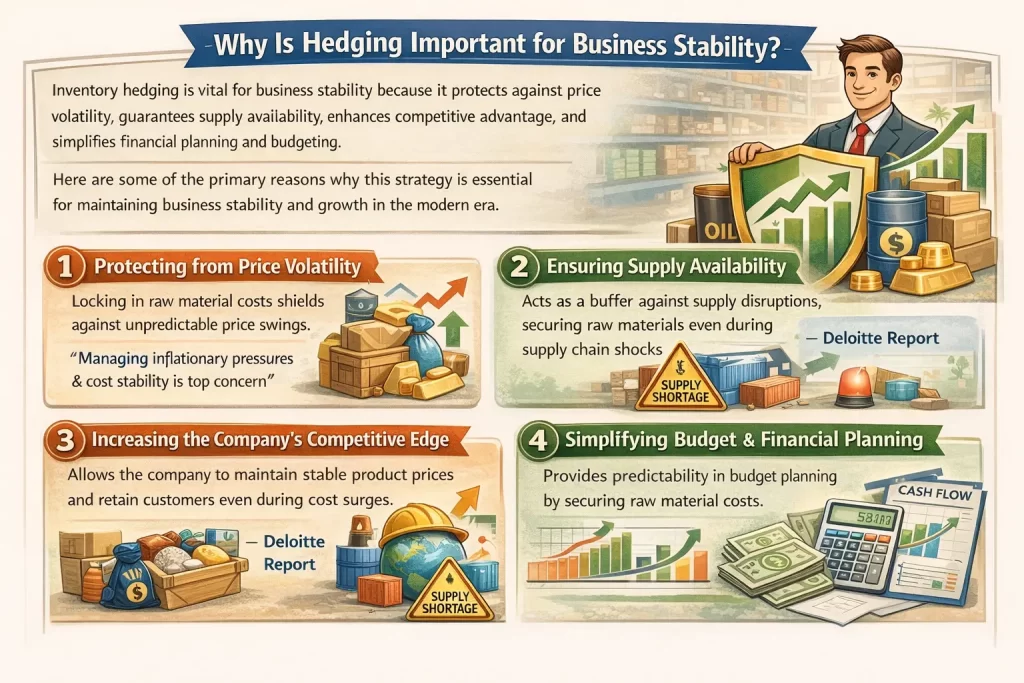
Inventory hedging is vital for business stability because it protects against price volatility, guarantees supply availability, enhances competitive advantage, and simplifies financial planning and budgeting.
Here are some of the primary reasons why this strategy is essential for maintaining business stability and growth in the modern era.
1. Protecting from price volatility
The most fundamental benefit of inventory hedging is its ability to shield a company from wild and unpredictable price fluctuations. By purchasing raw materials or components in large quantities when prices are low or stable, a company can effectively lock in its production costs for an extended period.
According to a report by Deloitte, managing inflationary pressures is a top concern for executives, and cost stability is a key defense mechanism.
2. Ensuring supply availability
Disruptions in the supply chain, whether caused by natural disasters, geopolitical conflicts, pandemics, or logistical issues, can lead to critical shortages of raw materials and halt entire production processes. Inventory hedging acts as a buffer, ensuring supply availability is maintained even when the global supply chain experiences shocks.
3. Increasing the company’s competitive edge
When raw material costs rise sharply, many companies are forced to increase the selling prices of their products, which can potentially reduce demand and lead to customer loss. A company that has implemented inventory hedging has an advantage because it can maintain more stable, competitive selling prices for a longer period.
4. Simplifying budget and financial planning
One of the biggest challenges in financial management is the uncertainty of future operational costs. Inventory hedging provides greater predictability in budget planning because the cost of a significant portion of raw materials is already known and secured. This stability allows the finance team to create more accurate cash flow projections, profit and loss statements, and working capital requirements.
Types and Strategies of Effective Inventory Hedging
Effective inventory hedging strategies include physical hedging (stockpiling), financial hedging through instruments like futures contracts, negotiating long-term supplier contracts, and diversifying the supply base.
Here are some of the most common inventory hedging strategies used by businesses to manage price and supply risks.
1. Physical hedging
This is the most common and straightforward form of inventory hedging, in which a company directly purchases and stores physical stock in quantities exceeding its everyday needs. This strategy is highly effective for protecting against supply shortages and short to medium-term price increases.
For example, companies can leverage a demand stock forecasting feature within their ERP system to analyze purchasing trends and supplier lead times. By using automated replenishment settings and real-time inventory tracking, businesses can determine the right quantity to hedge while keeping carrying costs under control.
2. Financial hedging
This strategy does not involve storing physical stock but instead uses financial instruments to lock in the future prices of commodities or raw materials. Standard methods include futures contracts, forward contracts, or options.
3. Long-term contract strategy
This method involves negotiating and signing long-term purchase contracts with suppliers at a predetermined price. With such a contract, a company can secure its supply and pricing for a specific period, such as one to three years, thereby protecting it from short-term market volatility.
4. Supplier and geographic diversification
While not a direct form of price hedging, supplier diversification is a highly effective hedging strategy against supply disruption risks. By having multiple suppliers located in different geographic regions, a company can reduce its dependency on a single source.
Challenges and Risks in Implementing Inventory Hedging
The primary challenges of inventory hedging include high storage and insurance costs, the risk of product obsolescence or damage, significant capital tied up in stock, and inaccurate market forecasting, which can lead to losses.
Here are some of the main challenges and risks to be aware of when implementing inventory hedging.
1. High holding costs
The most tangible risk of physical hedging is the increase in storage or holding costs. These costs include warehouse rent, insurance, utility bills (such as electricity for refrigeration), labour costs for inventory management, and security expenses.
2. Risk of product obsolescence or damage
Storing products for long periods increases the risk that they will become obsolete, especially for items related to rapidly changing technology or fashion trends. In addition, products with a limited shelf life, such as food ingredients or chemicals, are at risk of quality degradation or even expiring before they can be used.
3. Tied-up working capital
Inventory hedging significantly ties up a company’s working capital in non-liquid inventory. The funds used to purchase hedge stock cannot be used for other potentially more productive investments, such as new product development, market expansion, or technological innovation.
4. Inaccurate market forecasting
The success of any inventory hedging strategy, whether physical or financial, heavily relies on the accuracy of forecasting future price and demand trends. If a company hedges in anticipation of a price increase, but the price instead drops drastically, the company will be stuck with stock purchased at a higher price than the current market rate.
Study Case: Inventory Hedging Strengthens Supply Chain Resilience for a Regional Manufacturer
A mid-sized manufacturer in Southeast Asia faced frequent production interruptions and rising material costs due to volatile raw material prices and periodic supply delays. Without a structured strategy to anticipate cost fluctuations or secure consistent material supply, the company often scrambled to replenish inventory reactively, which increased procurement spend and disrupted production schedules.
To address these issues, the company adopted an inventory hedging strategy based on market trend analysis and internal forecasting. By purchasing key raw materials in larger quantities during periods of stable pricing and storing them strategically, the business reduced its exposure to sudden cost spikes and minimized the risk of material shortages. This deliberate accumulation of controlled stock provided a buffer against both price volatility and supply disruptions, improving planning accuracy and production continuity.
The implementation also included clear guidelines on how much hedge stock to hold based on demand forecasts and historical cost patterns. Over time, this proactive approach lowered overall inventory costs compared to reactive buying during price surges and enhanced financial planning by making future expenses more predictable. The strategy helped stabilize operations, improve budget forecasting, and maintain competitive pricing—even when market conditions were turbulent.
Conclusion
FAQ About Inventory Hedging
-
What is the difference between safety stock and inventory hedging?
While both involve holding extra stock, their purposes differ. A safety stock protects against normal demand and lead-time variability. In contrast, inventory hedging is a proactive strategy to guard against larger, predictable market events like inflation or major supply chain disruptions.
-
When is the best time to implement an inventory hedging strategy?
The best time is when you have strong data indicating potential future price hikes or supply shortages. This could be based on market trend reports, inflation forecasts, or geopolitical risk analysis. Implementation should occur before the event to maximise benefits.
-
Can small businesses apply inventory hedging?
Yes, small businesses can apply inventory hedging on a smaller scale. Strategies such as negotiating long-term contracts with local suppliers or making slightly larger purchases before seasonal price increases can be very effective, provided a careful cost-benefit analysis is conducted.