




Key Takeaways
|
Understanding Malaysia’s Mandatory E-Invoicing Landscape
According to LHDN, an e-invoice is a digital record of a seller-buyer transaction issued, transmitted, and validated via the MyInvois portal or API. It must include mandatory data fields and, once validated, receive a Unique Identifier Number as the legally recognized proof of transaction.
Compliance is crucial because MyInvois enables real-time reporting and validation, strengthening tax oversight and reducing underreporting. For businesses, it also supports cleaner audit trails and helps avoid penalties that can disrupt cash flow and operations.
This regulation affects taxpayers involved in B2B, B2C, and B2G transactions across Malaysia. It rolls out in phases by annual revenue, but ultimately applies to businesses of all sizes, including MSMEs.
The Direct Financial Risks of E-Invoice Non-Compliance
One of the most tangible and alarming consequences of e-invoice non-compliance is the direct financial impact on a company’s cash flow and profitability. Here is a detailed breakdown of the primary financial risks that every company must be aware of to safeguard its financial health.
- Heavy fines under the Income Tax Act 1967
Under Sections 112 and 113 of the Income Tax Act 1967, failing to issue an e-invoice to the required standards is a serious offense, with fines from RM200 to RM20,000. Because penalties may apply per offense, multiple missed invoices can quickly lead to significant cumulative fines. - Potential imprisonment for serious offenses
Severe violations, such as e-invoice forgery or deliberate data manipulation, can trigger the harshest penalties, including up to six months’ imprisonment for responsible parties, such as directors. This creates direct personal liability for leadership, making end-to-end compliance and strong internal controls non-negotiable. - Loss of input tax credit claims
A significant hidden risk is losing the ability to claim input tax credits, since valid proof of purchase is now an LHDN-validated e-invoice. If a supplier’s e-invoice is missing or invalid, you can’t offset output tax, which quietly raises costs and erodes margins. - Increased audit and investigation costs
Non-compliance can put your company on LHDN’s high-surveillance radar, increasing the likelihood of more frequent and intensive audits. This drives up compliance costs through extra documentation work, internal time, and tax consultant fees that pull resources away from growth.

Operational Risks That Disrupt Business Continuity
Beyond the clear financial and legal penalties, the most immediate risks of e-invoice non-compliance are disruptions to daily business operations. Here is a detailed look at the operational problems that can arise and threaten your business’s stability.
- Invoice rejection and payment delays
Without LHDN validation, an invoice may be treated as invalid, allowing customers to delay or refuse payment. This stretches billing cycles and can quickly disrupt cash flow and day-to-day liquidity. - Supply chain and vendor relationship disruptions
E-invoicing requires both issuing and receiving valid e-invoices, so non-compliance from your side or your suppliers can stall procurement and accounts payable. Over time, this friction can strain vendor relationships and affect the continuity of materials or services. - Increased manual administrative workload
Without an integrated solution, teams often end up with double entry, manual portal checks, and constant error fixes for each transaction. This drains productivity and raises the risk of mistakes that create even more compliance issues. - Difficulties in financial data reconciliation
If your internal records don’t match what’s validated on MyInvois, monthly and quarterly reconciliation becomes slow and error-prone. These mismatches also increase audit risk and can invite deeper scrutiny from LHDN. A robust e-invoicing implementation in Malaysia is your best defense against this.
Long-Term Legal and Reputational Risks
While fines and operational disruptions are immediate impacts, e-invoice non-compliance also carries long-term risks that can permanently damage the foundation of a business. Here are the legal and reputational risks that need to be seriously considered as part of your compliance strategy.
- Increased scrutiny from LHDN
A history of non-compliance can place your business under closer LHDN monitoring, where returns and transaction patterns face tighter review. This increases the likelihood of deeper checks and keeps leadership stuck in reactive compliance instead of growth. - Reputational damage among clients and partners
E-invoice non-compliance can signal weak governance, making your business look unreliable or poorly managed. Clients and partners may hesitate to commit long-term if they worry that invoicing issues will affect delivery and trust. - Potential for legal disputes with business partners
Invoice rejections and payment delays can escalate into contractual disputes, especially when one party claims losses due to invalid documentation. These cases are costly, time-consuming, and can permanently damage relationships that took years to build.
How to Avoid E-Invoice Compliance Risks?
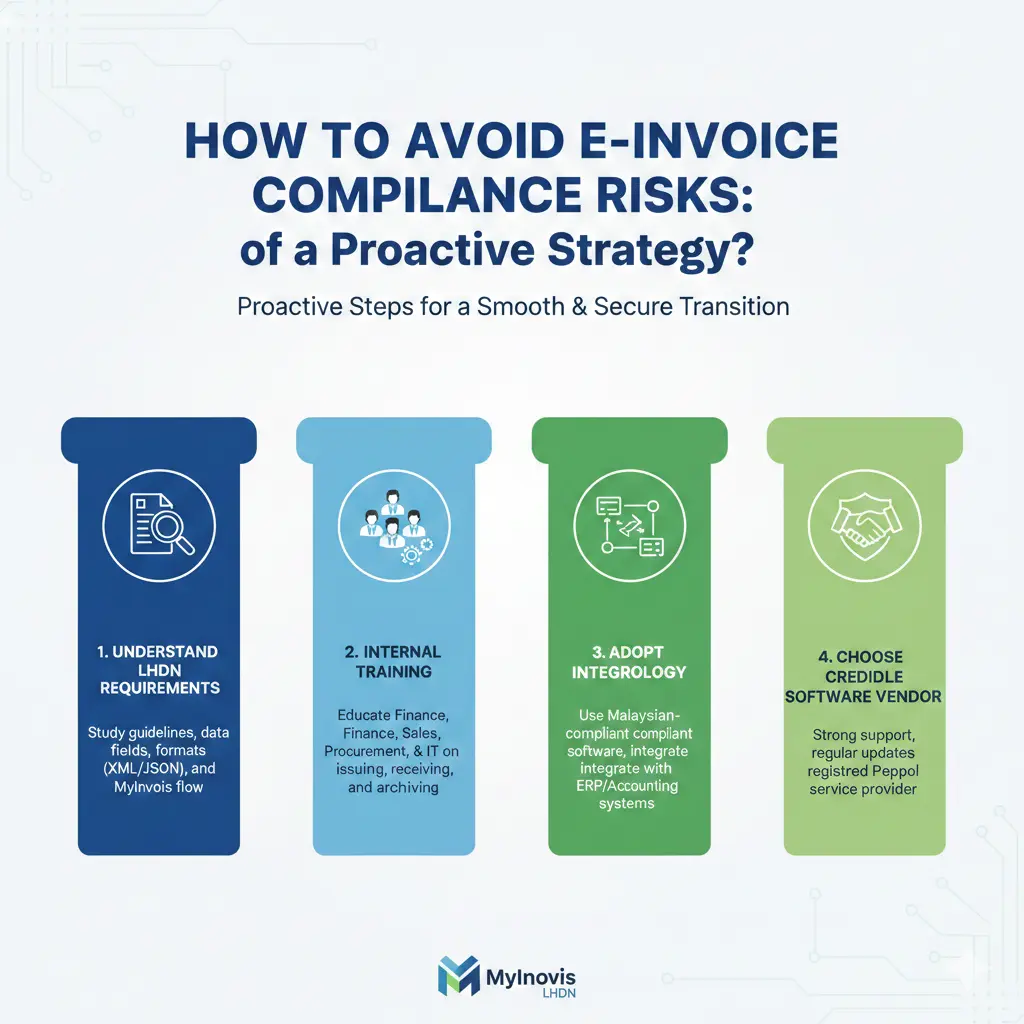
Facing the array of risks involved, a proactive approach is the only way to ensure a smooth and secure transition to e-invoicing. The official LHDN e-invoice portal provides detailed guidelines that should be the basis of your strategy. Here are the key pillars of an effective strategy to mitigate e-invoice compliance risks.
- Deeply understand LHDN requirements
Study LHDN’s official guidelines to understand the mandatory data fields, accepted formats (XML/JSON), and the MyInvois validation flow. Treat this as your baseline to avoid misinterpretation and compliance gaps. - Conduct internal training for relevant teams
Train finance, sales, procurement, and IT on how to issue, receive, archive, and correct e-invoices under the new process. Clear role ownership reduces errors and keeps exception handling consistent. - Adopt the right integrated technology solution
Manual e-invoicing increases risk, so use a solution built for Malaysian requirements and validation rules. Prioritize integration with ERP, accounting, or sales systems to prevent double entry and data mismatches. - Choose a credible e-invoice software provider
Pick a vendor with strong support and a track record of updating features as LHDN rules evolve. Ensure they are a registered Peppol service provider to strengthen security and interoperability.
Case Study: E-Invoice Non-Compliance Impact on a Malaysian SME
A mid-sized trading firm in Johor failed to integrate e-invoicing into its billing process ahead of the mandatory rollout, continuing to issue traditional invoices even after its revenue threshold hit the compliance phase. As a result, its invoices were repeatedly rejected by clients and it faced accumulating fines under Malaysia’s Income Tax Act for each non-compliant transaction, straining the company’s cash flow and damaging its reputation with vendors.
As government enforcement tightened, the business also saw delayed payments and increased audit scrutiny from the Inland Revenue Board, forcing urgent reallocation of internal resources to fix mismatched records and reconcile accounts on the MyInvois portal. These disruptions significantly increased administrative workload and operational costs, slowing down routine processes.
In response, management decided to adopt an e-invoicing automation solution that integrated billing with the MyInvois compliance framework, providing real-time validation and reducing manual errors an effort that later prompted them to evaluate pricing schemes that fit their transaction volume and long-term digital transformation plan.
Conclusion
E-invoicing non-compliance risks in Malaysia can escalate quickly, leading to financial penalties, tax credit complications, invoice rejections, and payment delays. If left unmanaged, these issues can disrupt cash flow, weaken audit readiness, and affect overall business credibility.
A structured e-invoicing system helps automate invoice creation, validation, and tracking within a controlled workflow. With centralized documentation and real-time visibility, businesses can minimize manual errors and maintain stronger alignment with regulatory requirements.
By adopting a more organized and technology-driven approach, companies can ensure a smoother transition to digital compliance without slowing daily operations. To better understand how an integrated system can support your rollout, consider consulting with a specialist to assess your current finance processes and compliance readiness.
FAQ About E-Invoice Risks of Non Compliance
-
What is the main penalty for failing to issue an e-invoice in Malaysia?
The primary penalty is a financial fine under the Income Tax Act 1967, ranging from RM200 to RM20,000 per violation. For more serious offenses, imprisonment of up to three years may also be imposed on the responsible parties.
-
Can I still issue manual or PDF invoices after the mandate takes effect?
No. Once the implementation timeline applies to your company, all transactions must be documented with an e-invoice validated through LHDN’s MyInvois portal. Manual or standard PDF invoices will no longer be considered valid proof of transaction for tax purposes.
-
What happens if my customer rejects an e-invoice I sent?
If the e-invoice has been validated by LHDN, the customer cannot legally reject it as proof of a transaction. However, if there is an error in the invoice details, you must cancel that e-invoice via the MyInvois portal and issue a new, corrected one.
-
Besides fines, what are the hidden costs of e-invoice non-compliance?
Hidden costs include the loss of input tax credit claims, increased audit expenses, time wasted on manual administrative work, potential payment delays from customers, and costs arising from legal disputes with business partners.
-
How does an ERP system assist with e-invoice compliance?
An ERP system helps by automating the entire process. It uses data from sales orders to automatically generate compliant e-invoices, which are then submitted for validation and recorded in the accounting system without manual data entry, ensuring accuracy and efficiency.