










Order picking is the stage of warehouse operations where customer orders are physically collected, and it often consumes the most time and manpower. Because it sits at the heart of fulfillment, even small inefficiencies here can ripple across the entire operation.
One approach that helps streamline this activity is batch picking supported by a Warehouse Management System. By allowing staff to gather items for several orders in one route, it reduces travel time and makes daily workflows far more organized.
Still, many facilities struggle to balance speed, accuracy, and labor use when adopting new picking methods. So how does batch picking actually work in practice, and where does it make the biggest difference? Let’s take a closer look at the concept, its benefits, and what to consider before applying it.
Key Takeaways
|
What Is Batch Picking?
Batch picking is an efficient order fulfillment strategy where a warehouse picker collects items for several orders in one trip instead of handling each one separately, significantly cutting down repetitive travel across the warehouse floor.
This method works best for high-volume operations with many small orders, as it groups similar picks and reduces walking time, which boosts productivity and shortens fulfillment cycles.
By consolidating multiple orders into a single picking run, batch picking minimizes unnecessary movement and accelerates overall order processing, making it especially valuable for e-commerce warehouses looking to increase throughput without adding staff.
Read more: What is Voice Picking? How it Works and Its Benefit
How Does Batch Picking Work in Detail?
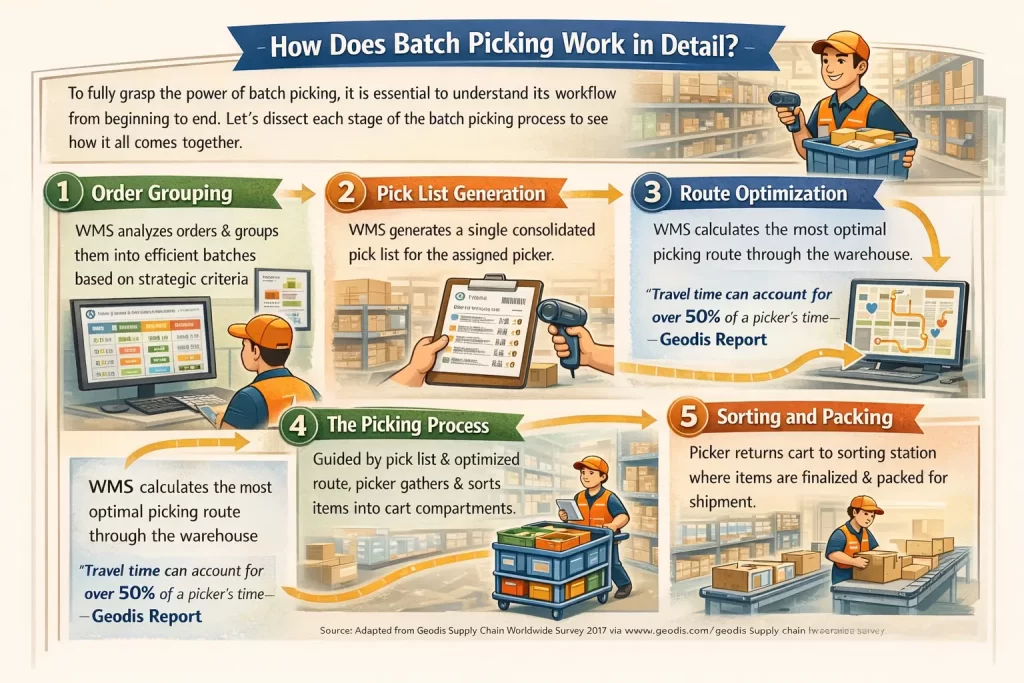
To fully grasp the power of batch picking, it is essential to understand its workflow from beginning to end. Let’s dissect each stage of the batch picking process to see how it all comes together.
1. Order grouping
The process begins when a Warehouse Management System (WMS) automatically analyzes incoming customer orders and groups them into an efficient batch. This grouping is based on a variety of strategic criteria, such as SKU commonality, the proximity of item storage locations, or shipping priority levels.
2. Pick list generation
Once the optimal batch is formed, the WMS generates a single, consolidated pick list for the assigned picker. This digital or paper list contains all the items from every order within the batch, along with the total quantity required for each SKU.
Once all items in the batch have been collected, the picker moves the consolidated goods to the truck bay staging area for packing, sorting, and final dispatch.
3. Route optimization
To maximize efficiency and eliminate wasted movement, the WMS automatically calculates the most optimal picking route through the warehouse. This route is designed to minimize the picker’s travel distance by directing them from one location to the next in a logical, sequential manner.
According to a report by Geodis, travel time can account for over 50% of a picker’s time. Hence, an optimized route significantly reduces walking time, allowing them to focus on the primary task of picking items.
4. The picking process
Guided by the optimized list and route, the picker navigates the warehouse using a cart or tote system with multiple compartments, each designated for a specific order. Upon arriving at an SKU location, the picker retrieves the total quantity needed for the entire batch and immediately distributes the items into the corresponding order compartments.
5. Sorting and packing
After all items in the batch have been collected, the picker returns the cart to a designated sorting or packing station. Here, each completed order within its compartment is verified one last time before being packed for shipment.
Key Benefits of Implementing Batch Picking
Adopting the batch-picking method can significantly improve warehouse operational efficiency. Its benefits extend beyond increased speed, directly reducing costs and enhancing customer satisfaction.
For warehouse managers and business owners, understanding these advantages is crucial for justifying the investment in the necessary technology and process changes required for a successful implementation.
Here are the primary benefits you can expect after successfully implementing this strategy in your facility.
1. Increased travel time efficiency
The most significant advantage of batch picking is the dramatic reduction in picker travel time. By collecting items for multiple orders in a single trip, pickers no longer need to repeatedly walk back and forth to the storage location for different orders. This simple consolidation converts time that was previously wasted on walking into productive time spent actively picking goods, directly boosting overall throughput.
2. Improved picker productivity
As travel time decreases, an individual picker can process a significantly higher number of orders within the same timeframe. This heightened productivity per employee means your facility can fulfill a larger volume of orders without proportionally increasing your headcount.
3. Reduced operational costs
The increase in productivity directly correlates with a decrease in the labor cost per fulfilled order. You can accomplish more with your existing resources, which reduces the need for overtime pay or hiring temporary staff during high-demand periods.
4. Accelerated order fulfillment cycle
By processing multiple orders in parallel, the total time from order receipt to shipment, known as the order cycle time, is significantly reduced. Customers receive their orders faster, which is a key driver of satisfaction and loyalty in today’s competitive e-commerce landscape.
Comparing Batch Picking with Other Picking Methods
Selecting the right picking method depends heavily on the unique characteristics of your warehouse operation, including the number of SKUs, order volume, and the average number of items per order.
This comparison will highlight the scenarios where each method excels, enabling you to assess which one, or combination of techniques, is the best fit for your business needs.
1. Batch picking vs. discrete picking
Discrete picking, also known as single-order picking, is the most basic method in which one picker works on only one order from start to finish. While its simplicity reduces the risk of error, this method is highly inefficient in terms of travel, as the picker must traverse the entire warehouse for each order.
2. Batch picking vs. zone picking
In zone picking, the warehouse is divided into several distinct zones, and each picker is assigned to retrieve items exclusively within their designated area. Orders are then passed from one zone to the next until they are complete, often via a conveyor system. This method is effective for large warehouses with a high SKU count, but can create bottlenecks if orders accumulate in a particular zone.
3. Batch picking vs. wave picking
Wave picking combines elements of both discrete and zone picking, where orders are released for picking in scheduled “waves” at specific times throughout the day. This scheduling helps coordinate the flow of goods between picking and shipping. While wave picking provides a highly structured workflow, batch picking offers more dynamic flexibility.
A Step-by-Step Guide to Implementing Batch Picking in Your Warehouse
Implementing batch picking is more than just changing how pickers retrieve items; it’s a systematic shift that requires careful planning, the right technology, and thorough training. A smooth transition is essential to ensure you can reap the full efficiency benefits without disrupting your ongoing operations.
Each step is designed to minimize risk and maximize the return on your investment in this powerful strategy.
1. Analyze your current warehouse operations
The first step is to conduct a thorough analysis of your current operational data. Identify key metrics, including the average number of orders per day, the average number of items per order, and the distribution of your most frequently ordered SKUs.
2. Choose the right technology (WMS)
An effective batch picking implementation is nearly impossible without a capable Warehouse Management System (WMS). Choose a WMS, such as Warehouse Management System, which offers advanced features for automatic order grouping, route optimization, and seamless integration with barcode scanners.
3. Reorganize your warehouse layout if necessary
Evaluate your current warehouse layout to ensure it supports an efficient picking process. Make sure your fastest-moving items are placed in the most accessible locations (a practice known as slotting) to shorten travel times further.
4. Train your team thoroughly
Any change in process requires comprehensive training to ensure success. Train your picking team on how to use the new hardware, such as handheld scanners, understand the consolidated pick lists, and follow the new sorting and packing workflows.
5. Start with a pilot test and evaluate
Begin with a small-scale pilot test, perhaps involving just one or two pickers or focusing on a specific product category. Monitor Key Performance Indicators (KPIs) such as pick rate (lines per hour) and order accuracy to assess the impact of the new method.
Study Case: How a Malaysian E-Commerce Warehouse Improved Fulfillment with Batch Picking

Conclusion
FAQ About Batch Picking
-
What is the ideal number of orders in a batch?
The ideal number varies based on cart capacity, items per order, and SKU location density. Typically, a batch can contain 10 to 20 orders, but a good WMS will determine this dynamically for maximum efficiency.
-
Can batch picking be done manually without a WMS?
While technically possible, it is highly inefficient and prone to error. Manually grouping orders and optimizing routes is time-consuming and negates most of the method’s benefits. Using a WMS is strongly recommended.
-
Is this method suitable for all product types?
Batch picking is most effective for small to medium-sized products that are easy to handle and can fit into totes on a cart. For large or bulky items, other methods, such as discrete or zone picking, may be more appropriate.