










An Advanced Shipping Notice (ASN) is a digital document sent before goods arrive, detailing shipment contents and quantities. It allows warehouse teams to prepare in advance rather than relying solely on manual checks at the dock.
Without early shipment visibility, receiving can become time-consuming and prone to inventory discrepancies. Pre-arrival data helps streamline verification, reduce errors, and support faster dock-to-stock processes.
As supply chains move faster, accurate and timely information becomes essential for operational control. How does ASN transform receiving workflows, and what benefits does it bring to inventory accuracy and warehouse efficiency? Let’s take a closer look.
Key Takeaways
|
What is an Advanced Shipping Notice (ASN)?
An Advanced Shipping Notice (ASN) is a digital document sent by a supplier before goods arrive, containing detailed shipment data such as items, quantities, and packaging structure. This early visibility helps warehouses prepare labor, space, and equipment in advance, making the receiving process faster, more organized, and more accurate.
Also known as an EDI 856, an ASN differs from a traditional packing slip because it’s transmitted electronically ahead of delivery rather than traveling with the shipment. This timing advantage enables the Warehouse Management System (WMS) to pre-load expected inventory and automatically match it against actual receipts, reducing manual checks and minimizing errors.
Beyond a basic item list, an ASN uses a hierarchical data structure that links orders to pallets, cartons, and individual items. Using identifiers like SSCC barcodes, warehouse teams can scan a pallet and instantly view all SKUs and quantities inside eliminating tedious counting and dramatically accelerating dock-to-stock time.
ASN vs. Packing Slip vs. Bill of Lading
To fully grasp the value of the ASN process, it is essential to distinguish it from other common shipping documents. Confusion often arises because these documents contain overlapping information, yet they serve distinct functions in the logistics lifecycle.
- The Bill of Lading (BOL)
The Bill of Lading is a legal transport document issued by the carrier that confirms shipment details, destination, and transfer of responsibility. While it shows pallet counts and shipment ownership, it does not provide SKU-level data needed for fast and accurate inventory updates. - The Packing Slip
A packing slip is a physical document that lists the items inside a shipment and supports manual receiving. Because it depends on physical handling, missing or damaged slips often lead to time-consuming counts and higher risk of human error. - The Advanced Shipping Notice (ASN)
The ASN is a digital document that connects purchase orders with warehouse receiving systems. Since ASN data is integrated into WMS or ERP beforehand, scanning the pallet or carton barcode instantly verifies contents, enabling faster and more accurate automated receiving.
The Mechanics of the ASN Process Flow
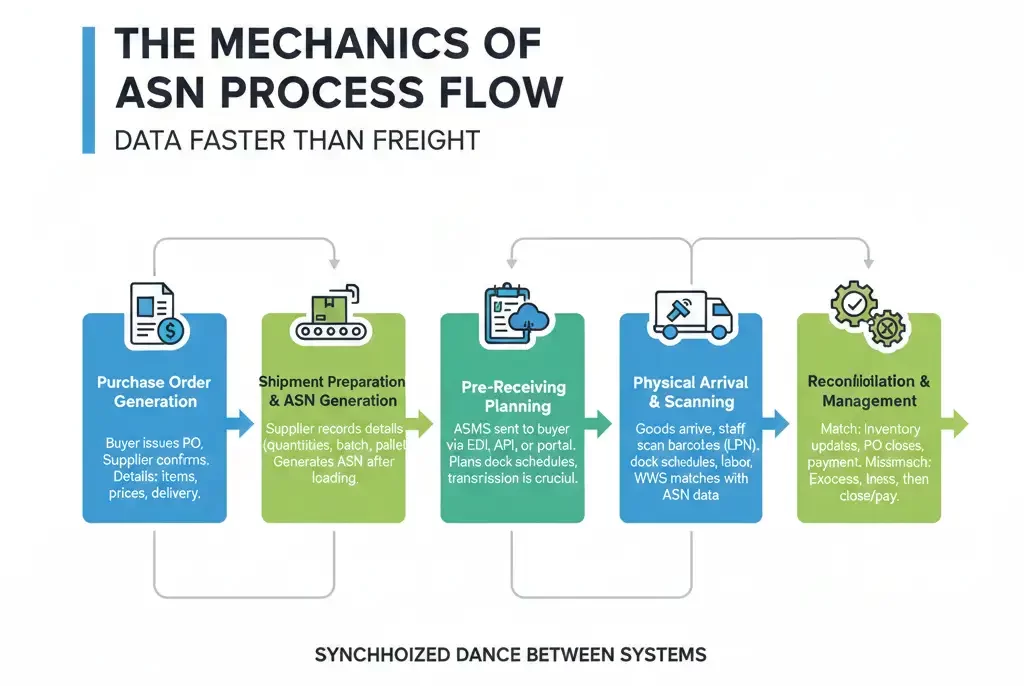
Implementing an ASN process involves a synchronized dance between the supplier’s system and the retailer’s or buyer’s system. This flow ensures that data travels faster than the freight. The process typically follows a specific sequence of events designed to maintain data integrity.
- Purchase Order Generation
The ASN process starts when the buyer issues a Purchase Order (PO) detailing items, quantities, prices, and delivery schedules. The supplier confirms the PO and begins order fulfillment. - Shipment Preparation and ASN Generation
While picking and packing, the supplier’s system records shipment details such as quantities, batch numbers, and pallet structure. Once loading is complete, the system generates the Advanced Shipping Notice (ASN). - Data Transmission
The ASN is sent to the buyer via EDI, API, or a vendor portal immediately after shipment departure. Late transmission forces warehouses into manual receiving and slows down operations. - Pre-Receiving Planning
After receiving the ASN, the Warehouse Management System (WMS) validates it against the PO to detect discrepancies early. Managers use this data to plan dock schedules, labor allocation, and storage space. - Physical Arrival and Scanning
When goods arrive, staff scan pallet or carton barcodes instead of counting items manually. The WMS matches the license plate number (LPN) with ASN data, enabling fast and accurate receiving. - Reconciliation and Exception Management
If shipment data matches the ASN, inventory updates instantly for put-away or cross-docking. Any mismatch triggers an exception process, and once confirmed, the system closes the PO and supports payment authorization.
Why ASN is the Backbone of Modern Receiving
The transition from manual receiving to ASN-driven receiving is often cited as one of the highest ROI initiatives in warehousing. The benefits extend beyond simple time savings; they fundamentally change how inventory is managed.
Technical Standards: EDI 856 and GS1-128
The efficacy of the ASN process relies on standardized communication protocols. If every supplier sent shipping data in a different format (Excel, PDF, email body), the automation would fail. The industry standardizes this through EDI and barcode labeling.
The Structure of EDI 856
The EDI 856 is the standard electronic format for an ASN within the ANSI X12 standard used principally in North America. It is a hierarchical document that organizes data into levels:
- Shipment Level: Bill of Lading number, carrier details, total weight.
- Order Level: Purchase Order number, customer reference.
- Tare (Pallet) Level: Pallet ID, SSCC number.
- Pack (Carton) Level: Carton ID, UCC-128 number.
- Item Level: SKU, UPC, quantity, lot number, expiration date.
This hierarchy is crucial because it allows the receiver to drill down to the necessary level of detail. A retailer might only scan the Pallet SSCC, trusting that the cartons and items inside match the EDI 856 structure.
GS1-128 (UCC-128) Shipping Labels
The physical link between the digital ASN and the physical box is the GS1-128 shipping label. This label contains a barcode that represents the SSCC. When the supplier generates the ASN, they also print and apply these labels. The SSCC acts as a unique license plate for that specific logistic unit. When the warehouse scanner reads this barcode, it references the ASN data to identify the contents. Without compliant labeling, the ASN data is useless because the receiver cannot link the physical box to the digital record.
Common Challenges in Implementing ASN
While the benefits are clear, implementing an ASN process is not without hurdles. It requires cooperation across the supply chain and robust technological capabilities.
- Supplier Compliance
Encouraging suppliers to send ASNs is a major challenge, especially for smaller vendors without advanced ERP or WMS systems to produce EDI 856 data and compliant labels. Instead of relying only on penalties like chargebacks, companies often achieve better long-term results through vendor portals or web-based EDI tools that simplify participation. - Data Integrity and Timing
ASN data must be accurate and sent before the shipment arrives to support automated warehouse receiving. Incorrect quantities or late transmission can cause inventory discrepancies and force teams back into manual processes, reducing the value of ASN automation. - Integration Complexity
EDI integration between supplier and buyer systems can be technically demanding due to differences in data definitions. Issues like case pack mismatches or unit-of-measure (UOM) conversions require middleware and precise mapping rules to ensure a smooth ASN workflow.

Step-by-Step Guide to Implementing ASN
For warehouse managers looking to transition from manual to ASN-based receiving, a structured approach is necessary to minimize disruption.
Step 1: Technology Assessment
Confirm your WMS or ERP can process EDI 856 ASN transactions for inbound logistics automation. Also ensure handheld devices support GS1-128 barcode scanning for fast, accurate receiving.
Step 2: Define Specifications
Develop a clear vendor compliance guide covering EDI data fields and pallet or carton labeling standards. Include ASN timing rules, such as requiring submission hours before delivery.
Step 3: Vendor Segmentation and Onboarding
Group suppliers by shipment volume and technical readiness before launching ASN adoption. Start with high-volume, tech-ready vendors through a pilot program to validate workflows.
Step 4: Testing and Validation
Run parallel testing by comparing ASN data with physical counts during receiving. This phase detects mapping errors like unit-of-measure mismatches without risking inventory accuracy.
Step 5: Go-Live and Monitoring
After successful testing, activate ASN receiving and track KPIs like dock-to-stock time and ASN accuracy. Gradually shift from full audits to spot checks as supplier performance stabilizes.
Industry-Specific Use Cases
The application of ASN varies slightly depending on the industry, driven by the specific nature of the goods and the speed of the market.
- Retail and E-Commerce
In retail, speed to shelf is essential, so ASNs enable flow-through and cross-docking operations. The WMS uses ASN data to route cartons directly to outbound trucks, while e-commerce facilities rely on it to handle returns and fast-moving inbound stock for rapid fulfillment. - Automotive and Manufacturing
Automotive manufacturers use ASNs to support Just-in-Time (JIT) production with minimal on-site inventory. The ASN confirms that required parts are en route, helping managers adjust schedules quickly if shortages or delays appear, preventing costly line stoppages. - Food and Beverage
For perishable goods, ASNs include batch, lot, and expiration data critical for inventory rotation. The WMS can immediately apply FEFO (First Expired, First Out) rules, avoiding manual date entry and reducing errors during receiving.
Comparing ASN with Traditional Receiving
To quantify the value, it is helpful to look at a direct comparison of the workflow steps involved in traditional versus ASN-enabled receiving.
| Feature | Traditional (Blind) Receiving | ASN Receiving |
|---|---|---|
| Data Entry | Manual entry of packing slip data. | Automated import via EDI/API. |
| Verification | Physical count of every item. | Scan of pallet/carton label (exception based). |
| Receiving Speed | Slow (Hours per truck). | Fast (Minutes per truck). |
| Error Rate | High (Human error in counting/typing). | Low (Data originates from supplier system). |
| Visibility | Unknown until unloading begins. | Full visibility prior to arrival. |
| Labeling | Often requires re-labeling upon receipt. | Supplier applies compliance labels (UCC-128). |
Future Trends in ASN and Receiving Technology
As supply chains become more digitized, the asn process warehouse environments rely on is evolving beyond simple EDI text files. Emerging technologies are enhancing the granularity, speed, and security of shipping data, turning ASNs into a richer and more strategic source of real-time logistics intelligence.
- RFID Integration
While barcodes require a line of sight to scan, Radio Frequency Identification (RFID) tags do not. Integrating RFID with ASN means that a warehouse can receive a shipment simply by having the pallet pass through a dock door equipped with RFID readers. The system instantly verifies that every tagged item listed on the ASN is present on the pallet, without a human pulling a trigger. This moves receiving from a “low-touch” process to a “no-touch” process.
- Blockchain for Immutable Data
Disputes often arise when a receiver claims items were missing, but the supplier claims they were shipped. Blockchain technology can create an immutable ledger of the ASN data and the handover of custody. When the ASN is generated, it is recorded on the blockchain. When the goods are received, that event is also recorded. This creates a single version of the truth that reduces friction in invoice reconciliation.
- Predictive Analytics and AI
Advanced WMS platforms are beginning to use Artificial Intelligence to analyze ASN data against historical performance. If a specific supplier historically has a variance on “Item X,” the AI can flag the incoming ASN for a specific audit of that item, while allowing the rest of the shipment to pass through. This intelligent auditing maximizes accuracy while minimizing labor.
Industry-Specific Applications of ASNs
Although the core idea of an Advanced Shipping Notice is the same—shipment data arriving before the goods—its operational impact varies by industry. Each sector uses ASN data differently to optimize speed, accuracy, and planning within its supply chain workflows.
- Manufacturing: Just-in-Time (JIT) Precision
In manufacturing, especially automotive and electronics, ASNs support JIT strategies where materials move quickly from dock to production with minimal storage. In an efficient asn process warehouse environment, ASN data feeds ERP and MRP systems, confirming component availability, triggering alerts for shortages, and providing lot or serial traceability for quality control and recalls. - Retail and Distribution: Enabling Cross-Docking
Retailers and distribution centers use ASNs to maximize inventory velocity and reduce handling costs. The WMS matches inbound ASN data with outbound orders, allowing pallets to move directly to shipping lanes instead of storage making efficient cross-docking possible. - E-Commerce: High-Velocity Inventory Turnover
E-commerce operations rely on ASNs to handle large SKU volumes and rapid demand changes. Early shipment data enables faster receiving, supports backorder release or pre-selling, and simplifies the intake of mixed-SKU cartons without time-consuming manual counts.
Implementing an ASN Strategy: Steps and KPIs
Transitioning from manual receiving to an ASN-driven workflow is not a “flip the switch” operation. It requires a phased implementation strategy involving technical integration, vendor negotiation, and rigorous testing.
Phase 1: Vendor Compliance and Onboarding
The technical capability to receive an ASN is useless if suppliers cannot send one. The first step involves segmenting suppliers based on volume and technical maturity. High-volume suppliers should be prioritized for EDI integration.
Organizations must create a clear Vendor Compliance Manual that stipulates:
- The required EDI standard: Typically EDI 856 or a specific XML schema.
- Labeling requirements: The specific format of the GS1-128 (formerly UCC-128) barcode labels that must be physically attached to pallets or cartons.
- Timing requirements: Defining that the ASN must be transmitted at the time of shipment departure, not upon arrival.
Phase 2: Technical Integration and Mapping
The ERP or WMS team must map the incoming data fields to the internal database. Essential mapping points include:
- Carrier Information: SCAC codes, trailer numbers, and tracking IDs.
- Product Data: Vendor SKU to Internal SKU translation.
- Hierarchy: Defining the parent-child relationships (Pallet > Carton > Item).
During this phase, “dummy” shipments should be processed in a sandbox environment to ensure that scanning a test barcode correctly populates the receiving screen with the data contained in the test ASN.
Critical KPIs to Measure Success
To validate the ROI of an ASN implementation, logistics leaders should track specific Key Performance Indicators:
- ASN Timeliness Rate: The percentage of ASNs received before the physical shipment arrives at the gate. A target of >98% is standard for best-in-class operations.
- ASN Accuracy Rate: The frequency with which the physical count matches the ASN data. Discrepancies here indicate vendor errors or data corruption.
- Dock-to-Stock Time: The total time elapsed from the truck docking to the goods being available for sale or use. Successful ASN implementation should reduce this by 40% to 60%.
- Receiving Labor Cost Per Unit: A financial metric tracking the reduction in man-hours required to process inbound volume.
Common Pitfalls and Mitigation Strategies
Even with strong benefits, an asn process warehouse setup can face operational risks if timing and data flow are not controlled. Without proactive governance, small ASN failures can ripple into receiving delays and inventory errors.
- The Timing Mismatch
Problems occur when trucks arrive before the ASN data reaches the WMS, forcing teams back into manual receiving.
Mitigation: Apply a gate-hold rule until the ASN is visible in the system and trigger alerts when ASNs are late. - Data Discrepancies (The “Trust Gap”)
If ASN quantities don’t match physical stock, inventory accuracy drops and staff lose trust in the system.
Mitigation: Run random pallet audits and enforce supplier accountability through performance tracking or chargebacks. - Inconsistent Unit of Measure (UOM)
Different interpretations of cases vs. eaches can cause major stock distortions.
Mitigation: Standardize UOM codes and validate them during EDI mapping before ASN data enters the WMS.
Advanced Best Practices for Future-Proofing
For organizations that have mastered the basics of ASN receiving, advanced technologies can further leverage this data for hyper-automation.
- RFID and ASN Integration
Pairing ASNs with RFID removes the need for manual barcode scanning. As tagged pallets pass through dock door readers, the system auto-matches them to the ASN and receives shipments in seconds, enabling near “touchless” receiving. - Dynamic Yard Management
AWhen ASNs connect with a Yard Management System (YMS), inbound trailers can be prioritized before they even reach the dock. The system evaluates the ASN contents and directs drivers to the right door—cross-dock lanes for urgent goods or holding areas for non-critical stock—transforming ASN data into a yard optimization engine.
Conclusion
ASNs have evolved from a supporting document into a strategic enabler of fast, data-driven warehouse operations. When shipment information flows ahead of physical goods, businesses gain the visibility needed to plan labor, allocate space, and reduce receiving errors. This shift improves accuracy, shortens dock-to-stock time, and lowers overall inventory handling costs.
However, successful ASN adoption requires more than technology alone. It depends on aligned processes, system integration, and strong collaboration with suppliers to ensure data consistency and reliability. Organizations that treat ASN implementation as part of a broader digital supply chain strategy typically achieve far greater operational stability and responsiveness.
If your warehouse operations still rely heavily on manual receiving, it may be the right time to evaluate how ASN processes could support your efficiency goals. Consulting with supply chain and system experts can help you assess readiness, identify integration needs, and design a roadmap that fits your operational environment.
FAQ About ASNS In Warehouse
-
What is the difference between an ASN and a packing slip?
An ASN (Advanced Shipping Notice) is a digital document sent electronically before the shipment arrives, allowing for automated receiving and planning. A packing slip is a physical paper document attached to the shipment used for manual verification.
-
How does ASN improve warehouse receiving?
ASN improves receiving by allowing warehouses to scan barcodes (license plates) to receive entire pallets instantly, rather than manually counting every item. It also enables cross-docking and better labor planning.
-
Why is supplier compliance important for ASN?
If suppliers do not send accurate ASNs or fail to apply readable barcode labels, the receiving warehouse cannot automate the process. Non-compliance forces the warehouse to revert to slow, manual receiving methods.