








Predictive maintenance uses real-time equipment data to anticipate failures before they happen. When implemented effectively, it helps manufacturers reduce downtime, extend asset lifespan, and improve maintenance planning.
However, its success depends on reliable data, consistent processes, and clear action plans. Without proper coordination, insights can be overlooked and teams may revert to reactive repairs.
So how can manufacturers turn predictive signals into structured, timely actions across the plant? Let’s explore practical steps, essential metrics, and implementation strategies to build a scalable and effective predictive maintenance program.
Key Takeaways
|
What Is Predictive Maintenance?
Predictive maintenance is a proactive maintenance strategy that uses condition-monitoring tools and data analytics to predict potential equipment failures. Maintenance is scheduled just before breakdown occurs to prevent unplanned downtime and maintain optimal asset performance.
This approach relies on real-time machine data collection and analysis to detect early warning signs of failure. By acting only when necessary, businesses can minimize disruptions and improve operational reliability.
The primary goal of predictive maintenance is to reduce unexpected breakdowns, optimize maintenance costs, and extend asset lifespan without over-maintaining equipment. It helps organizations achieve higher efficiency while protecting long-term operational productivity.
Predictive vs. Preventive vs. Reactive Maintenance: Key Differences
Choosing the right maintenance strategy is a crucial decision that directly impacts operational efficiency and overall manufacturing operations. Each approach, whether reactive, preventive, or predictive, has its own unique characteristics. Here is a detailed comparison of these three maintenance strategies.
| Aspects | Reactive maintenance (run-to-failure) | Preventive maintenance (time-based) | Predictive maintenance (condition-based) |
| Trigger | Breakdown occurs | Time or usage interval | Condition data signals risk |
| How it works | Repair after failure | Service on a fixed schedule | Monitor sensors and maintain when needed |
| Pros | Low upfront effort, simple | More predictable, easier planning | Less downtime, optimized cost, longer asset life |
| Cons | Unplanned downtime, costly emergency repairs, and secondary damage risk | Over or under-maintenance ignores the real condition | Needs sensors, analytics, clean data, and change management |
| Best fit | Non-critical assets | Predictable wear assets | Critical assets, uptime-focused plants |
How Does Predictive Maintenance Work?
Implementing predictive maintenance turns machine data into timely maintenance actions, so issues are addressed before they disrupt production. The workflow is most effective when data, analytics, and execution are integrated into a single continuous loop.
- Data collection
Sensors capture real-time condition signals such as vibration, temperature, pressure, and oil levels from the machine during operation. This data is sent to a central system and combined with maintenance history and operator logs to build a complete asset picture. - Data analysis
Analytics and machine learning compare incoming data against a baseline of normal machine behavior. When patterns shift or anomalies appear, the system flags early signs of wear, misalignment, or performance degradation. - Prediction & alerting
The model estimates failure risk and timing based on detected trends, such as rising vibration levels or repeated temperature spikes. When thresholds are crossed, it triggers alerts to the right team so action can be planned before the issue escalates. - Scheduling & execution
Alerts are converted into work orders, with spare parts checks and technician scheduling based on priority and urgency. When integrated with manufacturing software, maintenance scheduling can align with production plans to minimize downtime and keep records up to date for future predictions.
Key Benefits of Implementing Predictive Maintenance
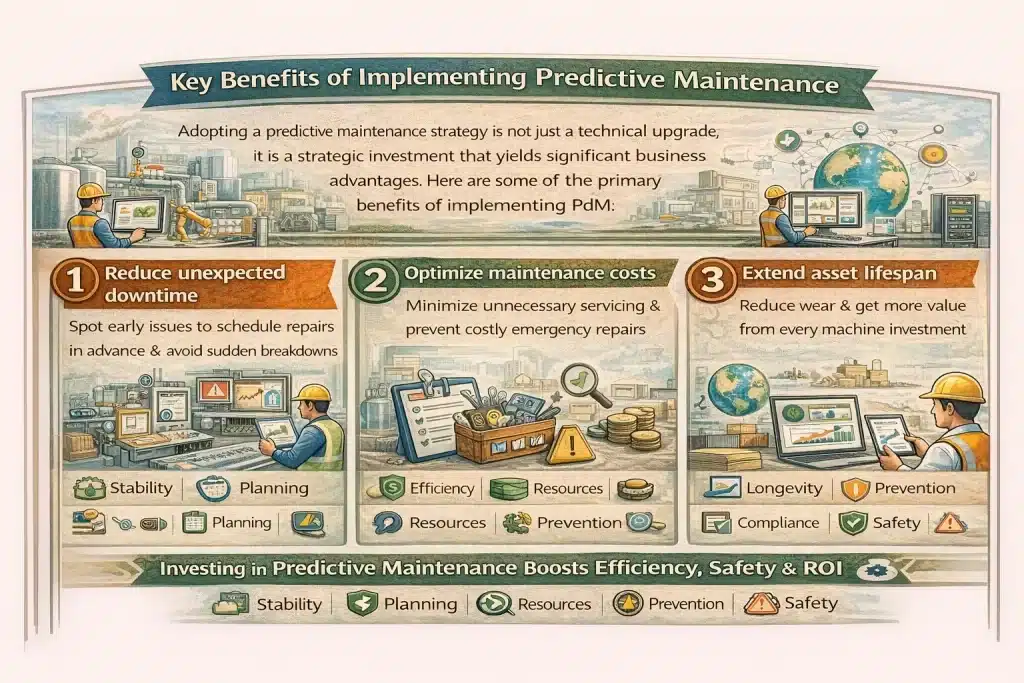
Adopting a predictive maintenance strategy is not just a technical upgrade; it is a strategic investment that yields significant business advantages. Here are some of the primary benefits of implementing PdM.
- Reduce unexpected downtime
Predictive maintenance helps you prevent sudden breakdowns by spotting early warning signs before production stops. This lets you schedule repairs during planned windows, keeping output stable and customer commitments on track. - Optimize maintenance costs
Because the actual condition of the equipment triggers maintenance, you avoid unnecessary servicing and reduce waste of spare parts and labor. Early detection also prevents minor issues from turning into expensive emergency repairs that disrupt budgets. - Extend asset lifespan
Timely interventions keep machines running in healthy operating ranges, reducing wear that accelerates long-term damage. As a result, assets last longer, replacements can be delayed, and you get more value from every capital investment. - Improve workplace safety
Preventing catastrophic failures lowers the risk of accidents caused by sudden mechanical faults and unsafe operating conditions. It also supports safer, more compliant operations aligned with standards like Good Manufacturing Practice (GMP).
Steps to Implement Predictive Maintenance in Your Company
Adopting predictive maintenance is a transformative journey that requires strategic planning and careful execution. Here are five key steps to initiate and scale a predictive maintenance program within your organization.
- Define goals and select critical assets
Start by setting clear PdM targets, such as reducing downtime, lowering maintenance costs, or improving safety, so success is measurable. Then choose a small set of high-impact assets for a pilot, focusing on machines whose failure would most disrupt production. - Invest in the right technology
Install the right sensors to capture meaningful condition signals, such as vibration and temperature, then funnel that data into a platform that can analyze and visualize trends. Prioritize a manufacturing software solution that integrates monitoring, work orders, and spare parts tracking into a single workflow. - Train the team and build a proactive culture
Upskill maintenance teams to interpret data, respond to alerts correctly, and follow standardized workflows instead of relying on guesswork. Involve technicians early so they adopt the system, trust the insights, and consistently act before problems escalate. - Analyze, evaluate, and scale
Track pilot results using KPIs such as downtime reduction, maintenance cost savings, and OEE improvement to confirm impact. Use what you learn to refine thresholds and processes, then expand PdM step by step to other critical assets.
Case Study: Predictive Maintenance Adoption in Malaysian Manufacturing
A large metal fabrication plant in Selangor experienced frequent machine breakdowns that disrupted production schedules and led to high repair costs, largely because maintenance was reactive and based on fixed time intervals rather than actual equipment condition. These unexpected failures caused overtime expenses, delayed deliveries, and strained relationships with key clients.
To address this, the company implemented a predictive maintenance system that used IoT sensors and real‑time analytics to monitor equipment performance and predict failures before they occurred. With advanced alerts and data‑driven maintenance scheduling, machine uptime improved significantly, unplanned stoppages dropped, and overall operational efficiency increased.
Seeing the positive impact on productivity and cost savings, the maintenance team began evaluating pricing schemes and software tiers for predictive maintenance platforms that could scale with their expanding production lines while offering flexible support packages within the company’s IT budget.

Conclusion
FAQ About Predictive Maintenance
-
Is predictive maintenance suitable for small businesses?
Yes, absolutely. With the increasing affordability of sensor technology and cloud-based software solutions, small businesses can now implement PdM gradually. The key is to start with the most critical assets to maximize initial ROI before expanding.
-
How long does it take to see results from PdM implementation?
The time to see ROI can vary depending on the project’s scale and industry, but many companies start seeing positive results within 6 to 12 months. Reductions in downtime and emergency repair costs are often the first benefits realized.
-
What data is most important for predictive maintenance?
The most common and effective data types are vibration, temperature, oil analysis, and acoustic data. However, the most crucial data depends heavily on the asset type. For rotating machinery like motors, vibration analysis is paramount.
-
What is the main difference between CMMS and predictive maintenance software?
A CMMS is a system for managing and documenting maintenance activities, like work orders. In contrast, predictive maintenance software focuses on analyzing data to predict when maintenance is needed. Modern solutions like a Manufacturing ERP often integrate both functions.