








Project delays are more common than many teams expect. According to PMI’s Pulse of the Profession report, nearly 11% of project investment is wasted due to poor performance, often caused by schedule overruns and weak planning discipline. In industries like construction and infrastructure, even a few days of delay can translate into significant financial impact and strained stakeholder trust.
This is why structured scheduling methods matter. The Critical Path Method (CPM) helps project teams clearly identify which tasks directly determine project duration, so attention and resources can be focused where delays would hurt the most. Instead of reacting to problems, CPM gives teams a clearer roadmap from the start.
Key Takeaways
|
What Is The Critical Path Method (CPM)?
The Critical Path Method (CPM) is a project planning and scheduling technique that maps tasks, dependencies, and durations to model how work flows from start to finish. It identifies the critical path, or the longest chain of dependent tasks that determines the shortest possible project duration, where any delay directly pushes back completion.
CPM is critical because it replaces guesswork with clear priorities, showing which tasks have no flexibility and which have float for smarter decision-making. This visibility helps managers prevent bottlenecks, allocate resources effectively, and control risks early so projects stay on time and within budget.
Key Benefits of Implementing the Critical Path Method for Businesses
Using the Critical Path Method helps businesses move from reactive problem-solving to structured, timeline-driven execution. With clearer task dependencies and priorities, teams can manage projects with more control and fewer surprises.
- Improve planning accuracy and time estimates
CPM forces teams to break projects into smaller tasks and assign realistic durations based on actual work requirements. This reduces missed steps and makes timelines more reliable for stakeholders and budgeting. - Optimize resource allocation more efficiently
CPM shows which tasks are critical and which have float, so managers can shift people or equipment without risking the final deadline. This prevents overstaffing on low-impact work while protecting activities that directly affect completion. - Mitigate risks and spot bottlenecks earlier
Because CPM highlights the tasks that cannot slip, it helps managers focus monitoring on the highest-risk activities. This visibility makes it easier to prepare contingencies before delays turn into cost overruns. - Increase transparency and strengthen communication
CPM creates a shared project map that makes dependencies and priorities easy for every team to understand. With everyone aligned on what drives the schedule, coordination improves, and status updates become more actionable.
6 Practical Steps to Determine the Critical Path in Your Project
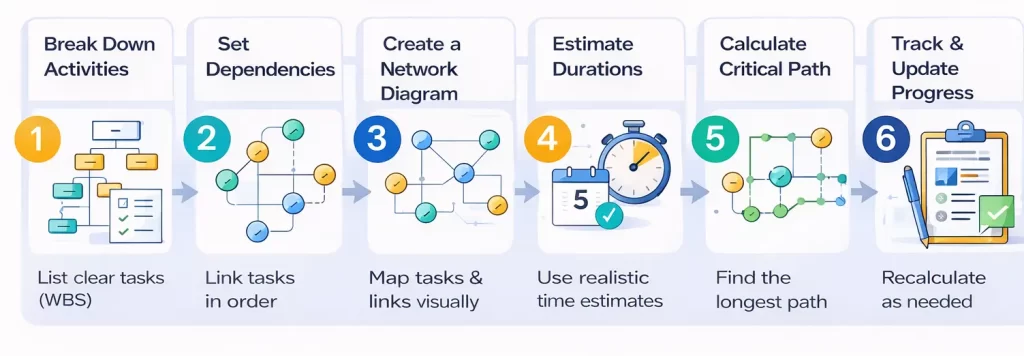 Finding the critical path becomes much easier when you follow a structured workflow instead of relying on gut feeling. These steps help you map dependencies clearly, so you can spot what truly controls the project’s finish date.
- List all activities with a Work Breakdown Structure
Break the project into clear, trackable tasks so nothing important gets missed. A complete activity list prevents hidden work from causing scope creep and schedule gaps later. - Define the dependencies between activities
Identify which tasks must finish before others can start to form a logical sequence. Accurate dependencies prevent unrealistic schedules that look good on paper but fail on site. - Build a network diagram to map the workflow
Visualize tasks and dependencies in a diagram so you can see what runs in parallel and what must be sequential. This makes it easier to align teams and understand the true flow of work. - Estimate the duration of each activity
Assign realistic time estimates using past project data and input from the people doing the work. Better duration estimates improve the reliability of your entire schedule and reduce last-minute surprises. - Calculate the longest path to identify the critical path
Add up the total duration of each path in the network and find the longest one. That longest chain is the critical path, meaning any delay there directly delays the whole project. - Monitor progress and update the plan regularly
Track actual start and finish dates and recalculate the critical path as conditions change. A small slip on a non-critical task can consume its float and turn it into the new critical path.
Key Terminologies You Must Know in CPM
Understanding CPM terminology helps you read a schedule like a control panel, not just a timeline. Once these terms click, you can spot where the project has flexibility and where even a small delay will hit the finish date.
- Earliest Start (ES) and Earliest Finish (EF)
ES is the earliest time a task can begin after all predecessors are done, and EF is calculated as EF = ES + Duration. Example: if ES = 5 days and Duration = 3 days, then EF = 5 + 3 = 8 days. - Latest Start (LS) and Latest Finish (LF)
LS is the latest time a task can start without delaying the project, and LF is the latest time it can finish, using LS = LF – Duration. Example: if LF = 10 days and Duration = 3 days, then LS = 10 – 3 = 7 days. - Float or Slack (Total Float and Free Float)
Total Float shows how long a task can slip without moving the project end date, calculated as Total Float = LS – ES or Total Float = LF – EF. Example: if LS = 7 and ES = 5, then Total Float = 7 – 5 = 2 days (and if LF = 10 and EF = 8, then Total Float = 10 – 8 = 2 days). - Crash Duration and Fast Tracking
Crashing shortens the schedule by adding resources to critical tasks, usually increasing cost, such as adding overtime for a concrete crew to finish sooner. Fast-tracking overlaps tasks that were planned sequentially, such as starting interior work before exterior finishes, can reduce time but increase rework risk.
Example of Critical Path Method Application (Construction Project Case Study)
This construction case study shows how CPM turns a complex schedule into a clear, manageable plan. With many dependent tasks happening in sequence and in parallel, CPM helps pinpoint what truly drives the finish date.
Imagine a two-story commercial building that must be completed as efficiently as possible for tenant handover. The goal is to determine the minimum project duration and identify which activities require the most stringent monitoring.
Start by listing activities with durations and predecessors to build the workflow, then map them into a network diagram. From there, add up each path’s duration to find the longest one, which becomes the critical path.
If the longest path is A → B → C → E → G → H = 45 days, that’s the minimum completion time, and any delay in those tasks delays the whole project. Shorter paths reveal float; for example, a 32-day path means 13 days of float (45 − 32), giving managers room to reassign resources without moving the final deadline.
Fundamental Differences Between CPM and PERT for Managers to Know
CPM and PERT often appear side by side, but they solve different planning problems. The key is whether your project timeline is predictable or still full of unknowns.
| Aspect | CPM (Critical Path Method) | PERT (Program Evaluation and Review Technique) |
| Time-estimation approach | Deterministic: uses one fixed duration per activity | Probabilistic: uses three estimates per activity (optimistic, most likely, pessimistic) |
| Best fit | Predictable, repeatable work with reliable historical data | High-uncertainty work with limited or no historical data |
| Typical use cases | Construction, maintenance, manufacturing rollouts, standard implementations | R&D, new product development, innovative software builds, complex first-time initiatives |
| Output focus | Identifies the critical path and schedule control points | Estimates expected durations under uncertainty and likely completion ranges |
| Strength | Strong for schedule control, monitoring, and resource planning | Strong for planning when task durations are uncertain, and risk is high |
| Limitation | Less accurate if task durations are volatile or unknown | It can be heavier to estimate and maintain because it requires multiple time inputs |
Optimizing the Critical Path Method with Construction Management Software
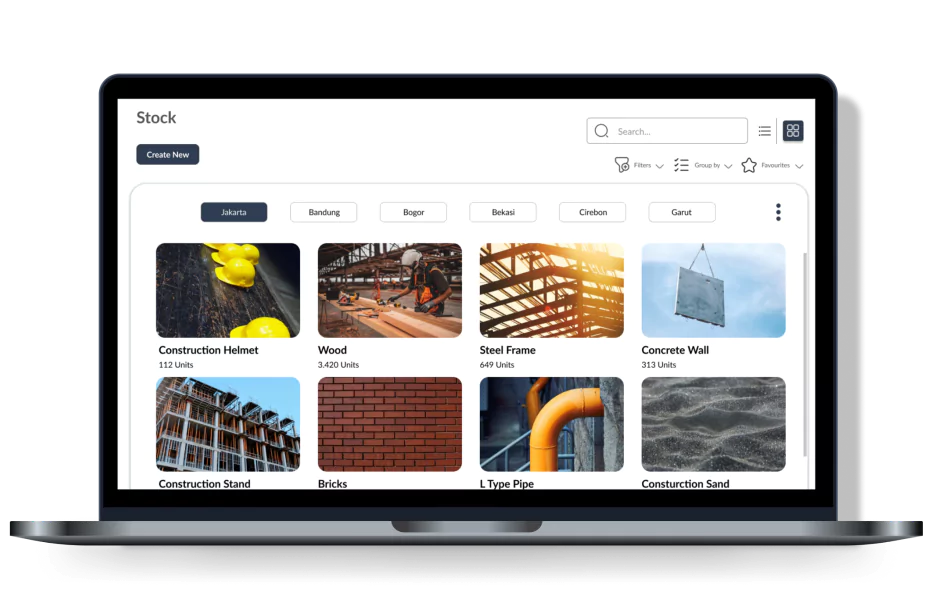
Using CPM is not just about mapping tasks once at the beginning of a project. To get real value, it needs to be reviewed and refined as the project progresses.
One practical way to optimize CPM is by regularly reassessing task durations and dependencies. Assumptions made during planning may change once execution begins. By updating timelines with real progress data, teams can quickly identify emerging bottlenecks before they escalate.
Another key improvement area is resource allocation. If critical tasks lack sufficient manpower or materials, the entire schedule is at risk. Aligning resource planning closely with critical activities ensures that high-impact tasks receive priority support.
Finally, communication plays a crucial role. When stakeholders understand which activities sit on the critical path, decision-making becomes faster and more focused. Discussions shift from “what should we prioritize?” to “what protects the project deadline?”
Conclusion
The Critical Path Method remains one of the most practical tools for managing complex project timelines. By identifying which activities directly influence the project completion date, teams gain clarity on where attention truly matters.
More importantly, CPM encourages disciplined planning and continuous monitoring. When used consistently and supported by accurate data, it helps reduce uncertainty, minimize avoidable delays, and improve overall project control.
If you want to manage construction schedules with more control and less guesswork, try a free demo. See how automated CPM can help keep your projects on time, within budget, and aligned with quality targets.
FAQ About Critical Path Method
-
What happens if an activity on the critical path is delayed?
Any delay to an activity on the critical path will directly delay the project’s overall completion date by the same amount of time. This is because these activities have zero float or slack.
-
Can a project have more than one critical path?
Yes, it is possible for a project to have multiple critical paths. This occurs when two or more different paths through the network diagram have the same longest duration. This increases project risk as there are more activities that must be managed without any delay.
-
Is the Critical Path Method only suitable for large construction projects?
No, while it is widely used in construction, CPM is a versatile tool suitable for any project with interdependent tasks. It can be applied to software development, marketing campaigns, event planning, and many other fields to improve scheduling and resource management.
-
How often should the critical path be re-evaluated during a project?
The critical path should be re-evaluated regularly throughout the project’s lifecycle. Best practice is to update the schedule with actual progress and recalculate the path at key milestones or on a consistent weekly or bi-weekly basis to keep the plan relevant.