








Maintaining a balanced inventory is a timeless challenge for any business. Experiencing a stockout means lost sales and disappointed customers, while overstocking ties up capital and increases storage costs.
The reorder point (ROP) is a critical metric in inventory management that acts as a systematic trigger to solve this problem. It provides a clear, data-driven signal for when to replenish inventory, ensuring business operations run smoothly without costly interruptions.
When a product’s stock level reaches the reorder point, the Warehouse Management System automatically signals the procurement team to place a new order, accounting for the supplier’s lead time to deliver the goods. This proactive approach is fundamental to building a resilient and efficient supply chain.
Key Takeaways
|
Unpredictable demand and supplier delays can make it difficult to maintain the right inventory levels, increasing the risk of stockouts. A reorder point helps businesses determine the optimal time to replenish inventory and maintain smooth operations.

What Is a Reorder Point (ROP)?
In simple terms, the reorder point is the minimum stock level that signals when you should place a new order to replenish your inventory. The goal is to ensure that new stock arrives just before the existing supply runs out completely, allowing business operations to proceed without interruption.
Why Is Reorder Point Crucial for Your Business?
The effectiveness of a reorder point depends on several factors that influence inventory levels and replenishment timing. Understanding these factors is essential to maintaining optimal stock availability while minimizing the risk of inventory shortages or excess stock.
1. Prevents Stockouts
A reorder point ensures new inventory is ordered before stock runs out. This helps businesses maintain product availability, avoid missed sales opportunities, and prevent customer dissatisfaction caused by out-of-stock items.
2. Reduces Overstocking
Without a clear reorder point, businesses may purchase more inventory than necessary. An accurate ROP helps maintain optimal stock levels, reducing storage costs and minimizing the risk of obsolete inventory.
3. Improves Cash Flow
Holding excess inventory ties up working capital that could be used elsewhere in the business. By ordering only when needed, companies can manage cash flow more effectively and allocate resources more strategically.
4. Minimizes Emergency Costs
Unexpected stock shortages often lead to urgent purchases and expedited shipping fees. A well-calculated reorder point helps businesses replenish inventory on time and avoid unnecessary procurement expenses.
5. Supports Customer Satisfaction
Consistent product availability enables businesses to fulfill orders promptly. This reliability improves the customer experience and helps build long-term trust and loyalty.
6. Enables Data-Driven Decisions
Reorder points are based on actual demand and lead-time data rather than assumptions. This allows businesses to make more informed inventory decisions and improve overall supply chain performance.
7. Strengthens Supply Chain Resilience
By maintaining adequate stock levels, businesses are better prepared for demand fluctuations and supplier delays. This reduces operational disruptions and supports business continuity.
By considering these factors when calculating a reorder point, businesses can establish more accurate replenishment strategies and maintain balanced inventory levels. A well-defined ROP not only reduces inventory-related risks but also supports smoother operations, better customer service, and more efficient supply chain management.
The Reorder Point Formula and How to Calculate It
To calculate the reorder point, you can use the standard formula that combines average daily demand and supplier lead time:
Reorder Point = (Average Daily Demand × Average Lead Time) + Safety Stock
Each component in this formula is critical for determining the final accuracy. Understanding how to calculate each of these variables accurately is the key to implementing a reliable and effective ROP system.
Below is a detailed explanation of each component in the formula, which will help you master its application in your own business context.
1. Lead time demand
Lead time demand is the total amount of stock projected to be sold during the lead time, the period from when you place an order until the goods arrive at your warehouse. This component is calculated by multiplying the average daily demand by the average lead time in days.
For example, if you sell an average of 10 units of a product per day and your supplier takes 7 days to deliver an order, your lead time demand is 70 units. This figure becomes your baseline minimum stock requirement to survive a normal reordering cycle without running out of products.
2. Safety stock
Safety stock system is the extra inventory you hold to protect your business from uncertainties, such as sudden demand surges or supplier delivery delays. Without safety stock, any anomaly in the supply chain or market behavior could immediately lead to a stockout, causing lost sales and customer dissatisfaction.
The amount of safety stock can be calculated using various methods, ranging from a simple formula based on a percentage of lead time demand to more complex statistical calculations involving the standard deviation of demand and lead time to achieve a specific service level. This buffer is a critical investment in operational stability.
A Practical Example of Reorder Point Calculation
To calculate the reorder point effectively, you need accurate historical data on daily sales, supplier delivery lead times, and a predetermined safety stock level. Let’s use a practical scenario for a retail store that sells a popular product, the “Smart LED Desk Lamp,” to simplify understanding.
Suppose the store, “Bright Future,” wants to determine the reorder point for this product. After analyzing data from the last three months, they have gathered the following information: the average sales are 20 units per day, and the average lead time from their supplier is 10 days. To anticipate demand spikes during the holiday season or potential shipping delays, the company has set its safety stock at 50 units.
- Calculate Lead Time Demand:
- Lead Time Demand = Average Daily Demand × Average Lead Time
- Lead Time Demand = 20 units/day × 10 days = 200 units
- Add Safety Stock:
- Reorder Point = Lead Time Demand + Safety Stock
- Reorder Point = 200 units + 50 units = 250 units
- Interpret the Result:
- The calculation shows that the reorder point for the “Smart LED Desk Lamp” is 250 units. This means that when the stock level of these lamps in Bright Future’s warehouse reaches 250, the system should automatically trigger a new order to the supplier. By doing this, 200 units will cover sales during the 10-day waiting period, and the remaining 50 units will serve as a buffer for unexpected events, ensuring product availability is maintained.
Key Factors Influencing Reorder Point Accuracy
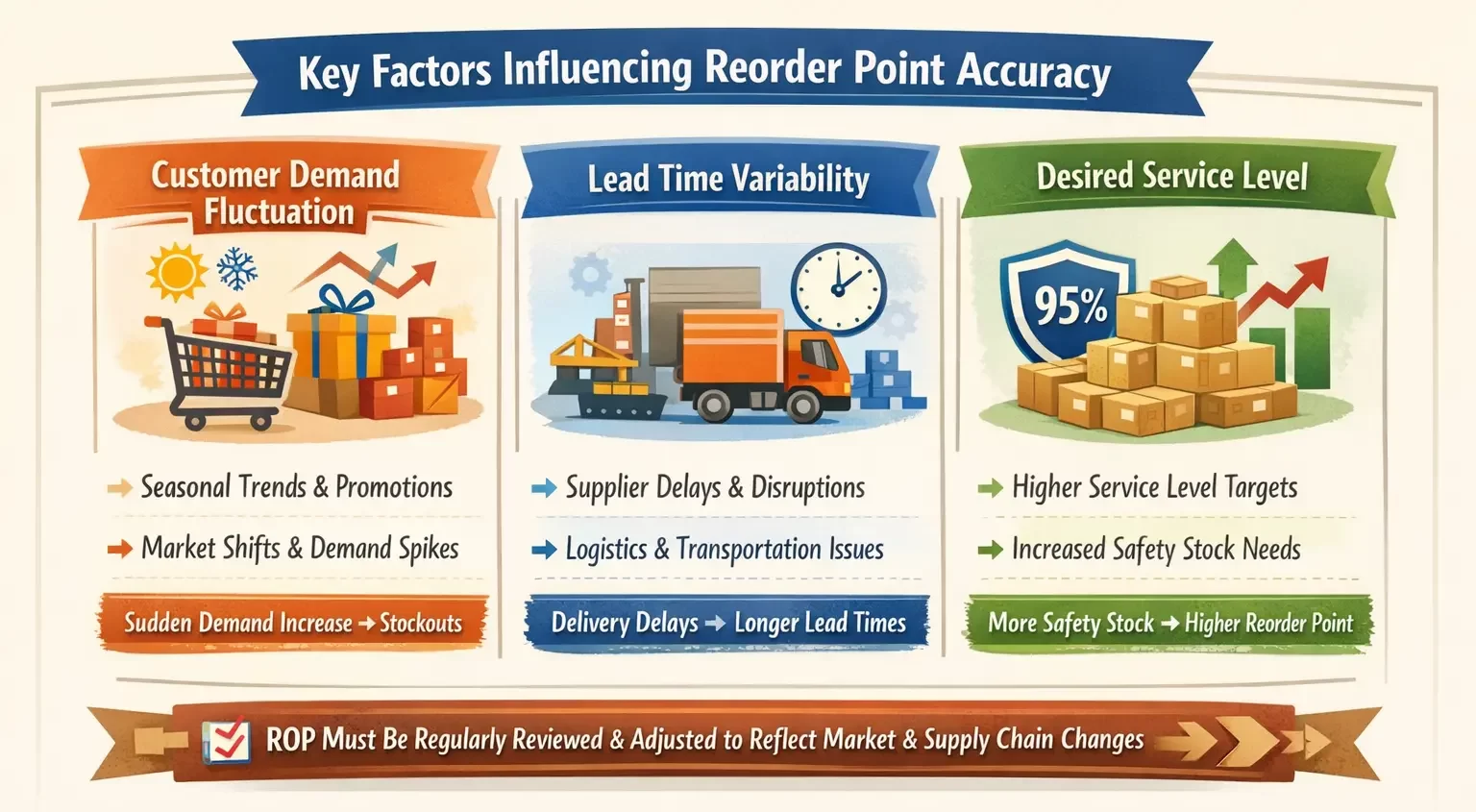
The primary factors influencing the accuracy of the reorder point are the variability in customer demand and the consistency of supplier performance. ROP is not a static number that, once set, remains valid forever; it must be reviewed and adjusted periodically to reflect changing market conditions and supply chain dynamics.
The success of a reorder point implementation heavily depends on a deep understanding of its various influencing variables. From seasonal trends that cause demand fluctuations to supplier reliability in meeting delivery schedules, each element has a direct impact on how much stock you need to have on hand.
1. Customer demand fluctuation
Changes in customer buying patterns, whether due to seasonal trends, promotions, or shifts in market conditions, are the most significant factor affecting ROP. If demand suddenly increases and your ROP is too low, you will experience a stockout and lose potential revenue.
2. Lead time variability
Inconsistent supplier performance can disrupt even the most carefully calculated reorder point. Delivery delays, whether due to production issues, logistical challenges, or other external factors, will extend the actual lead time beyond your initial estimate.
3. Desired service level
The service level is the target probability of not experiencing a stockout during a reorder cycle. For instance, a 95% service level means you are willing to accept a 5% risk of a stockout. The higher the service level you aim to achieve, the larger the safety stock you will need, which in turn will increase your reorder point.
Common Challenges in Implementing Reorder Point
A primary challenge in implementing a reorder point system often stems from poor data quality and a reliance on manual processes that are prone to errors. Although the concept of ROP sounds simple, its real-world execution requires discipline, accurate data, and an integrated system.
Many businesses, especially those that are still growing, face difficulties in collecting and maintaining clean, real-time sales and inventory data. Furthermore, the failure to regularly review and update ROP parameters in line with market changes can quickly render the system ineffective.
1. Poor data quality
A reorder point calculation will only be as accurate as the data you use. If historical sales data is incomplete, real-time stock data is out of sync, or supplier lead time records are inconsistent, the resulting ROP calculation will be flawed. The principle of garbage in, garbage out is highly applicable here; inaccurate data will lead to incorrect ordering decisions and ultimately worsen inventory problems rather than solving them.
Regular data audits, such as stock reconciliation, are also essential for identifying and correcting discrepancies before they affect decision-making. By prioritizing data quality, companies can build a reliable foundation for their reorder point calculations and unlock the full potential of data-driven inventory management.
2. Manual and error-prone calculations
Relying on spreadsheets or manual calculations to track reorder points across hundreds or thousands of SKUs is a recipe for disaster. This process is not only incredibly time-consuming but also highly susceptible to human error, such as data entry mistakes or simply forgetting to place an order on time.
The solution to this challenge lies in automation. Modern inventory management software automates the entire process, from tracking stock levels in real-time to calculating reorder points and even generating purchase orders automatically when stock hits the trigger level.
3. Failure to regularly update ROP
The market is never static, and neither should your reorder points be. Customer demand changes, new suppliers come and go, and lead times can fluctuate for a variety of reasons. One of the biggest challenges is the failure to consistently review and adjust ROPs periodically, for instance, every quarter.
To overcome this, businesses should establish a formal process for regularly reviewing and updating their reorder points. This process should involve analyzing recent sales data, evaluating supplier performance, and considering any upcoming market changes or promotions.
Automating Reorder Point with Inventory Management Software
By leveraging centralized sales and stock data, the system can dynamically calculate the optimal ROP and automatically send notifications to the procurement team when inventory levels reach the predetermined threshold. This eliminates the risk of human error and ensures that the reordering process is executed in a timely and efficient manner, a crucial advantage in a fast-paced market.
Adopting technology to manage reorder points is a transformative step that frees your team from repetitive administrative tasks, allowing them to focus on more strategic activities like supplier relationship management and market trend analysis.
Study Case: How a Malaysian Retailer Improved Inventory Using Reorder Point Formula