













In today’s fast-paced Malaysian business landscape, leaders face rising operational costs and increasing pressure to innovate digitally. Many companies struggle with complex IT systems that rely on manual processes, creating inefficiencies and slowing growth.
These challenges highlight the need for automation. By adopting cloud-based workflows, businesses can improve operational agility, reduce downtime, and respond faster to market changes—staying competitive in Malaysia’s dynamic economy.
Implementing cloud automation allows companies to streamline processes, enhance data accuracy, and make smarter decisions. With the right tools, businesses can transform operations and unlock growth opportunities without getting bogged down in manual tasks.
Key Takeaways
|
What Exactly Is Cloud Automation?
For business leaders, cloud automation functions as a digital workforce that executes operational procedures like server provisioning and patching 24/7 with perfect consistency. It codifies these tasks into software scripts that trigger automatically in response to demand, ensuring that technology enables rather than constrains growth.
A key distinction lies between automation, which executes a single repetitive task, and orchestration, which coordinates multiple automated tasks into a cohesive workflow. While automation handles discrete actions like starting a server, orchestration manages the complex sequence required to deliver a full business service.
The ecosystem relies on three core components: automation tools that manage workflows, Infrastructure as Code (IaC) for consistent provisioning, and governance policies that ensure compliance. These elements work in concert to create a secure, self-regulating environment that minimizes manual effort and maximizes reliability.
Why Cloud Automation Is a Strategic Business Priority?
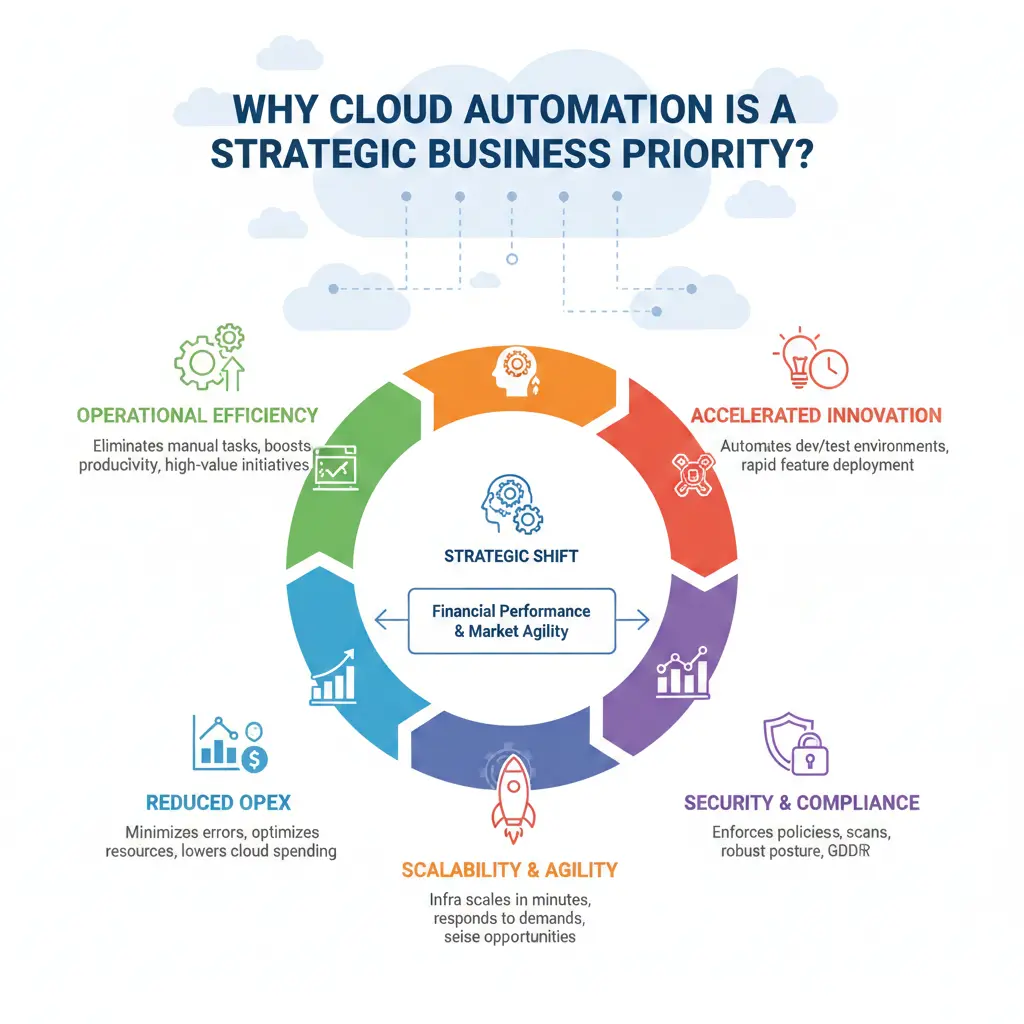
Adopting cloud automation is a critical strategic move that directly influences financial performance and market agility in the digital economy. It shifts the focus from manual maintenance to innovation, allowing organizations to scale efficiently and meet dynamic demands.
- Drastic improvement in operational efficiency: Automation eliminates time-consuming manual tasks, freeing up engineering teams to focus on high-value strategic initiatives. This shift boosts overall productivity and allows the organization to achieve more with existing resources.
- Significant reduction in operational expenditure (OPEX): By minimizing manual errors and optimizing resource usage, automation significantly lowers the risk of costly downtime and unnecessary cloud spending. Gartner forecast suggests that optimizing these costs is essential for managing rising IT budgets effectively.
- Enhanced business scalability and agility: Automated workflows allow infrastructure to scale up or down in minutes in response to fluctuating market demands or traffic surges. This capability ensures businesses can seize opportunities quickly without compromising performance or availability.
- Strengthened security and compliance posture: Automation tools continuously enforce security policies and conduct vulnerability scans to ensure strict adherence to regulations like GDPR. This proactive approach creates a robust, auditable security posture that minimizes the risk of data breaches.
- Accelerated product innovation cycles: By automating the creation of development and testing environments, companies can significantly speed up their software development lifecycle. This enables rapid deployment of new features, helping businesses stay ahead of the competition in a fast-paced market.
Cloud Automation vs. Cloud Orchestration
Automation and orchestration are often used together in cloud operations, yet each plays a very different role. To help you clearly see how they compare, the table below summarises their core differences in a simple side-by-side view before we dive deeper into each concept.
| Aspect | Cloud Automation | Cloud Orchestration |
|---|---|---|
| Primary Function | Automates a single, repeatable task | Coordinates multiple automated tasks |
| Scope | Narrow and task-specific | Broad, manages full workflows |
| Examples | Restarting VMs, installing updates | Deploying an application across environments |
| Human Intervention | Minimal after setup | Minimal, but involves more complex planning |
| Outcome | Faster completion of individual actions | End-to-end delivery of a complete service |
Cloud automation manages individual tasks like restarting virtual machines or installing updates. Orchestration links these automated steps into a complete workflow that delivers full services. Used together, they create a coordinated cloud environment that improves efficiency.
“Many organisations underestimate the gap between automating a task and orchestrating an entire workflow. True cloud efficiency comes from aligning these automated steps into a seamless, well-governed process that consistently delivers business outcomes.”
— Angela Tan, Regional Manager
How Does Cloud Automation Work?
Cloud automation translates manual procedures into software-driven workflows using scripts, templates, and policies. This layered approach ensures that from resource deployment to security monitoring, the infrastructure remains self-managing and resilient.
1. Automated resource provisioning and de-provisioning
Instead of manual setup, developers use Infrastructure as Code (IaC) templates to define precise resource requirements, enabling the platform to provision servers automatically. This ensures standardization and rapid deployment, removing the delays associated with manual administration.
When these resources are no longer required, the system automatically de-provisions them to prevent resource sprawl. This capability directly reduces costs by ensuring you only pay for the infrastructure you are actively using.
2. Consistent configuration management
Automation tools enforce consistency by applying standard configurations across all servers simultaneously, eliminating the risk of “configuration drift.” This ensures that every part of your infrastructure mirrors the approved settings defined in your central templates.
Updates or patches are rolled out via these central templates, ensuring every server receives the necessary changes instantly. This eliminates the need for manual updates and ensures that the entire environment remains in its desired state.
3. Proactive monitoring and problem remediation
Modern platforms continuously monitor infrastructure health, detecting anomalies such as high CPU usage or application errors in real time. This vigilance allows the system to identify potential issues before they escalate into service outages.
Upon detection, the system triggers automated remediation workflows, such as restarting a server, to resolve issues. This rapid response significantly reduces the mean time to resolution while maintaining high user availability.
4. Automated security and governance
Automation maintains security by enforcing identity access rules and continuously scanning for vulnerabilities or open ports. It acts as an always-on guardian that validates every change against your company’s security policies.
If a non-compliant change is detected, the system immediately reverts it or alerts security teams, ensuring continuous adherence to regulatory standards. This automated oversight is crucial for maintaining compliance in highly regulated industries.
Benefits of Cloud Automation
Implementing cloud automation delivers tangible improvements across various facets of business operations, driving both performance and stability. These benefits empower organizations to operate with greater precision while significantly reducing overhead.
- Efficiency and reliability: Automated processes run 24/7 with consistent precision, eliminating bottlenecks associated with human intervention. This ensures critical workflows are executed reliably and faster than manual methods allow.
- Cloud security: Automation enforces strict governance policies and performs continuous security scans to detect vulnerabilities instantly. This reduces the attack surface and ensures compliance with industry regulations is always maintained.
- Cost efficiency: By automatically rightsizing resources and shutting down unused instances, businesses can drastically cut cloud waste. This financial governance ensures that IT spending is directly aligned with actual usage and business value.
- Reduction in errors: Replacing manual inputs with scripted workflows virtually eliminates the risk of human error in configurations and deployments. This leads to a more stable environment with fewer outages and less time spent on troubleshooting.
To further enhance operational precision, integrating Inventory Software ensures your physical stock management aligns perfectly with your automated digital workflows. This synergy provides end-to-end visibility and efficiency across your entire supply chain.
Examples of Cloud Automation in Various Industries
The versatility of cloud automation allows it to address unique operational challenges across diverse sectors, from finance to healthcare. These real-world applications demonstrate how automation drives transformation and creates specific business value.
- Financial sector: Banks utilise automation to rapidly deploy secure mobile apps while continuously validating configurations against strict compliance standards such as PCI DSS. This ensures speed-to-market without compromising the security of sensitive financial data.
- Manufacturing and supply chain: Manufacturers integrate IoT with cloud automation to monitor production lines and trigger automatic purchase orders when inventory runs low. This proactive management minimises downtime and ensures a smooth flow of materials through the supply chain.
- Retail and e-commerce: E-commerce platforms leverage auto-scaling to dynamically adjust server capacity during traffic spikes, such as sales events, ensuring seamless performance. Additionally, automation processes real-time customer data to deliver personalised marketing, driving higher engagement and sales.
- Healthcare services: Healthcare providers use automated governance to secure electronic health records in compliance with HIPAA regulations. Researchers also automate the provisioning of high-performance computing for data analysis, accelerating medical discoveries while managing costs.
Successful Cloud Automation Implementation Strategy (Roadmap)
A successful automation journey requires a structured roadmap to transform processes and culture effectively. Following a phased approach ensures that initiatives are aligned with business objectives and deliver measurable ROI.
1. Stage 1: Assess needs and define clear objectives
Begin by identifying repetitive, error-prone tasks through a thorough assessment of current IT processes and team challenges. This helps pinpoint high-impact areas where automation can deliver the quickest value.
Define measurable goals tied to business outcomes, such as reducing deployment time or cutting cloud spending, to guide the initiative. Having clear targets ensures that the automation strategy remains focused on driving tangible business improvements.
2. Stage 2: Select the right tools and platforms
Choose tools based on your specific needs, existing stack, and team skills, considering options like AWS CloudFormation or Terraform. It is crucial to select platforms that integrate well with your current environment to avoid compatibility issues.
Start with native cloud provider tools for ease of use and supplement with third-party solutions as your automation maturity grows. This allows your team to build competence gradually before tackling more complex automation scenarios.
3. Stage 3: Start with a pilot project and measure results
Select a low-risk, well-defined pilot project, such as automating test environments, to gain hands-on experience without disrupting core operations. This controlled environment allows for safe experimentation and learning before broader rollout.
Establish KPIs beforehand to measure the project’s impact, providing a clear business case to support broader adoption across the organization. Demonstrating early success with data is key to securing stakeholder buy-in for future phases.
4. Stage 4: Scale, optimise, and foster a culture of continuous improvement
Scale successful efforts by documenting learnings and creating reusable templates while investing in training to upskill your teams. Building a knowledge base ensures that best practices are standardized across the organization.
Treat automation as an ongoing process by regularly reviewing workflows and metrics to optimize performance and drive continuous business value. Continuous refinement ensures that your automation strategy evolves alongside your changing business needs.
Common Challenges in Cloud Automation Adoption and Their Solutions
While the benefits are clear, the path to cloud automation is often obstructed by technical and cultural hurdles that can derail progress. Anticipating these challenges allows leaders to set realistic expectations and allocate resources effectively.
A proactive mitigation strategy is essential to turn these potential roadblocks into opportunities for organizational growth. Below are common obstacles and practical solutions to navigate the adoption process successfully.
- The internal team’s skill gap: A lack of in-house expertise can be overcome by investing in training programs and partnering with managed service providers. Fostering a culture of continuous learning ensures your team builds the necessary skills for long-term success.
- New security risks from automated processes: Automation can propagate errors quickly, so it is crucial to adopt a DevSecOps mindset by integrating security checks early in the process. Implementing strict access controls and automated vulnerability scanning ensures the environment remains secure.
- Cloud cost management becomes more complex: Ease of provisioning can lead to resource sprawl, which should be managed by integrating FinOps practices into automation workflows. Automated tagging and budget alerts help track ownership and control spending to prevent budget overruns.
- Resistance to cultural and workflow changes: Teams may resist new processes, requiring strong leadership to communicate that automation eliminates tedious work rather than jobs. Involving employees in workflow design fosters ownership and demonstrates the value of focusing on strategic tasks.
The Future of Cloud Automation: Trends to Watch
The evolution of cloud automation is being driven by AI and financial governance, promising even greater abstraction of complexity. Understanding these emerging trends enables business leaders to build a forward-looking strategy that remains competitive.
- AIOps: Integrating AI for predictive operational management: Artificial Intelligence for IT Operations uses machine learning to predict issues and automate root cause analysis before they impact the business. This shift moves operations from reactive maintenance to predictive management, enhancing system availability.
- Serverless and container automation: As infrastructure becomes abstracted, automation will focus on managing high-level services like Kubernetes and serverless functions. This simplifies operations further, allowing developers to concentrate solely on code and application innovation.
- FinOps: Integrating automation in cloud financial management: The integration of automation with financial management will drive cost accountability through automated budget actions and resource optimization. This trend ensures that as cloud environments scale, they do so in a financially responsible and efficient manner.
Study Case: Cloud Automation Enhances Operational Efficiency at a Malaysian Enterprise
A mid‑sized Malaysian enterprise faced operational bottlenecks due to manual IT processes and disconnected systems, which slowed workflows and increased downtime. To address this, the company adopted cloud automation tools that centralized key functions such as server provisioning, software updates, and infrastructure monitoring. By automating repetitive tasks and standardizing configurations, the firm reduced manual intervention and minimized human error.
After implementation, the organization saw improved operational efficiency and faster deployment cycles. Cloud automation enabled consistent infrastructure management, accelerating application releases and ensuring smoother performance across environments. This enhanced reliability also reduced unexpected downtime, allowing IT staff to focus on strategic initiatives instead of routine maintenance.
Conclusion
Cloud automation is a strategic pillar that empowers Malaysian businesses to streamline operations, reduce errors, and maximize efficiency. By leveraging automated workflows, companies can focus on high-value activities rather than repetitive manual tasks, ensuring greater agility in a competitive market.
Implementing cloud automation requires careful planning and expert guidance to align technology with your operational goals. Consulting with specialists can help identify the most impactful processes to automate, select the right solutions, and integrate systems seamlessly across finance, inventory, and HR functions.
Take the next step toward operational excellence by exploring tailored automation strategies for your business. Schedule a consultation today to see how cloud automation can optimize your workflows, increase productivity, and support sustainable growth.
FAQ About Cloud Automation
-
What is the main difference between cloud automation and traditional IT automation?
Traditional IT automation often focuses on on-premise, static infrastructure, while cloud automation is designed for the dynamic, scalable, and API-driven nature of cloud environments, emphasising speed and elasticity.
-
How do you measure the ROI of cloud automation?
ROI is measured by tracking key metrics such as reduction in operational costs (OPEX), decreased time-to-market for new applications, improved developer productivity, and a reduction in downtime or security incidents
-
What are the first steps to start with cloud automation?
No, cloud automation is scalable and beneficial for businesses of all sizes. Startups and SMEs can leverage it to operate with the efficiency of a larger enterprise, enabling them to compete more effectively.