









Ever feel like warehouse issues only show up after they’ve already caused delays? That’s often a sign the real problem starts with planning, not daily operations. How a warehouse is structured and managed plays a major role in how smoothly a business runs and how well it can grow.
When planning falls short, the impact spreads quickly from slower deliveries to rising operational costs. Over time, these inefficiencies hold back performance and make it harder to scale with confidence. Clear visibility and structured processes are key to preventing small issues from turning into bigger disruptions.
In this guide, we’ll explore the core elements of effective warehouse planning and how the right systems can support more controlled, efficient operations as your business moves forward.
Key Takeaways
|
What Is Warehouse Planning?
Warehouse planning is the strategic process of designing and organizing all resources within a facility for peak efficiency. It encompasses workflows, inventory, labor, and technology to create a seamless operation.
This critical function is typically managed by logistics managers, supply chain directors, or operations executives. Their goal is to align the warehouse’s daily activities with the company’s broader strategic objectives.
Why Is Warehouse Planning Crucial for Your Business?
Investing in a structured plan is a strategic move that directly boosts your company’s financial health and market reputation. Effective planning transforms your warehouse from a cost center into a hub of profitability.
1. Optimize space and asset utilization
Meticulous planning helps maximize every square meter of your facility for storage and operations. This increases capacity and reduces the cost per unit stored without requiring physical expansion.
2. Enhance operational efficiency
A well-designed plan establishes logical workflows that minimize unnecessary movement and reduce downtime. This directly lowers labor costs per order and increases your overall throughput capacity.
3. Improve inventory accuracy and control
It provides a framework for tracking every item accurately from arrival to departure. This real-time visibility prevents stockouts and reduces capital tied up in overstocked goods.
4. Reduce operational costs
By optimizing layouts and workflows, you can significantly cut labor hours and reduce financial losses from obsolete or lost goods. This comprehensive approach directly lowers the largest operational expenses in a warehouse.
5. Increase customer satisfaction
Ultimately, an efficient warehouse app ensures faster and more accurate order fulfillment. This reliability builds brand loyalty and improves customer retention in a competitive market.
Key Components in Warehouse Planning
A comprehensive warehouse plan integrates several core components that must work together seamlessly. Understanding their interplay is key to building a robust and synergistic operation.
1. Layout and workflow
The layout dictates the physical flow of goods, people, and equipment from receiving to shipping. An optimal design minimizes travel distances and prevents operational bottlenecks.
2. Inventory management system
This system acts as the digital brain, tracking all stock movements and providing real-time visibility. It automates inventory control across the order fulfillment warehouse to ensure accurate data for strategic decision-making.
3. Labor and equipment
These resources execute all physical activities based on workload projections and operational design. Proper management ensures tasks are completed efficiently and safely with the right tools.
4. Technology and information systems
Technology connects all warehouse components, enabling seamless data flow and process automation. It provides the tools for real-time tracking and monitoring of key performance indicators.
The Warehouse Planning Process in 7 Strategic Steps
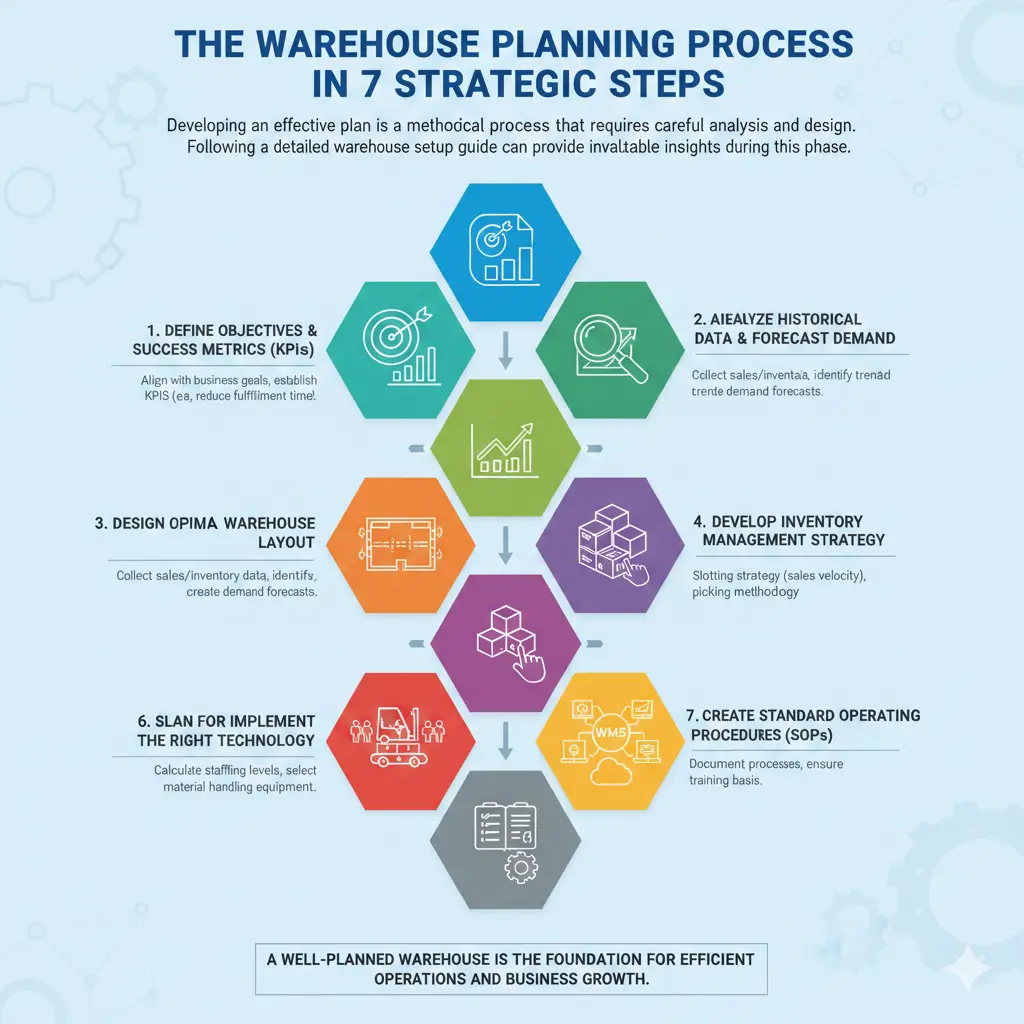
Developing an effective plan is a methodical process that requires careful analysis and design. Following a detailed warehouse setup guide can provide invaluable insights during this phase.
1. Define objectives and success metrics (KPIs)
First, align your warehouse objectives with broader business goals, such as reducing fulfillment time. Then, establish relevant KPIs to track progress and measure success accurately.
2. Analyze historical data and forecast demand
Collect and analyze historical data on sales and inventory movements to identify trends. This analysis forms the basis for creating an accurate demand forecast for future planning.
3. Design an optimal warehouse layout
Map out all functional areas to create a logical, one-way material flow. The design should consider product characteristics and equipment needs to maximize space and efficiency.
4. Develop an inventory management strategy
Develop a slotting strategy to place SKUs in the most logical storage locations based on sales velocity. Also, determine the most suitable picking methodology to increase team productivity.
5. Plan for labor and equipment needs
Calculate the staffing levels required for each function based on workload projections. Concurrently, select the appropriate type and quantity of material handling equipment for your layout.
6. Select and implement the right technology
Evaluate and select the right technology, with the right Warehouse Management System (WMS) at the core. This system orchestrates all activities and provides the most efficient routes to operators.
7. Create standard operating procedures (SOPs)
Document all designed processes into clear Standard Operating Procedures (SOPs). These guides ensure every task is performed consistently and serve as a basis for training.
Best Practices for Effective Warehouse Planning
Creating a solid plan is just the start; the real challenge is keeping it relevant amid changing business conditions. Adopting a mindset of continuous improvement is crucial for long-term success.
1. Conduct regular reviews and audits
Schedule regular reviews to evaluate performance against your established KPIs. This allows you to identify improvement areas and adjust strategies before issues escalate.
2. Leverage automation technology
Implement a robust Warehouse Management System (WMS) to automate complex decisions and reduce manual errors. This technology provides a quantum leap in both productivity and accuracy.
3. Prioritize safety and ergonomics
Design ergonomic workstations and ensure the facility is clean, well-lit, and free of obstructions. A focus on safety reduces injuries and improves overall employee morale.
4. Train your team comprehensively
Provide comprehensive and ongoing training to ensure your team masters all tools and systems. A well-trained team is your most valuable asset for achieving operational excellence.
Study Case: Warehouse Planning Improves Performance in a Malaysian Distribution Centre
A regional distribution centre in Malaysia faced challenges with inventory visibility, order accuracy, and warehouse coordination due to outdated manual processes. To address these issues, the company implemented a Warehouse Management System (WMS), integrating barcode and radio frequency tracking across receiving, stocking, picking, and dispatch operations. This system connected warehouse activities with enterprise software, enabling real-time inventory monitoring and more accurate fulfilment.
After adopting the structured warehouse planning and management approach, the distribution centre saw improvements in operational efficiency and order fulfilment speed. The enhanced visibility helped teams reduce errors in stock handling and align warehouse tasks with overall business goals. Managers were also able to better forecast inventory needs and coordinate internal workflows more effectively.
Conclusion
Warehouse planning plays a crucial role in building efficient operations and supporting long-term business growth. A structured approach helps align space utilization, workflows, and service levels so your warehouse can operate with greater consistency and control.
Turning strategy into results requires the right digital foundation to connect data, processes, and teams. With better visibility and coordinated planning, warehouses can move from day-to-day firefighting toward more stable, predictable performance.
If you’re exploring ways to strengthen your warehouse operations, consider discussing your current challenges and goals with a solutions consultant to identify the most suitable system approach for your needs.
FAQ about Warehouse Planning
-
What is the meaning of warehouse planning?
Warehouse planning is the process of designing and managing resources such as space, inventory, labor, and equipment to ensure smooth and efficient warehouse operations.
-
How to plan a warehouse?
Start by assessing storage needs, creating an organized layout, defining workflows, using warehouse management software, and continuously monitoring performance to improve productivity.
-
What are the 4 main functions of a warehouse?
The four main functions are storage, inventory control, order processing, and distribution, which work together to support effective supply chain management.