









Southeast Asia produces nearly 80% of the world’s natural rubber (ARC Group). Thailand, Indonesia, Vietnam, and Malaysia are the biggest contributors. In Malaysia alone, rubber product exports reached around 14 billion USD in 2021, with latex goods as the biggest contributor.
However, turning raw latex into usable material is not as simple as tapping a tree and shipping the liquid. Latex compounding is the process that sits between raw latex and finished products like gloves, balloons, catheters, and foam mattresses. It involves mixing latex with chemicals like vulcanizers, stabilizers, and fillers in exact proportions. Get the formula slightly wrong and the end product tears too easily, loses shape, or fails safety testing.
This guide explains how the latex compounding process works, what goes into each stage, where quality problems usually start, and what manufacturers can do to keep production consistent.
Key Takeaways
|
What is Latex Compounding?
Latex compounding is a fundamental process that transforms raw natural or synthetic latex into a ready-to-use material. It involves mixing liquid latex with various chemical additives in a precise formulation.
The primary goal is to engineer specific material properties like strength, elasticity, and durability. This ensures each product batch meets strict and consistent quality standards for commercial use.
The Differences Between Natural vs. Synthetic Latex Compounding
While the goal is to enhance material properties, the approaches for natural and synthetic latex differ due to their chemical origins. Understanding these differences is crucial for optimizing formulations and controlling quality.
| Feature | Natural Latex Compounding | Synthetic Latex Compounding |
|---|---|---|
| Origin | Extracted from the Hevea brasiliensis rubber tree, an organic source. | Produced from petroleum derivatives through polymerization. |
| Primary Focus | Enhancing durability, stability, and standardizing properties due to raw material variability. | Refining specific, pre-designed properties like oil or abrasion resistance. |
| Typical Additives | Requires potent antioxidants and antimicrobial agents to protect against degradation. | Uses special plasticizers for flexibility or functional additives for technical applications. |
Key Chemical Ingredients in the Latex Compounding Process
The success of latex compounding depends on the precise selection and proportion of chemical additives, known as the formulation. Each component has a specific function that contributes to the final material’s performance.
- Vulcanizing agents
These agents, like sulfur, create cross-links between rubber polymer chains to provide strength and elasticity. This process, defined by the American Chemical Society, ensures mechanical durability. - Accelerators
Accelerators increase the rate of the vulcanization reaction, allowing it to occur faster and at lower temperatures. This improves production efficiency and enhances the final product’s physical properties. - Activators
Activators, such as zinc oxide, work with accelerators to optimize the vulcanization process’s efficiency. They ensure the reaction proceeds consistently for a uniform cure and predictable performance. - Antioxidants and antiozonants
These protective additives slow the material’s degradation from exposure to oxygen, heat, and UV light. They chemically interfere with oxidative reactions to extend the product’s service life. - Fillers
Fillers like carbon black enhance mechanical strength, while others like calcium carbonate reduce production costs. They also modify properties such as hardness and abrasion resistance. - Stabilizers and thickeners
Stabilizers keep rubber particles evenly dispersed to prevent premature coagulation during mixing. Thickeners adjust the compound’s viscosity for specific processing methods like dipping or coating.
What Happens at Each Stage of Latex Compounding
There are five main stages in latex compounding. Each one builds on the previous step, so a mistake early on usually carries through the entire batch.
- Weighing and material preparation
Every batch starts with a formula. Chemicals like sulphur, zinc oxide, accelerators, and stabilizers are weighed using calibrated scales. Even a small error here changes the final product. Too much zinc oxide and the compound thickens too fast during storage. Too little sulphur and the rubber will not cure properly. - Dispersion
Some chemicals do not dissolve in water. They need to be ground into fine particles and mixed into a water based suspension using a ball mill or colloid mill before they can enter the latex.
If the particles are not fine enough, they clump instead of spreading evenly. The result is inconsistent curing and weak spots in the finished product. This stage is hard to fix after the fact. Once a poorly dispersed chemical enters the mix, you cannot undo it. - Mixing
Dispersions and liquid additives are added to the raw latex one at a time while stirred at low speed. The order matters. Adding chemicals in the wrong sequence can trigger early coagulation or destabilize the latex before the compound is ready. - Maturation
After mixing, the compound is stored for a set period to let early stage vulcanization begin. Glove compounds may need 24 to 72 hours. Foam compounds may need longer.
Shortening maturation is a common shortcut when deadlines are tight. But an under matured compound behaves differently during dipping or moulding, and defects usually only show up after curing. - Quality testing
A sample is pulled and tested for viscosity, pH, total solid content (TSC), and mechanical stability. If anything falls outside the target range, the batch is adjusted or held back. This is the last checkpoint before production. Catching a problem here costs time. Missing it costs an entire production run.
Common Challenges and Solutions in Latex Compounding
While an established process, latex compounding faces several technical and operational challenges in an industrial setting. Identifying and mitigating these issues is key to maintaining a smooth and profitable operation.
- Compound instability
A major challenge is preventing coagulation, where rubber particles clump together due to improper pH or contamination. The solution involves strict pH monitoring and using appropriate stabilizers to maintain homogeneity. - Pre-coagulation
This premature hardening occurs if the vulcanization reaction starts too early, often due to high temperatures. Control mixing tank temperatures and use accelerators with a longer induction period to prevent this. - Raw material variability
Natural latex quality can vary by season or origin, affecting product consistency. Implement strict supplier qualification and adjust formulations dynamically to compensate for these variations. - Regulatory compliance
Adhering to strict safety standards from bodies like the FDA is a significant challenge. Maintain complete documentation for raw materials and stay updated on the latest regulations to ensure compliance.
How Manufacturing Software Helps Latex Compounding
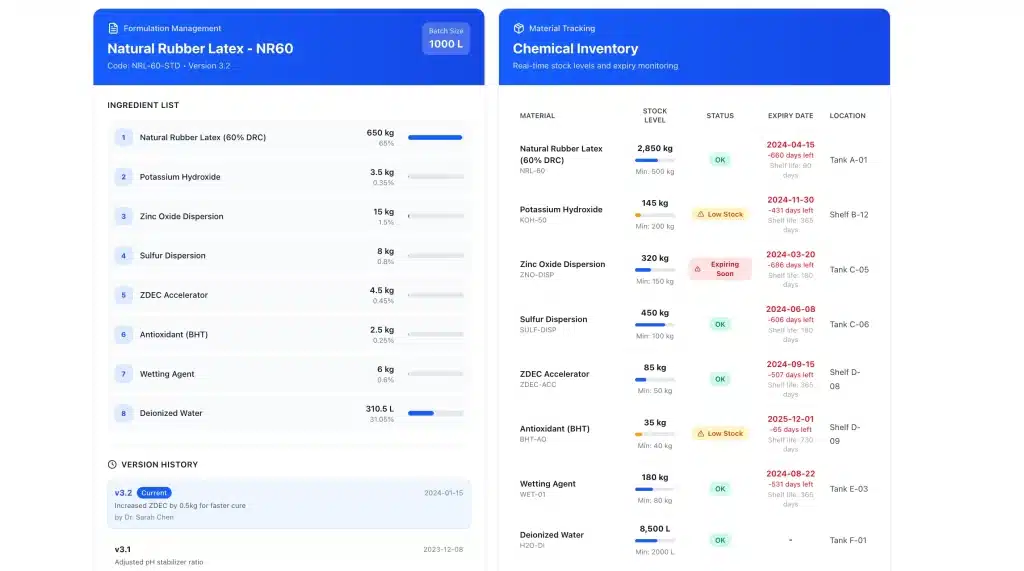
The same production gaps that cause problems in industries like paint manufacturing also show up in latex compounding. The warehouse does not flag low stock on zinc oxide until production already needs it. QC results are logged manually and only reviewed at the end of the week. Maturation times are tracked on whiteboards that nobody updates consistently. Manufacturing software connects those gaps into one system.
- Formulation management: Every compound recipe is stored digitally with exact ingredient ratios. When a formula is updated, the system applies it to all future batches automatically. No more outdated recipe sheets on the factory floor.
- Material tracking: The system monitors chemical stock levels in real time and triggers reorder alerts before shortages disrupt production. For chemicals with shelf life limits, it flags expiring stock first.
- Production scheduling: Batches are scheduled based on actual orders, tank availability, and maturation time requirements. This prevents the common problem of compounds sitting too long or being rushed to production before they are ready.
- Quality checkpoints: Test results for viscosity, pH, and TSC are logged at each stage and linked to the batch number. If a batch fails testing, the system traces it back to the exact materials and operator involved.
ERP systems with manufacturing modules cover all of these functions. Most providers offer free trials or demos, so you can test which one fits your production workflow before committing.
Applications of Latex Compounding Products Across Various Industries
The flexibility of the latex compounding process allows for creating materials with diverse properties for nearly every industrial sector. This adaptability opens the door for applications ranging from disposable goods to durable industrial components.
- Medical and healthcare industry
This sector uses latex for products like medical gloves and catheters, valuing its barrier properties and elasticity. Formulations are strictly regulated to ensure biocompatibility and minimize allergy risks. - Consumer goods
Everyday products like balloons, shoe soles, and latex foam mattresses are made from compounded latex. Each item requires a unique formulation, such as high abrasion resistance for footwear. - Construction and automotive industries
Latex compounds are used in tile adhesives and waterproof coatings in construction and for seals and hoses in automotive. These applications demand high durability and resistance to harsh conditions. - Textiles and adhesives
In textiles, latex is used for carpet backing to lock in fibers and provide dimensional stability. It also forms the basis for water-based adhesives used in packaging and woodworking.
Read more: What Are Precision Components and How to Choose Them?
Conclusion
Latex compounding is an essential science that transforms raw latex into high-performance materials for numerous industries. Precise formulation and process control are the foundation for achieving market-leading quality and consistency.
To stay competitive, adopting technology like HashMicro Manufacturing Software is a crucial strategic step. It optimizes efficiency, ensures traceability, and drives innovation through data and automation.
By combining formulation expertise with a powerful ERP system, your operations can become more productive and resilient. Take the next step and schedule a free demo to see how we can help.
Frequently Asked Questions About Latex Compounding
-
What exactly happens during latex compounding?
Latex compounding is where you turn raw latex into a controlled production formula. You mix base latex with stabilisers, accelerators, fillers, and other additives in specific ratios. The goal is consistency. You want stable viscosity, proper dispersion, and predictable curing behaviour before the material moves to the next stage. If control slips here, defects usually show up later in production.
-
Why is formulation control so critical in latex production?
Small miscalculations create expensive problems. Adding chemicals in the wrong order or missing a measurement can destabilise the compound, affecting elasticity, tensile strength, or curing performance. Latex reacts to heat, shear, and chemical balance, so disciplined batching protects product quality and reduces material waste.
-
What common mistakes cause compound instability?
Instability often comes from rushing the process. Skipping proper dispersion time, ignoring temperature fluctuations, using inconsistent raw materials without adjustment, or cutting maturation time short can all affect compound performance. These issues may not appear immediately but often surface during quality testing.
-
How do you manage variability in natural latex?
Natural latex varies from batch to batch depending on sourcing and storage conditions. You manage this by testing incoming materials before compounding and adjusting formulations based on actual lab results. Standardising raw material inspections helps reduce unexpected behaviour during mixing and keeps production consistent.