







 Limited to 100 registrants

BAS compliance refers to how businesses report and manage tax obligations through the Business Activity Statement. It works by tracking GST, PAYG, and other taxes, then submitting accurate reports to meet ATO requirements and avoid penalties.
Proper BAS compliance helps businesses maintain accurate financial records and reduce reporting errors. It also supports better cash flow management and minimises the risk of penalties and compliance issues.
Key Takeaways
BAS compliance covers how businesses record, calculate, and report tax obligations through the ATO, affecting everything from cash flow to director liability.
BAS reporting involves tracking GST on sales & purchases, managing PAYG withholding & instalments, and lodging statements within deadlines.
Key challenges in BAS compliance include manual data errors, disconnected systems, missed deadlines, and incorrect tax classification.
Building a reliable BAS process involves structuring tax codes, reconciling accounts, reviewing reports before submission, and lodging on time

What is a BAS?
A Business Activity Statement (BAS) is a tax reporting form that registered businesses in Australia submit to the Australian Taxation Office (ATO). It consolidates multiple tax obligations into a single submission, including Goods and Services Tax (GST), Pay As You Go (PAYG) withholding, and PAYG instalments.
A BAS, or Business Activity Statement, is a form submitted to the ATO that businesses use to report and pay multiple tax obligations. It consolidates several tax types into a single periodic report.
Every business registered for GST must lodge a BAS. The ATO automatically sends a BAS once a business obtains an ABN and registers for GST.
A BAS covers GST collected on sales, GST paid on purchases, PAYG withholding from employee wages, and PAYG instalments. Some businesses also report fringe benefits tax instalments depending on their activities.
What BAS Compliance Means for Your Business
BAS compliance covers how a business records, calculates, and reports tax obligations through the Business Activity Statement. It ensures tax data is accurate, timely, and aligned with ATO requirements.
For businesses, this goes beyond submitting reports. It involves maintaining proper records, applying correct tax treatment, and keeping financial processes consistent within a structured financial system.
The following table outlines the main components involved in BAS reporting and how they affect business operations.
| Component | Description | Business Impact |
|---|---|---|
| GST | Tax collected on sales and paid on purchases | Affects cash flow and determines tax payable |
| PAYG Withholding | Tax withheld from employee wages | Ensures payroll tax compliance and accurate reporting |
| PAYG Instalments | Advance tax payments based on business income | Helps manage future tax liabilities |
| Other Taxes | Additional obligations depending on business activities | Varies based on industry and reporting requirements |
Understanding BAS and ATO requirements
The Business Activity Statement is used by the ATO to collect key tax information from businesses. It brings multiple tax obligations into one reporting process.
Understanding how the ATO expects data to be recorded and submitted helps reduce errors. It also ensures compliance is maintained across reporting periods.
Taxes included in BAS reporting
BAS reporting includes several taxes that businesses must manage regularly, such as GST and PAYG withholding. These amounts must be calculated accurately based on transactions.
Some businesses may also report additional obligations depending on their activities. Each tax component needs to be recorded and reported correctly.
The following table outlines the main components involved in BAS reporting and how they affect business operations.
| Component | Description | Business Impact |
|---|---|---|
| GST | Tax collected on sales and paid on purchases | Affects cash flow and determines tax payable |
| PAYG Withholding | Tax withheld from employee wages | Ensures payroll tax compliance and accurate reporting |
| PAYG Instalments | Advance tax payments based on business income | Helps manage future tax liabilities |
| Other Taxes | Additional obligations depending on business activities | Varies based on industry and reporting requirements |
Reporting frequency and obligations
BAS reporting frequency depends on business turnover and registration requirements. Businesses may report monthly, quarterly, or annually.
Meeting deadlines is essential to avoid penalties and interest charges. Consistent reporting also helps maintain accurate financial records.
Who Needs to Lodge a BAS in Australia?
Lodging a BAS is a legal obligation for most businesses operating in Australia. Whether a business must lodge depends primarily on GST registration status and the nature of its tax obligations.
1. GST-registered businesses
Businesses with an annual GST turnover of $75,000 or more must register for GST and lodge a BAS. Non-profit entities have a higher registration threshold of $150,000.
Businesses below the $75,000 threshold can choose to register for GST voluntarily. Once registered, they are also required to lodge a BAS regularly.
2. Businesses with PAYG withholding obligations
Any business that withholds tax from employee wages must include PAYG withholding in their BAS. This applies even if the business is not registered for GST.
Accurate PAYG reporting ensures employee tax contributions are correctly passed on to the ATO each period.
3. Ride-sourcing and taxi operators
Ride-sourcing and taxi operators must register for GST regardless of their annual turnover. This means they are also required to lodge a BAS from the first dollar earned.
This obligation applies to all operators providing these services to passengers in Australia.
Why BAS Compliance Impacts More Than Just Tax
BAS compliance affects more than tax reporting, as it directly influences financial control and business stability. Poor compliance can create risks that go beyond penalties and disrupt overall operations.
Financial penalties and legal exposure
Incorrect or late BAS submissions can result in penalties and interest charges from the ATO. These costs can quickly add up and affect financial performance.
Consistent errors may also lead to further legal complications. Maintaining accurate reporting helps reduce exposure to these risks.
Audit risks and ATO scrutiny
Inconsistent or inaccurate reporting increases the likelihood of ATO audits. Businesses with irregular patterns are more likely to be reviewed.
Clear and accurate records help reduce scrutiny. This makes it easier to respond if a review or audit occurs.
Cash flow and working capital impact
BAS reporting affects how businesses manage tax payments and cash flow. Miscalculations can lead to unexpected liabilities that strain working capital.
Accurate tracking of GST and other taxes helps businesses plan payments more effectively. This is easier when supported by financial management software that connects tax data with real-time financial insights.
Director liability and business risk
Directors can be held accountable for failing to meet tax obligations. This creates both financial and legal risks for the business.
Strong compliance processes help reduce this exposure. It also supports better governance and decision-making.
How BAS Reporting Actually Works
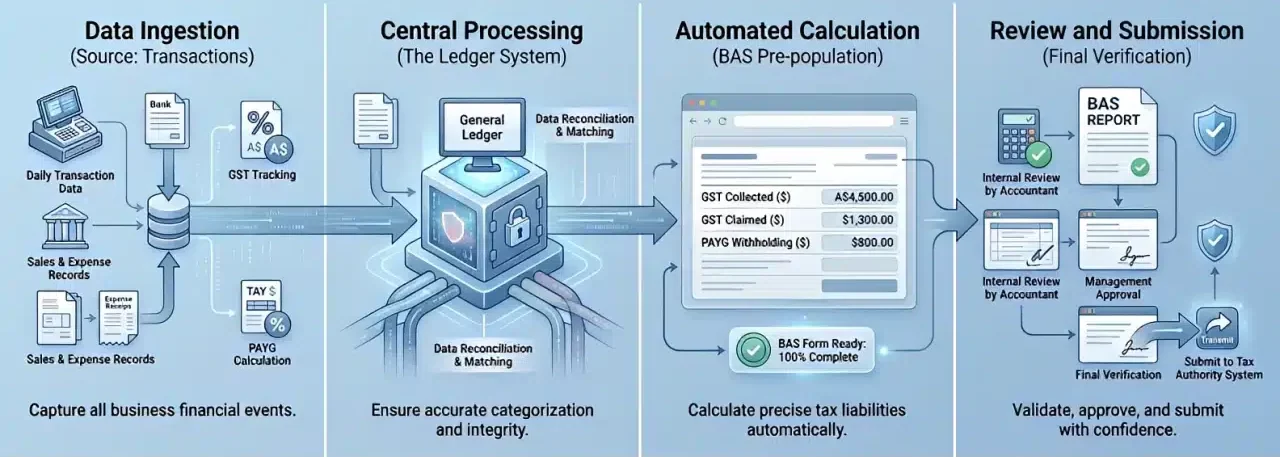
BAS reporting follows a structured process that brings together tax data from daily transactions. Each component must be tracked, calculated, and reported accurately to meet ATO requirements.
Tracking GST on sales and purchases
Businesses must record GST collected from sales and GST paid on purchases. This ensures the correct net GST amount is reported.
Accurate tracking helps avoid overpaying or underreporting tax. It also supports compliance with Goods and Services Tax compliance requirements and reliable financial reporting.
Managing PAYG withholding and instalments
PAYG withholding covers tax withheld from employee wages. PAYG instalments apply to tax paid in advance based on business income.
Both must be calculated correctly and included in BAS reporting. Proper management helps maintain compliance and avoids adjustments later.
Handling industry specific tax components
Some businesses have additional tax obligations depending on their activities. These may include specific reporting requirements beyond standard GST and PAYG.
Understanding these obligations ensures all relevant taxes are included. This helps prevent incomplete or incorrect submissions.
Preparing and lodging the BAS
Once all data is recorded, businesses prepare the BAS by summarising tax amounts. The statement must then be submitted to the ATO within the required timeframe.
Reviewing data before lodgment helps reduce errors. Timely submission ensures compliance and avoids penalties.
"Understanding how BAS reporting works is crucial for managing GST, PAYG, and other obligations accurately. Getting each stage right reduces errors and makes lodgment more straightforward."
Key Challenges in Maintaining BAS Compliance
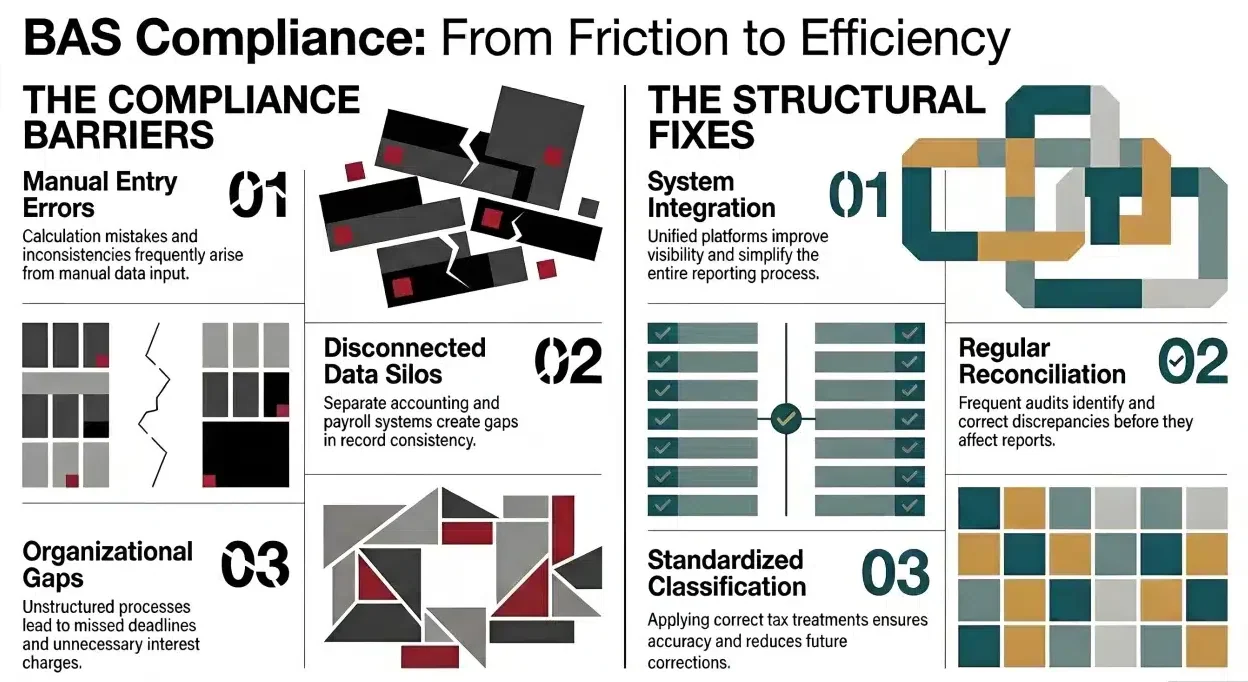
Maintaining BAS compliance can be difficult when processes are not well structured. Common issues often come from manual work, poor visibility, or inconsistent reporting practices.
Manual data errors and reconciliation issues
Manual data entry increases the risk of calculation mistakes and inconsistencies. These errors can affect the accuracy of BAS reports.
Regular reconciliation helps identify and correct discrepancies early. Maintaining clear and organised financial documentation also improves reporting accuracy and reduces compliance risks.
Disconnected systems and data silos
Using separate systems for accounting, payroll, and reporting creates gaps in data. This makes it harder to maintain consistency across records, especially in multi-site companies.
Integrated systems improve visibility and data accuracy. They also simplify the reporting process.
Missed deadlines and reporting gaps
Missing BAS deadlines can lead to penalties and interest charges. Delays often happen when reporting processes are not well organised.
Clear schedules and reminders help ensure reports are submitted on time. This supports consistent compliance.
Incorrect tax classification
Incorrectly classifying transactions can result in inaccurate tax reporting. This often happens when tax rules are misunderstood or applied inconsistently.
Applying the correct tax treatment ensures accurate reporting. It also reduces the need for corrections later.
How to Lodge a BAS Statement
Lodging a BAS correctly requires accurate records, careful calculations, and timely submission. Following a clear process helps reduce errors and ensures each component is reported correctly.
1. Gather records and reconcile accounts
Collect all financial records for the reporting period, including sales invoices, purchase receipts, and payroll data. Ensure all accounts are reconciled before starting.
Reconciliation confirms that all transactions are captured. It also reduces the risk of missing or duplicate entries in the BAS.
2. Calculate GST collected and paid
Add up all GST collected from taxable sales during the period. Then calculate the GST paid on eligible business purchases.
The net GST amount is the difference between the two figures. This is the amount reported in the BAS as payable or refundable.
3. Calculate PAYG withholding and instalments
Calculate the total tax withheld from employee wages during the reporting period. This is reported in the PAYG withholding section of the BAS.
If the business pays PAYG instalments, include the instalment amount for the period. Both figures must be recorded accurately before lodgment.
4. Fill out the BAS form
Enter all calculated figures into the relevant fields on the BAS form. Each tax component has a designated section, so accuracy in field placement is important.
The ATO pre-fills certain information on the BAS. Review this data carefully and update any figures that do not reflect actual transactions.
5. Review before submitting
Check all figures for accuracy before lodging the BAS. Confirm that GST, PAYG, and any other reported amounts align with your financial records.
Reviewing before submission helps catch errors early. Corrections after lodgment can attract additional ATO attention.
6. Lodge your BAS
Businesses can lodge online via the ATO Business Portal or through a myGov account linked to the ATO. Online lodgment includes a two-week extension on the standard due date.
Other options include lodging through SBR-enabled accounting software, via a registered BAS or tax agent, or by mail using the paper BAS form sent by the ATO.
BAS Compliance Across Different Industries
BAS compliance requirements vary across industries depending on how transactions are recorded and reported. Each sector faces different challenges in managing tax obligations accurately.
Construction and property
Construction and property businesses often deal with long project timelines and staged payments. This can make GST reporting and timing more complex.
Accurate tracking of project costs and revenue helps ensure correct reporting. It also reduces the risk of misstatements.
Retail and e-commerce
Retail and e-commerce businesses process high volumes of transactions daily. This increases the risk of errors in GST calculation and reporting.
Automated systems help manage large datasets more efficiently. They also improve accuracy and reporting consistency.
Healthcare and professional services
Healthcare and professional services may involve a mix of taxable and non-taxable services. This makes correct tax classification essential.
Understanding which services are subject to GST helps avoid reporting errors. It also ensures compliance with ATO requirements.
Building a Reliable BAS Compliance Process
A structured process helps businesses manage BAS compliance more consistently and accurately. Following clear steps reduces errors and improves reporting efficiency.
Structuring financial data and tax codes
- Set up clear tax codes for different types of transactions. This ensures GST and other taxes are recorded correctly from the start.
- Organise financial data in a consistent format. This makes reporting easier and reduces the risk of misclassification.
Reconciling accounts and verifying transactions
- Reconcile accounts regularly to ensure all transactions are recorded accurately. This helps identify discrepancies early.
- Verify key transactions before reporting. This reduces the risk of errors in BAS submissions.
Reviewing reports before submission
- Review BAS reports carefully before lodging them. This helps confirm that all figures are correct.Check for inconsistencies or missing data.
- This prevents the need for later adjustments.
Ensuring accurate and timely lodgment
- Prepare BAS reports ahead of deadlines to avoid last-minute errors. This improves accuracy and reduces stress.
- Submit reports on time to avoid penalties. Consistent lodgment supports long-term compliance.
Retaining BAS records for at least five years
- The ATO requires businesses to keep tax invoices, purchase receipts, and financial records for a minimum of five years. This applies to both digital and paper records.
- Maintaining organised documentation helps businesses respond more efficiently to audits, reviews, or requests to verify previous BAS submissions.
Integrated tools such as an enterprise accounting system in Australia can further support this process by aligning tax reporting, financial data, and compliance requirements within a single platform.
Smarter Ways to Manage BAS Compliance
Managing BAS compliance effectively requires more than manual tracking. Businesses need better systems and processes to improve accuracy and reduce risk.
1. Cloud accounting and system integration
Cloud accounting systems allow businesses to access financial data in real time. Integration between functions such as payroll and procurement through an ERP system helps ensure consistent data across reports.
This reduces manual work and improves accuracy. It also simplifies BAS preparation.
2. Real-time monitoring and automation
Real-time tracking helps businesses monitor tax obligations as transactions occur. This reduces the risk of errors building up over time.
Automation can handle repetitive calculations and reporting tasks. This improves efficiency and reduces manual mistakes.
3. Working with BAS agents and advisors
BAS agents and advisors provide guidance on tax requirements and reporting accuracy. They help businesses stay aligned with current regulations.
Professional support also reduces the risk of errors. It provides additional assurance before lodgment.
4. Strengthening internal tax governance
Strong internal processes help ensure consistency in tax reporting. Clear responsibilities and review procedures improve accountability.
This reduces reliance on manual checks. It also supports long-term compliance.
BAS Due Dates and Lodgment Schedule in Australia
Understanding when BAS reports are due helps businesses plan ahead and avoid penalties. Due dates vary depending on how frequently a business is required to lodge.
1. Monthly BAS due dates
Businesses with a GST turnover of $20 million or more must lodge and pay monthly. The due date is the 21st day of the month following the end of the reporting period.
For example, the BAS covering April activity is due on 21 May. Consistent monthly lodgment keeps tax obligations current and reduces the risk of accumulating liabilities.
2. Quarterly BAS due dates
Most businesses in Australia lodge their BAS quarterly. The ATO sets specific due dates for each quarter of the financial year.
| Quarter | Period | Due Date |
|---|---|---|
| Quarter 1 | July to September | 28 October |
| Quarter 2 | October to December | 28 February |
| Quarter 3 | January to March | 28 April |
| Quarter 4 | April to June | 28 July |
Quarterly lodgers with a turnover below $20 million can also gain a two-week extension by lodging online. This brings the effective deadline to 11 days later than the standard date for most quarters.
3. Annual GST return
Businesses voluntarily registered for GST with a turnover below $75,000 may be eligible to report and pay annually. The due date for the annual GST return is 31 October.
Annual lodgment reduces reporting frequency but requires careful record-keeping throughout the year to ensure accuracy at lodgment time.
4. Deferral options
The ATO may grant a deferral in exceptional circumstances, such as natural disasters or significant business disruptions. Businesses must contact the ATO before the due date to request a deferral.
Deferrals are assessed on a case-by-case basis and are not automatic. Businesses that regularly miss deadlines are less likely to be granted extensions.
5. What happens if you miss the due date
Missing a BAS due date can result in a failure-to-lodge penalty from the ATO. The penalty amount depends on the size of the business and how long the lodgment is overdue.
Interest charges may also apply to unpaid tax amounts. Businesses that miss a deadline should lodge as soon as possible according to ATO rules contact the ATO to discuss payment options.
Common Mistakes That Trigger ATO Attention
Certain reporting mistakes can increase the likelihood of ATO reviews. Avoiding these errors helps businesses maintain compliance and reduce risk.
GST misclassification
Incorrectly classifying GST on transactions can lead to inaccurate reporting. This often happens when tax rules are applied inconsistently.
Applying the correct GST treatment ensures accurate BAS reporting. It also reduces the need for adjustments.
Contractor vs employee errors
Misclassifying workers as contractors instead of employees can create tax issues. This affects PAYG withholding and reporting obligations.
Understanding the correct classification rules helps prevent compliance risks. It also ensures accurate reporting.
Unreported cash transactions
Failing to record cash transactions can result in incomplete reporting. This creates discrepancies in financial records.
Recording all income ensures accurate BAS submissions. It also reduces audit risks.
Incorrect timing of GST claims
Claiming GST at the wrong time can affect reporting accuracy. This often happens when transactions are recorded incorrectly.
Ensuring correct timing improves compliance and reporting consistency. It also avoids unnecessary adjustments.
Conclusion
BAS compliance plays a critical role in maintaining accurate tax reporting and financial control. With proper processes in place, businesses can reduce errors, avoid penalties, and manage obligations more effectively.
As reporting requirements become more complex, relying on manual processes increases the risk of mistakes and delays. Businesses that adopt structured systems and clear workflows can maintain consistency and improve overall performance.
If your business wants to improve BAS compliance and reduce reporting risks, you can request a free consultation to find the right approach for your needs.

FAQ About BAS Compliance
Businesses can correct BAS errors by revising the statement or adjusting the next BAS. Fixing errors early helps avoid penalties and additional scrutiny from the ATO.
Yes, BAS can be amended after submission. Businesses can update incorrect figures through revisions or include adjustments in future reporting periods.
Businesses can improve accuracy by using structured processes, reconciling data regularly, and adopting accounting systems that automate tax tracking and reporting.
Common triggers include inconsistent reporting, GST misclassification, missing transactions, and frequent errors across reporting periods.