








 Limited to 100 registrants

Understanding modern awards is essential for any business managing employees in Australia. These instruments sit at the centre of employment compliance and directly affect payroll, rostering, and workplace obligations. Therefore, businesses that apply modern awards correctly reduce legal risk and build fair employment practices from the outset.
Modern awards operate under the Fair Work Act 2009 and work alongside the National Employment Standards. While the NES sets minimum conditions for all employees, modern awards add industry and role-specific requirements. As a result, businesses gain clearer guidance on pay rates, hours, and entitlements.
For employers, payroll teams, and HR leaders, modern awards are not optional references. They influence daily operational decisions and shape how a workforce is managed. When applied correctly, they also support transparency, consistency, and trust across the company
Key Takeaways
Modern awards define minimum pay rates and employment conditions for specific industries and occupations.
Correct application reduces legal risk, prevents underpayment claims, and supports fair employment practices.
Modern awards sit above the NES and must always provide equal or better conditions.
Regular reviews, correct classifications, and automated payroll systems help maintain compliance.

What Is a Modern Award?
A modern award is a legally binding document that sets minimum employment terms for a specific industry or occupation. It outlines conditions such as pay rates, working hours, allowances, and overtime rules that businesses must follow.
These awards were introduced under the Fair Work Act 2009 to replace fragmented state and federal systems. The goal was to simplify employment regulation and create consistent standards across industries. Currently, more than 100 modern awards apply across the national workplace system.
Unlike the National Employment Standards, modern awards do not apply universally. Instead, they reflect how different industries operate and address practical work arrangements. For example, they specify penalty rates, shift structures, and classification levels.
Together with the NES and the national minimum wage, modern awards form a mandatory safety net. Businesses cannot undercut these conditions, even by agreement, which makes correct interpretation critical.
Why Modern Awards Matter for Australian Businesses
"Modern awards are not just compliance documents. They are practical tools that help businesses pay employees correctly, manage risk, and maintain trust in the workplace."
Modern awards play a direct role in day-to-day business operations. Failing to apply them correctly can trigger underpayment claims, audits, and reputational damage. Therefore, compliance should remain a priority rather than an afterthought.
1. Industry-specific pay and conditions
Modern awards standardise wages and conditions within each sector. This creates consistency across the compensation management process and ensures employees receive fair pay for the demands of their work.
2. Reduced exposure to underpayment claims
Many high-profile wage disputes stem from award misinterpretation. By identifying and applying the correct modern award, businesses lower their risk of back-pay liabilities and penalties. A strong compliance process protects cash flow and business continuity.
3. Clear expectations for employers and employees
Modern awards provide transparent rules around breaks, overtime, and allowances. When expectations are clear, disputes reduce and workplace relationships improve. Consequently, engagement and retention often rise.
Who Is Covered by a Modern Award?
Most employees in Australia fall under a modern award. This includes full-time, part-time, and casual workers employed by companies operating within the national system.
Coverage usually depends on the industry of the business or the duties performed by the employee. In some cases, occupational awards apply regardless of the industry. Therefore, job content matters more than job titles.
However, not all employees are covered. Senior roles, high-income earners above the threshold, or employees on approved enterprise agreements may fall outside award coverage. Each situation requires careful assessment.
Key Components of a Modern Award
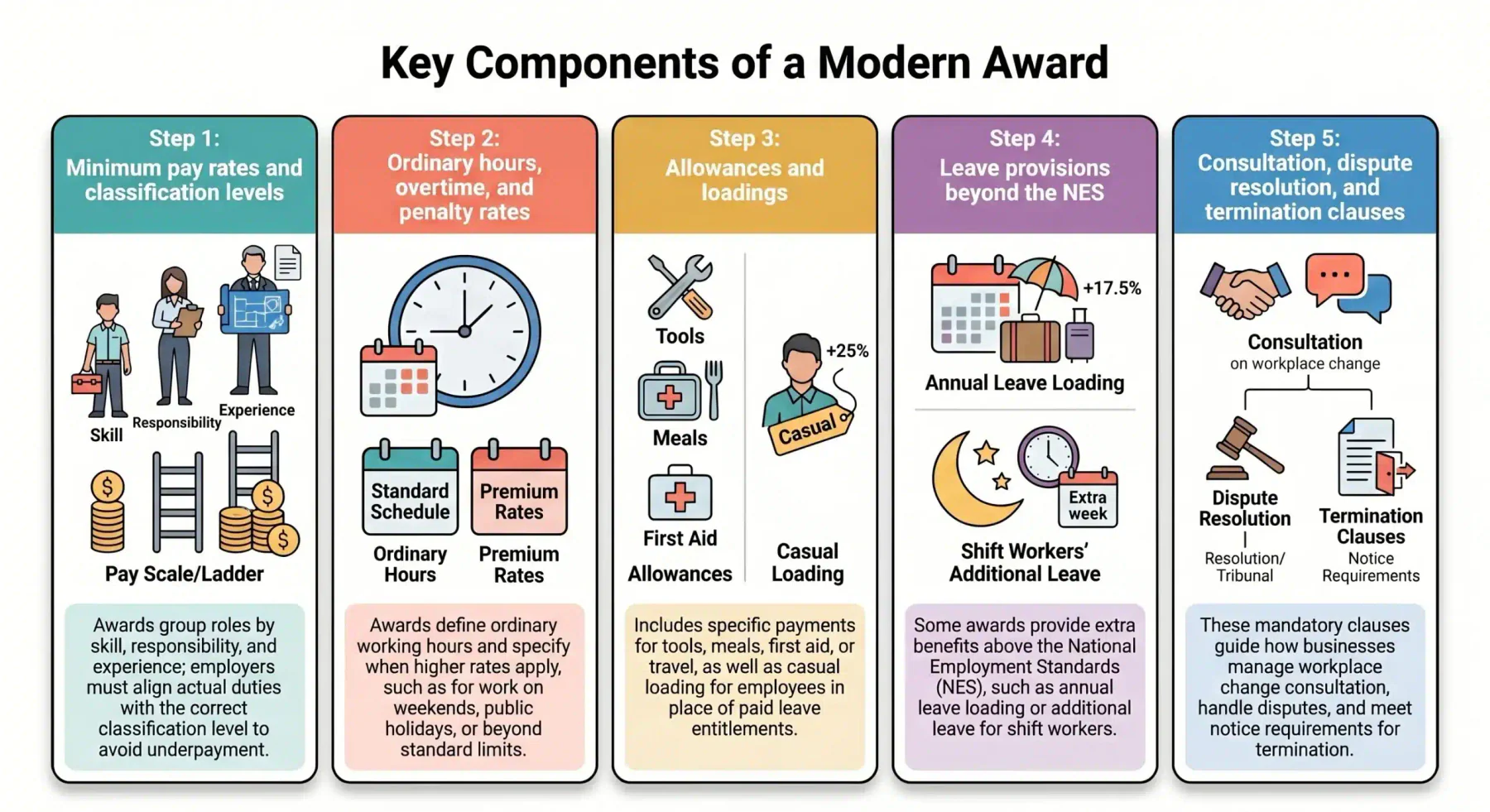
To achieve full compliance, HR professionals must have a granular understanding of the following components found within most awards:
1. Minimum pay rates and classification levels
Awards group roles by skill, responsibility, and experience. Each level has a set minimum rate. Employers must align actual duties with the correct classification to avoid underpayment.
2. Ordinary hours, overtime, and penalty rates
Awards define ordinary working hours and when higher rates apply, so accurate overtime rate calculation is essential. Work outside these limits often attracts overtime or penalty rates, including weekends and public holidays.
3. Allowances and loadings
Many awards include allowances for tools, meals, first aid duties, or travel. Casual employees also receive a casual loading in place of paid leave entitlements.
4. Leave provisions beyond the NES
Some awards offer extra benefits, such as annual leave loading or additional leave for shift workers. These entitlements sit above the NES and must be honoured.
5. Consultation, dispute resolution, and termination clauses
Every award includes clauses on workplace change consultation, dispute handling, and notice requirements. These rules guide how businesses manage sensitive employment matters.
How Modern Awards Work with the NES and Enterprise Agreements
Modern awards do not operate in isolation. Instead, they interact closely with the NES and enterprise agreements, forming a layered employment framework.
1. Awards as the next layer above the NES
The NES sets the absolute minimum conditions for all employees. Modern awards build on this base by adding industry-specific terms. Importantly, an award can never provide less than the NES.
2. Enterprise agreements and the Better Off Overall Test (BOOT)
Businesses may replace awards with enterprise agreements. However, these agreements must pass the Better Off Overall Test. Each employee must be better off than under the relevant modern award.
3. Individual Flexibility Arrangements (IFAs) within awards
Awards allow flexibility through Individual Flexibility Arrangements. These agreements vary certain terms, such as hours or allowances, while ensuring the employee remains better off overall.
How to Identify and Apply the Right Modern Award
Selecting the correct modern award requires careful review and ongoing attention. Misclassification often leads to compliance issues later.
1. Search the Fair Work Commission register
Begin by checking the Fair Work Commission award register. Identify whether your business falls under an industry award or whether specific roles align with occupational awards.
2. Match employee duties to award classifications
Compare employee responsibilities with award classification descriptions. Focus on actual work performed rather than position titles, as titles alone can mislead.
3. Check coverage clauses and exclusions
Each award includes a coverage section. Some roles or businesses may be excluded, even if they appear relevant at first glance.
4. Apply correct pay rates, allowances, and loadings
Once identified, configure a modern workforce management system to reflect correct rates, penalties, and allowances. Automation helps reduce manual errors and improves consistency across teams.
How Businesses Across Industries Use Modern Awards
Modern awards support workforce management across a wide range of industries. Each sector applies them differently based on operational needs.
Retail and hospitality businesses rely on awards to manage penalty rates, split shifts, and extended trading hours. These rules help structure rosters and control labour costs.
Construction companies use awards to manage site allowances, travel payments, and weather-related provisions. These conditions reflect the mobile nature of the work.
Healthcare and aged care providers apply awards to manage continuous care, sleepovers, and travel between clients. Clerical awards, meanwhile, support structured progression for administrative roles.
Common Modern Award Compliance Mistakes
Many businesses unintentionally breach modern awards due to oversight rather than intent. These errors often accumulate over time.
Some employers rely on annualised salaries but fail to reconcile them against award entitlements. Without regular checks, underpayments can grow unnoticed.
Others neglect to update classifications as roles expand. When responsibilities increase without pay adjustments, liability builds steadily.
Missing allowances also cause frequent breaches. Even small entitlements must be paid. Incorrect casual loading calculations further increase compliance risk.
Best Practices for Managing Modern Award Compliance

Effective award management requires ongoing attention rather than one-off reviews. Strong systems reduce risk and support sustainable growth.
1. Review awards annually after Fair Work wage decisions
The Fair Work Commission typically updates minimum wages on July 1st each year. Ensure your payroll system is updated immediately to reflect these changes.
2. Classify every employee correctly from day one
Document your classification decisions. Having a clear rationale for why an employee was placed at a certain level provides a defense during audits.
3. Use payroll or ERP software to apply awards automatically
Manual calculations are prone to error. Australian compliant HR software with built-in award interpretation engines can automatically apply the correct rates based on timesheet data.
4. Maintain complete records of hours, pay, and entitlements
The Fair Work Act mandates that employers keep records for seven years, so dependable employee records software is critical. This includes hours worked, leave balances, and any agreements made regarding IFAs.
Conclusion
Modern awards shape how businesses manage pay, hours, and employee entitlements. When applied correctly, they reduce compliance risk and create clarity for both employers and employees. As a result, businesses can operate with greater confidence and consistency.
Staying compliant requires ongoing attention, accurate classifications, and reliable payroll processes. If you need help interpreting or applying modern awards correctly, book a complimentary consultation to review your current approach.
Frequently Asked Question
A modern award sets legally enforceable minimum pay and conditions for specific industries or occupations.
No. Coverage depends on industry, role duties, income level, and whether an enterprise agreement applies.
Yes. Businesses may offer better terms, but never less than award minimums.
Incorrect awards can cause underpayment claims, penalties, and reputational damage.
Pay rates typically update annually after Fair Work wage decisions.