









 Limited to 100 registrants

Financial audit reporting is an independent review of a company’s financial records and statements to verify accuracy and compliance with accounting standards. It provides a formal audit opinion that helps businesses maintain transparency, reduce reporting risks, and build trust with stakeholders.
Financial audit reporting is an accounting audit reporting system that evaluates financial statements to ensure accuracy and compliance with applicable standards. It provides an independent assessment that supports transparency in financial reporting.
It works by having an external auditor review financial records and issue an opinion based on sufficient evidence. This ensures financial information is reliable and meets regulatory requirements.
Key Takeaways
Understand how financial audit reporting validates financial records and ensures compliance with accounting standards.
Learn how audit reports differ from financial statements and internal audits in terms of purpose and responsibility.
Explore unqualified, qualified, and adverse opinions, along with other audit report types used in practice.
Break down the structure of a financial audit report, including opinion, basis, and key audit matters.

What Financial Audit Reporting Means for Business Compliance
Financial audit reporting shows whether a company’s financial records meet regulatory and accounting requirements. It helps reduce the risk of misstatements and ensures compliance is properly maintained.
An independent audit also strengthens credibility and builds trust with stakeholders. This allows financial information to deliver financial analysis insights and be used confidently for decision making.
Financial Audit Reports vs Financial Statements and Internal Audits
Financial audit reports, financial statements, and internal audits have different roles in financial management. Understanding these differences helps clarify how each supports compliance and decision making.
Financial statements present a company’s financial position and performance and are prepared by internal teams. A financial audit report is issued by an independent auditor to assess whether those statements are accurate and compliant.
Internal audits focus on reviewing controls and processes to improve operations. Unlike external audit reports, they are used for internal evaluation rather than validating financial statements for external stakeholders.
Types of Audit Opinions and Audit Reports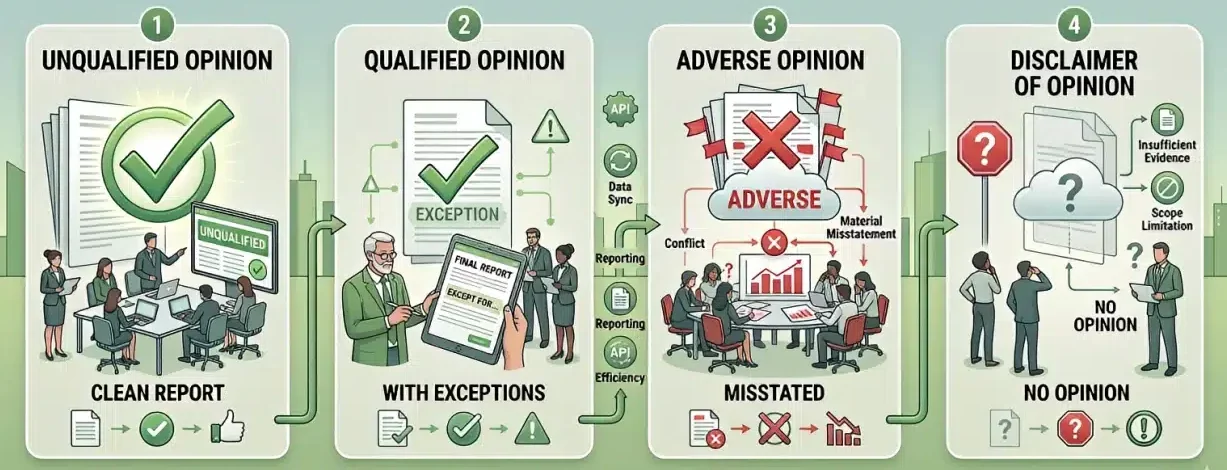
Audit reports vary based on the outcome of the audit and the purpose of the review. Understanding these types helps interpret audit results and their implications for compliance and decision making.
Audit opinions
- Unqualified opinion
Indicates that financial statements are accurate and comply with applicable standards. This is the most favourable outcome for a business. - Qualified opinion
Given when specific issues are identified but do not affect the overall reliability of the financial statements. - Adverse opinion
Indicates that financial statements contain material misstatements and do not present a true and fair view. - Disclaimer of opinion
Issued when the auditor cannot obtain sufficient evidence to form an opinion. This signals significant uncertainty.
Other audit reports
- Internal audit report
Focuses on evaluating internal controls, risk management, and operational processes within the company. - Compliance audit report
Assesses whether the business follows relevant regulations, policies, and legal requirements. - Operational audit report
Evaluates the efficiency and effectiveness of business operations and processes. - IT audit report
Reviews system security, data integrity, and access controls to ensure reliable information systems. - Forensic audit report
Investigates financial irregularities or suspected fraud for legal or regulatory purposes. - Performance audit report
Assesses whether activities or programs are operating efficiently and achieving intended outcomes.
Key Components of a Financial Audit Report
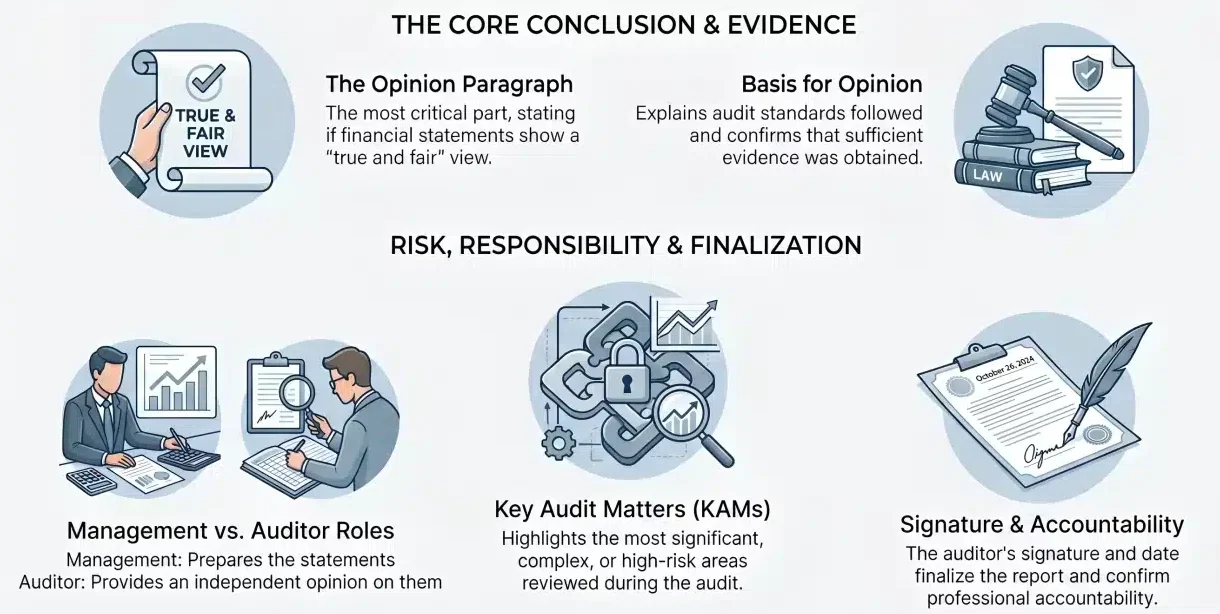
A financial audit report follows a structured format to ensure clarity and consistency in presenting audit results. Each component plays a role in explaining the auditor’s findings and responsibilities.
Opinion paragraph
States the auditor’s conclusion on whether the financial statements present a true and fair view. This is the most critical part of the report.
Basis for opinion
Explains how the audit was conducted and confirms that sufficient evidence has been obtained. It also outlines the standards followed during the audit.
Key audit matters
Highlights the most significant areas reviewed during the audit. These typically involve complex judgments or higher risk areas.
Responsibilities
Defines the roles of management and the auditor. Management prepares the financial statements, while the auditor provides an independent opinion.
Signature details
Includes the auditor’s signature, date, and relevant registration information. This confirms accountability and finalisation of the report.
"A well structured audit report not only validates financial accuracy but also strengthens transparency and accountability across business operations."
Auditing Standards and Regulatory Requirements
Financial audit reporting follows established standards to ensure consistency, reliability, and accounting audit compliance. These frameworks guide how audits are performed and reported.
AUASB and auditing standards
The auditing framework is based on standards issued by the Australian Auditing and Assurance Standards Board. These standards define how audits should be conducted.
Key auditing standards
Core standards include those governing audit opinions, reporting structure, and communication of key matters. They ensure reports are consistent and comparable.
Regulatory oversight
In Australia, key regulatory bodies include the Australian Securities and Investments Commission (ASIC) for corporate entities and the Australian Charities and Not-for-profits Commission (ACNC) for registered charities.
These bodies monitor audit quality and enforce compliance with applicable standards, ensuring auditors maintain independence and follow proper procedures.
Who Requires Financial Audit Reporting
Financial audit reporting is required for entities that meet specific regulatory or accountability thresholds. These requirements ensure transparency and protect stakeholder interests.
Large companies
Under the Corporations Act 2001, companies that meet certain revenue, asset, or employee thresholds are required to undergo external audits and lodge audited financial reports with ASIC. This ensures their financial reporting remains transparent and compliant.
Public companies
Entities that raise funds from the public must provide audited financial reports. This helps maintain investor confidence and regulatory compliance.
Charities
Registered charities must comply with ACNC reporting requirements. Those meeting revenue thresholds are required to submit audited financial reports, ensuring accountability in the use of funds.
Government entities
Public sector organisations are subject to audits to ensure proper use of public funds and compliance with financial regulations.
What to Include in a Financial Audit Report
A financial audit report should present key information in a clear and structured format. This ensures stakeholders can understand audit findings and make informed decisions.
Audited financial statements: Includes core financial documents such as the income statement, balance sheet, and cash flow statement.
Notes and disclosures: Provide additional context to financial data, including accounting policies and detailed breakdowns.
Materiality considerations: Explains the thresholds used by auditors to determine which issues are significant.
Going concern assessment: Evaluates whether the business can continue operating in the foreseeable future.
Audit findings and emphasis areas: Highlights key issues, risks, or important matters identified during the audit.
When to Use Software Instead of a Template
A template can hold the structure of an audit report just fine. What it can't do is prove where every figure inside it actually came from once an external auditor starts asking questions.
A few situations tend to expose that gap:
- Data for the audit sits across separate accounting, inventory, and procurement systems. Reconciling three exports into one template before the auditor even arrives eats weeks that could go toward fixing actual findings.
- Prior-year findings keep resurfacing. A static checklist doesn't track whether last year's control weakness was actually resolved or just noted and forgotten.
- Multiple audit types run against the same business in a year. A compliance audit, an IT audit, and the annual financial audit each pulling from different manual records makes cross-referencing genuinely painful.
- Materiality thresholds and key audit matters change between periods. A template built for last year's scope needs manual rework rather than simply reflecting what's material now.
- Auditors ask for the trail behind a number, not just the number. Templates rarely retain who entered a figure, when it changed, or what supporting document backs it.
A single voluntary audit with straightforward records rarely needs more than a template, but recurring statutory audits, several audit types, or data scattered across systems change that calculus fast.
An accounting system built for audit readiness keeps the evidence trail intact from the start, so the audit doesn't rely on someone rebuilding it under deadline pressure.
Download Free Financial Audit Report Templates
Financial audit reports follow a structured format to ensure clarity and consistency in presenting audit findings. Using predefined templates helps organise audit results and improves transparency.
The templates below are based on standard audit reporting practices and have been adjusted to align with applicable regulatory requirements. This ensures they are suitable for both compliance and practical use.
Independent auditor report unqualified opinion template
Used to present a clean audit opinion where financial statements comply with applicable standards and present a true and fair view.
INDEPENDENT AUDITOR REPORT UNQUALIFIED OPINION TEMPLATE

Independent auditor report qualified opinion template
Used when specific material issues are identified but do not affect the overall reliability of the financial statements.
INDEPENDENT AUDITOR REPORT QUALIFIED OPINION TEMPLATE
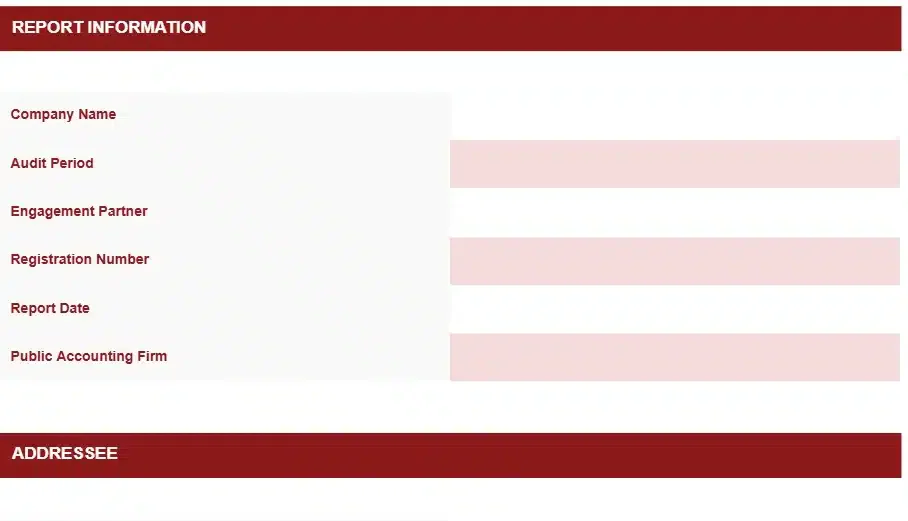
Internal audit report template
Focuses on evaluating internal controls, risk management, and operational effectiveness within the organisation.
INTERNAL AUDIT REPORT TEMPLATE
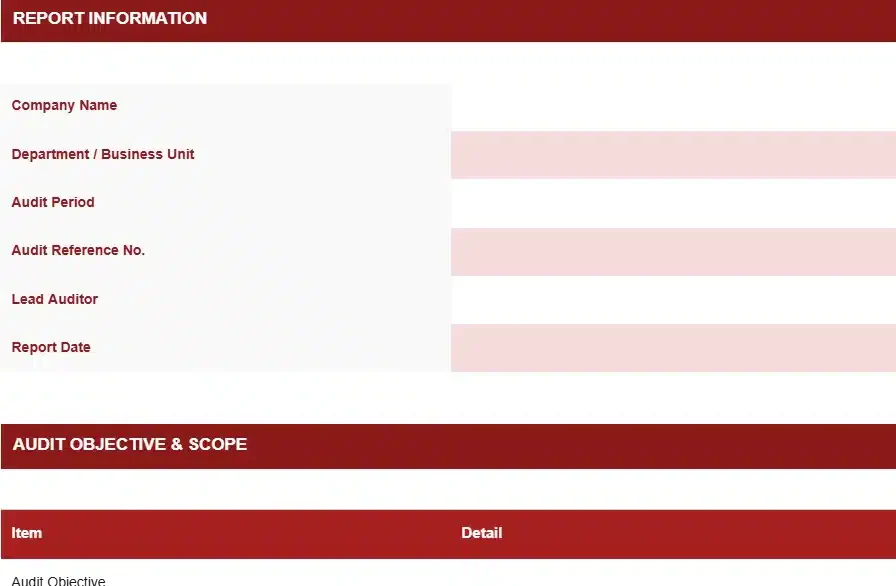
Compliance audit report template
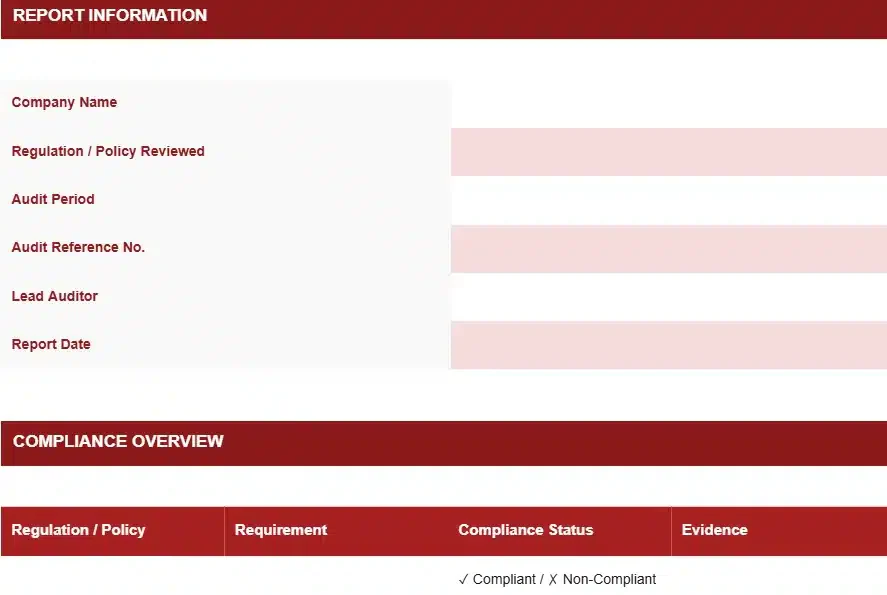
Assesses whether the business adheres to regulatory requirements, internal policies, and applicable standards.
COMPLIANCE AUDIT REPORT TEMPLATE
Audit findings and observations template
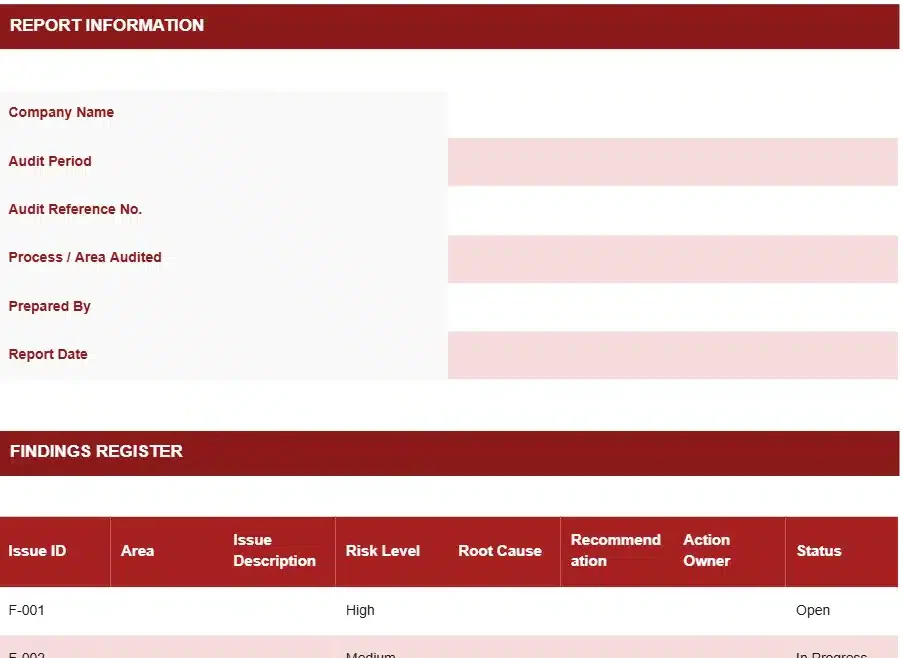
Documents identified issues, risk levels, and recommended actions to address control weaknesses or compliance gaps.
AUDIT FINDINGS AND OBSERVATIONS TEMPLATE
Audit planning memorandum template
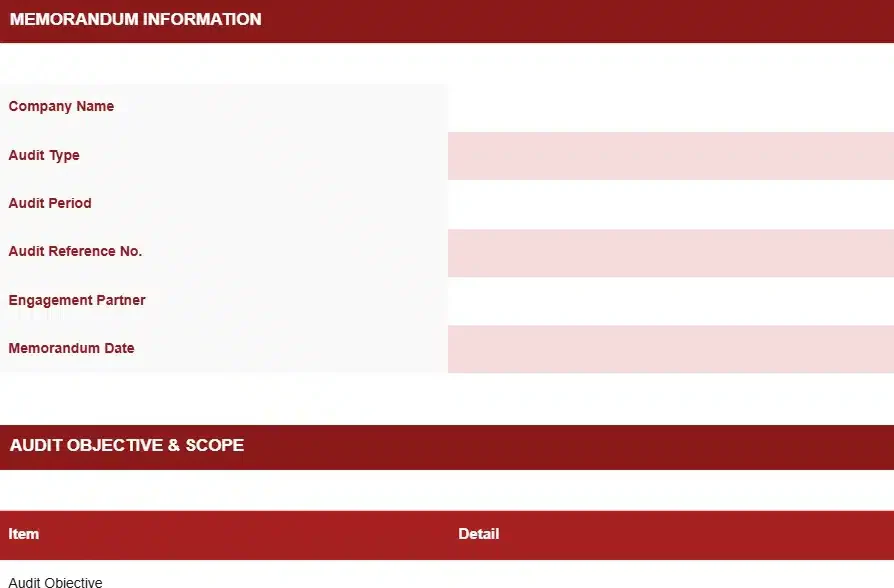
Outlines audit scope, objectives, key risks, and the overall audit strategy before the audit process begins.
AUDIT PLANNUNG MEMORANDUM TEMPLATE
Internal audit checklist template
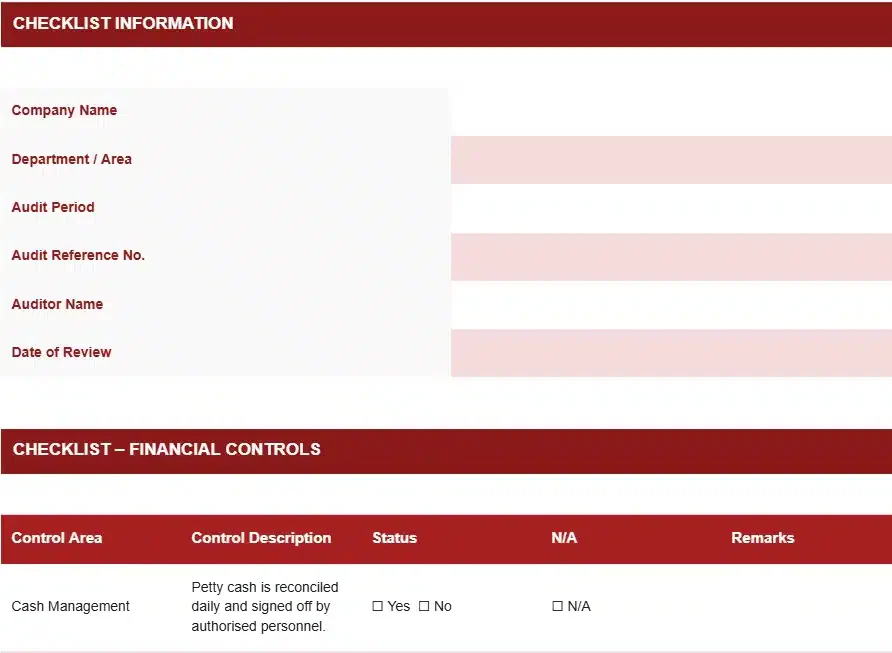
Provides a structured checklist to review internal processes, controls, and compliance areas during an audit.
INTERNAL AUDIT CHECKLIST TEMPLATE
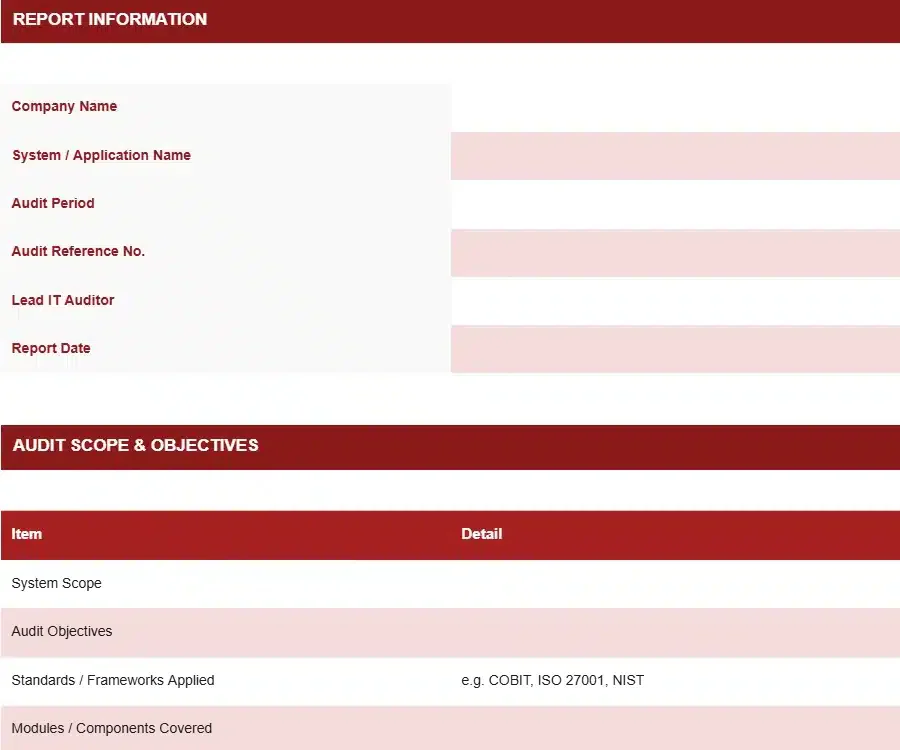
IT audit report template
Evaluates system security, data integrity, and access controls to ensure reliable and secure information systems.
IT AUDIT REPORT TEMPLATE
Preparing for a Financial Audit and Best Practices
Preparing for a financial audit requires structured processes and tools for financial audit to ensure accuracy and minimise delays. A well-prepared process helps auditors complete their review efficiently and reduces the risk of issues.
- Maintain organised financial records
Ensure all financial data, supporting documents, and reconciliations are complete and up to date. This makes it easier for auditors to verify information. - Understand audit requirements
Identify applicable standards and reporting obligations early. This helps avoid compliance issues during the audit. - Review internal controls
Evaluate internal processes to ensure controls are functioning effectively. Strong controls reduce the risk of audit findings. - Address issues in advance
Resolve discrepancies and review prior audit findings before the audit begins. This prevents repeated issues. - Use structured systems and tools
When financial data is spread across accounting, inventory, and procurement functions, using an accounting audit software consolidates records in one place. It reduces the manual effort of pulling data from multiple sources before an audit and supports more efficient audit processes in line with Australian regulatory requirements.
Conclusion
Financial audit reporting ensures financial transparency and supports compliance with applicable standards. It helps businesses reduce risk and maintain reliable financial information.
A structured audit process also improves accountability and builds stakeholder trust. You can request a free consultation to improve your audit readiness and reporting approach.

FAQ About Financial Audit Reporting
If a company fails a financial audit, it may receive a qualified or adverse opinion, which can affect investor confidence and may trigger regulatory scrutiny.
The duration varies depending on the company size and complexity, but most financial audits take several weeks to a few months to complete.
Yes, small businesses can choose to conduct voluntary audits to improve credibility, strengthen internal controls, and prepare for future growth.
Auditors usually request financial statements, bank records, invoices, contracts, and supporting documentation to verify transactions.