




The construction industry has long been known as a traditional and labour-intensive sector. Fragmented workflows, complex supply chains, and manual processes often cause delays and cost overruns. Safety risks and poor coordination have also been long-standing challenges.
Today, the industry is experiencing a major digital transformation. Technologies like artificial intelligence are changing how projects are designed, planned, and built. Data now plays a central role in improving project visibility and decision making.
AI helps construction teams analyse large amounts of project data quickly. It supports better scheduling, cost control, and risk management through AI-powered construction software. This shift toward predictive planning helps companies improve efficiency and long-term growth.
Key Takeaways
AI helps construction companies improve safety, planning, and decision making using data-driven insights.
Practical AI applications include automated estimating, site monitoring with drones, and predictive equipment maintenance.
Construction firms often face challenges such as fragmented data, skill gaps, and high implementation costs when adopting AI.
Successful AI adoption requires starting with high-value use cases, training teams, and integrating tools with existing systems.

What Is AI in Construction?
AI in construction refers to a group of technologies that mimic human thinking. These systems can learn, analyse patterns, and solve problems using large sets of project data. In construction, AI processes information like blueprints, schedules, costs, and site data to generate useful insights.
Machine learning is one of the main technologies behind AI. It studies past project data to identify patterns such as common causes of delays or cost overruns. This helps project managers make better decisions before problems appear.
Other technologies include computer vision, natural language processing, and construction robotics. Computer vision monitors site activity through cameras and drones, while NLP reads contracts and documents. Robotics combines machines with AI to automate tasks and improve efficiency on construction sites.
Benefits of AI in Construction
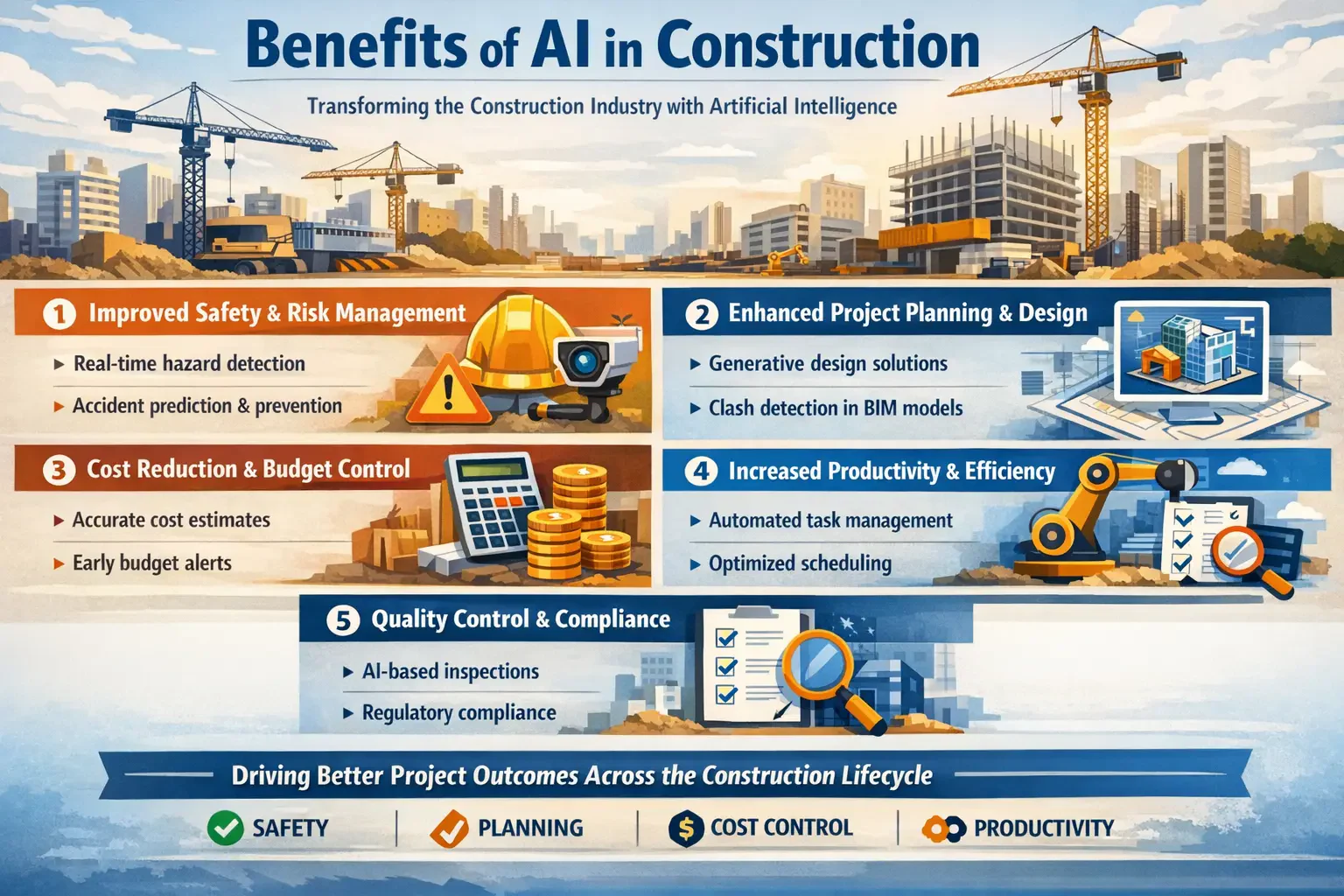
AI helps solve long-standing challenges in the construction industry. By using data-driven insights, companies can improve safety, planning, budgeting, and productivity. These improvements support better project outcomes across the entire construction lifecycle.
1. Improved Safety and Risk Management
Construction sites involve high-risk tasks such as heavy machinery operation and working at heights. Traditional safety methods rely on manual inspections and incident reports, which are often reactive. AI changes this by monitoring sites in real time and detecting safety violations instantly.
Machine learning can also analyse past incidents, weather conditions, and task risks to predict potential hazards. This allows managers to take preventive actions before accidents happen. As a result, companies can reduce incidents, protect workers, and lower liability costs.
2. Enhanced Project Planning and Design
Planning and design mistakes can cause serious delays and extra costs during construction. AI improves this phase through generative design, which creates multiple optimized design options based on project requirements. Architects and engineers can quickly evaluate the best solutions.
AI also strengthens Building Information Modeling by detecting clashes between structural and mechanical systems early. Fixing these conflicts in the digital model prevents expensive rework on site. This leads to more efficient planning and smoother project execution.
3. Cost Reduction and Budget Control
Cost overruns are common in construction due to inaccurate estimates and unexpected changes. AI helps create more accurate project estimates by analysing historical data, labour costs, and market conditions. This improves bidding accuracy and financial planning.
During construction, AI tracks project spending and predicts potential budget issues early. Managers receive alerts if productivity drops or material costs increase. This allows teams to adjust resources quickly and keep the project within budget.
4. Increased Productivity and Efficiency
Construction productivity often suffers from manual processes and complex coordination between teams. AI helps automate routine administrative tasks such as document processing and request management. This frees project managers to focus on strategic decisions.
On-site workflows also improve with AI-powered scheduling and resource planning. Machine learning can optimise work sequences and reduce idle time between trades. Combined with robotics and automation, this significantly boosts overall project efficiency.
5. Quality Control and Compliance
Maintaining quality standards and meeting regulations is critical in construction. AI supports quality control by comparing site data with digital design models to detect errors early. Problems can be corrected quickly before they affect later construction stages.
AI also helps ensure compliance with building codes and environmental regulations. Systems can review design specifications and monitor site conditions automatically. This reduces the risk of violations and simplifies reporting for regulators and stakeholders.
How AI Is Used in Construction
AI delivers real value through practical use on construction projects. Companies apply it to improve planning, site monitoring, equipment management, and procurement. These applications support better decision-making and create more effective tools for contractors from early planning to project completion.
Preconstruction Planning and Estimating
The preconstruction stage determines the success of the entire project. AI speeds up quantity takeoffs by analysing blueprints or 3D models and automatically counting materials. This reduces manual work and improves estimating accuracy.
Machine learning also predicts future material prices and project costs using historical data. Estimators can evaluate different scenarios and prepare more reliable bids. This helps protect profit margins and create realistic budgets.
On-Site Monitoring and Robotics
AI improves site visibility through drones, cameras, and automated monitoring systems. These tools capture images and convert them into detailed site maps to track construction progress. Managers can quickly compare actual work with the project schedule.
AI-powered robots also assist with physical construction tasks. Autonomous machines can perform excavation, bricklaying, and layout marking with high precision. This speeds up construction while improving quality and safety.
Predictive Maintenance and Equipment Management
Heavy equipment is expensive and critical to project timelines. AI uses sensors and IoT data to monitor machinery conditions such as temperature, vibration, and fuel use. This allows early detection of potential mechanical issues.
Predictive maintenance alerts managers before equipment fails. Repairs can be scheduled in advance to avoid unexpected downtime. This approach improves equipment lifespan and keeps projects running smoothly.
Supply Chain and Procurement Optimisation
Construction supply chains involve many suppliers and complex logistics. AI helps forecast material demand based on project schedules and historical usage patterns. This ensures the right materials arrive at the right time.
AI also evaluates supplier performance and tracks global supply risks. Procurement teams can identify reliable vendors and secure better pricing. This improves purchasing decisions and reduces supply disruptions.
Common Challenges in Adopting AI for Construction
Adopting AI in construction offers many benefits, but it also comes with challenges. One major issue is poor data quality and fragmented systems across teams. Companies must digitize and centralize project data before AI can deliver reliable insights.
Another challenge is the skills gap within the industry. Many construction firms lack expertise in data science, machine learning, and advanced software integration. This makes it harder to build and manage AI solutions internally.
Cultural resistance and high implementation costs can also slow adoption. Some professionals prefer traditional methods and may be skeptical about AI tools. In addition, firms must invest in technology, training, and cybersecurity to support digital operations.
Best Practices for Implementing AI in Construction
Adopting AI successfully requires a structured and strategic approach. Companies should focus on clear goals, proper training, and system integration. A phased implementation helps reduce risk and improve long-term results.
- Start with High-Value Use Cases
Firms should begin with specific problems where AI can deliver quick results. For example, AI can improve cost estimating, safety monitoring, or scheduling accuracy. Early success builds confidence and supports wider adoption across the organization.
- Build AI Literacy Across Teams
Employees must understand how AI tools work and how to use their insights. Training helps managers, engineers, and site supervisors apply AI effectively in their daily work. A culture of learning encourages teams to adopt new technologies with confidence.
- Integrate AI with Existing Systems
AI tools should connect with current systems like BIM, project management platforms, and ERP software. Integration prevents data silos and ensures information flows across departments. This creates a unified data environment for better decision making.
- Measure ROI and Continuously Improve
Tracking results helps companies understand the value of AI investments. Firms should monitor improvements in safety, productivity, cost control, and project timelines. Continuous evaluation allows teams to refine strategies and maximize long-term benefits.
Real-World Industry Use Cases
AI is already delivering real results across multiple construction stages. Companies are using it to improve design decisions, automate repetitive tasks, and monitor safety conditions on active job sites.
One example is generative design in preconstruction. Architects enter constraints like space requirements, materials, and budgets, and AI generates thousands of optimized design options in minutes.
On-site, AI-powered machinery can handle repetitive tasks such as grading and earthmoving with high precision. Computer vision systems also monitor safety, alerting supervisors if workers are missing PPE or entering restricted zones.

Strategic Implementation Steps
Integrating AI with construction project workflows requires a structured approach. Companies need to focus on data readiness, small pilot projects, and workforce training before scaling the technology.
The first step is conducting a data audit. Firms must digitize legacy documents and standardize reporting so AI systems can access clean, structured information.
After that, companies should run small pilot programs. Testing AI tools on a single project helps measure ROI and allows teams to resolve operational issues before wider adoption.
Advanced Practices and Future Outlook
Organizations that already use AI are moving toward more advanced applications. These include combining AI with digital twins and IoT data to monitor building performance in real time.
Digital twins create virtual models of physical buildings that update continuously with sensor data. AI analyzes this data to predict system failures, such as HVAC problems, before they occur.
In the future, AI will work alongside robotics, automation, and smart contracts. These technologies could make construction projects faster, more efficient, and more sustainable.
"AI is transforming construction by making projects safer, more efficient, and smarter from planning to completion."
Conclusion
AI is transforming the construction industry by improving planning, safety, and operational efficiency. With data-driven insights, companies can make faster decisions and reduce risks across the project lifecycle. This allows construction firms to manage projects with greater accuracy and control.
As technology continues to evolve, AI will become a core part of modern construction operations. Companies that adopt these tools early can gain stronger productivity and long-term competitiveness. If you want to explore how AI solutions can support your projects, consider requesting a free consultation with our expert