







The traditional view of employees as expenses has shifted. Businesses now recognize that their workforce is their most valuable asset, and Human Capital Management (HCM) has emerged as the strategic discipline built around that reality.
Modern HCM spans the full employee lifecycle, from recruitment and onboarding through performance, learning, and succession planning. As business complexity grows, mastering this discipline has become essential for sustainable success and long-term resilience.
For that reason, this blog will teach you everything you need to know about HCM and how you can maximize your workforce and scale your business drastically.
Key Takeaways
Human Capital Management is the discipline of treating the workforce as a capital asset, aligning employee development with business goals to drive productivity, innovation, and long-term competitive advantage.
The core components of HCM include talent acquisition, onboarding, training, performance management, compensation, and workforce analytics, which are deeply interconnected and dependent on each other.
Implementing HCM requires a structured approach covering needs assessment, technology selection, change management, and continuous performance monitoring.
Advanced HCM practices such as predictive analytics, AI-driven learning, continuous sentiment analysis, and integrated ERP systems are redefining how companies manage their workforce.
What Is Human Capital Management?

Human Capital Management (HCM) is a strategic approach to acquiring, managing, developing, and optimizing your workforce. HCM is built on the premise that employees possess value through their knowledge and skills, contributing directly to business productivity and profitability.
Investing in employees is therefore not a sunk cost but a strategic investment. While traditional HRM focuses on administrative tasks such as payroll, compliance, and grievance handling, HCM elevates these functions into a unified, proactive business strategy.
By shifting the focus from managing resources to optimizing capital, HCM empowers companies to build agile, resilient workforces capable of navigating market disruption, technological change, and shifting consumer demands.
Modern HCM is linked with technology. The term HCM also refers to the suite of software platforms used to implement these strategies across the business, including an employee management system that gives management real-time data and actionable insights to support smarter decisions.
This data-driven approach allows companies to move from intuition-based decisions to predictive analytics, enabling them to forecast talent shortages, identify flight risks, and measure the direct impact of HR initiatives on business performance.
"A strong HCM strategy is what separates businesses that grow from those that stagnate. When HCM is done right, you see lower turnover, stronger performance, and a workforce that scales with the business."
Why Human Capital Management Is Important






As industries commoditize and technology becomes universally accessible, a company’s workforce remains its only true sustainable competitive advantage. Businesses can unlock higher levels of performance and operational excellence by consistently developing their employees.
Improving Workforce Productivity
One of the most immediate impacts of effective HCM is a significant enhancement of workforce productivity. Productivity is about working smarter, more efficiently, and with greater purpose.
HCM achieves this by aligning an employee’s skills and role with the broader objectives of the business. When employees leverage their natural strengths and have the tools and training to succeed, output increases in both quantity and quality.
HCM frameworks emphasize continuous performance management over annual reviews. By setting clear expectations, measurable KPIs, and providing regular feedback, managers help employees course-correct in real time.
This approach minimizes wasted effort and ensures every individual contributes directly to the company’s strategic goals.
By addressing skills gaps through targeted training, HCM ensures the workforce remains capable of using new technologies and methodologies, driving continuous operational efficiency.
Attracting and Retaining Talent
In today’s competitive job market, the war for talent is a daily reality for businesses across all sectors. HCM plays a pivotal role in positioning a company as an employer of choice.
It begins with building a compelling Employer Value Proposition (EVP), a clear articulation of what the company offers in exchange for an employee’s time, skills, and dedication.
A strong HCM strategy ensures the company’s employer brand is visible, attractive, and authentic, drawing in better candidates who resonate with its culture and values.
Equally important is retaining top talent. High employee turnover is costly, not just in recruitment and training expenses, but also in the loss of knowledge and the disruption of team dynamics.
HCM addresses retention by focusing on the entire employee experience. This includes compensation, pathways for career advancement, and a supportive work environment.
When employees feel valued, see a tangible future within the company, and are continuously challenged and developed, their loyalty increases and voluntary attrition rates fall significantly.
Supporting Business Growth
Business growth and scalability are fundamentally dependent on workforce capabilities. Whether a company is expanding into new markets, launching a product line, or acquiring a competitor, it needs talent that is agile, adaptable, and ready for new challenges.
HCM provides the strategic framework to support this growth. Through rigorous workforce planning, HR leaders can anticipate future talent needs and begin cultivating the required skills well in advance of actual demand.
HCM places strong emphasis on succession planning and leadership development. By identifying high-potential employees and providing targeted mentorship, cross-functional training, and leadership opportunities, companies build a robust internal pipeline of future executives.
This ensures business continuity and stability, even during rapid expansion or unexpected leadership transitions. A well-executed HCM strategy ensures that growth is never bottlenecked by a lack of capable talent.
Enhancing Employee Engagement
Employee engagement is the emotional commitment an employee has to their company and its goals. Engaged employees do not just work for a paycheck; they genuinely care about their work and the success of the business.
HCM drives high levels of engagement by addressing the psychological and emotional needs of the workforce. This means creating a culture of transparency, recognition, and open communication where employees feel appreciated.
HCM strategies also prioritize employee well-being, recognizing that physical, mental, and financial health are vital for high performance. Flexible work arrangements, wellness programs, and strong support systems help prevent burnout.
Connecting an employee’s daily work to the broader mission of the business gives their role a sense of meaning and purpose. When employees understand how their individual efforts make a difference, intrinsic motivation rises sharply.
The result is higher levels of innovation, better customer service, and a more vibrant corporate culture that reinforces the company’s ability to attract and retain top talent.
Core Components of Human Capital Management
To effectively manage and optimize a workforce, businesses must implement a structured framework that spans the entire employee lifecycle. The core components of HCM are deeply interconnected, and success in one area frequently depends on the effectiveness of the others.
By taking a holistic view of these components, HR professionals and business leaders can create a seamless ecosystem that nurtures talent from the first point of contact through to eventual retirement or transition.
Talent Acquisition and Recruitment
Talent acquisition is the foundational pillar of HCM. It takes a proactive approach that identifies long-term talent needs and builds pipelines of qualified candidates to meet them.
This component requires a deep understanding of the labor market, competitor analysis, and sophisticated employer branding strategies to attract passive candidates who are not actively job hunting but are open to the right opportunity.
The recruitment process itself must be rigorous, equitable, and efficient. It involves advanced sourcing techniques, social media, and professional networks, and structured interviewing processes designed to minimize bias.
Modern talent acquisition places strong emphasis on the candidate experience. From the clarity of the job description to the responsiveness of the HR team and the ease of the application process, every interaction shapes the candidate’s perception of the company.
A positive candidate experience increases the likelihood of offer acceptance and enhances the company’s reputation in the broader talent marketplace.
Employee Onboarding and Training
Once a candidate is hired, the focus shifts to onboarding and training. Effective onboarding integrates new employees into the company, familiarizes them with the culture, and equips them with the knowledge and tools needed to be productive.
A comprehensive onboarding program extends well beyond the first day or week. It is often a 90-day or longer journey that includes regular check-ins, mentorship assignments, and structured goal-setting.
Proper onboarding significantly reduces time-to-productivity and is a major factor in long-term employee retention.
Training and development represent the ongoing investment in human capital. As technological advancements render certain skills obsolete at a rapid pace, continuous learning has become essential for every business.
This component involves conducting skills gap analyses, designing relevant curricula, and utilizing delivery methods such as e-learning platforms, instructor-led workshops, and on-the-job training.
By fostering a culture of continuous learning, companies not only improve their overall capability but also signal to employees that the business is genuinely invested in their long-term career growth.
Performance Management
Performance management is the systematic process through which a company involves its employees in improving effectiveness and achieving its mission and goals.
In modern HCM, performance management has evolved from the dreaded annual review into a continuous, collaborative process. It involves setting clear, agile goals such as Objectives and Key Results (OKRs) aligned with the company’s strategic direction.
Real-time feedback is a central element of this approach, replacing infrequent, high-stakes evaluations with regular, constructive conversations that keep employees on track.
This component requires managers to act more like coaches than traditional supervisors. Regular one-on-one meetings, 360-degree feedback mechanisms, and peer recognition programs are integral to this modern approach.
The goal is to identify roadblocks to performance early, celebrate successes frequently, and create actionable development plans for each employee.
By decoupling performance conversations from compensation discussions, companies can foster a more open, honest dialogue about career development, skill enhancement, and personal growth.
Compensation and Benefits Management
Compensation and benefits management, often referred to as Total Rewards, is a critical HCM component that directly impacts a company’s ability to attract, motivate, and retain talent.
This goes far beyond establishing base salaries. A comprehensive Total Rewards strategy encompasses variable pay such as bonuses and commissions, equity compensation, and a wide array of benefits tailored to the diverse needs of the modern workforce.
Effective management in this area requires continuous benchmarking against industry standards to ensure external competitiveness, while maintaining internal equity to prevent pay disparities and foster a sense of fairness.
Modern benefits packages are increasingly holistic, moving beyond standard health insurance and retirement plans to include mental health support, flexible working stipends, childcare assistance, and financial wellness programs.
By offering a customizable and comprehensive rewards package, including staffs benefits, companies can address the unique lifestyle needs of their employees, significantly boosting loyalty and job satisfaction.
Workforce Planning and Analytics
Workforce planning and analytics form the analytical backbone of HCM. This component involves analyzing current workforce demographics, assessing future business scenarios, and identifying gaps between the talent a company has and what it will need.
Strategic workforce planning allows HR leaders to make informed decisions on recruitment scaling, training investments, and restructuring initiatives before critical shortages or redundancies occur.
HR analytics takes this further by applying statistical modeling and data science techniques to employee data. Key metrics include turnover rates, time-to-hire, engagement scores, and performance ratings.
By analyzing these metrics, companies can uncover hidden trends and correlations. Predictive analytics can identify which departments are at the highest risk of attrition or which recruitment channels yield the highest-performing candidates.
This data-driven approach elevates HR from a reactive administrative function to a proactive, strategic partner in business decision-making.
Key Functions of Human Capital Management Systems
While the strategic components of HCM provide the theoretical framework, Human Capital Management Systems (HCMS) and HR Information Systems (HRIS) provide the technological infrastructure needed to execute these strategies at scale.
As companies grow, managing human capital via spreadsheets and disconnected software tools becomes inefficient, error-prone, and strategically limiting.
Modern HCM systems centralize employee data, automate routine administrative tasks, and provide powerful analytical tools, freeing HR professionals to focus on high-value, strategic work.
Payroll and Benefits Administration
At the most fundamental level, an HCM system must flawlessly execute payroll and benefits administration. Payroll processing is complex, involving varied wage rates, overtime, shift differentials, taxes, and deductions.
All of this must comply with constantly changing local and national labor laws. A robust HCM platform automates these calculations, reducing the risk of human error and ensuring employees are paid accurately and on time.
Benefits administration is equally streamlined through employee self-service portals. Instead of HR manually processing paper enrollment forms, employees can log in, compare health plan options, update dependents, and manage retirement contributions directly.
The system automatically syncs this data with payroll for accurate deduction processing and communicates enrollment information directly to third-party insurance carriers.
This automation drastically reduces the administrative burden on HR while empowering employees to manage their own benefits with greater transparency and control.
Time and Attendance Tracking
Accurate time and attendance tracking is essential for operational efficiency, payroll accuracy, and labor law compliance. Modern HCM systems offer sophisticated time-tracking modules that go far beyond traditional punch clocks.
Employees can log hours via web portals, mobile applications, or biometric scanners. For companies with remote or field-based workforces, geofencing technology ensures employees are clocking in from authorized locations.
These systems also manage complex scheduling requirements, allowing managers to create shift rosters, handle shift-swap requests, and monitor overtime accruals in real time.
Leave management is fully integrated within the same platform. Employees submit time-off requests through the system, which automatically checks accrued balances and routes the request to the appropriate manager for approval.
This centralized visibility helps managers maintain adequate staffing levels and prevents the operational disruptions caused by unexpected absences.
Talent Management Tools
Beyond administrative functions, advanced HCM platforms feature comprehensive talent management suites that support the entire employee lifecycle.
These tools include Applicant Tracking Systems (ATS) that streamline recruitment by parsing resumes, scheduling interviews, and managing candidate communications.
Once a candidate is hired, the system triggers automated onboarding workflows, ensuring IT provisions equipment and the new hire completes all required compliance training.
For ongoing development, integrated Learning Management Systems (LMS) allow companies to host proprietary training content, track course completion, and manage certifications.
Performance management modules facilitate the setting of OKRs, schedule continuous feedback sessions, and digitize the appraisal process.
By housing all talent management functions within a single platform, HR leaders gain a unified, 360-degree view of every employee’s journey, performance history, and career trajectory.
HR Analytics and Reporting
Beyond administrative functions, advanced HCM platforms feature comprehensive talent management suites that support the entire employee lifecycle.
These tools include Applicant Tracking Systems (ATS) that streamline recruitment by parsing resumes, scheduling interviews, and managing candidate communications.
Once a candidate is hired, the system triggers automated onboarding workflows, ensuring IT provisions equipment and the new hire completes all required compliance training.
For ongoing development, integrated Learning Management Systems (LMS) allow companies to host proprietary training content, track course completion, and manage certifications.
Performance management modules facilitate the setting of OKRs, schedule continuous feedback sessions, and digitize the appraisal process.
By housing all talent management functions within a single platform, HR leaders gain a unified, 360-degree view of every employee’s journey, performance history, and career trajectory.
How to Implement Human Capital Management Successfully
Transitioning from fragmented HR practices to a unified HCM approach supported by a new technology platform is a major change for any business. It requires careful planning, cross-functional collaboration, and a strong focus on change management.
A poorly executed implementation leads to low user adoption, data integrity issues, and failure to realize the expected return on investment. To ensure success, companies should follow a structured, phased approach.
Define HR and Business Objectives
The first and most critical step is to clearly define what the business is trying to achieve. Implementing new software purely for the sake of modernization is a recipe for failure.
Leadership must conduct a thorough needs assessment to identify the specific pain points and strategic goals the new HCM strategy must address. Are you trying to reduce time-to-hire? Improve retention? Strengthen compliance across multiple locations?
Perhaps you need better data to drive succession planning. Defining these goals precisely before selecting a system ensures the solution is built around real business needs rather than assumed ones.
It is equally essential to engage stakeholders from across the business, not just within HR. Finance, IT, Operations, and frontline managers will all interact with the HCM system, and their requirements must be documented.
By establishing clear, measurable objectives upfront, the company creates a benchmark against which the success of the implementation can be evaluated, ensuring the final solution aligns with the broader business strategy.
Choose the Right HCM Platform
With clear objectives defined, the next step is selecting the right HCM technology platform. The market ranges from specialized standalone tools to comprehensive, all-in-one enterprise suites.
Companies must evaluate vendors on functionality, scalability, user experience, security, and total cost of ownership. It is crucial to look beyond immediate needs and select a platform that can scale as the business grows.
During the selection process, companies should issue a Request for Proposal (RFP) to shortlisted vendors and conduct rigorous product demonstrations. Involving end-users in these demos helps gauge the intuitiveness of each platform.
Vendor scrutiny should also cover customer support quality, data privacy compliance, and compliance regulatory for HR, such as GDPR or CCPA, as well as the frequency of software updates.
Choosing a vendor that acts as a long-term strategic partner, not just a software provider, is key to sustaining value well beyond the initial implementation.
Industry Use Cases of Human Capital Management
While the core principles of HCM apply universally, their application varies significantly across industries. Understanding how HCM adapts to unique sector challenges highlights its versatility and strategic value.
- Healthcare
In healthcare, HCM systems are critical for managing complex compliance requirements, tracking specialized medical certifications, and optimizing dynamic shift scheduling.
With high burnout rates among medical professionals, healthcare companies leverage HCM tools to monitor employee well-being and facilitate access to mental health resources.
Streamlining administrative burdens through automation allows doctors, nurses, and support staff to focus their energy on patient care rather than paperwork.
- Manufacturing
Manufacturing companies face the dual challenge of an aging workforce and the rapid integration of automation. HCM in this sector focuses heavily on workforce planning and skills tracking.
By identifying skill gaps caused by new technologies, manufacturers can deploy targeted reskilling and upskilling programs before those gaps affect production.
HCM systems also manage safety training modules and track compliance with workplace safety regulations, minimizing accidents and ensuring operational continuity.
- Technology and Software
For tech companies, the speed of innovation directly dictates market success. HCM strategies in this sector prioritize rapid talent acquisition, agile performance management, and continuous learning.
Tech firms use advanced HCM platforms to create personalized development paths, ensuring engineers and developers stay current with emerging programming languages, cybersecurity threats, and technological trends.
Strategic Steps for Implementing an HCM Framework
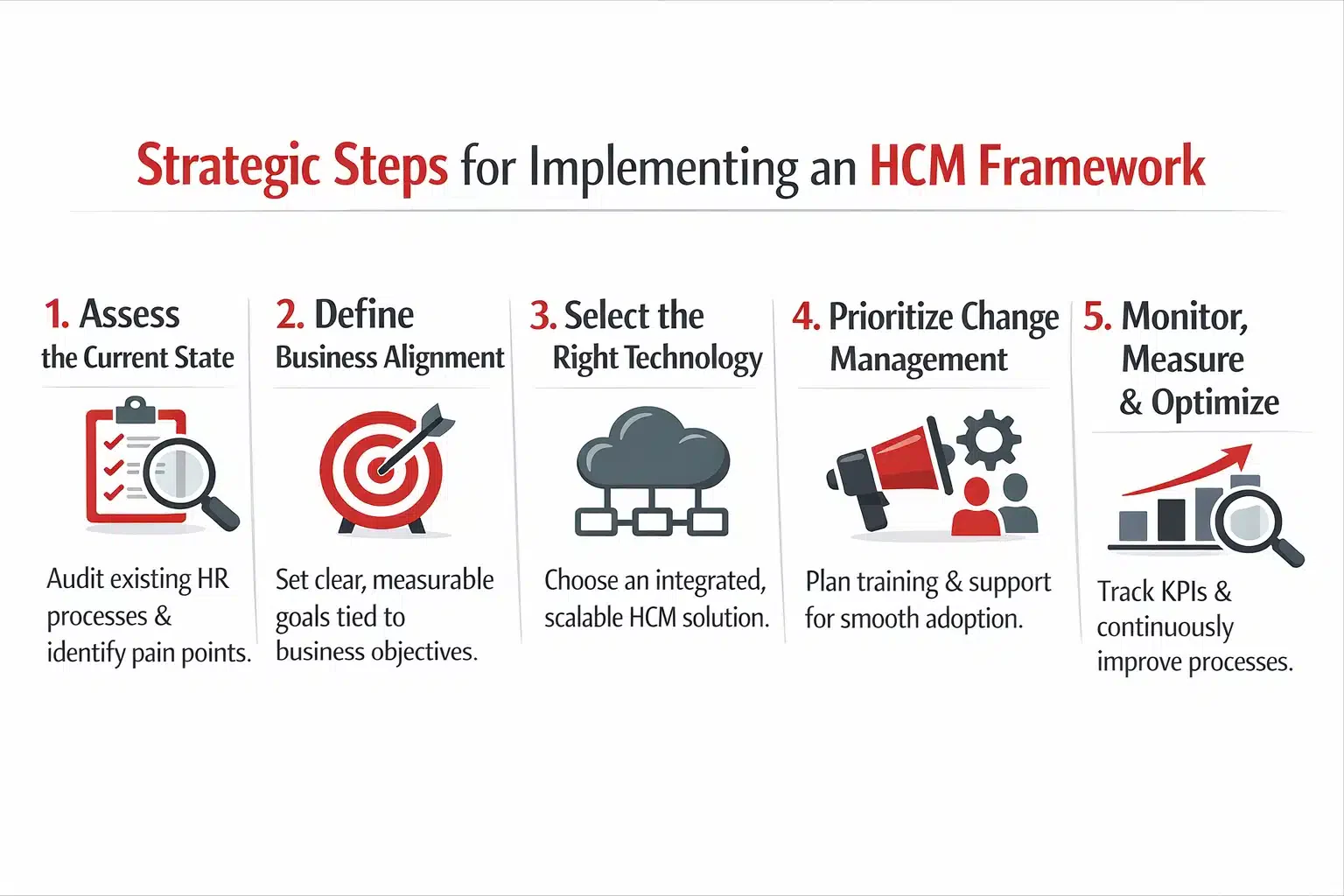
Transitioning from traditional HR processes to a comprehensive HCM model requires meticulous planning and execution. Companies that follow a structured implementation roadmap are far more likely to realize the full value of their investment.
1. Assess the Current State
Begin by conducting a thorough audit of existing HR processes, legacy software, and data management practices. The goal is to establish an honest baseline before any new system is introduced.
Identify bottlenecks in your current recruitment, onboarding, and performance workflows. Flag compliance risks, data quality issues, and areas where the employee experience consistently falls short.
Document findings across all HR functions and share them with key stakeholders. This audit forms the foundation of your requirements and prevents the common mistake of digitizing broken processes rather than fixing them.
2. Define Business Alignment
An HCM strategy without measurable business objectives is unlikely to deliver meaningful results. Establish clear, quantifiable goals before selecting any technology or redesigning any process.
Goals might include reducing voluntary turnover by 15%, shortening average time-to-hire, or building a more robust internal leadership pipeline. Each objective should map directly to a broader corporate priority.
Defining these targets upfront also creates the benchmarks against which the success of the entire HCM implementation will be evaluated, giving leadership a clear picture of return on investment.
3. Select the Right Technology
Choose an HCM software suite that scales with your business. Prioritize cloud-based solutions that offer unified modules covering payroll, talent acquisition, performance management, time tracking, and advanced analytics.
Avoid point solutions that solve only one problem. A fragmented technology stack creates data silos and integration headaches that undermine the very goals HCM is designed to achieve.
Evaluate vendors on implementation support, data security, compliance capabilities, and the quality of their customer success programs. A strong vendor partnership is as important as the software itself.
4. Prioritize Change Management
Even the most sophisticated HCM system will fail without strong user adoption. Develop a comprehensive change management and communication plan well before go-live.
Provide role-specific training for executives, managers, and frontline employees. Each group interacts with the system differently, and generic training rarely drives meaningful adoption.
Identify internal champions in each department who can support their peers during the transition. Early wins and visible executive sponsorship go a long way in building confidence across the business.
5. Monitor, Measure, and Optimize
Post-launch, establish a regular cadence for reviewing HCM performance data. Track KPIs such as time-to-hire, retention rates, engagement scores, training completion rates, and payroll accuracy.
Use system analytics to identify underutilized features and uncover process gaps that may not have been visible before go-live. Gather structured feedback from employees and managers every quarter.
HCM implementation is not a one-time project but a continuous improvement cycle. The companies that derive the greatest long-term value are those that treat the platform as a living system that evolves with the business.
Common Pitfalls in HCM Deployment
Despite the clear benefits, many companies stumble during HCM implementation. Recognizing these common traps early can save significant time, money, and internal goodwill.
- Lack of Executive Buy-In
When leadership views HCM as an HR project rather than a strategic business transformation, funding and cross-departmental cooperation quickly dry up.
Without executive sponsorship, the initiative struggles to gain the visibility and resources it needs. HR teams are left pushing for adoption without the authority to drive meaningful change.
To avoid this, frame the HCM business case in terms of revenue impact, risk reduction, and competitive advantage. Leaders respond to business outcomes, not HR metrics alone.
- Poor Data Migration
Transferring outdated, duplicated, or inaccurate employee records into a new HCM system corrupts the very foundation on which the platform is built. Flawed data leads to payroll errors, unreliable analytics, and compliance risks.
Before migration, invest time in a thorough data cleansing exercise. Audit all existing employee records, resolve duplicates, standardize formats, and validate accuracy against source documents.
Establish data governance protocols from day one. Assign clear ownership for each data category and define quality standards that will be maintained long after go-live.
- Ignoring the Employee Experience
Even a technically superior HCM system will fail if employees refuse to use it. A clunky interface, difficult navigation, or poor mobile experience creates friction that drives resistance and low adoption.
Involve a representative sample of end-users in the selection and testing process. Their feedback on usability should carry significant weight in vendor evaluations.
Post-launch, monitor system usage data closely. Low adoption in specific features or departments is an early signal to address through targeted training or interface adjustments before the problem compounds.
Advanced Practices Shaping the Future of HCM
As workplace dynamics evolve, so do the capabilities of Human Capital Management. Forward-thinking companies are already adopting next-generation practices to maintain their competitive edge and attract top-tier talent.
Predictive Workforce Analytics
Moving beyond historical reporting, predictive analytics uses deep data to forecast future workforce trends. HR leaders can now identify which departments are at the highest risk of turnover before resignations happen.
They can also forecast skill shortages based on market trends and identify high-potential employees ready for leadership roles before a vacancy even occurs. This shift from reactive to predictive transforms how businesses plan their workforce.
Artificial Intelligence and Machine Learning
AI is revolutionizing the entire talent lifecycle. Machine learning algorithms can automatically screen thousands of resumes, identifying top candidates while reducing the influence of unconscious bias in the initial selection process.
Internally, AI-driven learning management systems curate personalized training content for each employee based on their current role, past performance, and long-term career aspirations, making development more relevant and effective.
Continuous Listening and Sentiment Analysis
The traditional annual engagement survey is rapidly becoming obsolete. Advanced HCM incorporates continuous listening through frequent pulse surveys and AI-powered sentiment analysis of internal communication platforms.
This gives management a real-time view of workforce morale, enabling rapid intervention when stress levels rise, engagement dips, or cultural issues begin to emerge. Early signals are far easier to address than fully developed problems.
Using Software to Manage Human Capital
Managing human capital at scale is only achievable with the right software infrastructure. Modern HCM platforms bring together payroll, talent acquisition, performance management, learning, and workforce analytics into a single, integrated system.
For companies with complex operations, ERP systems with embedded HRM modules provide an even deeper level of integration. Recruitment data flows directly into headcount budgets, new hire records sync automatically with payroll, and training completions are tracked alongside performance ratings.
Choosing the right platform is not just a technology decision; it is a strategic one. The best HCM software removes administrative friction, surfaces actionable insights, and gives HR the tools to act as a genuine driver of business performance.
Conclusion
Human Capital Management is no longer a back-office function. It is a core discipline that shapes whether a company can attract, develop, and retain the talent needed to compete and grow.
Companies that invest in robust HCM strategies and the right supporting technology will be best positioned to navigate a rapidly changing talent landscape. Those who treat their people as their most valuable asset will lead their industries for years to come.
We provide a free consultation with experts from our team to anyone who is interested in applying sophisticated systems to improve their business, which includes HCM systems. Start your free consultation today and consult the experts to find the right solution for your workforce strategy.
Frequently Asked Question
Human Capital Management (HCM) is a strategic approach to acquiring, developing, and optimizing a company's workforce. It treats employees as capital assets and aligns HR practices with broader business goals to improve performance, retention, and long-term growth.
The core components of HCM include talent acquisition, onboarding and training, performance management, compensation and benefits, and workforce planning and analytics. These components work together across the full employee lifecycle to build a high-performing workforce.
HCM improves employee retention by focusing on the entire employee experience, including career development pathways, competitive compensation, well-being programs, and a culture of recognition and open communication that makes employees feel valued and motivated to stay.
An HCM system, also known as an HRIS or HCMS, is a software platform that centralizes employee data and automates HR processes such as payroll, time tracking, benefits administration, recruitment, and performance management into a single integrated system.
Small businesses benefit from HCM by gaining structured processes for hiring, onboarding, and managing performance that would otherwise be handled informally. Cloud-based HCM platforms offer scalable, cost-effective solutions that grow alongside the business without requiring a large HR team.