














Every product that leaves your warehouse goes through picking and packing. A picker retrieves the right items from storage. A packer places them into the correct packaging before dispatch.
Done well, pick and pack is invisible to the customer. Done poorly, it creates returns and costs that erode margins. In Australian warehouses, these two steps account for 55 to 65% of fulfilment operating costs.
This article covers what the process involves, which picking methods suit different warehouse sizes, the most costly errors, and how WMS software helps Australian businesses reach maximum order accuracy.
Key Takeaways
Pick and pack fulfilment is the warehouse process that starts when a customer orders and ends when a correctly packed parcel leaves for dispatch.
The step-by-step process runs six stages: order verified in WMS, pick list generated, items retrieved, barcode scanned at pick, packed with correct materials, then labelled and dispatched.
Picking methods range from piece picking for low volumes to batch, zone, and wave picking for higher throughput.
WMS software can improves accuracy and speed by optimising pick routes, enforcing barcode verification, automating cartonisation, and updating inventory in real time.

What is Pick and Pack Fulfilment?

Pick and pack fulfilment is the warehouse process that starts when a customer places an order and ends when a correctly packed parcel leaves for carrier collection.
A picker uses a pick list to locate and retrieve the correct products from their storage locations. A packer then places those items into appropriate packaging with the right materials, documentation, and label.
Within the broader fulfilment lifecycle (receiving, putaway, storage, pick and pack, dispatch, and returns), pick and pack carries the highest proportion of warehouse labour.
For Australian e-commerce and wholesale operations, pick and pack represents a major opportunity for cost reduction and accuracy improvement supported by modern storage management tools.

How the Pick and Pack Process Works
A well-run pick and pack operation follows a repeatable six-step sequence. Skipping or compressing any step is where errors enter the system and costs accumulate across thousands of orders.
- Order received and verified in WMS: The WMS receives the order from your e-commerce platform or ERP, validates stock availability, and triggers a pick list. Manual spreadsheet operations introduce delay and re-keying errors at this step.
- Pick list generated and assigned: The WMS creates an optimised pick list, grouping items by location, batch, zone, or wave based on your configuration, and delivers it to the picker’s mobile device or prints it at the station.
- Picker retrieves items from storage locations: The picker moves through the warehouse following the assigned route, retrieving the specified SKUs and quantities from their bin or shelf locations.
- Quality check via barcode scan: Each item is scanned to verify it matches the order before it enters the tote. This step accounts for the measurable difference between 95% and 99%+ order accuracy in warehouse benchmarks.
- Packing: correct box, materials, and documentation: Items are packed into the appropriate box or mailer with suitable void fill, fragile protection where needed, and a packing slip or invoice. The WMS or packing station specifies the correct box type for each order.
- Labelling and dispatch: The shipping label is printed and applied. The parcel enters the dispatch queue for carrier collection. The WMS updates inventory in real time and triggers the customer tracking notification.
Picking Methods: Which Type Suits Your Warehouse?
Your picking method directly affects picker productivity, warehouse travel time, and your error rate. Most Australian warehouses start with piece picking and move to batch or zone picking once daily order volumes consistently exceed 70 orders.
1. Piece picking
Piece picking assigns one picker to one order from start to finish. The picker retrieves all items on the pick list before returning to the packing station.
It is best suited to low-volume operations, high-SKU complexity, and orders requiring personalised packaging. Accuracy risk is low because each order is handled by a single person with no sorting required.
Most Australian warehouses begin with piece picking. It becomes a productivity constraint once daily order volumes consistently exceed 50 to 80 orders, at which point travel time per order inflates measurably.
2. Batch picking
Batch picking sends one picker into the warehouse to collect items for multiple orders in a single trip. Items are sorted into individual orders at the packing station after retrieval.
It suits high-volume operations with repeat SKUs across orders, particularly where same-day fulfilment targets apply. A WMS groups orders into batches automatically based on SKU overlap and carrier cutoff timing.
Accuracy risk sits at medium. Sorting errors at the packing station are the primary failure point, which is why barcode verification at pack becomes more important with this method.
3. Zone picking
Zone picking divides the warehouse into defined areas. Each picker works exclusively within their assigned zone and does not travel to other sections of the warehouse.
It suits large warehouses with distinct product categories and multi-person picking teams that require accurate stock coordination. Accuracy risk is low per zone, though orders spanning multiple zones require coordination before reaching the packing station.
A WMS manages the hand-off between zones automatically, consolidating items at the packing station once all zones have fulfilled their portion of each order.
4. Wave picking
Wave picking combines zone and batch picking into a scheduled structure. Pickers remain within their assigned zone but pick for multiple orders simultaneously during defined time windows called waves.
It suits high-volume distribution centres operating under tight carrier cutoff windows. The method requires a WMS to function effectively, as wave scheduling, zone coordination, and batch grouping all run automatically.
Accuracy risk is medium-low. Complexity is higher than any other method, but a correctly configured WMS reduces that complexity to a managed workflow rather than a manual coordination task.
Packing: Getting It Right Every Time
Picking gets the right product to the station. Packing ensures it arrives intact and creates the customer’s first physical brand experience.
The packing station should have within reach: box and mailer options in multiple sizes, void fill, fragile and moisture-protection materials, packing slips, and a label printer linked to your WMS.
Box selection matters more than most operators expect. Oversized boxes increase dimensional weight charges with carriers like Australia Post, StarTrack, and CouriersPlease.
Undersized boxes risk transit damage. A WMS with cartonisation rules recommends the smallest appropriate box for each order’s dimensions and weight, removing guesswork at the station.
Warehouses achieving 99%+ order accuracy pair barcode scanning at pick with WMS-guided cartonisation at pack. Both steps are necessary. One without the other leaves a gap in the verification chain.
Common Pick and Pack Errors and How to Prevent Them
A returned shipment costs two to three times the original fulfilment cost when you account for customer service handling, repackaging, re-shipping, and potential inventory write-off.
Most errors fall into five categories. Each has a direct prevention mechanism that WMS software enforces across every order, without relying on individual picker judgement.
1. Mis-picks (wrong item)
The most common error type. Typically caused by similar products stored adjacently, or pickers relying on visual recognition rather than actively scanning each item at the point of pick.
Prevention: enforce barcode scan at every pick. Configure WMS alerts for adjacent high-similarity SKUs. Use clear bin labelling with location codes at every pick face.
2. Quantity errors
Under-packing misses one unit from a multi-unit order. Over-packing sends two when one was ordered. Both result in a return and the customer service cost that follows.
Prevention: count confirmation at the packing station. WMS pick quantity verification with a second scan before the tote moves to packing.
3. Mislabelling and wrong address
A label printed for the wrong order, or applied to the wrong parcel, reaches the carrier before anyone catches it. Discovery at that stage means a return or reship at full cost.
Prevention: label printing triggered only after barcode confirmation of correct parcel contents. Scan-to-verify before the parcel enters the dispatch lane.
4. Transit damage
Fragile items arrive broken due to inadequate void fill, oversized packaging, or missing fragile flagging at the packing station.
Damage claims with carriers like Australia Post and StarTrack typically fall on the shipper, making prevention cheaper than any claim process.
Prevention: WMS packing rules that flag fragile SKUs automatically. Standardised packing SOPs by product category with a visual prompt at each station.
5. Inventory discrepancy
Physical stock does not match WMS records. A picker cannot locate an item or pulls from the wrong bin, causing order delays and incorrect fulfilment that compounds without a real-time update system.
Prevention: real-time inventory updates after every pick transaction. Regular cycle counts. Software for improving warehouse control also helps enforce strict bin location discipline through WMS location management.
Warehouses enforcing barcode scanning at both pick and pack reduce error rates from the industry average of 1 to 3% for manual operations to under 0.5% consistently.
At 300 orders per day, that is the difference between 3 to 9 errors daily and fewer than 2. Accumulated over a year, the cost in returns, rework, and customer churn is substantial.
In-House Pick and Pack vs Outsourcing to a 3PL
For growing Australian e-commerce and wholesale businesses choosing between in-house fulfilment and third-party shipping partners, this is an important strategic decision. Below is a balanced comparison of where each model performs best.
| Criteria | In-house + WMS | 3PL outsourced |
|---|---|---|
| Upfront cost | Higher: warehouse lease, staff, WMS software, and equipment investment | Lower: no capital outlay; pay per unit picked or per order processed |
| Cost at scale | Lower per unit once fixed costs are spread across volume (typically 100+ orders/day) | Higher per unit as volume grows; 3PL margin embedded in every pick |
| Quality control | Full control over SOPs, team standards, and WMS configuration | SLA-governed but less direct day-to-day oversight |
| Brand packaging | Full flexibility: custom boxes, tissue, inserts, gift messaging on your schedule | Possible but typically premium-priced and slower to implement or change |
| Peak volume | Limited by headcount; requires seasonal hiring planned in advance | High flexibility; 3PL absorbs volume spikes across their entire client base |
| Best for | 100+ daily orders, complex or branded packaging, high-SKU operations | Under 80 to 100 daily orders, simple product mix, or validating e-commerce volume before capital commitment |
The economic crossover point in Australia, where in-house becomes more cost-effective than 3PL, typically falls between 80 and 150 daily orders, depending on average order value and SKU complexity.
Below that threshold, outsourcing wins on economics. Above it, in-house fulfilment with WMS delivers lower per-unit costs, full quality control, and direct oversight of packing standards.
Businesses with strong brand packaging requirements often find the crossover arrives earlier than raw order volume alone suggests.
How WMS Software Improves Pick and Pack Accuracy & Speed
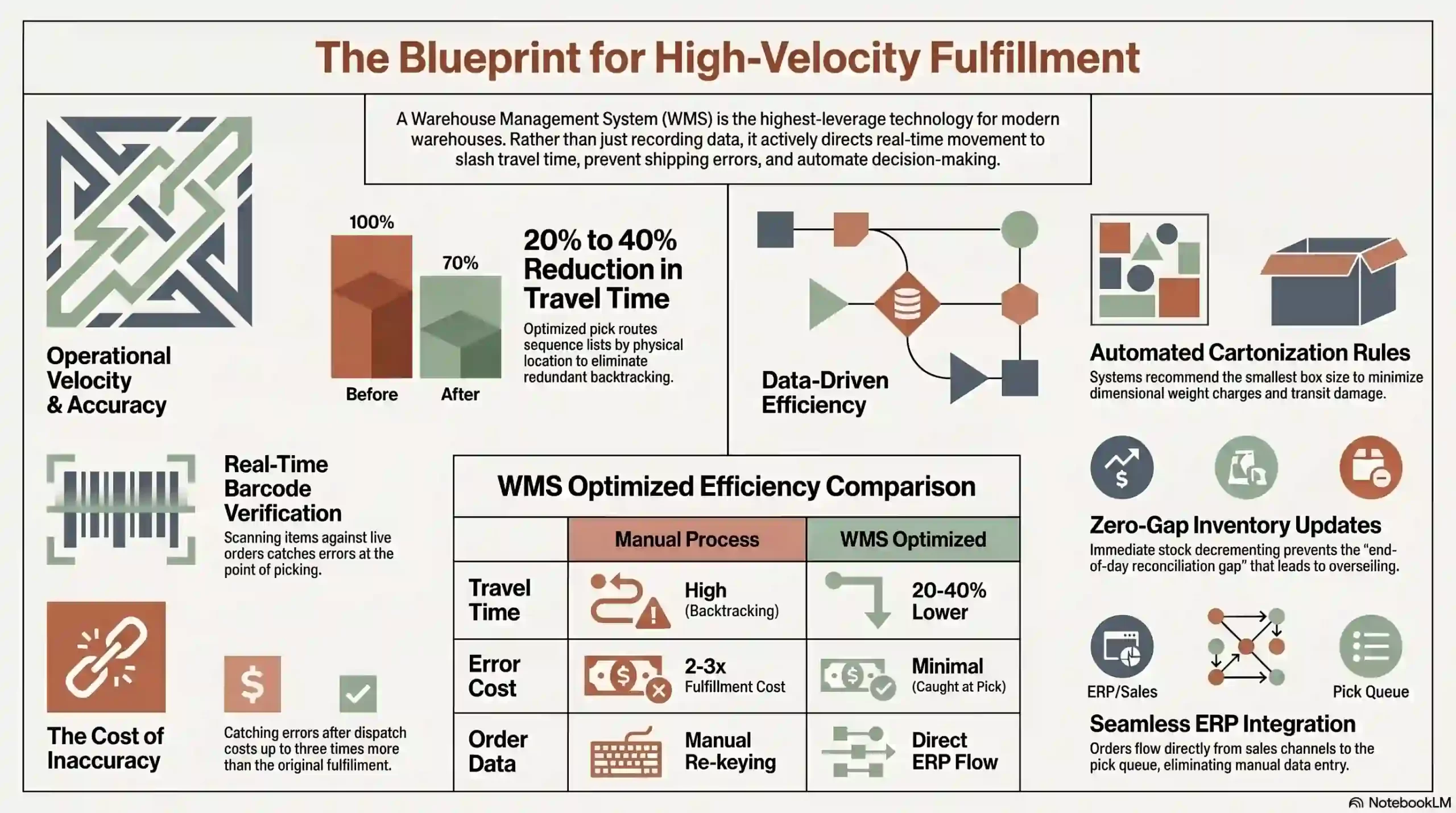
A warehouse optimization platform does not just record inventory. It actively directs every step of the pick and pack process in real time, making it the single highest-leverage technology investment available to warehouse operators.
1. Optimised pick routes
The WMS sequences pick lists by physical location, eliminating backtracking that inflates travel time. Route optimisation typically reduces picker travel time by 20 to 40% with no additional headcount required.
2. Automatic picking method assignment
For each wave, the WMS selects the most efficient picking method based on live order volume, SKU distribution, and carrier cutoff deadlines. No manual scheduling or wave planning required from the warehouse manager.
3. Barcode verification at pick and pack
Every scan is validated against the live order in real time. The system alerts the picker immediately if a wrong item is scanned, before it is packed, labelled, or shipped.
Catching errors at pick costs seconds. Catching them after dispatch, as customer returns, costs two to three times the original fulfilment cost.
4. Cartonisation rules
The WMS recommends the smallest appropriate box or mailer for each order based on item dimensions and weight. This reduces dimensional weight charges with Australian carriers and transit damage rates simultaneously.
5. Real-time inventory updates
Every pick decrements inventory immediately. You see actual available stock at any moment, with no end-of-day reconciliation gap that causes overselling or delayed order confirmation.
6. Performance dashboard
Track order accuracy percentage, picks per hour, exception rates by error type, and on-time dispatch rate by shift, day, or individual team member.
Trend data surfaces productivity issues before they compound into operational problems that require reactive headcount increases.
7. ERP integration
Orders flow directly from your sales channels and ERP into the WMS pick queue. No manual re-keying, no processing delay, no order data errors introduced at the handoff point between systems.
KPIs to Measure Pick and Pack Performance
You cannot improve what you do not measure. These five KPIs give warehouse managers a complete picture of pick and pack performance, with benchmarks to set meaningful 90-day improvement targets.
Start with order accuracy rate and on-time dispatch rate. Both correlate directly with customer satisfaction and return rates, and both are immediately visible in a WMS dashboard.
1. Order accuracy rate
Order accuracy rate measures the percentage of orders shipped with the correct items, quantities, and packaging. It is the most direct indicator of pick and pack process quality.
The benchmark is 99% or above for operations using barcode scanning. Manual operations typically sit between 95 and 97%. A WMS tracks this through scan confirmation at both pick and pack, with an exception log per order.
2. Pick rate
Pick rate measures picker productivity in order lines picked per labour hour. It reflects how efficiently your picking method, warehouse layout, and WMS routing are performing together.
For piece picking, the benchmark sits between 50 and 80 lines per hour. Batch or wave picking, including voice-guided warehouse tasks, can typically reach 100 to 150 lines per hour with WMS route optimisation. A WMS logs picks per user per shift.
3. Cost per pick
Cost per pick divides total labour and warehouse overhead by the number of picks processed in a given period. It is the most direct measure of fulfilment cost efficiency.
The figure varies by warehouse size, SKU complexity, and the picking methods in use. A WMS reconciles labour cost data against daily pick volume automatically, removing the need for manual spreadsheet calculations.
4. Perfect order rate
Perfect order rate measures the percentage of orders delivered on time, complete, undamaged, and with correct documentation. It is the composite KPI that combines accuracy, speed, and packing quality into one figure.
The target for competitive Australian e-commerce operations is 95% or above. A WMS produces this figure by combining order management data with carrier integration records.
5. On-time dispatch rate
On-time dispatch rate measures the percentage of orders processed and handed to a carrier before the cutoff time. It is the operational metric most directly linked to your same-day or next-day delivery commitments.
The benchmark is 98% or above for operations with same-day or next-day dispatch targets. A WMS tracks this by comparing the dispatch timestamp against the carrier cutoff rule configured in the system.
Two weeks of baseline data is enough to begin. Record your current order accuracy rate and on-time dispatch rate, set a 90-day target, and review weekly. A WMS surfaces all five metrics automatically.
Pick and Pack Fulfilment in the Australian Warehouse Market
Australia’s online retail sector has grown substantially over the past decade, creating sustained pressure on warehouse operations to handle higher order volumes without proportional increases in headcount.
According to ABS Retail Trade Australia data, retail turnover across online-adjacent categories has trended upward consistently, with fulfilment volume following.
For Australian warehouse managers, the implication is direct. Picking methods and verification systems that worked at 50 orders per day will not scale to 200 without structural process changes.
Carriers like Australia Post, StarTrack, and Couriers. Please have service-level commitments that push Australian operators toward tighter dispatch cutoffs than many offshore fulfilment benchmarks assume.
Conclusion
Pick and pack is the operational core of any warehouse. The fundamentals stay consistent regardless of size: retrieve the right item, verify it, pack it properly, and dispatch on time.
Manual operations in Australia run at 1 to 3% error rates. WMS-supported operations with barcode verification consistently achieve under 0.5%, translating into fewer returns, less rework, and stronger customer retention.
To learn further regarding this topic, you can book a free consultation anytime and gain practical business insights.

Frequently Asked Questions
-
What is pick and pack fulfilment?
Pick and pack fulfilment is the warehouse process of retrieving the correct items from storage and packing them for dispatch after a customer places an order.
-
What is the pick and pack process in a warehouse?
The process runs in six steps: order verified in WMS, a pick list is generated, items are retrieved, each item’s barcode is scanned, items are packed with the correct materials, then labelled and dispatched.
-
What are the different pick and pack methods?
The four standard methods are piece picking (one order per picker), batch picking (multiple orders per picker), zone picking (pickers assigned to warehouse zones), and wave picking (zone picking in scheduled batches).
-
In-house vs 3PL: which is better?
3PL outsourcing typically wins below 80 to 100 daily orders. Above that threshold, in-house fulfilment with WMS delivers lower per-unit costs and full quality control.