














A financial management system helps businesses manage money, reporting, compliance, budgets, and cash flow in one structured platform. It also works as one of the most useful integrated tools for financial operations, helping finance teams connect transactions, approvals, and reports more clearly.
For Australian businesses, this matters because finance teams must handle GST, BAS, payroll-related records, supplier payments, cash visibility, and reporting obligations accurately.
The Australian Taxation Office requires businesses to keep accurate financial records, while some companies may also need to meet ASIC financial reporting obligations. A strong financial management system gives leaders better control over financial data, approvals, forecasting, and compliance.
Key Takeaways
A financial management system gives businesses better control over accounting, cash flow, budgeting, reporting, and compliance in one connected platform.
An FMS goes beyond basic accounting software by adding forecasting, approvals, analytics, risk controls, and wider financial visibility.
Australian businesses can use an FMS to improve GST readiness, financial accuracy, budget control, and real-time decision-making.
The right FMS should fit your business size, compliance needs, reporting requirements, integration goals, and long-term growth plans.

What Is a Financial Management System (FMS)?

A financial management system (FMS) is software used to manage core financial activities such as accounting, budgeting, billing, cash flow, procurement, and financial reporting. It helps businesses organise financial data and monitor transactions more efficiently. For local finance teams, it can also complement accounting tools for Australian businesses by adding stronger planning, approval, and reporting capabilities.
An FMS also gives businesses better visibility into overall financial performance. Management teams can track revenue, expenses, and cash flow more accurately across different departments or business units.
Compared to basic accounting software, financial management systems provide broader financial oversight and support more informed decision-making.
How Does a Financial Management System Work?
A financial management system works by collecting financial data from daily business activities into one platform. It records transactions such as invoices, payments, expenses, and budgeting activities automatically. These platforms also act as systems for managing financial records, keeping transaction data easier to track, review, and report.
The system then organises this information into financial reports and dashboards. This helps businesses monitor cash flow, track spending, and review financial performance more easily.
In integrated business environments, an FMS can also connect with sales, inventory, procurement, payroll, and project management systems. This reduces manual data entry and improves access to real-time financial information.

What Is the Financial Management Process?
The financial management process is how a business plans, controls, and reviews its finances. It helps companies manage cash flow, control spending, and support better business decisions.
Most businesses follow a process that includes budgeting, recording transactions, monitoring cash flow, and preparing financial reports. These activities help businesses stay organised and meet financial obligations.
When supported by a reliable system, finance teams can track financial performance more accurately and identify issues earlier. This also helps management make faster and more informed decisions.
Key Components of a Financial Management System
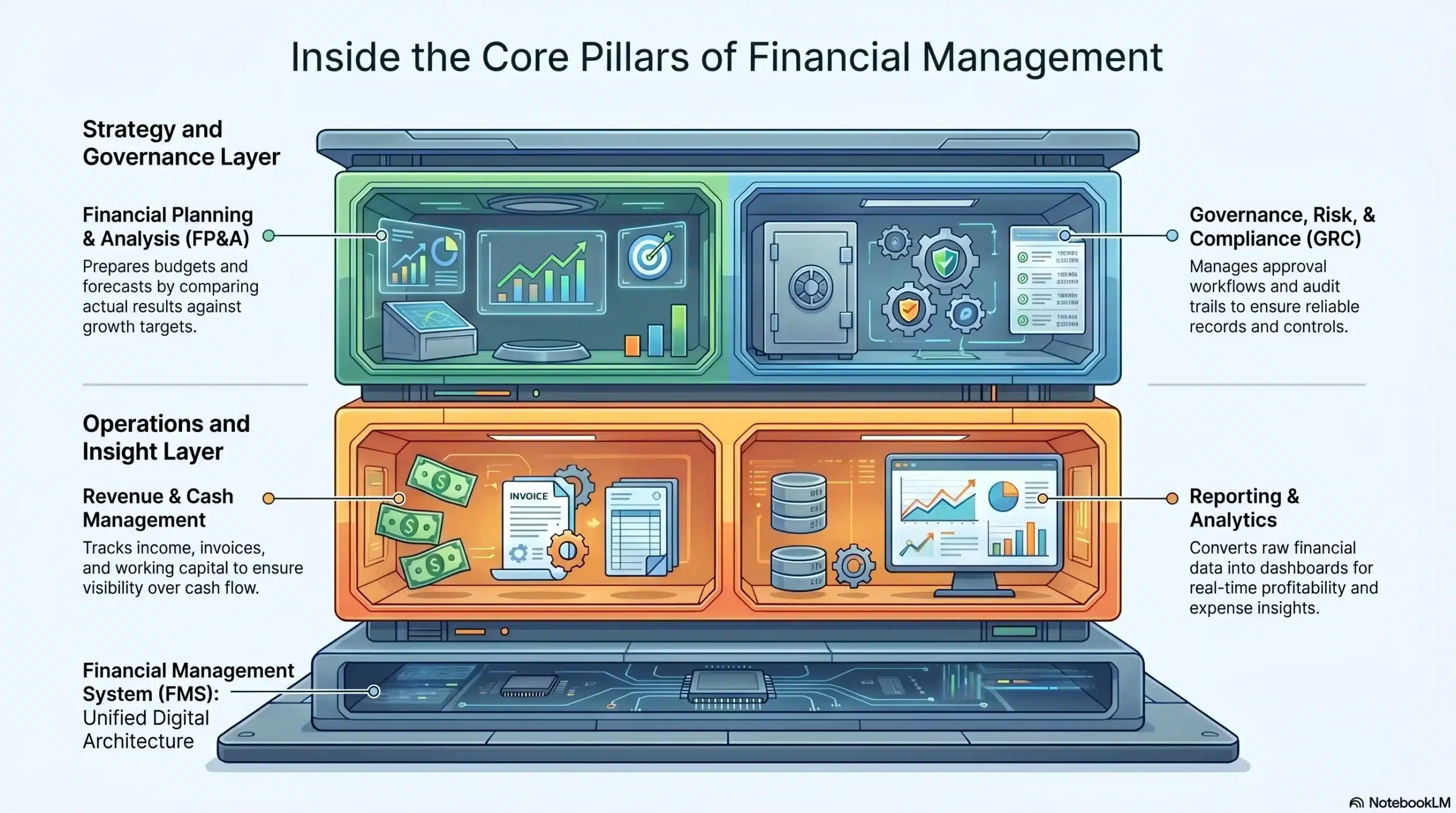
A good financial management system should support the main areas finance teams handle every day. These components help companies manage daily transactions while also planning for future growth.
1. Revenue & cash management
This component helps businesses track income, customer invoices, payment collections, bank balances, and cash flow. It is useful for companies that need better visibility over receivables, late payments, and working capital.
2. FP&A
Financial planning and analysis helps finance teams prepare budgets, forecasts, variance reports, and performance scenarios. It suits growing businesses that need to compare actual results against targets and plan future spending more carefully.
3. GRC (governance, risk, compliance)
GRC features help businesses manage approval workflows, audit trails, financial controls, and compliance risks. This is important for Australian companies that need stronger internal controls and reliable records for tax, audit, or reporting purposes.
4. Reporting & analytic
Reporting and analytics tools turn financial data into dashboards, management reports, and performance insights. They help leaders understand profitability, expenses, cash flow, and financial risks without waiting for manual spreadsheets.
FMS vs Accounting Software: What’s the Difference?
Accounting software usually focuses on bookkeeping, invoices, bank reconciliation, and basic financial reports. A financial management system covers those functions but adds planning, control, forecasting, compliance, and cross-department financial visibility. This makes an FMS more suitable as software for financial planning and control when businesses need deeper oversight than basic bookkeeping.
| Aspect | Accounting Software | Financial Management System |
|---|---|---|
| Main focus |
Bookkeeping and transaction recording | Financial control, planning, reporting, and decision-making |
| Best for |
Small businesses with simple finance needs | Growing businesses with complex operations or multiple departments |
| Reporting |
Basic profit, loss, balance sheet, and tax reports | Real-time dashboards, forecasts, budget tracking, and management reports |
| Integration |
Limited or add-on based | Connected with sales, procurement, inventory, payroll, and operations |
Who Needs a Financial Management System?
A financial management system is useful for businesses that can no longer manage finances efficiently using spreadsheets or basic accounting software. This is common when transaction volumes increase or financial processes become more complex.
Many businesses also use an FMS to manage approvals, reporting, budgeting, and cash flow more accurately across different departments or locations.
In Australia, financial management systems are commonly used in industries such as manufacturing, construction, retail, distribution, and professional services where stronger financial control and compliance are important.
Benefits of a Financial Management System for Australian Businesses
A financial management system helps businesses improve financial control, reporting accuracy, and decision-making. The following are some of the main benefits companies can gain from using an integrated financial management system.
- Tracks revenue, expenses, cash flow, and budgets in real time.
- Reduces manual work and spreadsheet errors through automation.
- Simplifies financial reporting, audit tracking, and compliance tasks.
- Helps businesses compare actual results with budgets and forecasts.
- Improves financial planning and cost control.
How to Choose the Right Financial Management System
Choosing the right financial management system starts with identifying the business’s main financial challenges, such as cash flow tracking, reporting delays, manual processes, or disconnected systems.
Businesses should also check whether the system supports GST reporting, payroll integration, audit trails, multi-entity management, and future business growth.
Before making a decision, compare systems based on usability, reporting features, security, support, and integration capabilities. Businesses should also focus on assessing financial reporting accuracy to ensure reports reflect reliable and up-to-date financial data.
The right FMS should help businesses manage finances more efficiently and make better financial decisions.
Conclusion
A financial management system helps businesses manage accounting, budgeting, cash flow, reporting, and compliance in one platform. This improves financial visibility and overall control.
With better access to financial data, businesses can monitor performance more accurately and make more informed decisions based on real-time information.
As businesses grow, spreadsheets and basic accounting tools often become harder to manage. A reliable FMS helps improve reporting, control costs, and support long-term financial planning.
Book a free consultation with our team to discover how the right financial management system can improve reporting, cash flow visibility, and overall financial control for your business.

Frequently Asked Question
A financial management system is software that helps businesses manage accounting, budgeting, cash flow, reporting, compliance, and financial planning in one connected platform.
Accounting software mainly records transactions and produces basic reports, while an FMS also supports budgeting, forecasting, approvals, analytics, compliance controls, and wider financial decision-making.
Australian businesses need a financial management system to manage GST, cash flow, reporting obligations, financial records, budget control, and real-time business performance more accurately.
The main features include accounting, revenue management, cash flow tracking, budgeting, forecasting, reporting, analytics, approval workflows, compliance controls, and system integrations.
A business should upgrade when spreadsheets or basic accounting tools can no longer handle its reporting needs, approval processes, multi-department visibility, or financial complexity.