






 Limited to 100 registrants

Retail inventory management plays a direct role in how well a retail business controls costs, fulfils customer demand, and protects cash flow. When stock levels stay accurate and aligned with sales, businesses avoid lost revenue and unnecessary holding costs. Therefore, retailers that manage inventory well operate with greater confidence and consistency.
Strong retail inventory management also supports growth. As sales channels expand and customer expectations rise, businesses need clearer visibility over stock movement. With the right processes and systems, retailers can respond faster to demand changes and make better stock decisions.
Key Takeaways
Retail inventory management connects planning, tracking, and selling stock to ensure product availability while controlling costs.
Retailers use methods such as FIFO, demand forecasting, and ABC analysis to improve stock accuracy and reduce waste.
Setting KPIs, optimising reorder points, and conducting audits help businesses maintain consistent inventory control.
ERP and POS integration delivers real-time inventory visibility, automated replenishment, and data-driven decisions.
What Is Retail Inventory Management?
Retail inventory management refers to how a business plans, tracks, stores, and sells its products. It covers the full lifecycle of stock, from purchasing items to selling them through a unified retail channels. The goal is to keep the right products available at the right time.
Effective inventory management ensures stock records stay accurate across all locations. As a result, retailers reduce errors, prevent stockouts, and limit excess inventory that ties up capital.
Why Inventory Management Is Important in Retail
"Effective inventory management is not about holding more stock. It is about holding the right stock, in the right place, at the right time."
Inventory often represents one of the largest expenses in retail. Poor control leads to overstocking, missed sales, and higher storage costs. Therefore, retailers must manage inventory carefully to protect margins.
Good inventory management also improves customer satisfaction. When products remain available and orders ship on time, customers trust the business and return more often.
How Retail Inventory Management Works
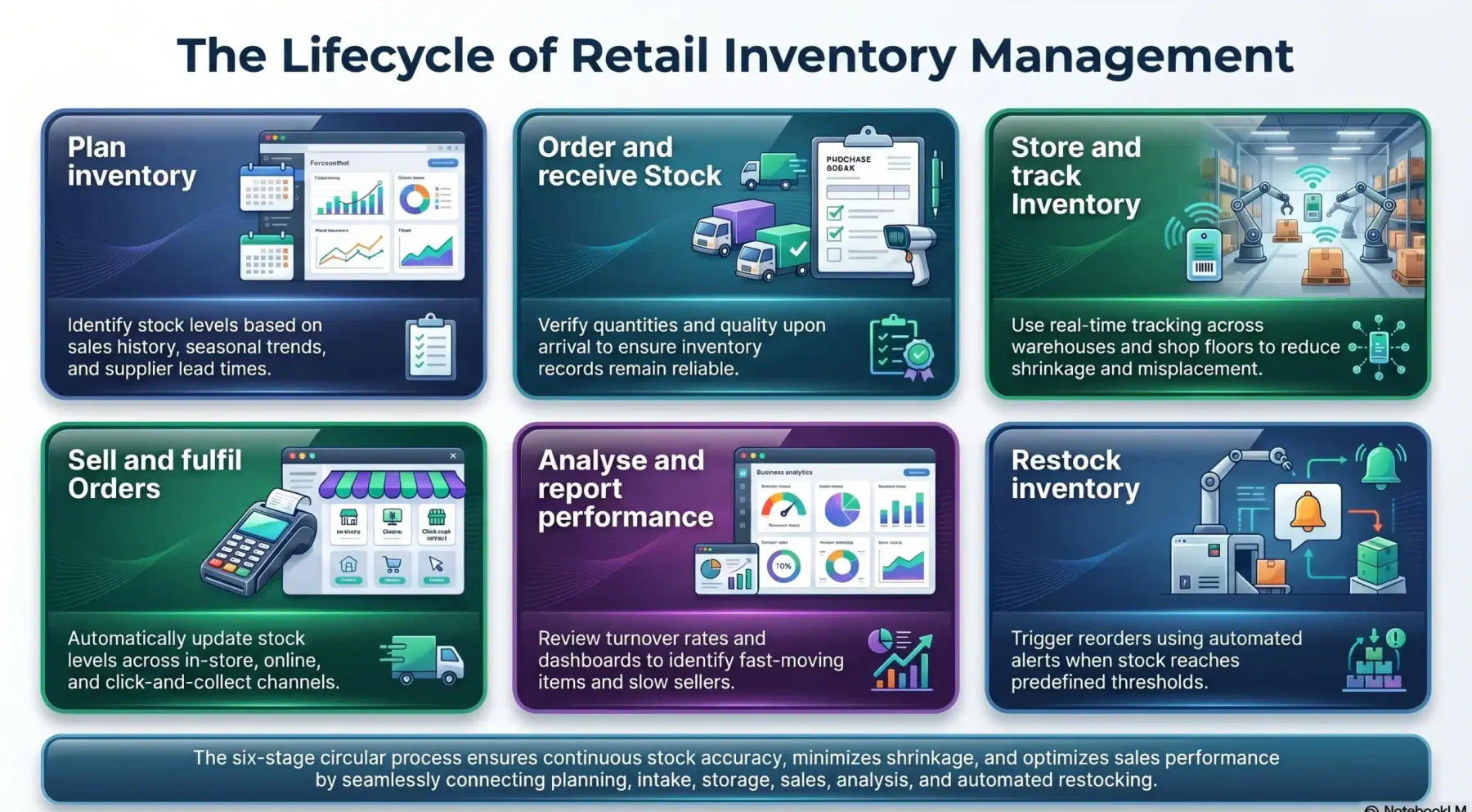
Retail inventory management follows a connected flow that supports daily operations. Each activity builds on the previous one to keep stock accurate and responsive to demand.
1. Plan inventory
Retailers start by identifying which products to stock and how much to hold. This planning relies on sales history, seasonal trends, and supplier lead times. Then, businesses can set realistic stock targets.
Clear planning helps retailers avoid excess inventory while still meeting customer demand. As a result, purchasing decisions become more controlled.
2. Order and receive Stock
Once plans are set, businesses place purchase orders with suppliers. When stock arrives, staff check quantities and quality before recording them in the stock control system.
Accurate receiving processes prevent discrepancies early. Therefore, inventory records remain reliable from the start.
3. Store and track Inventory
After receiving goods, retailers store inventory across warehouses or shop floors. Tracking systems monitor stock movement in real time.
This visibility allows staff to locate items quickly. It also reduces shrinkage and misplaced stock.
4. Sell and fulfil Orders
When customers make purchases, inventory systems update stock levels automatically. This applies to in-store sales, online orders, and click-and-collect services.
Accurate stock updates ensure orders are fulfilled correctly. As a result, retailers avoid selling unavailable items.
5. Analyse and report performance
Retailers then review inventory performance using reports and dashboards. These insights highlight fast-moving items, slow sellers, and stock turnover rates.
With this data, businesses can refine purchasing and pricing decisions.
6. Restock inventory
Based on performance analysis, retailers replenish stock when levels reach predefined thresholds. Automated alerts help trigger reorders at the right time.
Consistent restocking prevents disruptions and keeps shelves supplied.






Types of Retail Inventory
Retailers handle different inventory categories. Understanding each type supports better stock control and planning.
Raw materials
Raw materials include components used to create finished products. Retailers with private labels often manage this inventory to support production.
Managing raw materials carefully prevents delays and waste.
Work-in-progress
Work-in-progress inventory covers items that are partially completed. This applies mainly to retailers involved in light manufacturing or custom products.
Tracking this stock ensures production stays on schedule.
Finished goods
Finished goods are products ready for sale. This inventory directly impacts revenue and customer satisfaction.
Retailers must keep accurate records to avoid overselling.
Safety stock
Safety stock acts as a buffer against demand spikes or supplier delays. It protects sales during unexpected disruptions.
However, businesses must balance safety stock to avoid excess holding costs. This process can be easily managed using a retail sales tracking.
Dead stock
Dead stock includes items that no longer sell. This inventory ties up capital and occupies storage space.
Retailers should identify dead stock early and clear it through promotions or write-offs.
Retail Inventory Management Methods and Techniques
Retailers use different methods to control inventory more effectively. Each technique serves a specific purpose.
FIFO (First in, first out)
FIFO ensures older stock sells before newer stock. This method suits perishable and time-sensitive products.
As a result, retailers reduce waste and maintain product quality.
Just-in-Time (JIT) inventory
JIT inventory focuses on ordering stock only when needed. This approach lowers storage costs and excess inventory.
However, it requires reliable suppliers and accurate demand forecasting.
ABC analysis
ABC analysis groups inventory based on value and importance. High-value items receive closer monitoring than low-value stock.
This method helps retailers prioritise control efforts.
Demand forecasting
Demand forecasting uses historical data and market trends to predict future sales. Accurate forecasts improve purchasing decisions.
Therefore, retailers reduce both stockouts and overstocks.
Best Practices for Retail Inventory Management

Applying proven practices helps retailers maintain control as operations grow.
Set inventory KPIs
Key performance indicators such as stock turnover and sell-through rates provide clear benchmarks. These metrics show how well inventory performs.
Regular monitoring keeps teams accountable.
Forecast demand accurately
Retailers should update forecasts regularly using real sales data. This approach reflects changes in customer behaviour.
Better forecasts lead to smarter purchasing.
Optimise reorder points and safety stock
Reorder points define when to replenish inventory. Setting them correctly prevents both shortages and excess stock.
Safety stock levels should align with demand variability.
Conduct regular inventory audits
Routine stock counts uncover discrepancies early. Audits improve data accuracy and reduce losses.
They also strengthen internal controls.
Automate inventory processes
Automation reduces manual errors and saves time. Inventory tracking tools for retail updates stock levels automatically across systems.
As a result, teams focus on higher-value tasks.
Common Challenges in Retail Inventory Management
Retailers often face obstacles that affect stock accuracy and availability.
Inaccurate inventory data
Manual tracking leads to errors and mismatched records. Inaccurate data causes poor decisions.
Automation helps maintain consistency.
Demand fluctuations
Customer demand can change quickly due to trends or seasons. Without proper forecasting, retailers struggle to respond.
Flexible planning reduces this risk.
Supply chain disruptions
Delays from suppliers affect stock availability. Retailers must plan for lead time variability.
Safety stock and alternative suppliers help mitigate impact.
Overstocking and dead stock
Excess inventory increases storage costs and reduces cash flow. Poor sales visibility worsens this issue.
Regular analysis helps identify slow-moving items early.
Retail Inventory Management Systems

Technology plays a key role in managing retail inventory efficiently.
Spreadsheet-based systems
Spreadsheets offer basic tracking for small retailers. They are simple but prone to errors.
As operations grow, limitations become clear.
Inventory management software
Dedicated inventory software provides real-time tracking and reporting. These systems improve accuracy and visibility. Knowing the retail inventory software options for your business is vital for this reason
ERP systems for retail
ERP systems connect inventory with sales, finance, and procurement. This integration creates a single source of truth.
Retailers gain full operational visibility.
How ERP and POS Systems Improve Retail Inventory Management
ERP and POS systems work together to streamline inventory control. Their integration supports faster and more accurate decisions.
1. Real-time inventory tracking
ERP systems update stock levels instantly after each transaction. Retailers always know what is available.
This visibility enables intelligent retail monitoring, helping teams detect stock discrepancies and unusual movements before they cause larger losses.
2. Integration with POS and sales channels
POS integration synchronises in-store and online sales. Inventory data stays consistent across channels.
Therefore, retailers avoid overselling.
3. Automated stock replenishment
ERP systems trigger replenishment based on predefined rules. This automation prevents late reorders.
Stock availability remains stable.
4. Data-driven inventory decisions
ERP and POS data provide actionable insights. Retailers analyse trends and adjust strategies confidently.
Better data leads to better outcomes.
Conclusion
Retail inventory management determines how well a retail business controls stock, costs, and service quality. When inventory data stays accurate and processes remain connected, retailers reduce waste, improve fulfilment, and protect cash flow.
With the right systems in place, inventory decisions become faster and more reliable. Businesses gain clearer visibility across sales channels and stock locations. For tailored guidance, schedule a consultation with our experts to see how your inventory processes can improve.

Frequently Asked Question
Retail inventory management is the process of planning, tracking, storing, and selling stock to meet customer demand efficiently.
It helps retailers reduce stockouts, control costs, and maintain healthy cash flow.
Retailers use spreadsheets, inventory software, or ERP systems depending on scale and complexity.
ERP systems centralise inventory, sales, and purchasing data to provide real-time visibility and automation.
Retailers should conduct regular audits to maintain data accuracy and identify discrepancies early.