

Businesses today face rising costs, shifting consumer demands, and supply chain disruptions that make internal optimization no longer optional. Simply growing revenue is not enough. To stay competitive, businesses must focus on doing more with less without compromising quality.
Operational efficiency is no longer exclusive to large corporations. Businesses of all sizes, especially SMBs, need it to scale sustainably. The right workflows, systems, and integrated technologies are what separate firms that grow confidently from those that struggle to keep up.
With this insight in mind, optimizing operation is no longer an option; it is the next step. This page is a complete and comprehensive guide on how you can achieve operational efficiency for your business and surpass your competitors.
Key Takeaways
Operational efficiency is the balance between inputs and outputs that aims to eliminate waste, lower costs, and ensure every resource contributes directly to generating value.
Productivity measures how much a business produces, while efficiency measures how effectively it uses available resources.
Metrics such as operating expense ratio, OEE, cycle time, throughput, inventory turnover, and employee utilisation help businesses identify performance gaps.
Integrated systems, automation, predictive maintenance, and continuous improvement help businesses maintain efficient operations as they grow.

What Is Operational Efficiency?

Operational efficiency measures the ratio between the inputs a business uses and the outputs it generates. Inputs include time, money, labor, and materials. Outputs are the products, services, and revenue those inputs produce. The goal is to maximize outputs while minimizing inputs.
Lean management offers a practical lens for this. It focuses on identifying and eliminating waste, which is any activity that does not add value to the final product or the customer experience. Excessive inventory, redundant tasks, and long wait times all qualify.
Efficiency is not a destination. The business landscape shifts constantly, and what worked five years ago may now be a liability. Businesses must regularly audit their processes and maintain an agile mindset to stay optimized.
The financial payoff is significant. Reducing COGS and operating expenses widens profit margins, freeing up capital for reinvestment in growth, talent, or new markets.
Efficient operations also drive faster turnaround times, better product quality, and stronger customer service. These factors compound over time, building brand loyalty and increasing customer lifetime value.
"Operational efficiency is not about working harder or spending less. It is about making sure every process, every system, and every person is pointed in the same direction toward delivering value."
Operational Efficiency vs. Productivity
Operational efficiency and productivity are related but measure different things. Conflating them leads to misguided strategies. Understanding the distinction is essential for leaders who want to build a truly optimized business.
Productivity measures volume. If a manufacturing team produces 500 units in a shift and increases that to 600, their productivity has gone up. It answers the question: how much are we getting done?
Efficiency asks a different question: how well are we using our resources? If that same team hit 600 units by working excessive overtime, wasting materials, and producing more defects, productivity rose, but efficiency fell.
The same applies in sales. A team making 1,000 cold calls a week but closing only two deals is productive but inefficient. A team making 200 calls and closing 20 is generating far more value from the same investment of time.
The ideal state is both. High output achieved through optimized, sustainable workflows. Pushing for productivity at the expense of efficiency leads to burnout, quality issues, and bloated costs that quietly erode margins.
Key Metrics to Track
Managing operational efficiency requires objective data, not guesswork. A strong KPI framework gives leaders the ability to measure performance, spot bottlenecks, and track whether improvement initiatives are actually working.
Operating Expense Ratio (OER)
The OER compares total operating expenses to revenue. A lower ratio means the business generates more revenue relative to its overhead. If the OER trends upward over time, it is a signal that costs are growing faster than income.
Overall Equipment Effectiveness (OEE)
OEE is the gold standard for factory floor efficiency. It measures three factors: machine availability, performance speed, and defect-free output quality. A perfect score of 100% means good parts only, at full speed, with zero downtime.
Cycle Time
Cycle time is how long it takes to complete a process from start to finish. Reducing it lowers labor costs and improves throughput. The key is cutting non-value-added steps without letting speed compromise the quality of the final output.
Throughput
Throughput measures the volume of output produced in a given period. Increasing it without adding more inputs is a clear sign of improved efficiency. It also helps identify the slowest point in the process, where resources should be directed first.
Inventory Turnover Ratio
This metric shows how often inventory is sold and replaced over a period. A high ratio signals strong sales and lean stock management. A low ratio points to overstocking or sluggish demand, both of which tie up capital unnecessarily.
Employee Utilization Rate
This measures the share of employee time spent on productive, billable work versus administrative tasks. When skilled staff spend significant time on data entry or navigating clunky systems, efficiency suffers. Tracking it surfaces opportunities to automate and reallocate workloads.
Operational Efficiency Examples for SMBs
Theory only goes so far. Seeing efficiency principles applied in real business scenarios is what makes them actionable. SMBs face tighter budgets and fewer resources than large enterprises, but that does not make efficiency out of reach.
With the right approach, smaller businesses can apply the same principles as large corporations and compete well above their size. The examples below show exactly how that plays out across different types of operations.
Example 1: The E-commerce Retailer Optimizing Fulfillment
A growing e-commerce apparel business managed inventory and fulfillment manually through spreadsheets. As order volume grew, this became a serious bottleneck. Labor hours were disproportionately high relative to orders shipped, leading to delays and frustrated customers.
The fix was an integrated warehouse management system connected to their storefront. It automated inventory syncing, generated optimized picking routes, and replaced manual data entry with barcode scanners.
The result was a dramatic drop in cycle time per order. The same team processed three times the volume without overtime, lowering cost per shipment and improving customer satisfaction significantly.
Example 2: The Regional Manufacturing Plant Reducing Waste
A mid-sized automotive parts manufacturer faced shrinking margins despite steady demand. Their OEE score was low, driven by high defect rates and frequent machine downtime. Running machines longer to compensate only increases waste and energy costs.
They adopted Lean principles and introduced root-cause analysis for every defective part. A single calibration error on one machine turned out to be responsible for 60% of all defects. Fixing it drastically cut material waste.
They also shifted from reactive to preventative maintenance, servicing equipment during planned downtime. This reduced breakdowns, improved availability, and made production schedules far more predictable.
Best Practices for Operational Efficiency
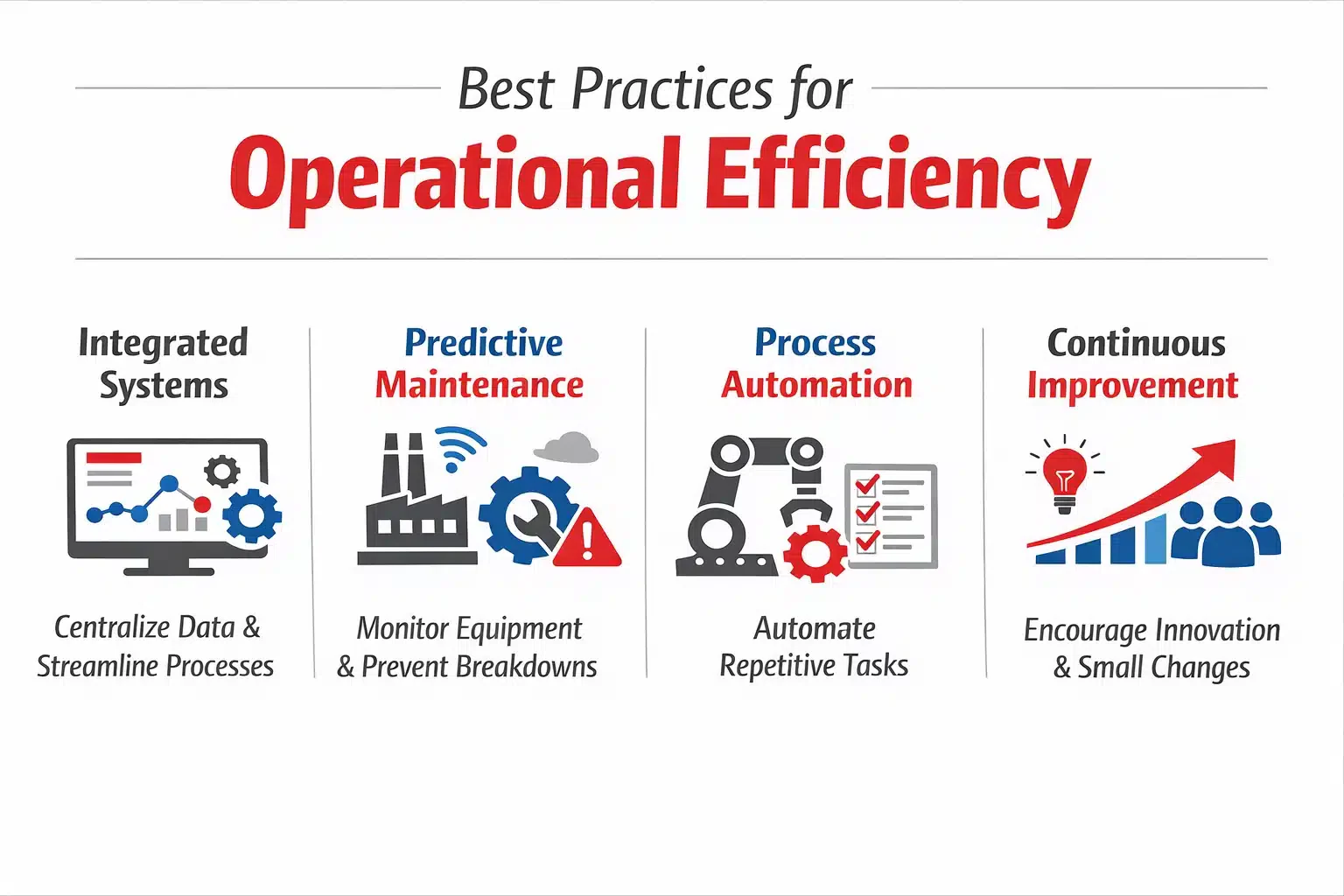
Achieving and sustaining operational efficiency takes more than a one-time initiative. It requires a deliberate combination of the right technology, well-engineered processes, and a workforce that is genuinely invested in continuous improvement.
Businesses that excel at this do not simply cut costs. They build systems and cultures that make efficiency a natural outcome of how work gets done every day. The practices below provide a practical roadmap for getting there.
Use Systems to Improve Efficiency
One of the biggest barriers to operational efficiency is fragmented software and manual data entry. When departments like sales, finance, and inventory each run on separate systems, data duplication and communication breakdowns are inevitable.
Employees end up spending valuable time reconciling figures across platforms instead of doing work that actually moves the business forward. Errors accumulate, and decisions get delayed.
The solution is a unified technological ecosystem. ERP systems are the most effective way to achieve this, centralizing all operations into a single source of truth.
When a sale is made, inventory updates automatically, finance is notified for invoicing, and the supply chain can adjust procurement forecasts in real time. No manual handoffs, no data gaps.
This level of integration eliminates redundant administrative work, accelerates cross-departmental workflows, and gives leadership the real-time visibility needed to make faster, more informed decisions.
Leveraging predictive maintenance
For asset-heavy industries like manufacturing and construction, equipment downtime is one of the biggest threats to efficiency. Businesses managing large facilities or multi-site operations often rely on facility management software to centralise asset tracking, maintenance schedules, and compliance records across locations. Maintenance falls into two approaches: reactive, which fixes problems after they occur, and preventative, which services on a fixed schedule regardless of need.
Reactive maintenance causes catastrophic, unplanned production halts. Preventative maintenance wastes capital by replacing parts that still have useful life. Neither approach is truly efficient.
The modern standard is data-driven maintenance, powered by IoT sensors and data analytics. Smart sensors monitor real-time metrics like temperature, vibration, and energy consumption across critical machinery.
AI algorithms analyze this data continuously, detecting subtle anomalies that signal a component is starting to degrade. Maintenance teams are alerted precisely when a machine needs attention, not before and not after.
This maximizes asset lifespan, virtually eliminates unplanned downtime, and ensures maintenance personnel are deployed only where and when they are genuinely needed.
Implementing automation
Human labor is the most expensive and error-prone input in most operations. Creative and strategic thinking are irreplaceable, but using human effort for repetitive, rule-based tasks is a drain that compounds over time.
Data entry, invoice generation, email follow-ups, and basic data routing consume vast amounts of time while adding little competitive value. These are exactly the tasks that automation is built to handle.
Robotic Process Automation (RPA) and workflow tools can execute these tasks with perfect accuracy at a fraction of the time. An automated workflow can scan vendor invoices, extract data, match it to purchase orders, and route it for approval instantly.
The business impact goes beyond speed. Automating repetitive work reduces operational costs, eliminates human error, and frees skilled staff to focus on customer relationships, product innovation, and strategic planning.
Automation becomes more valuable when it understands the business context behind each task. Click the Hashy banner below to discover how an AI coworker can use connected ERP data to help teams complete everyday work faster.






Building a Culture of Continuous Improvement
Technology and optimized processes will ultimately fail without the right culture behind them. Efficiency cannot be dictated from the top down. It requires genuine buy-in from the employees who execute the work every day.
When staff views efficiency initiatives as a tool to cut jobs or pile on more work, resistance is unavoidable. The goal has to be framed as making their jobs easier, not harder.
The best practice is building a culture of continuous improvement rooted in the Kaizen philosophy. Small, incremental changes made consistently over time produce significant results without disrupting the entire operation at once.
Frontline employees must be empowered to identify bottlenecks and suggest improvements. They are closest to the flaws in existing workflows and often have the most practical solutions.
Regular training, transparent communication about efficiency goals, and cross-functional teams tackling process improvement together ensure that operational excellence becomes a shared pursuit rather than a management directive.
Common Pitfalls to Avoid
The path to operational efficiency is full of potential missteps. Even well-intentioned efforts can backfire if these common traps are not recognized and avoided early.
- The Efficiency Trap
The most pervasive pitfall is cutting costs so aggressively that output quality begins to suffer. Slashing headcount or switching to cheaper materials may improve the expense ratio temporarily, but the drop in quality leads to customer churn and reputational damage that far outweighs the savings.
- Optimizing in Silos
Improving one department without considering its effect on others often just shifts the bottleneck elsewhere. If marketing quadruples lead volume but sales lack the capacity to handle it, overall efficiency has not improved. Process mapping must span the entire business, not just individual teams.
- Ignoring the Human Element
New systems and redesigned workflows disrupt the status quo. Without clear communication, training, and support, employees resist change or find workarounds that bypass the new processes entirely. Change management is not optional; it is a core part of any efficiency initiative.
- Relying on Outdated Technology
Patching broken workflows with more manual oversight or spreadsheet tracking only adds bloat. If the root issue is a lack of centralized data or automation, no amount of process tweaking will fix it. Legacy systems that limit efficiency must be retired, not maintained.
Conclusion
Operational efficiency is not a destination; it is a discipline that separates businesses that scale sustainably from those that don’t. By tracking proper metrics, eliminating waste, and investing in systems to connect the entire operation, businesses build a foundation that supports long-term growth.
The tools and practices covered in this guide, from ERP systems and predictive maintenance to automation, are not reserved for large enterprises. Any business willing to commit to smarter ways of working can achieve meaningful improvements in how it operates.
If you, too, are interested in achieving operational efficiency, you can consult with our expert to gain the business insight you need. We hope to aid you in improving your business, and we hope to see you again on our other blogs!

Frequently Asked Question
Operational efficiency is the ratio between the inputs a business uses and the outputs it generates. The goal is to maximize results while minimizing wasted resources, including time, labor, capital, and materials, without compromising quality.
Productivity measures how much output is generated in a given timeframe. Operational efficiency measures how well resources are used to generate that output. A business can be highly productive but still inefficient if the cost per unit is too high or waste is excessive.
The most important KPIs include the Operating Expense Ratio, Overall Equipment Effectiveness, Cycle Time, Throughput, Inventory Turnover Ratio, and Employee Utilization Rate. Together, these metrics give a complete picture of where performance can be improved.
A culture of continuous improvement, rooted in the Kaizen philosophy, encourages frontline employees to identify bottlenecks and suggest better ways of working. When efficiency is a shared value rather than a top-down mandate, improvements are more sustainable and resistance to change is significantly reduced.
The efficiency trap occurs when a business becomes so focused on cutting costs that it begins to degrade the quality of its products or services. To avoid it, cost reductions must always be weighed against quality control and customer satisfaction metrics, ensuring that value creation is never compromised.