






Managing a large-scale business requires more than disconnected software and manual spreadsheets. As operations expand across geographies and workforces grow, complexity increases rapidly, and the cost of fragmented systems becomes impossible to ignore.
A centralized platform that unifies finance, supply chain, HR, and project management gives leadership real-time visibility across the entire business. It eliminates redundant data entry, accelerates reporting, and enables faster, more confident decisions at scale.
This blog is a detailed explanation and guide of ERP for enterprises and how you too can implement it into your business for operational excellence.
Key Takeaways
Enterprise ERP is a comprehensive software platform that integrates and automates core business processes across finance, supply chain, HR, and project management.
Models of ERP systems includes Cloud, On-Premises, or Hybrid. Each model carries distinct cost, control, and scalability trade-offs.
A successful implementation follows six phases: strategic planning, business process reengineering, data migration, testing, change management and training, and go-live with post-implementation support.
Best practices is to keep customizations minimal, secure sponsorship, invest in change management, align the system with strategy, and treat implementation as a business transformation.
What Is Enterprise ERP?

Enterprise Resource Planning (ERP) is a comprehensive software platform that integrates and automates the core business processes of a company. The enterprise tier refers specifically to systems engineered for large, complex, and often multinational corporations.
These systems trace their roots to Material Requirements Planning (MRP) in the 1960s, which managed inventory and production schedules. By the 1980s, MRP II began incorporating financial and HR data. The term ERP was coined by Gartner in the 1990s.
Today, enterprise ERP has evolved well beyond its back-office origins, incorporating AI, machine learning, IoT, and predictive analytics to manage operations at a global scale.
What separates enterprise-grade systems from SMB solutions is their capacity to handle immense complexity: multi-currency transactions, global tax regulations, multi-language interfaces, and intercompany consolidations across dozens of countries simultaneously.
Enterprise ERP acts as a single source of truth. The CFO in New York and the Supply Chain Director in Singapore are working from the same real-time data, eliminating the version control and visibility gaps that plague disconnected systems.
The architecture relies on a centralized relational database. When a sales order is entered, the system automatically triggers an inventory check, updates the production schedule, alerts procurement, and generates an invoice in the accounts receivable ledger.
This level of orchestration reduces administrative overhead, minimizes human error, and accelerates the order-to-cash cycle, replacing the fragmented handoffs between standalone systems with a single, automated flow of information.
"An ERP system does not fix a broken business. It amplifies what is already there. Get your processes right before you go live, or the system will just make your problems faster"
Types of Enterprise ERP Systems
Choosing the right deployment model is one of the most critical decisions in any ERP implementation. It determines how the software is hosted, maintained, secured, and paid for, with significant implications for total cost of ownership (TCO).
Enterprise ERP systems generally fall into three categories: Cloud, On-Premises, and Hybrid. Each presents distinct advantages, trade-offs, and cost structures depending on the size, complexity, and regulatory environment of the business.
Cloud ERP
Cloud ERP has become the dominant deployment model for modern enterprises, driven by agility, scalability, and reduced IT overhead. The software and its data are hosted on remote servers managed by the vendor or a third-party provider such as AWS, Azure, or Google Cloud.
Cloud ERP typically operates on a SaaS subscription model, shifting the financial burden from a large upfront capital expenditure to a predictable operational expense. This model is also increasingly relevant for companies evaluating ERP tools for Australian businesses, especially when scalability, compliance, and multi-entity visibility become priorities.
Scalability is another key advantage. If a business acquires a new subsidiary or experiences a surge in transaction volume, cloud infrastructure can scale computing resources up or down without purchasing additional hardware.
Cloud systems are divided into multi-tenant and single-tenant architectures. Multi-tenant environments allow vendors to push automatic updates to all customers simultaneously. Single-tenant environments offer a dedicated instance with greater control over updates and deeper customization.
On-Premises ERP
On-Premises ERP is the traditional model where software is installed locally on a company’s own servers within its physical facilities or a privately managed data center. The business assumes full responsibility for implementation, maintenance, security, and upgrades.
Despite the shift toward cloud, on-premises ERP remains relevant for businesses in sectors with stringent data sovereignty requirements, such as defense contracting, aerospace, and government-affiliated entities that require physical control over their data.
On-premises solutions also offer extensive customization. Internal IT teams can modify the system to support highly proprietary workflows that off-the-shelf software cannot accommodate. However, this comes at the cost of significant upfront capital and ongoing IT overhead.
Hybrid ERP
Hybrid ERP combines cloud and on-premises deployments. It is popular among large global conglomerates that want cloud agility while maintaining legacy systems too complex or expensive to replace, providing a pragmatic, phased pathway to digital transformation.
A common hybrid approach is the Two-Tier ERP strategy. The headquarters retains a robust on-premises system (Tier 1) for complex financial consolidations, while regional subsidiaries and newly acquired entities run agile cloud-based systems (Tier 2) integrated back into Tier 1.
This allows subsidiaries to operate with software suited to their local needs without being constrained by the rigid headquarters system. It also accelerates post-merger integration, as onboarding a new entity onto a cloud Tier 2 system is far faster than a full migration.
Key Modules of an Enterprise ERP System
Enterprise ERP is not a single application but a suite of interconnected modules, each managing a specific functional area while sharing data through a centralized database. Businesses can implement the full suite or select modules based on their operational needs.
1. Financial Management
The financial management module is the bedrock of any enterprise ERP system. It handles core accounting functions, including the general ledger, accounts payable, accounts receivable, fixed asset management, and cash management.
At the enterprise level, this goes well beyond bookkeeping. The module handles multi-currency processing with real-time exchange rate adjustments and complex intercompany accounting across multiple subsidiaries, rolling everything up into a single consolidated financial statement.
Compliance is deeply embedded. The module automates revenue recognition, tax calculations across jurisdictions, and audit trail generation, ensuring adherence to GAAP and IFRS standards while giving the CFO real-time visibility into the business’s fiscal health.
2. Supply Chain and Procurement
The supply chain and procurement module governs the entire product lifecycle, from raw material acquisition to delivery to the end consumer. It aims to optimize inventory levels, reduce lead times, and minimize logistics costs across complex global networks.
On the procurement side, it automates purchase order generation, manages supplier relationships, tracks vendor performance, and facilitates RFQ processes. Centralizing procurement data allows large enterprises to negotiate better terms and volume discounts.
On the supply chain side, demand forecasting algorithms prevent both stockouts and overstock situations. The module integrates with warehouse management systems using barcode and RFID technology and incorporates transportation management to optimize shipping routes in real time.
3. Human Resources and Workforce Management
The HR module acts as the central repository for all employee data, covering the full lifecycle from recruitment and onboarding through to retirement. It replaces fragmented spreadsheets and legacy HRIS systems with a single, unified workforce management platform.
Core functions include payroll processing across multi-state and multinational tax structures, time and attendance tracking, shift scheduling, and automated processing of time-off requests at enterprise scale.
The module also covers talent management, including applicant tracking, performance appraisals, and learning management. Integrating HR data with financial and operational data allows leadership to analyze productivity, forecast labor costs, and build succession plans.
4. Project and Risk Management
The project management module is critical for businesses in construction, engineering, professional services, and IT consulting. It provides tools for planning, executing, and monitoring complex multi-phase projects, including Gantt charts, critical path analysis, and resource allocation matrices.
Project costs, including labor, materials, and overhead, are tracked against baseline budgets in real time. Employees log billable hours directly against project codes, integrating seamlessly with the financial module to generate accurate client invoices.
Risk management is built into this module. Businesses can identify, quantify, and mitigate potential project risks before they affect the bottom line, with scenario planning and resource bottleneck identification across the entire project portfolio.
5. Reporting and Analytics
The reporting and analytics module transforms the massive volume of data generated across the business into actionable intelligence. Self-service business intelligence tools give every level of the business access to the data they need without relying on IT to run queries.
Customizable dashboards display KPIs in real time, making the platform useful not only for executives but also as ERP software for supervisors who need faster visibility into day-to-day performance.
A CEO can view global revenue figures while a warehouse manager monitors daily picking metrics, with the ability to drill down from high-level summaries to granular transactional detail in a single click.
Advanced platforms use AI and machine learning to move beyond historical reporting into predictive analytics. The system can forecast a supply chain disruption based on global weather patterns or anticipate a cash flow dip based on seasonal trends, enabling proactive rather than reactive decisions.
Industry-Specific Use Cases for Enterprise ERP
While enterprise ERP serves general business needs by default, its true power is unlocked when tailored to specific industry verticals. Modern vendors address this through specialized industry editions and modules built around unique regulatory and operational requirements.
- Global Manufacturing
In manufacturing, enterprise ERP is the backbone of production. It manages everything from Bill of Materials (BOM) and capacity planning to shop floor control and quality assurance across multiple global facilities.
Integration with Industrial IoT sensors allows the system to trigger predictive maintenance alerts before a machine failure halts the production line. For multinational manufacturers, this capability alone can prevent millions in unplanned downtime.
- Healthcare and Life Sciences
Healthcare networks and pharmaceutical companies face stringent regulatory environments, including HIPAA and FDA compliance. Enterprise ERP tracks the full lifecycle of medical supplies, monitoring expiration dates and keeping counterfeit products out of the supply chain.
These systems also handle complex billing structures, insurance claims processing, and staff scheduling across multiple hospital campuses, all within strict patient data privacy protocols.
- Retail and Omnichannel Commerce
For global retailers, the challenge is synchronizing inventory across physical stores, e-commerce platforms, and third-party marketplaces. Enterprise ERP provides a single source of truth for inventory availability, preventing stockouts and overselling.
Advanced order management modules route fulfillment to the most cost-effective warehouse or retail location. Consolidated customer data enables personalized promotions and loyalty rewards across all channels.
Step-by-Step Enterprise ERP Implementation Process
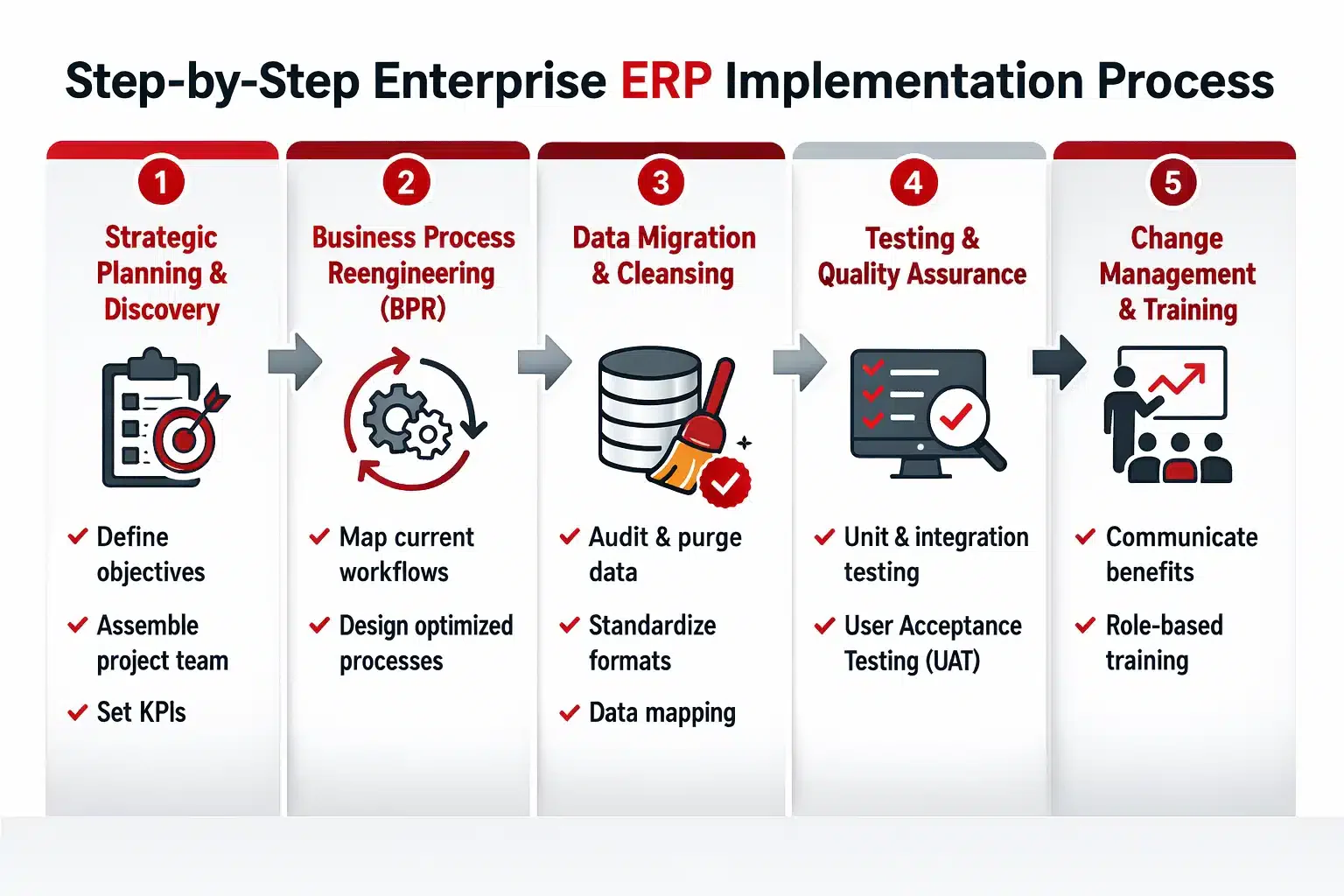
Deploying an enterprise ERP is one of the most complex IT initiatives a business can undertake. It requires meticulous planning, cross-functional collaboration, and a structured methodology to deliver on its investment.
Step 1: Strategic Planning and Discovery
Before any software is purchased, leadership must define the strategic objectives of the implementation. This includes a readiness assessment, identification of operational pain points, and establishing clear, measurable KPIs.
A dedicated project team must be formed, consisting of an executive sponsor, a project manager, and subject matter experts from every major department. Without this structure, implementations lose direction quickly.
Step 2: Business Process Reengineering (BPR)
A new ERP implementation is an opportunity to modernize outdated workflows, not simply replicate them in new software. Business Process Reengineering (BPR) involves mapping current workflows, identifying inefficiencies, and designing optimized future-state processes.
Rather than customizing the software to fit legacy processes, businesses should align their workflows with the best practices already embedded in modern ERP solutions. This reduces customization costs and simplifies future upgrades.
Step 3: Data Migration and Cleansing
Enterprise systems rely on accurate data. Migrating decades of legacy data into a new system requires auditing existing databases, purging obsolete or duplicate records, and standardizing data formats across the business.
A comprehensive data mapping strategy ensures information flows correctly into the new system’s architecture. The rule here is simple: garbage in, garbage out. Poor data hygiene will severely undermine the system’s effectiveness from day one.
Step 4: Testing and Quality Assurance
Rigorous testing is non-negotiable. This begins with unit testing of individual modules, followed by integration testing to confirm data flows seamlessly between departments.
User Acceptance Testing (UAT) is the final validation step, where actual end-users run through real-world scenarios to confirm the system performs as expected. All bugs, integration failures, and workflow bottlenecks must be resolved before go-live.
Step 5: Change Management and Training
Even the most advanced ERP will fail if the workforce resists adopting it. A formal change management strategy must communicate why the change is happening and how it benefits employees in their daily work.
Training should be comprehensive, role-based, and delivered through a mix of classroom instruction, digital adoption platforms, and hands-on sandbox environments. Employees must be confident users before the system goes live.
Step 6: Go-Live and Post-Implementation Support
The final phase is deployment, executed either as a Big Bang rollout where everything goes live simultaneously, or a phased approach, deploying by region or module. The phased approach carries significantly less risk for large enterprises.
Immediately after go-live, the business enters a hypercare period. The project team and vendor support staff remain on high alert to resolve technical issues quickly, provide user assistance, and ensure business continuity is maintained.
Common Implementation Pitfalls to Avoid
Despite best efforts, enterprise ERP projects have a notorious reputation for going over budget and past deadlines. Recognizing these pitfalls before they occur is critical to protecting the investment.
- Over-Customization
Modifying the core code of an ERP to replicate old processes creates significant technical debt. It makes the system unstable, complicates future upgrades, and inflates the implementation budget well beyond original projections.
Customizations should be kept to an absolute minimum. Standard configurations and API integrations are almost always a more sustainable path than rewriting core functionality to match legacy workflows.
- Lack of Executive Sponsorship
If C-suite executives are not visibly championing the project, departmental leaders may not allocate the necessary time and resources. Strong executive alignment is required to break down silos, enforce process changes, and resolve high-level disputes.
- Underestimating Change Management
Focusing solely on the technical deployment while ignoring the human element is a recipe for disaster. If end-users are not adequately trained or convinced of the system’s value, they will create shadow IT workarounds, completely negating the ROI of the new ERP.
Advanced Practices and the Future of Enterprise ERP
Enterprise ERP is evolving from a static system of record into a dynamic, intelligent system of action. Businesses that leverage these advanced practices are positioning themselves at the forefront of digital transformation.
Artificial Intelligence and Predictive Analytics
AI and machine learning are fundamentally changing how businesses interact with their ERP. Rather than manually running historical reports, executives can now rely on predictive analytics to forecast demand, identify supply chain bottlenecks, and optimize pricing strategies.
AI-driven automation is also taking over repetitive tasks such as intelligent invoice matching, automated journal entries, and HR chatbots that handle tier-one employee inquiries without human intervention.
Two-Tier ERP Architectures
Forcing every subsidiary onto a single monolithic ERP is overly rigid for large global conglomerates. The Two-Tier ERP strategy keeps a robust, compliant system at headquarters (Tier 1) while deploying agile, cloud-native ERPs at regional subsidiaries (Tier 2).
These tiers are tightly integrated, giving corporate leadership full visibility while allowing local branches the flexibility to operate within their specific regulatory environments and operational needs.
ESG and Sustainability Tracking
Enterprise ERPs are increasingly incorporating Environmental, Social, and Governance (ESG) modules in response to regulatory pressure and consumer demand for corporate responsibility.
These modules allow businesses to monitor their carbon footprint across the supply chain, track energy consumption in manufacturing facilities, and ensure ethical sourcing of raw materials, generating compliance reports directly from the core operational platform.
Headless ERP and Composable Business
The composable business model is shaping the future of enterprise architecture. A headless ERP separates back-end processing from front-end user interface, allowing businesses to build role-specific applications or integrate third-party microservices without disrupting the core database.
This modular approach gives large enterprises the agility to swap out individual capabilities as market demands shift, rather than undergoing costly system-wide upgrades every time the business needs to adapt.
Conclusion
Enterprise ERP is one of the most consequential investments a large business can make. When implemented correctly, it replaces fragmented systems and manual processes with a unified platform that gives every level of the business the visibility and control it needs to operate at scale.
The businesses that treat ERP as a strategic transformation rather than a software installation are the ones that extract lasting value from it. The technology provides the foundation. The discipline to align it with strategy, manage change, and continuously optimize it determines the outcome.
To learn even more regarding this topic, you can try our free consultation services today and consult the experts before choosing the right ERP path for your business. Let us aid you in your journey to implement your own ERP system and reach operational excellence.
Frequently Asked Question
Enterprise ERP is a comprehensive software platform that integrates and automates the core business processes of large, complex, and often multinational corporations. It acts as a single source of truth, connecting finance, supply chain, HR, project management, and analytics through a centralized database so every part of the business operates from the same real-time data.
Cloud ERP is hosted on remote servers managed by the vendor, operates on a SaaS subscription model, and offers scalability without hardware investment. On-Premises ERP is installed locally on the company's own servers, giving the business full control over data and customization but requiring significant upfront capital and internal IT resources to maintain.
The core modules of an enterprise ERP system include financial management, supply chain and procurement, human resources and workforce management, project and risk management, and reporting and analytics. Each module manages a specific functional area while sharing data through a centralized database.
Enterprise ERP implementations typically take between 12 and 36 months depending on the size of the business, the number of modules being deployed, the complexity of data migration, and the deployment approach chosen. Phased rollouts generally take longer but carry significantly less operational risk than a Big Bang deployment.
A Two-Tier ERP strategy involves maintaining a robust, highly compliant ERP system at corporate headquarters (Tier 1) while deploying more agile, cloud-native ERP systems at regional subsidiaries or newly acquired entities (Tier 2). These systems are tightly integrated, giving corporate leadership full visibility while allowing local branches the operational flexibility they need.