














Construction projects bring together materials, labour, equipment, suppliers, subcontractors, and capital. If one part arrives late or costs more than expected, the whole project can feel the impact.
That is why procurement matters so much in construction. It is not just about buying materials. It is about making sure every resource is sourced, approved, delivered, and managed at the right time.
A strong construction procurement process helps businesses control costs, avoid supply delays, and keep projects moving. It also gives project teams better visibility, especially when supported by digital tools for constructing that improve coordination between office teams, site teams, and suppliers.
Key Takeaways
Understand what construction procurement is and how it helps manage materials, suppliers, and contractor services in construction projects.
Learn why procurement is critical in construction projects for controlling costs, ensuring material availability, and managing contractors.
Explore the key stages of construction procurement including planning, supplier selection, tendering, and contract management.
Discover the step-by-step strategy for implementing an effective construction procurement framework in modern projects.
What Is Construction Procurement?
Construction procurement is the process of sourcing, negotiating, and securing the materials, services, equipment, and contractors needed to complete a construction project.
It goes beyond basic purchasing. Procurement starts early in the project, often before construction begins, and continues until the final delivery is complete.
Because construction projects vary in size, scope, budget, and technical requirements, procurement teams need a structured process. Many companies use a purchasing system for construction to manage suppliers, approvals, contracts, and purchase orders more efficiently.
Scope of Construction Procurement
Construction procurement covers more than raw materials. It can include heavy equipment, prefabricated components, subcontractor services, consulting services, and site-related resources.
Common procurement items include steel, concrete, timber, machinery, safety equipment, electrical systems, and mechanical components.
The goal is simple: make sure the right resources arrive in the right quantity, at the right location, and at the right time.
Procurement vs Purchasing in Construction
Purchasing is the act of buying goods or services. Procurement is broader because it includes planning, supplier evaluation, negotiation, contract management, and performance tracking.
In construction, this difference matters. A poor procurement decision can affect the project budget, delivery schedule, and quality of work.
When companies treat procurement as a strategic function, they can reduce waste, manage risks better, and improve project outcomes.
The Strategic Role of Procurement in Construction Projects
Procurement connects project planning with real construction work. Once designs, specifications, and budgets are approved, procurement teams turn those requirements into supplier agreements and material orders.
This helps project teams avoid delays caused by missing materials, unclear supplier terms, or late contractor mobilisation.
Many construction firms now use software for construction purchasing to manage vendor records, purchase requests, contracts, and delivery schedules in one place.
Why Procurement Is Critical in Construction Projects
Construction projects depend on careful coordination. Materials, labour, equipment, and contractors must all be available when needed.
Without a clear procurement strategy, teams may face late deliveries, rising costs, poor supplier performance, or unexpected shortages.
Good procurement keeps the project practical. It protects the budget, supports the schedule, and helps maintain consistent quality on site.
Controlling project costs
Materials, subcontractors, and equipment often make up a large portion of a construction budget. Even small purchasing mistakes can create major cost pressure.
Procurement teams help control costs through supplier comparisons, tendering, contract negotiation, and long-term vendor relationships.
They also look beyond the purchase price. Delivery fees, storage costs, maintenance, and replacement risks can all affect the final project cost.
Ensuring material availability
A construction schedule can only move forward if the required materials are available on time.
Procurement teams coordinate supplier timelines, delivery schedules, and backup options to reduce the risk of site delays.
This is especially important for long-lead items such as elevators, HVAC systems, structural steel, imported materials, and specialised equipment.
Managing contractors and suppliers
Construction projects rely on multiple suppliers, contractors, and subcontractors. Procurement helps select partners that can meet the project’s technical, financial, and safety requirements.
The process also defines contract terms, delivery expectations, payment conditions, and quality standards.
With clear supplier management, businesses can reduce disputes and keep vendors accountable throughout the project.
Common Methods of Construction Procurement
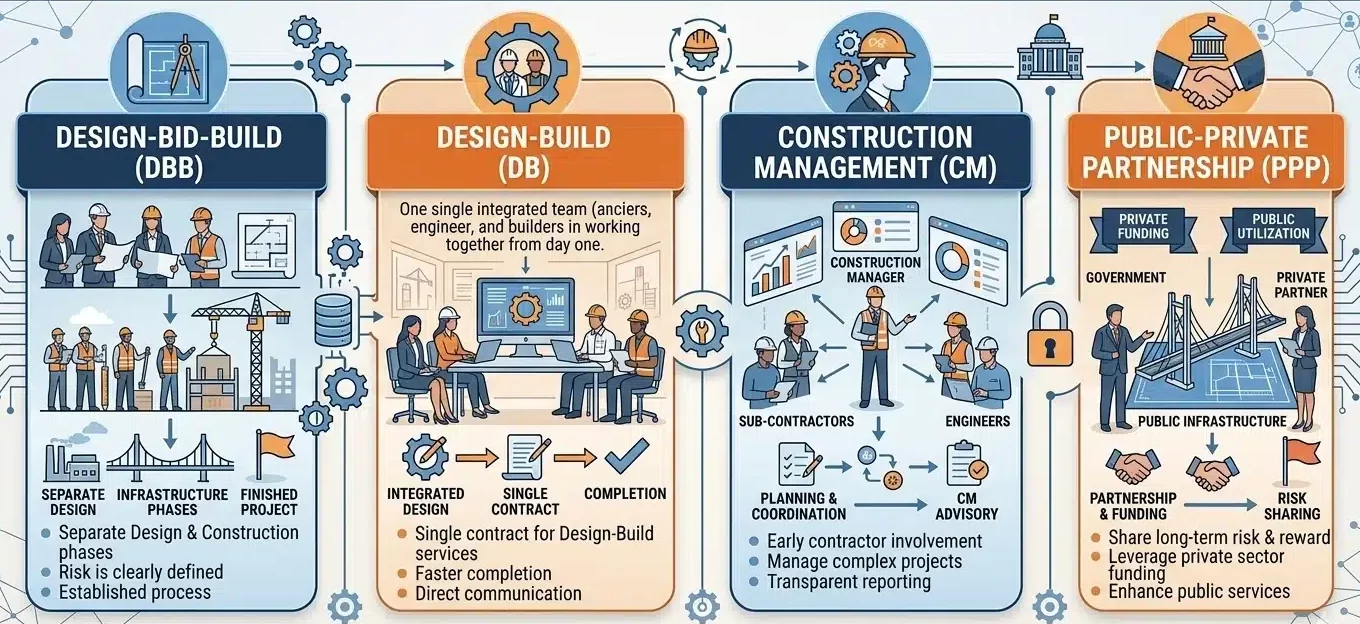
There is no single procurement method that works for every construction project. The right approach depends on project size, complexity, budget, risk level, and delivery timeline.
Each method affects how responsibilities are shared between the owner, designer, contractor, and suppliers.
Understanding these options helps project owners choose a structure that fits their goals.
1. Design-Bid-Build (DBB)
Design-Bid-Build is one of the most common construction procurement methods. The project owner first hires a design team to complete the plans and specifications.
After the design is finalised, contractors submit bids to carry out the construction work.
This method gives owners clear design control and competitive pricing, but it can take longer because design and construction happen separately.
2. Design-Build (DB)
Design-Build combines design and construction under one contract. The owner works with a single team responsible for both project design and delivery.
This approach encourages earlier collaboration between designers and builders.
Because design and construction can overlap, Design-Build often shortens timelines and reduces coordination issues.
3. Construction Management (CM)
In the Construction Management model, the owner appoints a construction manager to oversee planning, budgeting, scheduling, and contractor coordination.
This method is useful for large or complex projects with many moving parts.
The construction manager helps protect the owner’s interests while keeping suppliers, contractors, and site teams aligned.
4. Public-Private Partnership (PPP)
Public-Private Partnerships are often used for major infrastructure projects such as roads, rail networks, airports, and public facilities.
In this model, government agencies and private companies work together to finance, build, and sometimes operate the project.
This structure helps share financial risk, delivery responsibility, and long-term operational duties.
Stages of the Construction Procurement Process
Construction procurement follows a clear lifecycle. Each stage helps project teams plan purchases, select suppliers, manage contracts, and track delivery performance.
A structured process reduces guesswork. It also gives teams better control over cost, time, and supplier quality.
Project planning and requirements
Procurement begins with a clear understanding of what the project needs. Teams review design documents, drawings, specifications, and project budgets.
Engineers, quantity surveyors, and estimators may also help prepare bills of quantities and purchasing plans.
Good planning reduces the risk of missed items, duplicate purchases, and last-minute sourcing problems.
Vendor and contractor selection
Once requirements are clear, procurement teams identify potential suppliers and contractors.
They evaluate experience, financial stability, technical ability, safety records, delivery capacity, and past project performance.
This helps ensure that only reliable vendors move into the tendering or quotation stage.
Tendering and contract negotiation
During tendering, suppliers submit proposals that include pricing, delivery timelines, scope details, and technical capabilities.
Procurement teams compare these proposals carefully. The cheapest offer is not always the best choice.
Contract negotiation then helps clarify responsibilities, payment terms, delivery schedules, risk allocation, and quality expectations.
Contract award and procurement execution
After negotiations, the selected supplier or contractor receives the contract award.
At this point, procurement teams confirm delivery dates, order details, payment schedules, and reporting requirements.
Clear execution planning helps avoid confusion once construction work begins.
Performance monitoring and delivery management
Procurement does not stop after a contract is signed. Teams must continue tracking deliveries, supplier performance, quality standards, and contract compliance.
Regular monitoring helps identify problems before they affect the wider project schedule.
It also gives project managers reliable data for future procurement decisions.

Industry Applications of Construction Procurement
Procurement needs vary depending on the type of construction project. A high-rise building, hospital, road project, and warehouse development all require different sourcing strategies.
Each sector has its own supply risks, approval processes, and technical standards.
Commercial Real Estate and High-Rise Projects
Commercial and high-rise projects often require specialised materials and long-lead components.
Procurement teams may need to source curtain wall systems, elevators, HVAC equipment, fire safety systems, and custom interior finishes. Because schedules are usually tight, supplier reliability and early procurement planning are critical.
Civil Infrastructure and Public Works
Infrastructure projects often involve bulk materials, heavy equipment, and large contractor networks.
Procurement may be subject to strict public tendering rules, compliance requirements, and documentation standards. Teams also need to manage long supply chains for concrete, asphalt, structural steel, and drainage systems.
Healthcare and Specialised Facilities
Healthcare construction requires strict quality, safety, and compliance standards.
Procurement teams may source medical equipment, sterile materials, backup power systems, and specialised mechanical systems.
Supplier vetting is especially important because materials and contractors must meet healthcare regulations and certification requirements.
Step by Step Construction Procurement Strategy
Step by Step Construction Procurement Strategy
A strong procurement strategy gives construction teams a repeatable way to control sourcing decisions.
Without a clear approach, procurement can become reactive, inconsistent, and difficult to monitor.
The following framework helps businesses reduce risk, improve supplier coordination, and strengthen cost control.
1. Needs Assessment and Spend Analysis
Start by identifying the materials, services, equipment, and contractors required for the project.
Procurement teams should review drawings, specifications, project scope, and engineering documents before raising purchase requests.
Past spending data can also help teams compare supplier pricing, estimate budgets, and find cost-saving opportunities.
2. Supplier Prequalification and Risk Assessment
Before inviting bids, procurement teams should assess supplier capability.
This includes checking experience, financial strength, safety performance, delivery capacity, and previous project results.
A proper risk assessment helps prevent issues caused by unreliable suppliers or contractors that cannot meet project demands.
3. Defining Contract and Delivery Framework
Clear contracts reduce confusion. They should define responsibilities, payment terms, delivery schedules, project milestones, and risk allocation.
This gives both parties a shared reference point throughout the project.
A strong delivery framework also helps procurement teams track whether suppliers are meeting agreed expectations.
4. Technology Integration and E-Procurement
Digital procurement platforms make construction purchasing easier to manage.
They help teams compare supplier proposals, centralise approvals, track purchase orders, and monitor delivery status.
These purchasing tools reduce manual admin, improve transparency, and give managers better information when making sourcing decisions.
6. Performance Monitoring and KPI Tracking
After contracts are awarded, procurement teams should continue monitoring supplier performance.
Key metrics may include on-time delivery, cost variance, quality issues, procurement cycle time, and contract compliance.
Tracking these indicators helps teams solve problems early and improve future procurement planning.
Common Pitfalls in Construction Procurement
Even experienced project teams can run into procurement problems. The most common issues usually come from unclear scope, weak supplier evaluation, or poor contract planning.
The lowest bid fallacy
Choosing the cheapest contractor can create bigger costs later. Low bids may lead to quality issues, delays, disputes, or frequent variation claims.
A better approach is to assess value, experience, reliability, and total project impact.
Poor scope definition
Unclear project specifications make it hard for suppliers to quote accurately.
When the scope is vague, vendors may leave out key items or price the work incorrectly. This often leads to cost overruns during construction.
Inflexible contracts during market volatility
Material prices can change quickly due to supply shortages, currency shifts, or global demand.
Contracts that do not include price adjustment clauses may create financial pressure for both contractors and project owners.
Lack of supply chain visibility
Some procurement teams only focus on direct suppliers. This can be risky because delays may come from upstream manufacturers, importers, or logistics providers.
Better visibility helps teams prepare backup plans before supply problems reach the construction site.
Advanced Trends in Construction Procurement
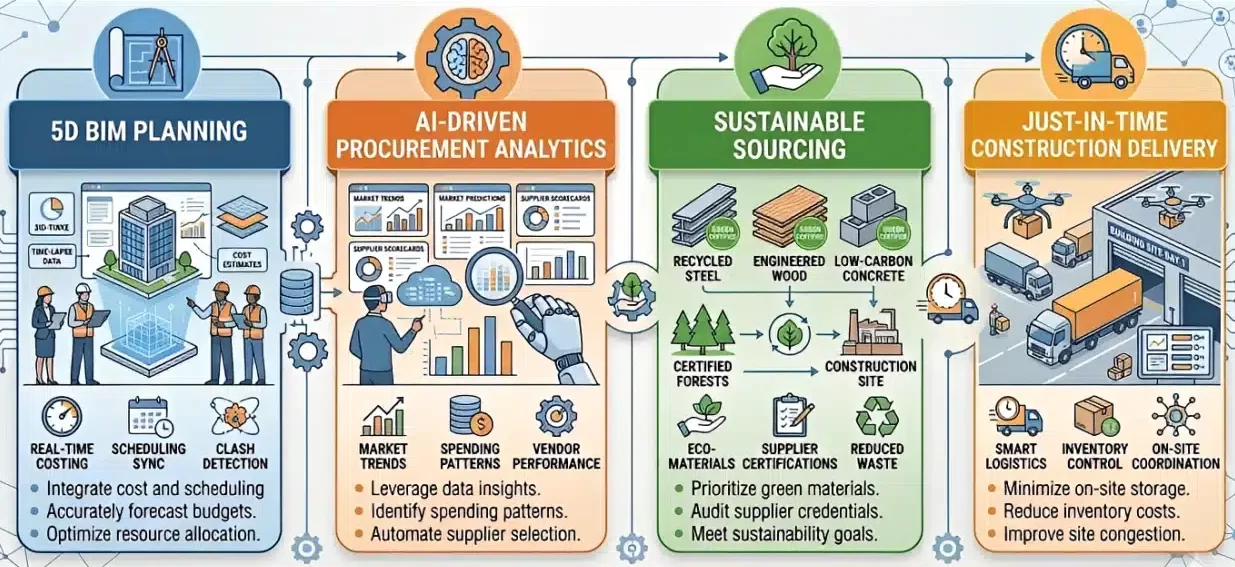
Construction procurement is becoming more data-driven. Many businesses now use digital systems, analytics, and sustainable sourcing practices to improve project delivery.
These trends help teams plan more accurately and respond faster when conditions change.
5D BIM for Procurement Planning
5D Building Information Modelling connects design, cost, and schedule data in one digital model. Procurement teams can use this information to estimate quantities, update material requirements, and respond to design changes more accurately.
This reduces manual calculation errors and supports better purchasing decisions.
Predictive Analytics and AI in Procurement
Predictive analytics can help procurement teams forecast supplier risks, material price changes, and delivery delays. AI-powered tools can also review procurement data to identify spending patterns and supplier performance issues.
These insights help teams make faster and more informed decisions.
Sustainable and Circular Procurement
Sustainability is now an important part of construction procurement. Many companies prioritise suppliers that offer low-impact materials, responsible sourcing, and recyclable products.
Circular procurement also encourages the reuse of materials, which can reduce waste and improve resource efficiency.
Lean Construction and Just-in-Time Procurement
Lean construction focuses on reducing waste and improving site productivity. Just-in-time procurement supports this by delivering materials only when they are needed on site.
This reduces storage needs, lowers the risk of material damage, and keeps construction areas more organised.
Measuring Procurement Performance in Construction
Procurement performance should be measured regularly. Without clear metrics, teams may struggle to see where costs, delays, or supplier issues are coming from.
The right indicators help businesses improve sourcing decisions and supplier accountability.
Cost Efficiency Metrics
Cost efficiency metrics show how well procurement teams manage budgets. Common examples include procurement savings, material cost variance, purchase price variance, and total procurement costs compared with estimates.
These metrics help teams understand whether sourcing decisions are protecting project margins.
Supplier Performance Metrics
Supplier performance metrics track how reliably vendors meet their commitments. Teams often measure on-time delivery, defect rates, contract compliance, response time, and service quality.
This makes it easier to identify strong suppliers and address underperformance early.
Procurement Impact on Project Delivery
Procurement directly affects project progress. Metrics such as procurement cycle time, material availability, delivery accuracy, and urgent purchase frequency can show whether procurement is supporting or slowing down the project.
When procurement works well, site teams experience fewer delays and better project flow.
Conclusion
Construction procurement gives project teams a structured way to source materials, manage suppliers, control costs, and reduce delivery risks.
A strong procurement strategy keeps contractors, suppliers, and site teams aligned throughout the project lifecycle. It also helps businesses respond better to price changes, material shortages, and supplier performance issues.
For construction firms that want better visibility and control, digital procurement systems can make a major difference. Request a free consult with our experts to explore solutions that support smarter construction procurement management.

Frequently Asked Questions About Construction Procurement
-
What is construction procurement?
Construction procurement is the structured process of sourcing materials, equipment, and contractor services needed to complete a construction project. It involves supplier evaluation, contract negotiation, and delivery coordination to ensure projects stay on schedule and within budget.
-
Why is procurement important in construction projects?
Procurement is important because it controls project costs, ensures timely material delivery, and manages supplier relationships. Effective procurement helps reduce delays, supply disruptions, and unexpected cost overruns.
-
What are the common methods of construction procurement?
Common construction procurement methods include Design–Bid–Build, Design–Build, Construction Management, and Public–Private Partnerships. Each method determines how responsibilities and risks are distributed between project stakeholders.
-
What are the stages of the construction procurement process?
The construction procurement process typically includes project planning, supplier selection, tendering, contract negotiation, contract award, and supplier performance monitoring during project execution.
-
How can companies improve construction procurement efficiency?
Companies can improve procurement efficiency by implementing structured procurement strategies, using digital procurement systems, monitoring supplier performance, and maintaining transparent supplier relationships.