














Warehouse errors cost Australian businesses more than just a return shipment.
Mispicks, missed scans, and slow pick rates compound across thousands of daily transactions into real revenue loss.
Voice picking gives warehouse teams a faster, more accurate way to work by replacing paper lists and handheld scanners with spoken instructions delivered directly through a headset.
Key Takeaways
The voice picking confirmation step helps achieve up to 99.9% accuracy because workers verbally confirm the bin location before touching any stock.
Effective WMS integration allows voice picking to work in real time.
When comparing voice picking vs RF scanning, voice picking often performs better in high-volume environments because workers can keep both hands free.
When choosing voice picking software, focus on WMS compatibility, voice recognition accuracy, and ease of implementation.

What Is Voice Picking?

Voice picking is a warehouse technology that uses headsets to guide workers through picking tasks. Workers listen to instructions and confirm picks verbally, eliminating the need for paper lists or handheld scanners.
The system connects to the warehouse management system (WMS) in real time, acting as software for storage oversight while improving inventory accuracy and reducing manual data entry.
Voice picking is widely used in fast-paced warehouses where speed and accuracy are essential.
How Does Voice Picking Work?
A voice picking system typically includes a wearable device, a headset, and software connected to the warehouse management system (WMS). Workers receive spoken instructions and confirm tasks verbally.
The WMS guides pickers to the correct location, tells them what quantity to pick, and records confirmations in real time. This keeps inventory and order data accurate.
By requiring workers to verify locations before picking, voice picking helps reduce errors. It also allows hands-free operation, improving efficiency and productivity.

Benefits of Voice Picking for Australian DCs
Voice picking supports improving picking accuracy with warehouse system capabilities by reducing errors and helping workers verify locations before collecting items. This can lower costly order mistakes and returns.
It also increases productivity by keeping workers’ hands and eyes free, allowing them to move through tasks faster than with paper lists or handheld scanners.
In addition, voice picking supports a safer workplace by reducing distractions and enabling workers to handle goods and equipment more efficiently.
Voice Picking Applications in Your Warehouse
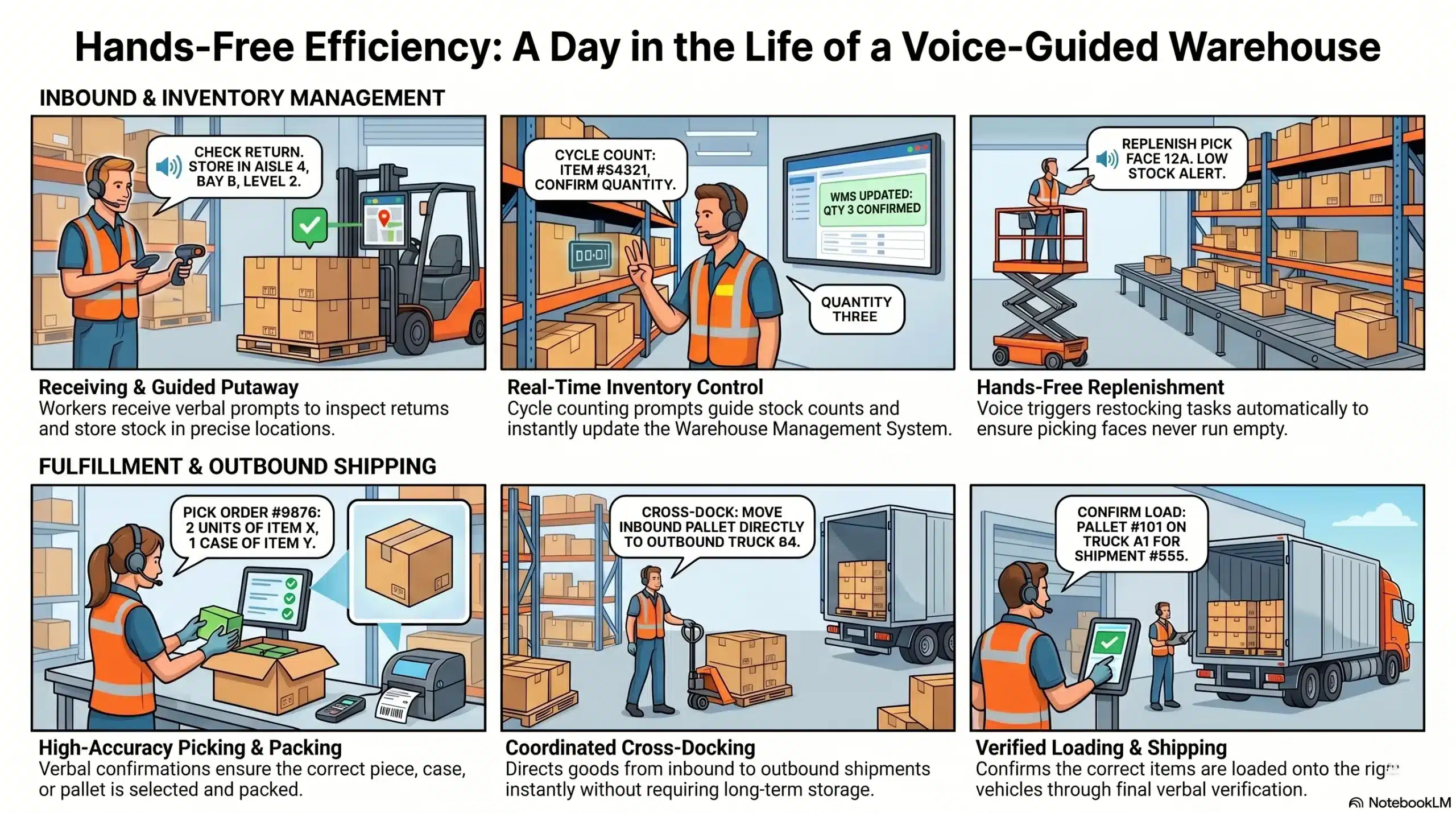
Voice picking can support end-to-end stock control across many warehouse tasks, not just order picking. It provides real-time instructions while allowing workers to keep both hands free.
- Order Picking: Supports piece, case, and pallet picking with verbal confirmations for accuracy.
- Receiving & Returns: Guides workers through stock receiving, inspection, and returns processing.
- Putaway & Replenishment: Directs workers to the correct storage locations and triggers restocking tasks when needed.
- Packing & Consolidation: Helps verify orders and match items to the correct shipment.
- Cross-Docking: Coordinates the movement of goods from inbound to outbound shipments without storage.
- Cycle Counting: Guides stock counts and updates inventory records directly in the WMS.
- Truck Loading & Shipping: Confirms the correct items are loaded onto outbound vehicles.
- Quality Control: Supports inspections and records results in real time for audit purposes.
Voice Picking vs RF Scanning: Which Is Right for Your Operation?
Both voice picking and RF scanning improve accuracy and connect directly to a warehouse management system (WMS), but they are designed for different operational needs.
RF scanning is often more affordable and suits warehouses with diverse products or tasks that require visual checks. Voice picking is better suited to high-volume environments that rely on smart order fulfilment technologies to improve speed, accuracy, and productivity.
| Feature | Voice Picking | RF Scanning |
|---|---|---|
| Pick accuracy |
Up to 99.9% | 99 to 99.5% typical |
| Hands-free operation |
Yes | No |
| Learning time |
1 to 2 days | 2 to 5 days |
| Noisy environment |
Good (trained to environment) | Excellent |
| Implementation cost |
Higher (headsets, voice terminals) | Lower (standard scanners) |
| Best for |
High-volume, repetitive picking | Mixed workflows, label verification |
| WMS integration |
Required | Required |
| Battery life per shift |
8 to 12 hours typical | 8 to 12 hours typical |
Integrating Voice Picking with Your WMS
Voice picking works alongside a warehouse management system (WMS), providing workers with real-time instructions and updating inventory records as tasks are completed within the best inventory platform for stock managers.
A reliable WMS integration is essential for accurate stock data and efficient warehouse operations, allowing tasks and confirmations to be processed instantly.
HashMicro’s warehouse management software supports voice picking integration, helping businesses manage warehouse workflows while delivering real-time guidance to workers on the floor.
How to Choose Voice Picking Software for Your Australian Business
When choosing voice picking software, focus on WMS compatibility, language support, hardware flexibility, and vendor support.
The system should integrate seamlessly with your WMS to support accurate inventory updates, efficient workflows, and real-time stock verification using barcode technology.
It should also support Australian English and local accents. Testing the software with your team can help ensure reliable voice recognition and smooth adoption.
Conclusion
Voice picking helps reduce picking errors and improve productivity by keeping workers’ hands free and focused on the task. It is particularly effective in high-volume warehouses where speed and accuracy are critical.
Successful implementation depends on reliable WMS integration and proper staff training. With the right setup, businesses can improve warehouse efficiency and inventory accuracy within a short period.
If you’re considering voice picking, starting with a pilot program can help measure its impact before a full rollout.
Schedule a free consultation to see how voice picking can integrate with your existing WMS.
Frequently Asked Question
Most workers are operational within 1 to 2 days. A short voice training session calibrates the system to each worker's speech patterns and after that the confirmation steps become second nature quickly.
Voice picking typically achieves 99.5 to 99.9% accuracy. Workers must verbally confirm the bin location before touching any stock which catches wrong-location errors before they turn into mispicks.
Via APIs or middleware that pass task data between the two systems in real time. The WMS sends pick instructions the worker confirms verbally and the confirmation returns to the WMS as an inventory transaction instantly.
ROI comes from three areas: fewer mispick corrections, 10 to 25% faster pick rates, and shorter onboarding time for new staff. Most Australian operations achieve payback within 12 to 24 months depending on pick volume and current error rates.
Voice picking delivers instructions through a headset and suits wide warehouses where workers travel between locations. Pick to light uses LED displays mounted at each bin and is faster in very dense small-parts environments but requires fixed hardware at every location making it harder to reconfigure when layouts change.