













Businesses today rely on networks of third-party suppliers, contractors, and service providers to operate. That reliance introduces risk at every level of the business.
Vendor risk management is the structured process of identifying, assessing, and controlling those risks. It helps businesses protect their operations, data, and reputation before problems emerge.
This blog covers the key components, step-by-step process, common challenges, and best practices that define a mature vendor risk programme.
Key Takeaways
Vendor risk management is a discipline for identifying, assessing, and controlling third-party risks across the full supplier lifecycle.
Key components include risk identification, assessment and classification, due diligence, mitigation controls, and continuous monitoring.
The vendor risk management process: identifying vendors, assessing risks, performing due diligence, establishing contracts, monitoring performance, and offboarding.
Best practices include assessing risk before onboarding, embedding controls in contracts, standardising documentation, and reviewing risk ratings regularly.

What Is Vendor Risk Management?

Vendor risk management (VRM) is a discipline focused on identifying, assessing, and mitigating the risks that arise from working with external suppliers and service providers.
It covers the full lifecycle of a third-party relationship, from initial supplier selection through to contract execution, ongoing management, and offboarding.
A key principle of VRM is that external partners are extensions of the business. A failure or breach on their part carries the same consequences as an internal one.
This extends to fourth-party risk: the exposure from subcontractors and vendors your direct suppliers rely on. A mature VRM programme maps this network for full visibility across the supply chain.

Why Vendor Risk Management Is Important
Third-party failures affect every part of a business, from data security and financial performance to regulatory standing and reputation. Understanding these drivers makes VRM a strategic priority.
1. Increasing reliance on third-party vendors
Most businesses now outsource significant functions to external parties, including cloud infrastructure, payroll, logistics, customer support, and software development.
Disruptions at a key supplier directly affect the business’s delivery. Financial difficulty, natural disasters, or labour disputes at a supplier quickly become your problem.
VRM gives procurement and operations teams visibility into where critical dependencies exist and where contingency plans need to be built.
2. Risk of data breaches and security incidents
Businesses routinely grant external suppliers access to internal systems, customer data, and proprietary processes to support operations.
This shared access creates an attack surface, and threat actors frequently target smaller, less-secure suppliers as an entry point into larger enterprise networks.
Compromised credentials are used to move laterally into more sensitive systems. Effective VRM requires evaluating each supplier’s security posture before granting access and monitoring continuously.
Key controls include verifying compliance with ISO 27001, reviewing penetration test results, enforcing encryption standards, and setting breach notification timelines in contracts.
3. Regulatory compliance and business continuity
Many industries hold the primary business legally responsible for the actions of its third-party suppliers, regardless of where the failure occurred.
Data protection laws, financial regulations, and environmental standards can impose significant penalties if a supplier fails to comply, with the contracting business bearing those consequences.
Beyond compliance, business continuity depends on supplier reliability. The sudden failure of a critical provider can halt operations within hours.
For Australian businesses, the ABS Business Indicators report provides useful context on sector-level supply chain exposure and business disruption risk.
Key Components of Vendor Risk Management
A structured VRM programme is built on several interconnected components, each serving a distinct function in identifying, evaluating, and reducing the threats that third parties introduce.
1. Vendor risk identification
Risk identification is the process of systematically surfacing all potential threats within a third-party relationship before they materialise.
It involves mapping every point of contact: what data is shared, what systems are accessed, what business functions depend on the service, and what subcontractors the supplier relies on.
The output is a risk register: a documented inventory of identified threats that forms the foundation for assessment and mitigation. Treat it as a living document, updated as circumstances change.
2. Risk assessment and classification
Once risks are identified, they are evaluated based on two dimensions: the likelihood of occurrence and the severity of impact.
Suppliers are then assigned to risk tiers, with high-risk partners being those whose failure would cause significant financial loss, operational disruption, or regulatory breach.
Medium and low-risk suppliers receive proportionally lighter oversight, ensuring that scrutiny is directed where consequences are greatest.
Assessment should also consider concentration risk: whether the business depends too heavily on a single supplier for a critical service.
3. Due diligence and vendor evaluation
Due diligence is the investigative process conducted before a contract is signed, verifying that a prospective supplier can meet the business’s security, operational, and compliance standards.
The process includes distributing security questionnaires, reviewing certifications such as ISO 27001 or SOC 2 Type II, and assessing financial stability. Sound vendor evaluation strategies prevent high-risk suppliers from entering the supply chain.
For high-risk partners, on-site audits may be conducted to verify that physical security controls and operational practices match the documented claims.
Thorough due diligence prevents high-risk suppliers from entering the supply chain. Identifying issues before contract signature is far less costly than after.
4. Risk mitigation and controls
Mitigation involves putting controls in place to reduce identified risks to an acceptable level. These controls fall into three categories: contractual, technical, and operational.
Contractual controls embed risk obligations directly into the supplier agreement: SLAs, breach notification timelines, right-to-audit clauses, and termination conditions.
Technical controls govern how the supplier accesses systems and data. These include role-based access restrictions, mandatory encryption, and regular independent security assessments.
Operational controls address process-level risks, including contingency planning, multi-sourcing strategies for critical services, and corrective action plans before go-live.
5. Continuous monitoring and reporting
A supplier’s risk profile changes over time. New management, financial stress, or a security incident can shift a low-risk partner into a high-risk category quickly.
Structured supplier oversight maintains visibility into supplier performance and risk posture throughout the contract. Automated tools scan for vulnerabilities, flag credit changes, and detect adverse news.
Regular reporting ensures risk insights reach the right decision-makers. Senior leadership needs clear, consistent data on supplier health to inform decisions about risk appetite.
Vendor Risk Management Process
A repeatable, well-defined process separates a mature VRM programme from ad-hoc assessments. These steps outline third-party risk oversight from initial identification through to offboarding.
1. Identify and categorise vendors
The first step is building a centralised inventory of every third party engaged by the business. In many businesses, unapproved suppliers and shadow IT proliferate unnoticed across departments.
This inventory should log every external entity, from major strategic partners to minor software subscriptions and one-off contractors.
Each supplier is then categorised by risk tier, based on data sensitivity, criticality of service, geographic location, and annual spend.
This categorisation determines the level of oversight each supplier receives and ensures the most rigorous scrutiny is applied where the risk is greatest.
2. Conduct risk assessments
With the supplier base categorised, targeted risk assessments are conducted for each tier. The goal is to quantify both inherent risk (before controls) and residual risk (after controls).
For high-risk partners, cross-functional teams from IT, legal, finance, and procurement evaluate business continuity plans, data privacy frameworks, and geopolitical exposure.
For medium and low-risk suppliers, streamlined assessments use standardised scoring criteria to maintain consistency without over-investing resources.
All assessments are documented to create an auditable record of risk decision-making, increasingly important under growing regulatory scrutiny.
3. Perform vendor due diligence
Following the internal risk assessment, the process moves outward to the supplier through a formal due diligence exercise.
Detailed questionnaires are issued, requiring documented evidence of security controls, compliance certifications, and operational stability.
Procurement and compliance teams review the submissions, including audit reports such as SOC 2 Type II, financial statements, and compliance records.
Where gaps are identified, remediation plans are agreed upon before the process continues. Suppliers unable to meet minimum standards are disqualified.
For regulated industries, in-person site visits may verify that physical security controls and operational workflows match the documented claims.
4. Establish contracts and SLAs
The contracting phase translates risk assessment and due diligence findings into legally binding obligations. A well-constructed contract is one of the most effective risk mitigation tools available.
Key inclusions are SLAs defining performance metrics, uptime guarantees, and issue resolution timelines. Security and privacy addenda specify the technical controls the supplier must maintain.
Right-to-audit clauses grant an independent assessment authority over the supplier’s environment. Termination clauses must define clear grounds for exit and secure offboarding if a breach occurs.
5. Monitor vendor performance and risks
Once the contract is live, procurement teams track performance against SLAs and conduct periodic reviews to identify service quality issues.
Automated risk intelligence platforms complement human oversight, scanning for compromised credentials, flagging credit score deterioration, and monitoring regulatory databases.
When a new risk is detected, an incident response protocol can be triggered immediately to isolate the exposure and demand remediation from the partner.
Monitoring data feeds into the central risk register, keeping each supplier’s profile current and enabling prompt tier reassignments when circumstances change.
6. Review, audit, and offboard vendors
High-risk suppliers should undergo formal periodic audits, at least annually, to verify that security controls remain aligned with current standards.
These reviews provide an opportunity to renegotiate terms, update SLAs, and assess whether the relationship continues to serve the business’s objectives.
When a contract ends, offboarding must be executed with the same discipline as onboarding. All logical and physical access rights must be systematically revoked.
The business must obtain written confirmation that all proprietary data has been permanently removed. Incomplete offboarding is one of the most common sources of residual third-party risk.
Types of Vendor Risk
Vendor risks fall into distinct categories. Identifying which type applies to each supplier helps you apply the right controls and prioritise reviews.
1. Cybersecurity and data privacy risk
Third-party vendors with access to your systems are a common entry point for breaches. Under the Privacy Act 1988, Australian businesses remain liable for how vendors handle personal information.
A vendor breach can trigger your own notifiable data breach obligations. Controls include access limitations, vendor security assessments, and contractual data handling clauses.
2. Operational and delivery risk
This risk arises when a vendor fails to deliver goods or services on time, at the agreed quality, or at all. Contingency planning and multi-vendor sourcing are the primary mitigations.
Supply chain disruptions, natural disasters, and financial instability can all interrupt vendor performance. Single-source dependency amplifies this risk significantly.
3. Financial and credit risk
A vendor facing financial difficulty may reduce service quality, delay delivery, or cease operations without notice. This risk is especially high for critical single-source suppliers.
Financial risk assessments cover credit ratings, audited financial statements, and payment history. Managing vendor payments through structured oversight can also surface early signs of financial instability before service disruption occurs.
4. Compliance and regulatory risk
Vendors operating outside regulatory requirements can expose your business to fines, audits, or reputational damage.
Australian obligations include the Modern Slavery Act 2018, Privacy Act 1988, and relevant industry-specific legislation. Your vendors must meet the same standards you are held to.
5. Reputational risk
Vendor misconduct, public scandals, or poor customer service can reflect on your brand and cause lasting commercial damage. Media monitoring and ESG screening help surface early warning signs.
Building a Vendor Risk Management Framework
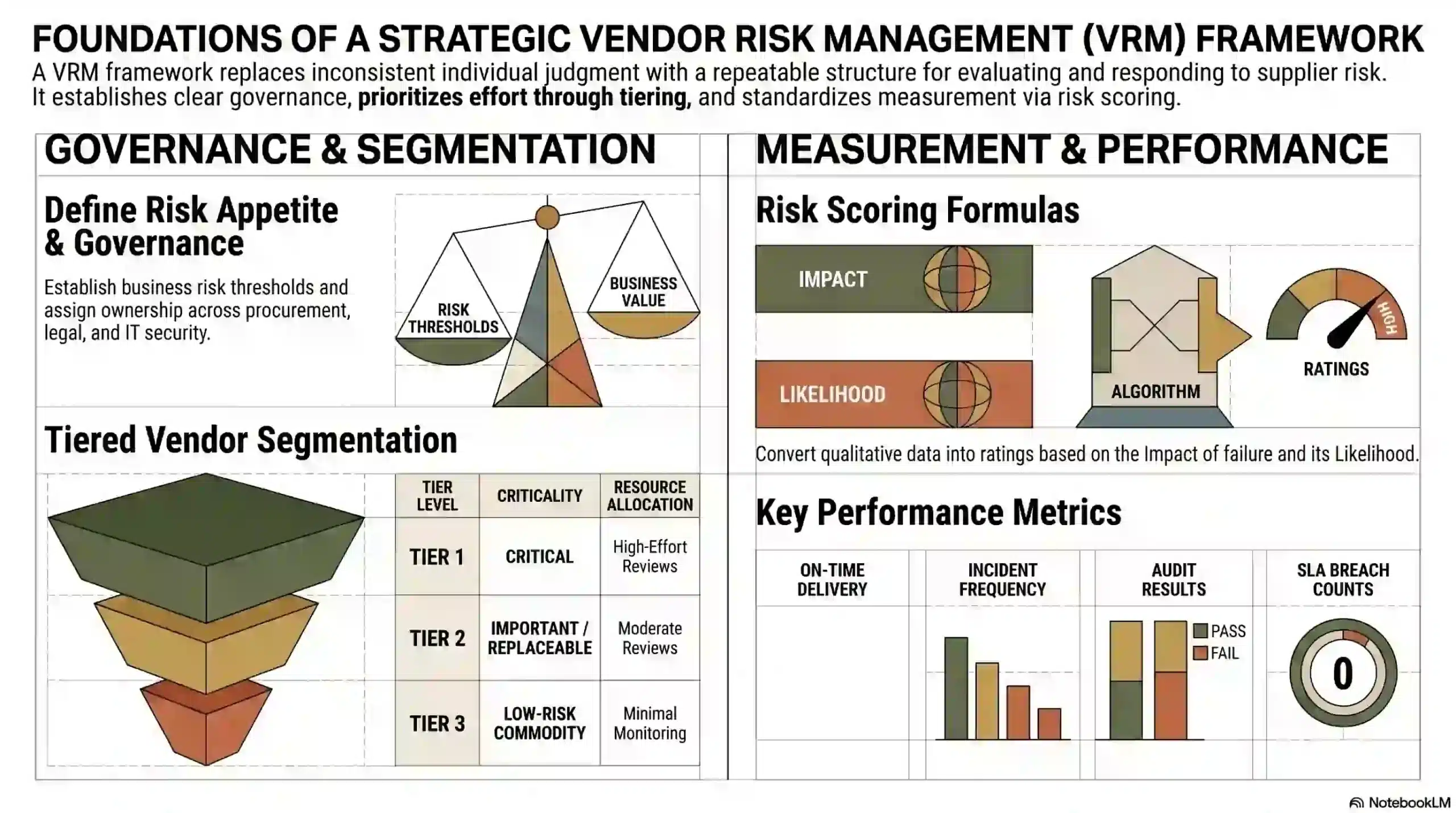
A VRM framework gives your team a repeatable structure for evaluating, monitoring, and responding to vendor risk. Without it, risk management depends on individual judgment and remains inconsistent.
1. Risk appetite and governance
Your framework starts with defining how much vendor risk your business is willing to accept. This threshold guides every subsequent decision.
Governance defines who owns vendor risk decisions. This typically includes procurement, legal, IT security, and a senior sponsor who escalates unresolved issues.
2. Vendor tiering and segmentation
Not all vendors carry the same risk. Tiering categorises vendors by criticality, so high-effort reviews go to high-risk suppliers.
A common three-tier model: Tier 1 for critical vendors, Tier 2 for important but replaceable vendors, Tier 3 for low-risk commodity suppliers.
3. Risk scoring and metrics
Risk scores convert qualitative assessments into comparable ratings. Scores should account for impact (what breaks if this vendor fails) and likelihood (how probable is that failure).
Useful metrics include on-time delivery rate, incident frequency, compliance audit results, and SLA breach counts.
Common Challenges in Vendor Risk Management
Even well-structured VRM programmes run into practical barriers. Recognising these challenges is the first step to addressing them effectively.
1. Limited vendor visibility
Many businesses lack complete, current information on who their vendors are, what they access, and how they operate. Vendor lists are often fragmented across departments.
Without a centralised register, it is difficult to assess exposure or respond quickly when a vendor incident occurs.
2. Manual processes and spreadsheet dependency
Spreadsheets cannot scale with a growing vendor base. They go stale, lack version control, and offer no alert mechanisms.
Manual tracking introduces human error into risk classifications and review scheduling. A missed review can leave a high-risk vendor unmonitored for months.
3. Inconsistent risk assessments
When assessments depend on individual judgment rather than standardised criteria, results are not comparable across vendors or reviewers.
Standardising questionnaires, scoring rubrics, and review cadences produces consistent risk ratings that hold up under audit.
4. Fourth-party and sub-contractor risk
Your vendors often rely on their own suppliers. These fourth parties are outside your direct control but can still expose you to data, compliance, or operational risk.
Contracts should require vendors to disclose subcontractors and apply equivalent risk controls down the supply chain.
Best Practices for Vendor Risk Management
Effective VRM programmes share common habits. These practices separate businesses that manage vendor risk from those that simply react to vendor incidents.
1. Assess risk before onboarding
Vendor risk decisions made at the start of a relationship are easier to enforce than changes demanded mid-contract.
Pre-onboarding due diligence should include security questionnaires, financial checks, compliance documentation, and reference checks. Tier 1 vendors warrant deeper scrutiny.
2. Include risk controls in contracts
Contracts are your primary enforcement mechanism. They should specify data handling requirements, audit rights, incident notification timelines, and termination triggers.
SLAs with measurable performance metrics give you contractual standing to act if a vendor underperforms or breaches an obligation.
3. Standardise vendor documentation
Consistent intake forms, risk questionnaires, and onboarding checklists create a comparable data set across your entire vendor portfolio.
Standardisation also reduces the effort required for each new assessment and makes it easier to train new team members.
4. Review and update risk ratings regularly
A risk rating assigned at onboarding becomes outdated. Vendor circumstances, your business context, and the regulatory environment all change over time.
Scheduled reviews at least annually, with triggered reviews after any significant incident, keep ratings current and defensible.
How Software Improves Vendor Risk Management
Manual VRM programs have a ceiling. As vendor counts grow, spreadsheets fail, and email-based reviews become unmanageable. Secured procurement tools remove these constraints and centralise vendor oversight at scale.
1. Centralised vendor profiles and documentation
VRM software consolidates all vendor records into a single searchable platform. Contacts, contracts, certifications, assessment history, and risk ratings are accessible in one place.
This eliminates the fragmented vendor data problem that makes manual VRM unreliable at scale, particularly as vendor counts grow.
2. Automated risk alerts and notifications
Intelligent purchasing software monitors vendor risk indicators and triggers alerts when thresholds are crossed. This includes contract expiry, overdue assessments, and flagged compliance issues.
Automated alerts replace calendar-based reminders and prevent reviews from being missed due to staff turnover or workload pressure.
3. Audit-ready reporting and dashboards
Real-time dashboards give procurement and risk teams a live view of vendor risk exposure across the portfolio. Risk scores, review status, and incident history surface in one view.
Exportable reports support board-level risk reporting, regulatory audits, and internal governance reviews without manual data compilation.
4. Workflow automation and approvals
Onboarding workflows, risk escalations, and remediation tasks can be automated, with approval routing ensuring the right people sign off at each stage. This cuts cycle time and prevents missed steps.
Vendor Risk Management in the Procurement Lifecycle
VRM is not a standalone activity. It integrates into procurement at every stage, from initial sourcing through to vendor exit.
1. Pre-qualification and vendor selection
Risk evaluation begins before a vendor is selected. Screening criteria should include financial stability, security posture, compliance track record, and capacity to deliver.
Involving risk and legal teams in the selection process prevents high-risk vendors from being onboarded on commercial grounds alone.
2. Contract negotiation and onboarding
Risk controls are embedded during contract negotiation. Data processing agreements, indemnity clauses, audit rights, and termination-for-cause provisions protect your position.
Onboarding is also the point where baseline documentation is collected: insurance certificates, compliance declarations, and system access records.
3. Active management and performance review
Ongoing monitoring keeps risk ratings current and surfaces performance issues before they escalate. KPIs should be reviewed at agreed intervals, with documented follow-up for any underperformance.
Regular business reviews with critical vendors maintain accountability and provide a structured forum to address emerging risks.
4. Offboarding and transition management
Vendor offboarding is a risk event. Access must be revoked, data returned or destroyed, and transition plans confirmed before a contract ends.
Poor offboarding can leave residual access vulnerabilities or compliance gaps. A structured checklist applied at exit closes these risks systematically.
Conclusion
Vendor risk management is no longer optional for Australian businesses. Supply chain complexity, data privacy obligations, and Modern Slavery Act requirements demand a structured approach.
A well-run VRM program reduces exposure, improves vendor performance, and demonstrates due diligence to regulators and clients alike.
If you are interested in learning further, book a free consultation with us and start optimizing your business today.
-
What is the difference between vendor risk management and enterprise risk management?
Enterprise risk management addresses all internal and external risks a business faces. Vendor risk management focuses specifically on risks introduced by third parties and supply chain relationships. VRM is typically a sub-discipline within a broader ERM framework.
-
How do you calculate a vendor risk score?
A vendor risk score combines two factors: the likelihood of a risk event and the potential business impact if it occurs. Scores are derived from questionnaire responses, financial data, and compliance certifications, then weighted by vendor tier.
What is the difference between a vendor risk assessment and vendor due diligence?
A vendor risk assessment is an internal evaluation of how much risk a supplier introduces. Vendor due diligence is the outward-facing verification of the supplier’s claims, certifications, and operational practices.
-
What certifications should you require from high-risk vendors?
For vendors handling data or IT systems, ISO 27001 and SOC 2 Type II are the most widely recognised certifications. For government-adjacent suppliers, ASD Essential Eight adherence is also commonly required.