












Warehouse management refers to how businesses handle the movement, storage, and tracking of goods inside a warehouse. It ensures products are received, stored, picked, and shipped efficiently.
When done properly, warehouse management helps reduce delays, improve accuracy, and support faster order fulfilment. It also allows businesses to manage stock levels more effectively and maintain smooth daily operations.
Key Takeaways
Explains how warehouse management works and how it keeps storage, tracking, and fulfilment processes organised across daily operations.
Covers the main warehouse processes from receiving goods to shipping orders, helping ensure accuracy and smooth operational flow.
Shows how warehouse management improves accuracy, reduces operational costs, and supports faster and more reliable order fulfilment.
Provides best practices to improve efficiency, maintain accurate data, and optimise warehouse operations for better overall performance.

What is Warehouse Management?
Warehouse management supports automated warehouse coordination across receiving, storage, picking, and shipping activities. It focuses on keeping operations organised, accurate, and efficient.
This includes managing inventory, warehouse layout, workforce, and equipment to ensure goods move smoothly through each stage. Strong warehouse management helps minimise errors, reduce costs, and improve overall performance.
Key Warehouse Management Processes
Warehouse operations follow connected processes for managing warehouse activities efficiently from arrival to delivery. Each stage plays a role in maintaining accuracy and operational flow.
- Receiving goods: Goods arrive at the warehouse and are checked against purchase orders to ensure accuracy and condition.
- Put-away and storage: Items are placed in designated storage locations based on size, demand, and accessibility.
- Inventory tracking: Stock levels are updated and monitored to maintain accuracy and prevent shortages or overstocking.
- Order picking: Products are selected from storage to fulfil customer orders based on required quantities.
- Packing: Items are checked, packed securely, and prepared for shipment.
- Shipping: Orders are dispatched to customers or distribution points, with tracking and documentation updated.
5 Core Principles of Warehouse Management
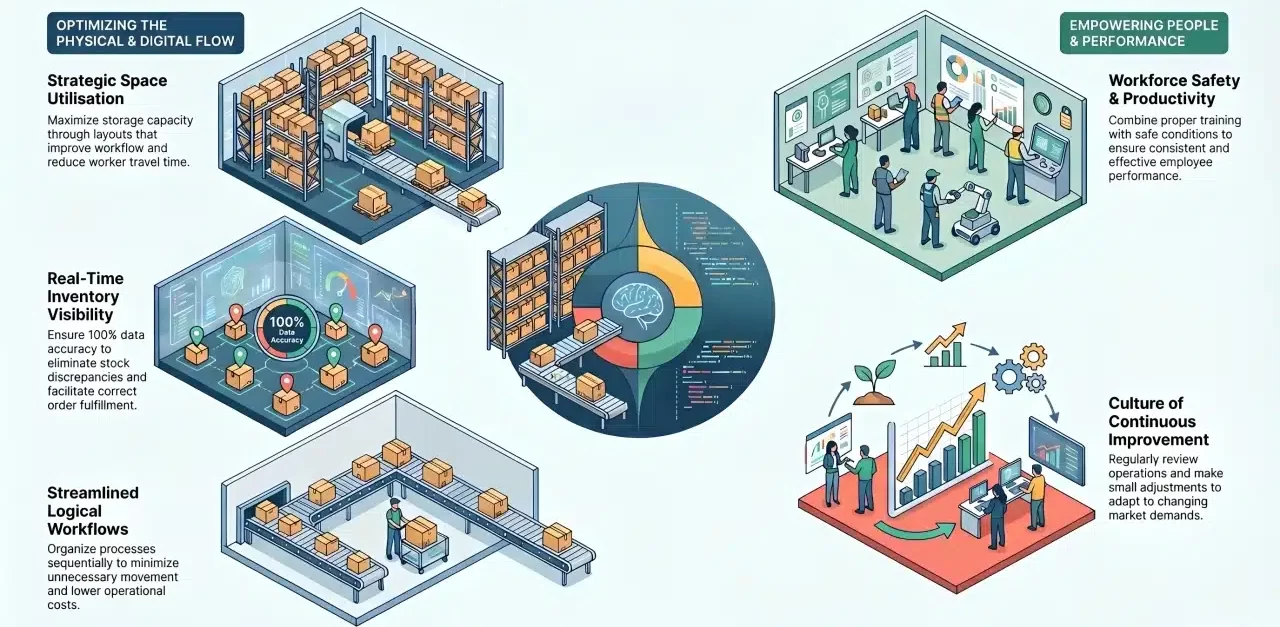
Effective warehouse management is built on a set of core principles that guide daily operations and long-term efficiency.
1. Efficient space utilisation
Warehouse space should be used strategically to maximise storage capacity without affecting accessibility. A well-planned layout reduces travel time and improves workflow.
2. Inventory accuracy and visibility
Accurate inventory data is essential to avoid stock discrepancies and fulfil orders correctly. Real-time visibility helps businesses track stock movement and make better decisions.
3. Streamlined workflow
Processes should follow a clear and logical flow to minimise delays and unnecessary movement. This helps improve productivity and reduce operational costs.
4. Workforce productivity and safety
Employees need proper training, clear procedures, and safe working conditions to perform effectively. A safe and efficient workforce supports consistent operations.
5. Continuous improvement
Warehouse operations should be reviewed regularly to identify areas for improvement. Small adjustments over time help maintain efficiency and adapt to changing demand.
Benefits of Effective Warehouse Management
When warehouse operations are managed properly, businesses benefit from improving warehouse productivity, efficiency, and fulfilment accuracy. These benefits often have a direct impact on both operations and customer experience.
1. Reduced operational costs
Efficient processes help minimise unnecessary movement, labour time, and storage inefficiencies. Over time, this reduces operational costs and improves overall resource allocation.
2. Improved order accuracy
Accurate inventory tracking and structured workflows reduce picking and packing errors. This helps ensure customers receive the correct products without delays or returns.
3. Faster order fulfilment
A well-organised warehouse allows goods to move quickly from storage to dispatch. This shortens delivery times and improves service reliability.
4. Better inventory control
Real-time visibility helps businesses maintain optimal stock levels and avoid overstocking or shortages. This supports better planning and purchasing decisions.
| Area | Before optimisation | After optimisation |
|---|---|---|
| Order accuracy | Frequent errors and returns | Higher accuracy and fewer mistakes |
| Processing time | Slow picking and delays | Faster fulfilment and dispatch |
| Inventory visibility | Limited tracking and data gaps | Real-time stock monitoring |
| Operational cost | Inefficient labour and storage use | Reduced costs and better efficiency |
Common Warehouse Management Challenges
Managing a warehouse involves balancing space, workforce, and inventory while dealing with daily operational pressure. Without proper systems, small issues can quickly affect overall performance.
1. Limited warehouse space
As product variety increases, storage space can become constrained. Poor layout planning makes it harder to store and access items efficiently.
2. Inventory inaccuracies
Manual tracking or disconnected systems can lead to mismatched stock data. This often results in delays, incorrect orders, or stock shortages.
3. Labour inefficiency
Unstructured workflows and lack of training can reduce productivity. Workers may spend more time moving between locations instead of completing tasks efficiently.
4. Demand fluctuations
Seasonal spikes or sudden changes in demand can put pressure on warehouse capacity. Without proper planning, this can lead to delays and fulfilment issues.

5 Steps to Automate Warehouse Management
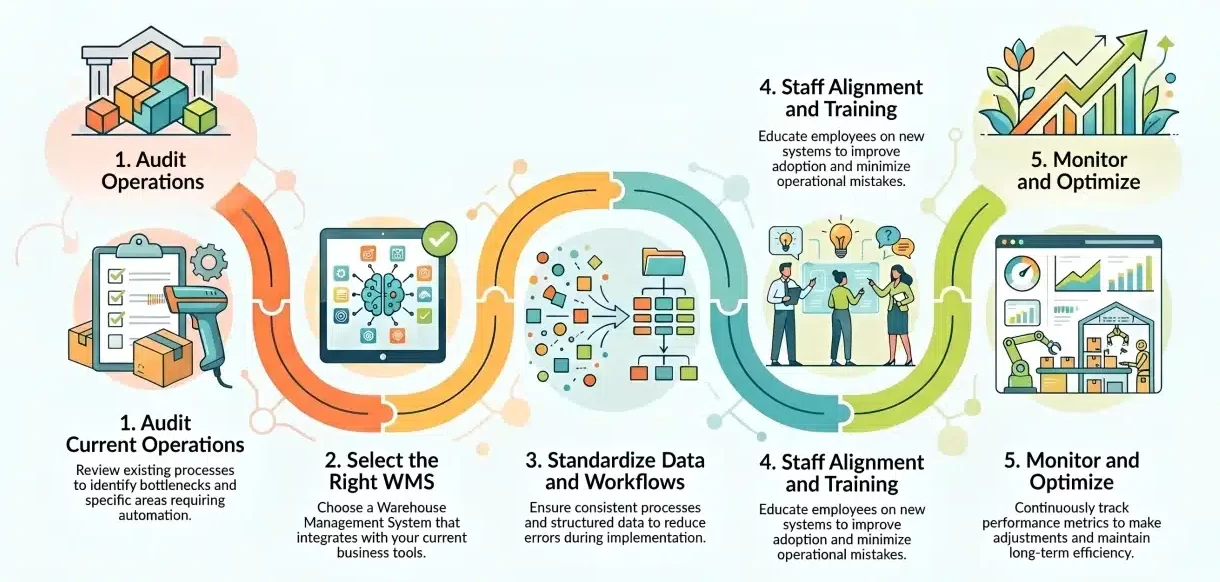
Automation helps improve accuracy, supports reducing manual warehouse tasks, and streamlines warehouse operations. A structured approach ensures that systems are implemented effectively without disrupting workflows.
- Assess current warehouse operations:
Review existing processes to identify inefficiencies, bottlenecks, and areas that require improvement. This helps determine what needs to be automated. - Choose the right warehouse management system:
Select a system that fits business needs and integrates with existing tools. A suitable system should support inventory tracking, order management, and reporting. - Standardise workflows and data:
Ensure processes are consistent and data is structured before automation. This reduces errors and makes system implementation smoother. - Train staff and align processes:
Employees need to understand how to use new systems and follow updated workflows. Proper training helps improve adoption and reduce mistakes. - Monitor performance and optimise:
After implementation, track system performance and identify areas for improvement. Continuous adjustments help maintain efficiency over time.








Warehouse Management Best Practices
Applying the right practices helps maintain efficiency, reduce errors, and keep warehouse operations consistent. These approaches support better control over inventory and daily workflows.
- Use a clear warehouse layout:
Organise storage areas based on product type, demand, and movement frequency. A structured layout reduces travel time and makes picking more efficient. - Implement real-time inventory tracking:
Use systems that update stock levels automatically to maintain accuracy. This helps prevent stock discrepancies and supports better planning. - Optimise picking and packing processes:
Choose the right picking method based on order volume and warehouse size. Efficient processes help speed up fulfilment and reduce errors. - Maintain accurate and consistent data:
Ensure all inventory data is updated regularly and follows a standard format. Clean data improves reporting and decision-making. - Train staff and standardise procedures:
Provide clear guidelines and training so employees follow consistent workflows. This reduces mistakes and improves productivity. - Monitor performance and adjust regularly:
Track key metrics such as order accuracy and processing time. Regular reviews help identify issues and improve operations over time.
Conclusion
Warehouse management helps businesses keep operations organised, improve accuracy, and ensure goods move efficiently from storage to delivery. When processes are structured properly, it becomes easier to reduce delays and maintain consistent fulfilment.
With the right systems and approach, businesses can improve visibility and overall performance. You can consult the experts to improve warehouse efficiency and operations.
FAQ About Warehouse Management
-
What is the difference between warehouse management and inventory management?
Warehouse management covers the overall operations inside a warehouse, including storage, picking, and shipping. Inventory management focuses specifically on tracking stock levels and availability.
-
What does a warehouse management system do?
A warehouse management system helps track inventory, manage storage locations, and streamline order processing. It improves accuracy and provides better visibility of stock movement.
-
What kind of business needs a WMS?
Businesses that handle large volumes of inventory or frequent order fulfilment benefit the most from a WMS. This includes retail, e-commerce, manufacturing, and distribution companies.
-
How does warehouse management improve order fulfilment?
Warehouse management improves fulfilment by organising workflows, reducing picking errors, and speeding up processing time. This helps ensure orders are delivered accurately and on schedule.