















An inventory report gives a clear view of what stock a business holds, where it sits, and how fast it moves. This visibility supports cash flow control, purchasing decisions, and reliable order fulfilment across sales channels.
For companies managing physical goods, knowing stock position at any moment helps prevent delays and wasted capital. It also allows teams to respond quickly when demand shifts or supply slows.
However, the real value comes from how the data is used. A well-prepared inventory report highlights inefficiencies, exposes dead stock, and supports confident planning across operations and finance.
Key Takeaways
An inventory report provides a clear record of stock levels, movements, and value, helping businesses maintain accuracy and control.
Inventory reporting reduces risk by improving forecasting, supporting EOFY readiness, and controlling holding costs.
Different inventory reports focus on availability, valuation, turnover, and reorder planning to support daily operations.
Including quantities, SKUs, valuation, and supplier data ensures inventory reports remain actionable and reliable.

What Is an Inventory Report?
An inventory report provides a detailed view of stock levels, inventory movements, and inventory value by tracking available, committed, and reorder stock. It helps businesses optimise stock levels, prevent stockouts, identify fast-moving items, and control inventory costs.
An inventory report is a structured record that summarises stock levels, movements, and inventory performance over a set period. It helps a business understand both the physical and financial condition of its stock.
The report consolidates data such as quantities, locations, costs, and sales activity. As a result, decision-makers can manage purchasing, production, and fulfilment with greater accuracy.
In the past, companies relied on manual spreadsheets updated after stocktakes. Today, most inventory reports pull data directly from an inventory report system and refresh automatically as transactions occur.
Although formats vary, the purpose stays the same across industries. An inventory report provides one reliable source of truth for what a company owns and sells.
Why Inventory Reporting Matters for Australian Businesses








According to ABS data, only around 4% of Australian businesses currently use ERP systems, while most still track inventory in spreadsheets or standalone POS, making EOFY stocktake reconciliation manual and error-prone.
For trading stock value disputes with the ATO, this is also the gap that gets businesses audited.
Running a product-based company involves long supply lines, strict compliance, and tight margins. Inventory reporting helps reduce risk by keeping stock aligned with demand and financial obligations.
1. Better stock control and demand forecasting
Long supplier lead times make accurate forecasting essential for maintaining availability. An inventory report reveals sales patterns, seasonal trends, and reorder timing, which supports smarter purchasing decisions.
With reliable data, a business avoids stockouts and excess stock at the same time. Therefore, customer demand stays met without tying up unnecessary capital.
2. Reducing holding costs and dead stock
Storage costs can quickly erode margins, especially when slow-moving items take up valuable space. Inventory reports expose underperforming stock before it becomes a long-term burden.
By identifying dead stock early, companies can discount, bundle, or clear items. As a result, they free up cash while improving warehouse efficiency.
3. Supporting EOFY stocktake and audit readiness
The financial year ending on 30 June requires accurate stock valuation. Inventory reports simplify this process by keeping records aligned throughout the year.
Instead of last-minute counting, businesses with consistent reporting rely on automated inventory tracking software and ongoing data. This approach reduces disruption and improves audit confidence.
Types of Inventory Reports
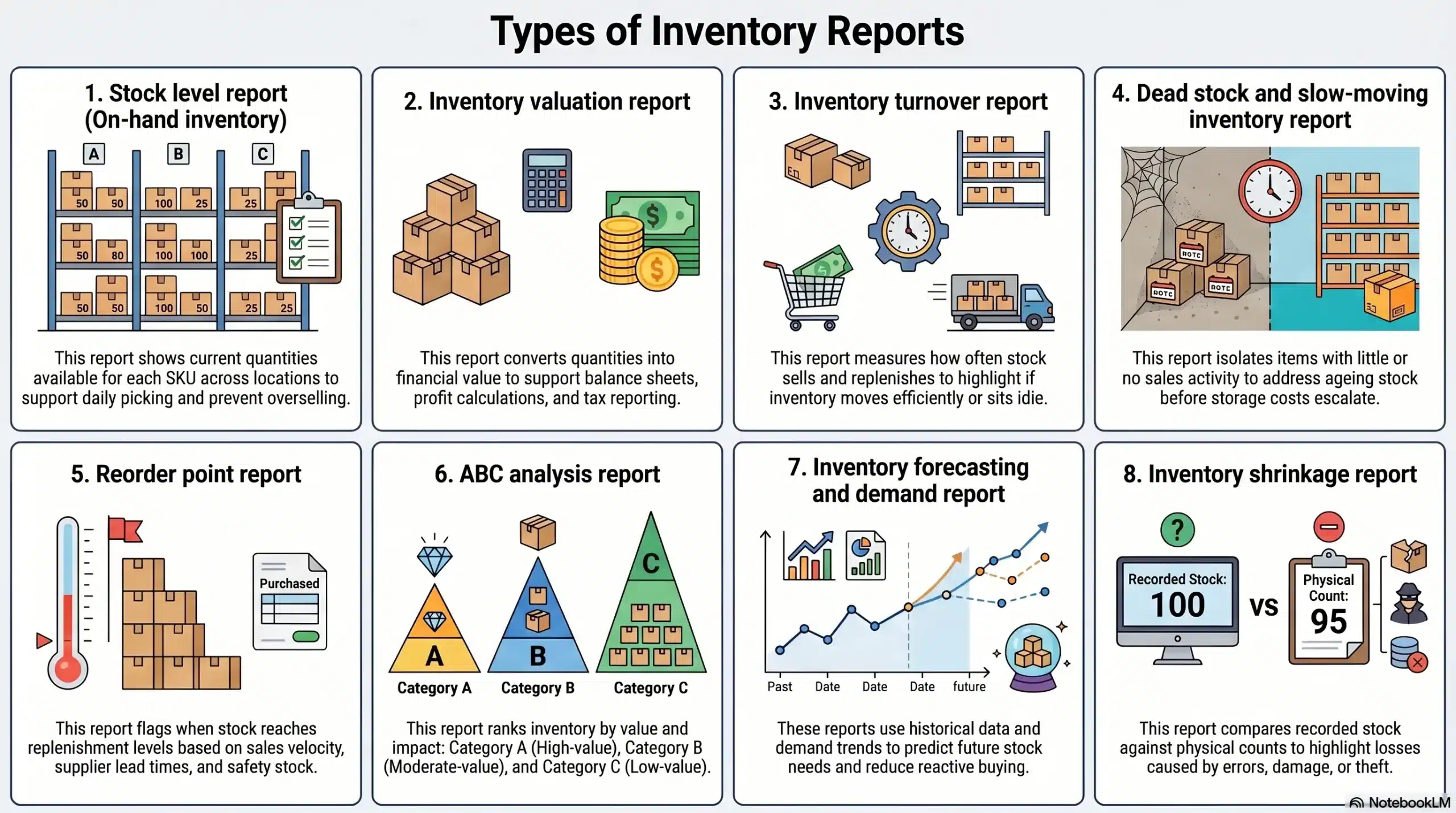
No single report answers every inventory question on its own. Different report types focus on specific operational and financial needs, which together create a complete picture.
1. Stock level report (On-hand inventory)
This report shows current quantities available for each SKU across locations. It supports daily picking, sales commitments, and basic availability checks.
Because it updates frequently, teams rely on it to prevent overselling and fulfil orders accurately.
2. Inventory valuation report
An inventory valuation report converts quantities into financial value. It supports balance sheets, profit calculations, and tax reporting.
By applying accepted costing methods, finance teams maintain consistent and compliant records.
3. Inventory turnover report
Also known as velocity report, inventory turnover report measures how often stock sells and replenishes over time. It highlights whether inventory moves efficiently or sits idle.
Low turnover often signals overstocking or weak demand, which then requires corrective action.
4. Dead stock and slow-moving inventory report
This report isolates items with little or no sales activity. It helps management address ageing stock before storage costs escalate.
Regular review prevents unsellable goods from consuming space and tying up capital.
5. Reorder/backorder point report
A reorder point report flags when stock reaches replenishment levels. It also surfaces items already in backorder. It accounts for sales velocity, supplier lead times, and safety stock.
As a result, purchasing teams act early and avoid gaps in availability.
6. ABC analysis report
This report ranks inventory by value and impact, helping prioritise control efforts.
- Category A: High-value items requiring strict control
- Category B: Moderate-value items needing routine review
- Category C: Low-value items suited to automated reordering
This structure ensures focus stays on products that drive revenue.
7. Inventory forecasting and demand report
Forecasting reports predict future stock needs using historical data and demand trends. They support planning for upcoming sales cycles.
With accurate forecasts, businesses order with confidence and reduce reactive buying.
8. Inventory shrinkage report
This report compares recorded stock against physical counts. It highlights losses caused by errors, damage, or theft.
Identifying shrinkage early allows corrective controls to be put in place.
9. Inventory ageing report
An inventory ageing report categorizes stock by how long it has been held. Age buckets typically cover 0–30, 31–60, 61–90, and 90+ days of storage.
This helps teams identify items approaching the point where holding costs exceed recoverable value. Early visibility supports clearance decisions before stock becomes a write-off.
Regular review also supports better purchasing discipline. Patterns in ageing stock often signal demand shifts that require reorder adjustments.
10. Inventory profitability report
This report compares gross margin per SKU against the cost of storing and handling that item. It reveals which products contribute genuine profit after holding costs are factored in.
High-turnover items with thin margins may still underperform once warehousing costs are included. This view helps finance and operations align on true product-level performance.
Results from this report support ranging decisions, pricing reviews, and storage allocation priorities.
What to Include in an Inventory Report

An effective inventory report includes clear, consistent data fields. These elements ensure the information remains actionable across teams using a platform for reporting stock.
1. Stock quantities, locations, and warehouse details
Reports must show exact quantities and where stock is stored. This includes all warehouse sites the company has and internal storage zones.
Clear location data speeds up picking and reduces handling delays during fulfilment.
2. SKU, product descriptions, and categories
Each item requires a unique SKU and standardised description. Categories allow performance analysis across product ranges.
Consistent naming prevents duplication and reduces reporting errors.
3. Valuation, cost of goods, and GST data
Unit costs and total valuation support accurate financial reporting. GST tracking ensures BAS figures remain correct.
These details link inventory directly to compliance and profitability.
4. Reorder levels, lead times, and supplier information
Including reorder points and supplier data turns reports into purchasing tools. Lead times guide timely replenishment.
This structure reduces delays and supports smoother procurement.
Australian Regulatory Context for Inventory Reporting
Inventory reporting in Australia carries legal weight. Stock valuation, trading stock declarations, and GST adjustments are all subject to ATO and AASB requirements that affect tax outcomes and audit exposure.
Understanding these obligations helps businesses structure their reporting correctly from the start, rather than correcting errors at year-end.
1. AASB 102 inventories standard
AASB 102 governs how Australian businesses must measure and disclose inventory. Stock is valued at the lower of cost and net realisable value.
Cost includes purchase price, conversion costs, and any other costs to bring stock to its current location and condition. Net realisable value is the estimated selling price less completion and selling costs.
Businesses must disclose the accounting policies used for inventory measurement. Total carrying amounts by category and any write-downs recognized in the period are also required disclosures.
2. ATO trading stock rules
The ATO requires businesses to value all trading stock at the end of each income year. The difference between opening and closing stock values directly affects taxable income.
Three valuation methods are accepted: cost, market selling value, or replacement value. Each item can use a different method, but the chosen method must be applied consistently year to year.
Small businesses with annual turnover below $5 million may use the simplified trading stock rules. If the value difference between opening and closing stock is $5,000 or less, no adjustment to taxable income is required.
3. GST treatment of inventory write-offs
When stock is written off due to shrinkage, damage, or obsolescence, a GST adjustment is required. Businesses must make a decreasing adjustment for any input tax credits previously claimed on those goods.
This applies when items are no longer used for a creditable business purpose. The adjustment must be reported in the BAS covering the period in which the write-off is recorded.
Accurate shrinkage reporting through inventory records supports correct GST treatment. Without it, businesses risk retaining input tax credits they are no longer entitled to claim.
Downloadable Inventory Report Templates
Creating inventory reports from scratch can be time-consuming. To assist you in standardizing your reporting processes, we have outlined the structure of several essential templates. You can easily recreate these structures in Microsoft Excel, Google Sheets, or your preferred spreadsheet software to begin tracking your inventory systematically.
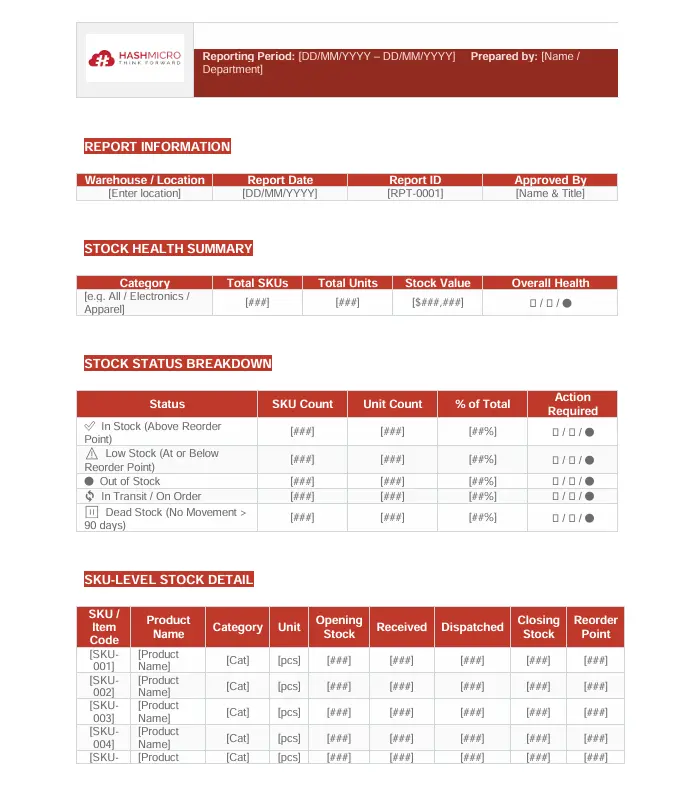
1. Stock level report template
Keeping track of your inventory levels is essential to avoid stockouts or overstocking. This stock level report template helps you monitor inventory status, identify shortages, and make timely replenishment decisions.
Stock Level Report Template
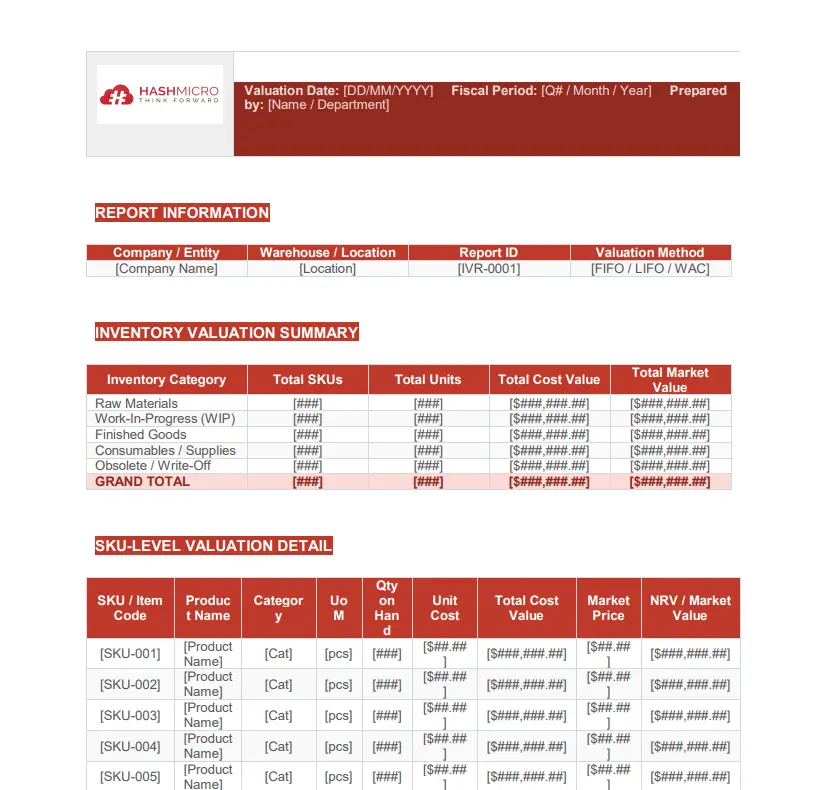
2. Inventory valuation report template
Beyond tracking quantities, understanding the financial value of your inventory is equally important for accurate reporting and decision-making. This template allows you to calculate and monitor the total value of stock held within a given period.
Inventory Valuation Report Template
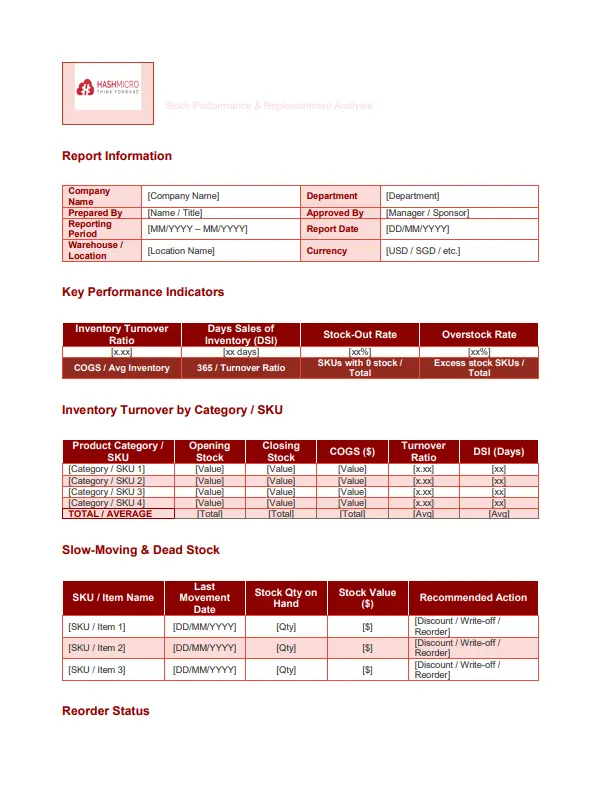
3. Inventory turnover report template
To optimise inventory performance, it’s important to understand how quickly stock moves through your business. This template helps you analyse turnover rates, identify slow-moving items, and improve inventory efficiency.
Inventory Valuation Report Template
Industry-Specific Use Cases for Inventory Reports

Inventory reporting adapts to industry demands and operating models. Each sector focuses on different risks and priorities.
1. Retail and omnichannel commerce
Retailers rely on real-time stock visibility across stores and online channels. Accurate reports prevent overselling and fulfilment errors.
They also support flexible fulfilment options across multiple locations.
2. Manufacturing and production
Manufacturers track raw materials, work in progress, and finished goods separately to ensure production runs without interruption.
A useful inventory report for a manufacturing business should capture component consumption per production run and any variance against the Bill of Materials.
3. Healthcare and pharmaceuticals
Healthcare inventory reporting prioritises safety and compliance. Expiry dates, batch numbers, and controlled substances require strict tracking.
Reports ensure items remain safe, traceable, and properly recorded.
4. Food and beverage
Perishable goods demand close shelf-life monitoring. Inventory reports highlight spoilage risks and usage variance.
This reduces waste while protecting profit margins.
Inventory Reporting Implementation Guide
Moving to structured inventory reporting requires alignment across systems and teams. A clear approach ensures reliable data from the start.
1. Reporting objectives and KPIs
Define what the business wants to improve, such as availability or holding costs. Then align reports to those objectives.
Clear KPIs keep reporting focused and relevant.
2. Baseline stock audit
A full stock count establishes accurate opening data. It also allows removal of obsolete or damaged items.
This creates a clean foundation for reliable reporting.
3. SKU standardisation
Consistent SKU rules prevent duplicate records and data confusion. Everyone must follow the same naming logic supported by proper inventory classification.
Standardisation protects long-term report accuracy.
4. Inventory management software
Modern inventory software automates updates across sales and purchasing systems. This removes manual errors and delays.
Integrated systems keep reports current and dependable.
5. Cycle counting routine
Regular cycle counts keep data accurate between full stocktakes. Small discrepancies are corrected early.
This practice maintains long-term reporting reliability.
6. Automated report distribution
Scheduled reports ensure the right people receive the right data. Each role gets relevant insights without manual effort.
Automation improves consistency and accountability.
Common Pitfalls in Inventory Reporting and How to Avoid Them
Inventory reporting errors often stem from process gaps and outdated tools. Recognising them early prevents larger financial and operational issues.
- Over-reliance on manual data entry leads to errors and outdated reports. Automated systems reduce human mistakes and keep data current across all channels.
- Disconnected systems create delays and inconsistencies between departments. Integrated platforms ensure data flows smoothly between sales, inventory, and finance.
- Ghost inventory causes unexpected stockouts and missed sales. Regular cycle counting keeps records aligned with physical stock levels.
- Ignoring historical trends limits forecasting accuracy. Tracking performance over time supports stronger planning decisions and helps with managing dead stock.
Advanced Inventory Reporting Practices
As supply chains grow more complex, advanced reporting methods provide stronger control and insight. These practices help businesses stay responsive and efficient.
- Predictive analytics and demand forecasting use historical patterns to anticipate future needs. This allows proactive purchasing and balanced stock levels.
- RFID and real-time tracking update inventory automatically as goods move. Reports reflect exact locations, reducing handling time and labour costs.
- Role-based dashboards deliver tailored insights to each team. Finance, operations, and warehouse staff access metrics that matter to them.
- Sustainability tracking highlights waste, transport impact, and spoilage. These insights support cost reduction and responsible operations.
Conclusion
An inventory report gives a business the clarity needed to manage stock with confidence. When used consistently, it supports better purchasing decisions, reduces unnecessary holding costs, and strengthens financial accuracy across the year.
By applying structured inventory control and reviewing reports regularly, companies gain tighter control over cash flow and fulfilment performance. If you want tailored guidance, book a free consultation with our team to review your current inventory process.

Frequently Asked Question
Inventory control tracks stock levels to ensure products are available without overstocking. It protects cash flow and improves fulfilment reliability.
Common methods include perpetual systems, periodic stocktakes, reorder points, and ABC analysis. These methods improve accuracy and planning.
Inventory control reduces storage, handling, and spoilage costs while preventing capital from being tied up in dead stock.
Inventory control focuses on stock accuracy, while inventory management includes purchasing, forecasting, and fulfilment activities.
Most businesses review inventory daily through systems and conduct cycle counts weekly or monthly to maintain accuracy.