














A stocktake is the physical process of verifying what a business actually holds in stock against what its systems record, closing the gap between data and reality.
For Australian businesses, the 30 June EOFY deadline makes accurate stock counts a legal requirement, with the ATO requiring verified inventory valuations to calculate taxable income correctly.
This article explains what a stocktake is and how digital inventory management solutions are changing the process.
Key Takeaways
A stocktake is the physical process of verifying quantities and condition of every item against system records, identifying variances caused by errors, damage, or theft before they compound.
Knowing the difference between a full stocktake and cycle counting helps businesses choose the right method for their operational needs and compliance obligations.
Four stocktake methods: full physical, cycle counting, spot check, and perpetual inventory stocktake.
Preparation steps include organising the warehouse, assigning counting zones, establishing a hard operations cutoff, and running a baseline system report before counting begins.

What Is Stocktake?

A stocktake, also called a stock count or inventory count, is the physical process of verifying the quantities and condition of every item a business holds.
Staff count, weigh, or measure each item on hand and compare those figures against the inventory records in the business’s software or accounting ledger.
The goal is to identify discrepancies between what the system shows and what is physically present. These gaps, called inventory variances, arise from data entry errors, misplaced goods, unrecorded damage, or theft.
By identifying and correcting variances, businesses keep their financial records accurate and their operational decisions grounded in real data rather than phantom figures.
For Australian businesses, the EOFY deadline of 30 June makes the stocktake especially critical.
The ATO requires businesses to report the value of trading stock at the start and end of each income year to calculate taxable income correctly. Inaccurate counts can lead to compliance penalties.
The Australian Bureau of Statistics consistently ranks inventory as one of the largest asset categories on Australian business balance sheets, making its accurate valuation a core governance responsibility.

Stocktake vs Cycle Count
Full stocktake and cycle counting are both methods for verifying inventory accuracy, but they differ significantly in scope, frequency, and impact on daily operations.
A full stocktake counts every item in the facility at one point in time. Operations typically pause during this process so inventory stays static and counts are not disrupted by goods moving in or out.
Businesses usually conduct a full stocktake annually, often timed to align with EOFY reporting. It gives auditors and the ATO a definitive snapshot of the entire inventory at one specific date.
Cycle counting takes a different approach. Small, specific portions of inventory are counted continuously throughout the year on a rotating schedule, without halting operations.
High-value items are counted most frequently, while slow-moving inventory and lower-priority stock are audited less often. This keeps inventory accuracy high year-round rather than correcting it once a year.
A full stocktake provides a clean reset of the entire ledger, while cycle counting turns accuracy into a continuous state rather than an annual event.
Cycle counting requires robust software capable of handling real-time updates alongside live transactions, which makes it a higher-investment approach for smaller businesses.
Many Australian businesses use a hybrid approach: cycle counting throughout the year for daily accuracy, and a streamlined full count at EOFY to satisfy regulatory and audit requirements.
| Factor | Full Stocktake Cycle | e Counting |
|---|---|---|
| Scope | All items counted at once | Small segments counted on rotation |
| Frequency | Annual (typically at EOFY) | Ongoing — daily, weekly, or monthly |
| Operational disruption | High — operations paused during count | Low — facility continues operating |
| Accuracy snapshot | Single definitive point in time | Continuous year-round accuracy |
| Audit suitability | Preferred by ATO and external auditors | Supports internal accuracy monitoring |
| System requirement | Basic inventory software sufficient | Requires a real-time inventory system |
| Best for | EOFY compliance and external audits | Businesses with high-volume, fast-moving stock |
Why Stocktake Matters for Businesses
Inventory often represents the largest single asset on a business’s balance sheet, making managing inventory more efficiently critical. Managing it poorly creates a cascade of failures across finance, operations, and customer service.
1. Ensures accurate inventory records
When micro-errors accumulate over months, the gap between digital records and physical reality widens. Items the system shows as available may no longer exist on the shelf.
This is called phantom inventory. It causes fulfilment failures when customers purchase items that staff cannot locate, resulting in cancelled orders, refunds, and permanent damage to brand trust.
Regular stocktakes reset the system to match reality, giving sales teams confidence in what they are offering and giving warehouse staff accurate data to pick and pack orders efficiently.
Accurate records also reduce the time staff spend searching for misplaced goods, which lowers labour costs and speeds up the entire fulfilment cycle.
2. Prevents stock shrinkage
Shrinkage is the loss of inventory between the point of purchase from a supplier and the point of sale to the customer. The primary causes are theft, administrative errors, vendor fraud, and product damage.
Without regular stocktakes, shrinkage can go unnoticed for months. A business might keep losing high-value goods without ever knowing the source or scale of the problem.
When a count reveals a significant variance in a specific category, management can investigate the cause and take targeted action, whether that is tighter access controls, better handling procedures, or staff reviews.
The stocktaking schedule also acts as a psychological deterrent. When employees know discrepancies will be identified quickly, the incentive to misappropriate stock diminishes significantly.
3. Improves forecasting and planning
Procurement decisions depend on accurate data. When inventory records are wrong, every purchasing decision built on them is also wrong.
If the system reports 500 units of a fast-moving product but only 50 exist on the shelf, the purchasing team may delay a reorder. The actual stock sells out, and the business faces a stockout that it could have prevented.
Verified stock data allows businesses to calculate accurate reorder points, safety stock levels, and order quantities. In Australia, where international shipping lead times are long, this precision is critical to continuity.
4. Keeps financial records reliable
Inventory directly affects financial statements. The closing stock value flows into the cost of goods sold calculation, which determines gross profit and net income for the financial year.
If a business overstates inventory because shrinkage was not captured, its COGS will be artificially low, inflating reported profit and increasing tax liability beyond what is actually owed.
The ATO requires businesses to value trading stock using recognised methods such as FIFO or weighted average cost, backed by physical counts. A compliant EOFY stocktake provides that documented proof.
Types of Stocktake
Different business models, inventory sizes, and operational constraints call for different counting approaches. Selecting the right method balances accuracy with operational continuity.
1. Full physical stocktake
A full physical stocktake counts every item in the facility at a single point in time. No goods are received or dispatched while the count is underway, keeping inventory completely static.
This freeze on operations prevents the moving-target problem, where items shift between locations mid-count and end up counted twice or missed entirely.
The full stocktake is labor-intensive and often runs over weekends or public holidays to minimise business disruption. But it provides the most complete and definitive record of the business’s physical assets.
External auditors and the ATO favour this method for EOFY verification because it delivers an unambiguous snapshot of every item owned at one specific date, with no ambiguity about timing.
2. Cycle counting
Cycle counting divides inventory into segments and counts each segment on a rotating schedule, daily, weekly, or monthly, without halting operations.
High-value items are counted most frequently. A category B item might be audited quarterly, while category C items are reviewed once per year. This matches audit frequency to financial risk.
Errors are caught within days rather than months, which stops small process failures from compounding. A picking error that causes consistent mislocation is identified and corrected quickly rather than discovered at the annual count.
Cycle counting requires disciplined staff and a robust inventory system that handles live updates while other transactions are simultaneously being processed across the facility.
3. Spot check stocktake
A spot check is an unscheduled, targeted count of a specific product, location, or category, triggered by a suspicious variance or operational concern.
If a particular SKU keeps showing stockouts despite adequate system quantities, a spot check on that item gives an immediate answer without disrupting the rest of the warehouse.
Spot checks are also effective as anti-theft controls. Randomly counting high-risk items at unpredictable intervals creates accountability and deters internal theft without committing to a full count.
They require minimal resources and can be completed within hours, making them a practical tool for investigating individual anomalies between scheduled cycle counts or annual stocktakes.
4. Perpetual inventory stocktake
A perpetual inventory system updates stock records automatically each time an item is received, picked, or dispatched, using barcode scans or RFID data to track every movement in real time.
In theory, perpetual systems eliminate the need for manual counts. In practice, human errors and physical events such as unscanned breakages cause the digital records to drift over time.
A perpetual stocktake uses the system’s real-time data to flag anomalies, such as negative balances or unexplained usage spikes, and triggers targeted physical checks on those specific locations.
This approach combines automation with human verification, delivering high accuracy with minimal disruption. It represents the most advanced stocktake model available to product-based businesses.
Key Stocktake Metrics
A stocktake generates data that is only useful if it is measured and acted on. These three metrics translate raw count results into performance indicators that drive process improvement.
1. Inventory accuracy rate
Inventory accuracy rate measures the percentage of SKU records in the system that exactly match the physical count. It is the primary indicator of how well day-to-day operational processes are functioning.
Formula: (Number of accurate item records ÷ Total item records counted) × 100
A world-class warehouse targets 98 to 99.9 percent. Anything below 95 percent signals systemic problems in receiving, picking, or data entry that require immediate investigation.
Tracking this metric across multiple stocktakes shows whether corrective actions, such as additional training or upgraded scanning hardware, are producing measurable improvement over time.
2. Stock variance percentage
Stock variance percentage quantifies the gap between the system’s expected quantity and the actual physical count. It reveals the severity of discrepancies, not just whether they exist.
Formula: ((Actual physical count – Expected system count) ÷ Expected system count) × 100
A 5 percent variance on low-cost consumables may be acceptable. The same percentage on high-value electronics could represent tens of thousands of dollars in unexplained loss.
Calculating variance by financial value, rather than unit count, directs investigation efforts toward the product categories with the highest risk to overall profitability.
3. Count completion time
Count completion time measures how long the stocktake takes from the moment counting begins to when all variances are investigated, and the system is updated with final figures.
For a full stocktake, this determines how long operations are disrupted. For cycle counts, it shows how much productive time is consumed by the auditing process each period.
Tracking this across multiple stocktakes reveals efficiency trends. If the count time increases while inventory volume stays flat, the process or the tools being used need review.
Common Stocktake Challenges
Even well-planned stocktakes encounter problems. Understanding these challenges in advance allows businesses to build processes that prevent them before they affect count accuracy.
1. Inaccurate counting
Manual counting is prone to error. Staff miscount items, tally the same location twice, miss bins in cluttered areas, or confuse units of measure, such as counting cases instead of individual units.
Paper-based count sheets amplify the problem. Handwritten totals are misread during data entry, and a single transcription error can offset dozens of correct physical counts.
Blind counting reduces this risk by hiding expected quantities on the count sheet, forcing a genuine physical tally rather than a confirmation that introduces bias toward the system figure.
2. Disruptions to operations
A full stocktake halts receiving, picking, and dispatching while the count runs. For businesses with tight fulfilment windows, this creates pressure to rush the process and introduce errors.
Even with operations frozen, goods in transit or items awaiting quality inspection create ambiguity. Clear cutoff rules and isolation areas for incoming shipments prevent double-counting.
Scheduling the full count during a historically quiet trading period, such as a Sunday or public holiday, reduces operational impact while still producing a reliable, defensible count.
3. Lack of employee training
Counting staff need more than the ability to read numbers. They must know the correct unit of measure for each SKU, how to handle damaged goods, and how to flag discrepancies properly.
Undertrained staff produce unreliable counts that require recounting, extending the stocktake, increasing labour costs, and delaying the system update that the business depends on.
A short briefing before each stocktake, covering procedures, scanning equipment, and escalation steps for problem items, significantly reduces error rates and recounting time.
How to Prepare for a Stocktake
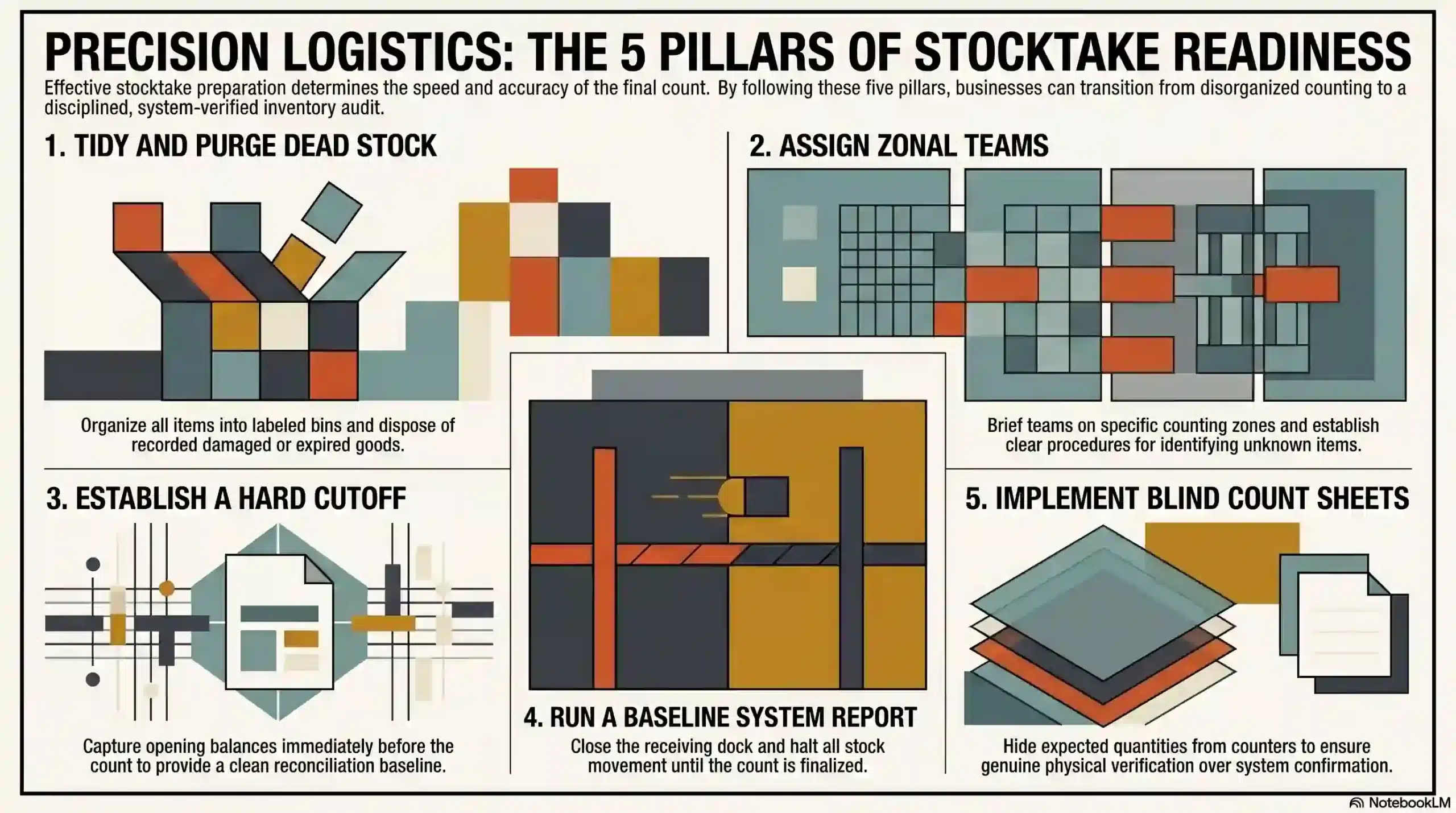
Preparation determines how fast and accurately the count will be. Businesses that start organising weeks before the stocktake consistently produce better results than those that begin the day before.
1. Tidy the warehouse and clear out dead stock
Every item should be in its correct bin or shelf location, clearly labelled, and accessible without moving other stock.
Known damaged or expired goods should be disposed of and recorded in the system before counting begins, so the count reflects saleable inventory only.
2. Assign teams and brief counting zones
Assign counting teams to specific zones and give each team a clear brief on their area, counting method, and escalation procedure for items that are hard to identify or locate.
3. Establish a hard operations cutoff
Decide exactly when the receiving dock closes, when the last pick is dispatched, and when the count sheet freeze begins. No goods should move after this point until the count is complete.
4. Run a baseline system report
Run a system report immediately before the count starts to capture opening balances, supporting the ATO’s record-keeping obligations that require documentation to be retained for five years.
5. Use blind count sheets
Configure count sheets or scanning devices to hide expected quantities. This forces genuine counting rather than confirmation of the number the system expects to see.
How Technology Improves Stocktake
Technology has shifted stocktaking from a labor-intensive, paper-based event into a faster, more accurate process that integrates directly with the inventory management system.
1. Barcode scanners and mobile counting devices
Automated stock tracking tools such as barcode scanners and mobile counting devices eliminate manual transcription. Each scan updates a digital record instantly, removing the data-entry step and the errors that come with it.
2. RFID technology
Unlike barcodes, RFID tags do not require line-of-sight scanning. A reader carried through a warehouse aisle captures hundreds of items simultaneously, cutting count time significantly.
3. Drones for high-rack auditing
In large distribution centres, autonomous drones equipped with optical scanners can audit high racks that are unsafe for staff to access manually, reducing both count time and safety risk.
4. Cloud-based inventory systems
Cloud-based inventory systems support centralised inventory monitoring with real-time visibility across multiple locations. Count results update the central database instantly, so managers see variances without waiting for a manual upload.
5. Predictive analytics and ERP integration
Predictive analytics built into modern ERP platforms identify which products or warehouse zones carry the highest historical variance, automatically scheduling targeted cycle counts for those areas.
This data-driven approach concentrates audit effort where it matters most, reducing the labour needed for a full sweep while maintaining accuracy in the highest-risk parts of the inventory.
Conclusion
A stocktake is one of the most direct ways a business can protect the accuracy of its inventory, its financial records, and its compliance with ATO reporting requirements.
Choosing the right method, tracking the right metrics, and investing in the right technology turns a regulatory obligation into an operational advantage that strengthens every decision the business makes.
Interested in conducting a stocktake for your business? Then you can request a free consultation with us today and improve your inventory management.

FAQ About Stocktake
-
What is the difference between a stocktake and a stock audit?
A stocktake is a physical count of items to verify quantities and conditions. A stock audit is broader, examining procurement records, invoices, and movement logs to verify that the entire inventory process is compliant and accurately documented. A stocktake is typically one component of a full stock audit.
-
How should dead stock and damaged goods be handled during a stocktake?
Damaged goods and dead stock should be identified, recorded in the system, and disposed of before the count begins, not during it. Writing them off beforehand gives a cleaner count of saleable inventory and simplifies the EOFY valuation the ATO requires.
-
Who is responsible for carrying out a stocktake?
In smaller businesses, the owner or manager typically oversees the count. In larger operations, a dedicated inventory controller or operations manager leads the stocktake, often with a separate verification team assigned to high-value or high-variance items to reduce the risk of counting bias.
-
Can stocktake results be used as evidence in an insurance claim?
Yes. A completed stocktake report with signed-off variances documents the quantity and value of goods on hand at a specific date. Insurers may request this evidence when assessing claims for theft, fire, or flood damage, making thorough documentation essential.
-
What records should a business keep after completing a stocktake?
Businesses should retain count sheets, variance reports, reconciliation records, and investigation notes for at least five years to meet ATO record-keeping obligations. These records also provide a verified baseline for comparison in the following year’s stocktake.