















A construction management system is a digital platform that helps businesses plan, manage, and complete construction projects. It connects office and field teams in one place while managing budgets, schedules, documents, and safety processes.
Australia’s construction sector continues to face strong delivery pressure, with tight margins, rising costs, and ongoing labour constraints affecting many projects. Infrastructure Australia reported in 2025 that around 60% of surveyed firms identified labour and skills as a significant threat to project delivery, highlighting how important strong operational control has become.
When teams still rely on disconnected spreadsheets, email threads, and scattered site updates, small issues can quickly grow into delays, cost overruns, and compliance risk. To keep projects moving efficiently, Australian builders and contractors need better coordination between the field and the back office.
A construction management system helps bring schedules, documents, communication, and reporting into one connected environment. With clearer visibility and faster access to information, project teams can respond earlier, make better decisions, and maintain stronger control throughout the delivery process.
Key Takeaways
|
What Is a Construction Management System?
A construction management system is a specialised software for contractors that helps builders and project teams plan, manage, and complete projects more efficiently. Unlike general software, a construction project management system is built for construction workflows such as budgeting, scheduling, document control, RFIs, submittals, and compliance tracking.
It acts as one central workspace where teams can manage project data, site activity, and back-office processes in real time. Instead of relying on disconnected spreadsheets and manual updates, a construction site management system helps everyone work from the same accurate information.
This connected construction system also improves collaboration across teams, subcontractors, and stakeholders by keeping communication clear and records easy to track. As a result, businesses can reduce costly mistakes, respond faster to project changes, and build a stronger foundation for better project delivery in the future.
Who Uses a Construction Management System?
A construction management system supports every key party involved in a project, from main contractors to design consultants and owners. Each user depends on it for different reasons, but all of them need the same thing: clear information, faster coordination, and better project control.
| User | Main Focus | Common Challenges | How the System Helps |
|---|---|---|---|
| General Contractors | Project oversight, budget, schedule, and subcontractor coordination | Keeping the project on track, coordinating multiple parties, controlling site progress, and maintaining consistent workflows | Centralises project data, keeps plans and documents aligned, tracks subcontractor progress, and improves process control |
| Subcontractors | Site execution, trade coordination, and daily progress | Coordinating work requirements, raising issues quickly, proving completed work, and keeping field teams efficient | Provides updated plans, standardises reporting, supports mobile communication, and records progress with photos and logs |
| Inspectors | Safety, quality, and compliance checks | Managing inspections efficiently, sharing findings clearly, enforcing compliance, and escalating issues fast | Uses digital checklists and forms, captures photos and notes in context, speeds up issue reporting, and creates clear audit trails |
| Project Owners and Developers | Budget visibility, risk oversight, and milestone tracking | Limited transparency, slow updates, budget uncertainty, and fragmented communication | Provides live dashboards, tracks progress and issues, improves approval flow, and keeps reporting clear and accessible |
| Architects and Engineers | Design coordination, document control, and technical review | Sharing revised plans, maintaining design quality, coordinating feedback, and responding to site queries | Distributes updated drawings instantly, supports RFI workflows, improves submittal review, and keeps communication linked to project documents |
1. General contractors
General contractors use a construction project management system for stronger construction project oversight from pre-construction to handover, managing schedules, budgets, and subcontractors efficiently.
The platform gives them a single reliable place to review plans, track progress, and respond faster when delays or cost changes arise. This helps them protect margins, maintain accountability, and keep the project moving with greater confidence.
2. Subcontractors
Subcontractors use the system to manage daily fieldwork with less confusion and fewer manual follow-ups. A construction site management system helps them access current drawings, submit RFIs, log site conditions, and capture proof of completed work from mobile devices.
It also makes communication easier when issues need to be raised quickly across teams. As a result, subcontractors can reduce rework, support billing claims, and keep crews focused on productive work.
3. Inspectors
Inspectors use the platform to check whether work meets safety, quality, and compliance requirements on site. The system helps them complete inspections with digital forms, document findings with photos, and share corrective actions with the right teams.
This process makes reporting more consistent and reduces the risk of missed details or delayed follow-up. It also creates a clear record that supports accountability across the project.
4. Project owners and developers
Project owners and developers use the platform to monitor project health without getting involved in every operational detail. They rely on dashboards and reports to review budget movement, milestone progress, major risks, and key decisions that may affect delivery.
This visibility helps them make faster approvals and stay confident that the project remains aligned with commercial goals. A connected construction system also builds stronger trust because owners can see progress and issues in real time.
5. Architects and engineers
Architects and engineers use the system to manage design coordination and keep project information accurate across all teams. They review RFIs, issue drawing updates, assess submittals, and verify that site execution still aligns with the design intent.
The platform helps them communicate technical changes more clearly and reduce errors caused by outdated documents. With better control over design information, they can support smoother collaboration and stronger build quality from start to finish.
Key Differences Between a Basic Construction System and a Full ERP Platform
Construction businesses often compare basic construction systems with full ERP platforms because both promise better control. However, they are built for different levels of operational complexity.
A basic construction system mainly improves how teams manage active projects. A full ERP platform connects project work with the wider business, including finance, HR, procurement, payroll, and reporting.
The right choice depends on what the business needs to fix first. Some contractors need faster site coordination, while others need stronger control across every department.
1. Project control vs business-wide control
A basic construction system focuses on the project itself. It helps teams manage schedules, documents, RFIs, site reports, tasks, and daily communication between the office and the field.
This makes it useful for contractors that want clearer visibility over active jobs. Project managers can track progress, follow up on issues, and keep site teams aligned with less manual work.
A full ERP platform goes further by managing the business behind the project. It links construction activity with accounting, procurement, HR, payroll, inventory, sales, and management reporting.
This wider control helps leaders understand how each project affects the business. They can review delivery progress, cost movement, resource use, and financial performance from one connected system.
2. Standalone workflows vs connected departments
A basic construction system usually improves a specific project workflow. It may support site updates, document control, scheduling, or team communication, but other departments may still use separate tools.
That setup can work well when the business only needs to fix project coordination. However, it can still leave gaps when project data needs to move into finance, procurement, or payroll.
A full ERP platform connects those departments through shared records. For example, a project purchase request can flow into approvals, supplier records, stock updates, invoices, and accounting.
This reduces duplicate data entry and lowers the risk of conflicting information. It also gives each department a clearer view of the same business activity.
3. Faster setup vs deeper implementation
A basic construction system is usually quicker to set up because it covers fewer processes. Teams can often start with scheduling, document control, or site reporting without changing the whole business.
This shorter rollout helps contractors improve project visibility sooner. It also makes training easier because users only need to learn the tools that affect their daily work.
A full ERP platform needs more preparation. The business must review workflows, clean data, configure modules, migrate records, and train users across several departments.
The longer setup reflects the broader scope. ERP takes more effort at the start, but it can deliver stronger long-term control when the business needs one connected operating system.
4. Lower entry cost vs larger investment
A basic construction system usually has a lower starting cost. Many platforms use subscription pricing based on users, projects, or selected features.
This makes it easier for small and mid-sized contractors to improve project management without a major upfront investment. Costs can also scale as the team grows.
A full ERP platform usually requires a larger budget. The investment often includes software licences, implementation, configuration, integration, user training, and ongoing support.
That higher cost can be worthwhile when disconnected tools are slowing the business down. ERP delivers the most value when it replaces fragmented processes across several departments.
5. Project reporting vs integrated business reporting
A basic construction system usually reports on project activity. Teams can monitor schedules, defects, RFIs, site updates, safety items, document status, and task progress.
These reports help project teams respond faster during delivery. They make day-to-day decisions easier because managers can see what is happening on site.
A full ERP platform combines project data with financial and operational data. Leaders can review project profitability, procurement costs, labour usage, billing status, and cash flow in one place.
This gives management a broader view of performance. Instead of only seeing whether a project is moving, they can see whether it is staying commercially healthy.
6. Best fit for your business
A basic construction system suits contractors that mainly need stronger project control. It works well when the priority is better scheduling, site reporting, document management, and team coordination.
It is also a practical option for businesses that are not ready to replace finance, HR, or procurement systems. They can improve project delivery first and expand later if needed.
A full ERP platform suits larger or growing contractors with more connected business needs. It becomes more useful when project delivery, finance, HR, procurement, and reporting must work from the same data.
Choosing the wrong level can create avoidable cost or complexity. The best option is the one that matches the business problem, not just the longest feature list.
5 Types of Construction Management Systems Compared

Different projects need different digital tools, so companies often choose a system based on the operational gap they want to fix first. A construction management system can support planning, field execution, safety, quality control, and connected collaboration throughout the project.
1. Construction project management system
- Focuses on project planning, scheduling, budgeting, and financial control
- Helps teams manage timelines, task dependencies, job costs, and change orders
- Supports stronger oversight from pre-construction to project closeout
A construction project management system acts as a solution for automated construction project control, helping contractors manage time, cost, and resources more efficiently.
2. Construction site management system
- Focuses on day-to-day site operations and field execution
- Helps teams record daily reports, site activity, equipment usage, and workforce updates
- Supports mobile access for supervisors, foremen, and field engineers
A construction site management system helps site teams manage work directly from the field with more speed and accuracy. It reduces manual reporting, improves visibility for the office team, and keeps site communication more consistent.
3. Construction safety management system
- Focuses on hazard control, compliance, and workforce safety
- Helps teams manage safety forms, toolbox talks, training records, and incident reporting
- Supports a more proactive and structured safety culture on site
This type of construction system helps businesses reduce safety risks before they become costly incidents. It also makes compliance easier to track and gives teams a clearer process for maintaining safer job sites.
4. Quality management system in construction
- Focuses on inspections, defect tracking, and quality assurance
- Helps teams check whether work meets specifications, standards, and contract requirements
- Supports faster issue resolution with photos, checklists, and assigned actions
A quality-focused system helps teams reduce rework and improve final project outcomes. It gives contractors a more structured way to maintain standards and deliver a smoother handover to the client.
5. Cloud-based construction management system
- Focuses on real-time access, system connectivity, and data sharing
- Lets office teams, site teams, and stakeholders work from the same live information
- Supports scalability, easier maintenance, and lower dependence on local servers
A cloud-based construction management system creates a more connected and responsive project environment. It helps teams collaborate in real time, access information from anywhere, and keep operations flexible as the business grows.
This table summarizes the distinction between each type of construction management systems.
| System Type | Primary Focus | Core Capabilities | Best For | Key Benefit |
|---|---|---|---|---|
| Construction Project Management | Planning, scheduling, budgeting, and financial control | Timelines, task dependencies, job costing, change orders | Contractors needing end-to-end project oversight | Automated control of time, cost, and resources |
| Construction Site Management | Day-to-day site operations and field execution | Daily reports, site activity, equipment usage, workforce updates | Site teams, supervisors, and field engineers | Faster, more accurate field reporting and site visibility |
| Construction Safety Management | Hazard control, compliance, and workforce safety | Safety forms, toolbox talks, training records, incident reporting | Businesses prioritising compliance and safer job sites | Proactive risk reduction and easier compliance tracking |
| Quality Management in Construction | Inspections, defect tracking, and quality assurance | Spec checks, standards compliance, photos, checklists, assigned actions | Contractors focused on reducing rework and handover quality | Structured standards and smoother project handover |
| Cloud-Based Construction Management | Real-time access, connectivity, and data sharing | Live information sharing, scalability, lower local-server reliance | Teams needing connected, flexible project collaboration | Real-time collaboration and scalable operations |
Key Features of a Construction Management System

The value of a construction management system comes from how each feature works together, not as separate tools but as one connected workflow. The right platform helps teams plan better, respond faster, and keep every part of the project aligned from office to site.
1. Project scheduling and task management
A construction project management system helps teams build clear schedules, assign responsibilities, and track deadlines with better control. It supports Gantt charts, task dependencies, and progress tracking so managers can spot delays before they affect the wider project.
When issues appear, the system helps teams adjust resources and update timelines quickly. This gives contractors a more practical way to keep work moving without losing visibility.
2. Budget and cost management
Budget and cost tools help teams compare planned spending against actual project costs in real time. They make it easier to track labour, materials, subcontractor expenses, and change orders without relying on scattered spreadsheets.
With one connected view of project finances, managers can identify overruns earlier and make faster commercial decisions. This protects margins and keeps the project financially disciplined from start to finish.
3. Document and drawing control
Document control keeps drawings, specifications, RFIs, submittals, and reports in one reliable location. Strong version control helps every team work from the latest approved document and reduces errors caused by outdated files.
The system also makes it easier to mark up plans, attach supporting records, and quickly find critical information. As a result, teams spend less time searching for files and more time keeping the project on track.
4. Subcontractor and procurement management
This feature helps contractors manage subcontractor coordination and procurement in construction projects more effectively. Teams can compare bids, issue purchase orders, monitor material delivery, and track vendor requirements from one platform.
It also helps businesses keep insurance, licences, and compliance records up to date so risks do not go unnoticed. A stronger procurement process supports smoother execution and fewer disruptions on site.
5. Safety and compliance management
Safety features help teams move from manual safety administration to a more proactive and consistent process. The system supports digital inspections, hazard reporting, toolbox talks, corrective actions, and training records in one place.
This makes it easier to track site issues, maintain compliance, and respond quickly when risks appear. A connected construction system also creates a stronger safety culture because expectations and records stay visible to the right people.
6. Quality control and inspection tools
Quality tools help project teams standardise inspections and reduce rework throughout the build. Site teams can complete checklists, record defects, attach photos, and assign follow-up actions directly from the field.
Instead of waiting until the end of the project, teams can address issues as work progresses. This leads to better workmanship, faster closeout, and a smoother handover.
7. Communication and collaboration tools
A modern construction management system improves communication by consolidating updates, records, and decisions in a single shared environment. Teams can manage RFIs, mark up plans, send updates, and notify stakeholders without relying on fragmented messages across different apps.
This gives every party more context and reduces misunderstandings that often slow construction. Stronger collaboration also helps office and field teams stay aligned on the same priorities.
8. Reporting and analytics
Reporting tools turn daily project activity into information that managers can actually use. Teams can generate updates on progress, costs, safety, and outstanding issues without spending hours manually building reports.
Dashboards also help leaders track key project indicators and respond to small issues before they become major problems. Better reporting supports faster decisions and a more confident management approach.
9. Mobile access for on-site teams
Mobile access allows field teams to use the system where the work actually happens. A construction site management system lets supervisors and engineers view drawings, submit logs, capture photos, update progress, and log working hours directly from a phone or tablet.
This reduces delays between the site and the office while improving the accuracy of daily reporting. Offline access also helps teams keep working even when on-site internet coverage is limited.

Benefits of a Construction Management System
For Australian contractors, the value of a construction management system goes far beyond digitising paperwork. Infrastructure Australia reported that construction accounted for 27% of all insolvencies in 2023–2024, making tighter control over costs, coordination, and delivery risk a business necessity rather than an optional upgrade.
1. Reduce rework before it eats into your margin
A construction project management system helps teams reduce rework by keeping drawings, approvals, RFIs, and change records aligned in one place. That matters on Australian projects where a missed revision, outdated plan, or unclear instruction can easily trigger delay costs, wasted labour, and disputes with subcontractors.
With stronger version control and clearer documentation, teams can catch issues earlier before they spread across the site. This protects programme certainty and helps preserve margin on projects where even small mistakes can become expensive.
2. Keep site and office teams working at the same speed
A construction site management system helps field and office teams work from the same live project information, rather than separate updates and disconnected spreadsheets. Site supervisors can submit daily logs, photos, progress notes, and issue reports directly from the field, while project managers can respond without waiting for end-of-day summaries.
This faster flow of information is especially valuable on Australian jobs where teams may be spread across multiple sites, subcontractors, and regional locations. Better alignment between office and site reduces delays, improves accountability, and keeps work moving with less friction.
3. Protect cash flow and strengthen cost control
Cash flow pressure can escalate quickly when variations, subcontractor claims, procurement costs, and progress billing are tracked manually. A connected construction system gives managers clearer visibility over committed costs, actual costs, pending approvals, and potential overruns while there is still time to act.
This makes it easier to control variation risk, protect payment timing, and prevent margin erosion across the life of the project. For Australian contractors operating in a high-cost environment, that level of financial clarity supports more stable delivery and stronger commercial discipline.
4. Improve compliance and safety without adding more admin
Construction businesses in Australia need to manage safety obligations, site records, inductions, inspections, and compliance documentation with consistency. A modern construction management system helps teams complete these tasks through standardised digital forms, mobile reporting, and clear audit trails, rather than relying on paper-based follow-up.
This improves visibility without creating unnecessary admin for supervisors and project teams already under delivery pressure. It also helps businesses respond faster during reviews, audits, or incidents because critical records are easier to access and verify.
5. Help teams make better decisions earlier
Project problems usually become expensive when teams spot them too late, not when they first appear. A construction project management system supports an AI-supported construction project by giving decision-makers a clearer view of delays, budget movement, RFIs, and site risks while action is still possible.
That means managers can reallocate labour, escalate approvals, adjust sequencing, or resolve blockers before they affect the wider programme. Faster, data-driven decisions help construction teams stay proactive rather than constantly reacting under pressure.
6. Build a more consistent way to deliver projects
Strong project delivery depends on repeatable processes, not just individual experience or last-minute effort. A construction site management system helps businesses standardise reporting, communication, inspections, and site workflows so project teams follow a more reliable operating rhythm from one job to the next.
This consistency improves onboarding, reduces process gaps, and supports better collaboration between internal teams and external trades. Over time, it helps Australian contractors scale with more confidence because delivery quality becomes less dependent on ad hoc workarounds.
Use Cases for Construction Management Systems in Australia
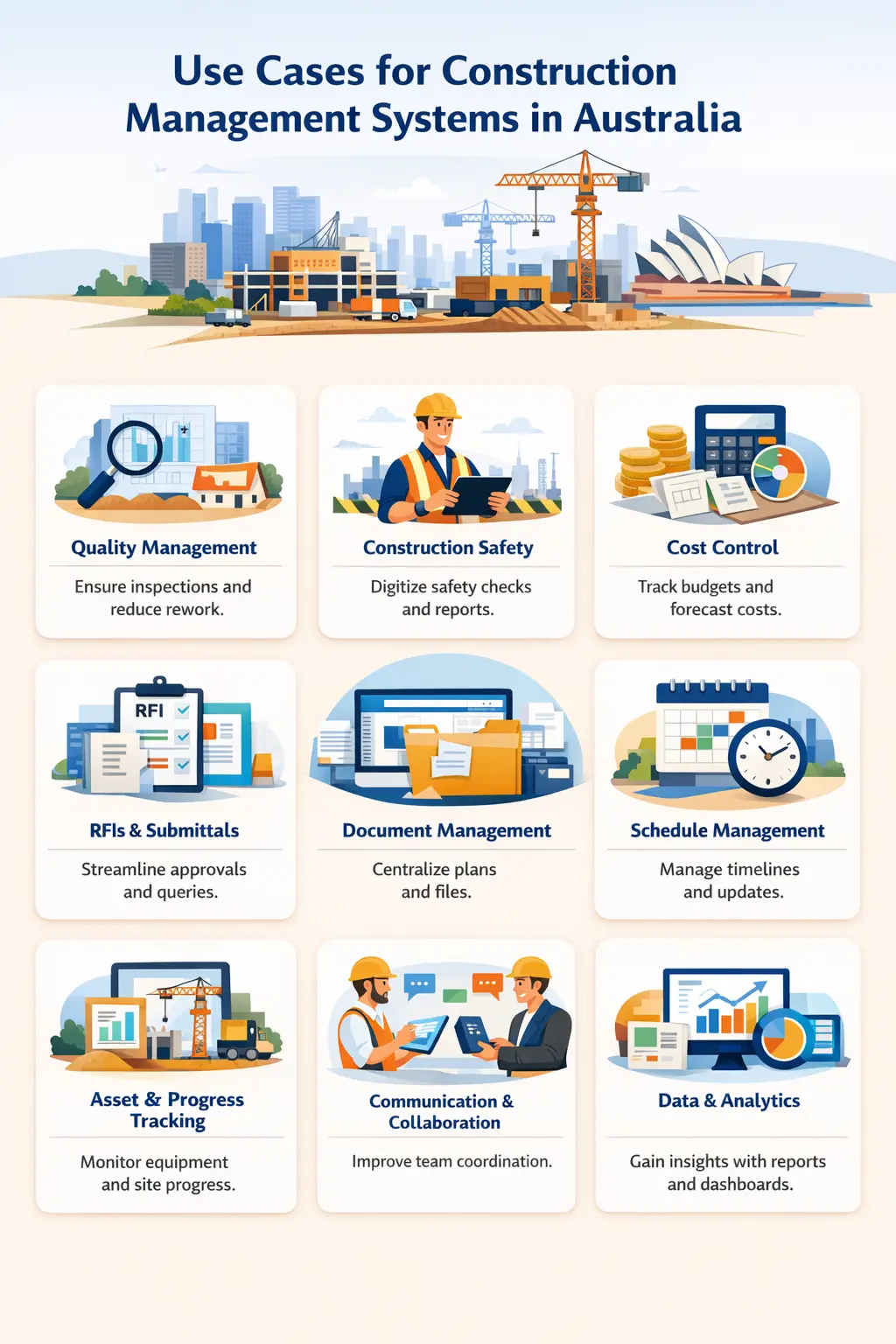
A construction management system provides project teams with a more structured way to manage daily operations, technical coordination, and commercial control on a single platform. Instead of relying on disconnected tools, Australian builders can use a single connected system to reduce delays, improve accountability, and keep every stage of the project moving with greater clarity.
- Quality management: A construction management system helps teams detect constructability issues earlier, standardise inspections, reduce rework, and streamline commissioning and handover with clearer document control and faster issue resolution.
- Construction safety: A construction site management system helps contractors build stronger safety processes by digitising checklists, incident reports, and field reports, enabling teams to identify hazards faster and respond before they escalate.
- Cost control: A construction project management system improves cost control by centralising financial data, increasing visibility over cost-related risks, and helping managers forecast earlier before budget pressure turns into margin loss.
- RFIs and submittals: The software streamlines RFI and submittal workflows by clearly assigning responsibilities, tracking approvals in real time, and linking technical queries to broader project changes.
- Construction document management: A connected construction system stores drawings, reports, specifications, and approvals in a single central location, so teams can access the right documents quickly and avoid mistakes caused by outdated files.
- Schedule management: The platform provides project teams with real-time visibility into schedules, version changes, and workflow updates, helping them manage delays earlier and keep stakeholders aligned with the latest timeline.
- Asset and progress tracking: Asset and progress tracking help multi-site contractors monitor installation status, commissioning progress, and field productivity more accurately, so both office and site teams can act on live project conditions.
- Communication and collaboration: A modern construction management system improves collaboration by consolidating meetings, updates, decisions, and follow-up actions on a single shared platform, reducing miscommunication and strengthening accountability.
- Data and analytics: Data and analytics tools transform project activity into dashboards, reports, and predictive insights, helping teams identify risks earlier, automate reporting, and make faster, more confident decisions.
As project demands grow, many contractors need more than separate tools for scheduling, reporting, and cost tracking. To explore the options that can support stronger delivery, clearer site-to-office coordination, and more reliable project control, see our recommended construction software for Australian businesses.
How to Choose the Right Construction Management System in Australia
Choosing the right system takes more than comparing features on a vendor page. You need to assess how your team works today, where the real gaps are, and which solution can best support your projects in the long run.
- Audit your current tools and processes: Review how your team currently handles scheduling, reporting, document control, site updates, and approvals to identify where delays, duplicate work, or miscommunication still occur.
- Define your project and business requirements: List the features your business truly needs based on project type, team structure, reporting needs, and future growth so you choose a system that fits operations instead of forcing new inefficiencies.
- Evaluate cloud-based vs on-premise options: Compare both options based on accessibility, scalability, maintenance, and ease of collaboration, then choose the model that best supports your office and site teams across Australian projects.
- Involve your team in the selection process: Ask for input from project managers, site supervisors, finance teams, and other key users so the system feels practical in daily work and gains stronger adoption after implementation.
Conclusion
Australia’s construction industry leaves little room for slow decisions, disconnected reporting, or avoidable mistakes. A construction management system helps builders, contractors, and project teams consolidate schedules, costs, documents, and site coordination into a single, clearer workflow.
When the right people can access the right information at the right time, projects become easier to control from pre-construction through handover. That means stronger cost discipline, better collaboration between office and site teams, and a more consistent way to manage risk, quality, and delivery performance.
If your current tools still create delays, duplicate work, or poor visibility across projects, it may be time to review a better approach. You can also consult our expert to discuss your operational challenges and find the right construction management system for your business in Australia.
FAQ About Construction Management Systems
-
Does the system support Peppol eInvoicing for federal government construction projects?
Yes, modern construction management systems in Australia support Peppol eInvoicing, which is required when invoicing Commonwealth government agencies. This lets contractors send structured electronic invoices directly through the Peppol network, reducing manual handling, speeding up payments, and meeting federal procurement compliance on large public construction projects.
-
What is a quality management system in construction?
A quality management system in construction helps teams make sure the finished work meets specifications, standards, and contract requirements. It usually supports inspections, defect tracking, punch lists, checklists, photo documentation, and follow-up actions to reduce rework and improve handover quality.
-
Can the system handle BIM file sizes and offline mobile access for remote Australian sites?
Most leading construction management platforms support large BIM file uploads, model viewing, and version control, so site teams can open drawings without performance issues. Many also offer offline mobile access, which lets field workers in remote Australian locations capture data, complete checklists, and sync the records once they reconnect to the network.
-
How much does a construction management system cost in Australia?
The cost in Australia varies based on the number of users, project complexity, deployment model, and the modules included. Smaller tools often use monthly per-user subscriptions, while larger construction platforms usually provide custom quotes for commercial or enterprise needs, especially when the business needs broader project, cost, and document control capabilities.
-
How are construction management systems classified?
Construction management systems are usually classified by their main function, such as project management, site management, safety management, quality management, or document management. They can also be classified by deployment model, such as cloud-based or on-premise, depending on how the software is accessed and maintained.