




Leave management is the structured process of tracking, approving, and administering employee time off, including annual leave, sick leave, and parental leave. For Australian businesses, it ensures legal compliance with the National Employment Standards (NES) under the Fair Work Act 2009, while maintaining workforce productivity and payroll accuracy.
Managing employee time off goes beyond attendance, requiring clear rules, accurate tracking, and coordination between HR and payroll within employee management software to ensure consistency.
For Australian companies, leave management directly affects legal compliance, operational continuity, and employee trust. Fair Work requirements and Modern Awards add complexity, therefore errors can quickly become costly.
As businesses scale, manual tools like spreadsheets increase risk. Structured and automated processes help companies reduce mistakes, maintain compliance, and support employees without slowing operations.
Key Takeaways
Leave management affects legal compliance, payroll accuracy, and employee trust. Errors can lead to penalties, disputes, and operational disruption.
Accurate accrual tracking, approval workflows, and payroll alignment reduce errors and ensure leave is handled consistently across the company.
Different leave categories have specific rules under employment law. Correct classification and tracking are essential for compliance and payroll accuracy.
Analysing leave patterns supports workforce planning, reduces burnout risks, and helps leaders make informed staffing decisions.

Understanding Leave Management
Leave management refers to how a company uses a system for leave management to control, approve, and record employee time off. It includes leave requests, approval workflows, balance tracking, and payroll alignment within a single process.
A well-managed approach ensures the business remains adequately staffed while employees receive their lawful entitlements. As a result, productivity improves without compromising fairness or employee wellbeing.
Beyond administration, leave management shapes workplace culture. Clear and consistent handling builds trust, while poor visibility often leads to frustration, disputes, and disengagement.
When managed effectively, leave data supports better planning. Companies can identify absence trends, reduce burnout risks, and make informed workforce decisions.
Why Leave Management Matters for Australian Companies
"Clear leave processes reduce disputes, protect compliance, and give both managers and employees confidence in how time off is handled."
Leave management affects legal compliance, payroll accuracy, and employee wellbeing. Mistakes often lead to penalties, disputes, and loss of trust. Strong systems protect the company while supporting sustainable workforce planning.
Fair work act compliance
Australian employment law sets strict minimum leave entitlements. Companies must calculate, grant, and record leave correctly under the Fair Work Act and NES.
Errors expose the business to penalties and reputational damage. Therefore, accurate records and updated rules are non-negotiable.
Payroll accuracy and financial control
Leave directly affects payroll calculations, including leave loading and final payouts. Poor data flow often results in overpayments or underpayments.
Accurate tracking also limits growing leave liabilities. Encouraging regular leave helps control long-term costs.
Employee wellbeing and retention
Simple leave processes encourage employees to rest when needed. Clear visibility of balances removes hesitation and confusion.
Supportive handling during illness or personal matters builds loyalty. As a result, retention and engagement improve.
Workforce planning and productivity
Unplanned absences disrupt workloads and deadlines. Visibility into upcoming leave allows managers to plan ahead using a system for roster management, reducing disruptions and workload gaps.
Patterns in leave data also highlight deeper issues. Leaders can then respond before problems escalate.
Core Elements of an Effective Leave Management System
A structured framework reduces errors and improves consistency. Whether manual or digital, several elements must work together.
Leave request and approval workflows
Employees need a simple way to submit leave requests. Managers then receive notifications and approve requests promptly.
Delegation rules prevent delays when approvers are unavailable. This keeps communication clear and timely.
Accurate accrual and balance tracking
Leave balances must update automatically based on hours worked. This is especially important for part-time and changing work arrangements.
Employees should access balances anytime. Transparency reduces disputes and admin workload.
Flexible leave policy settings
Different teams often follow different rules. The system must reflect internal policies, awards, and agreements accurately.
Controls also prevent breaches, such as invalid cash-out requests. Compliance stays intact without manual checks.
Payroll and timesheet alignment
Approved leave should flow directly into payroll. This removes duplicate entry and reduces human error.
Correct categorisation also supports accurate reporting and statutory obligations.
Real-time tracking and employee self-service
Employees should be able to check their leave balances, requests, and approval status without contacting HR. A leave management system provides real-time access from any device.
Managers also benefit from a centralised leave calendar, making it easier to see staff availability, avoid scheduling conflicts, and plan team coverage.






Types of Leave Under Australian Law
Understanding each leave type ensures accurate payroll and compliance. NES sets the baseline, while awards may add conditions.
Annual leave
Annual leave accrues progressively for full-time and part-time employees based on ordinary hours. Shift workers may receive higher entitlements under specific awards.
Leave loading often applies, increasing payroll complexity. Excess balances also require active management to control financial exposure.
Personal and career’s leave
This leave covers illness, injury, and caring responsibilities for immediate family members. It accumulates over time but is not usually paid out on termination.
Employers may request reasonable evidence to support absences. Accurate calculations are critical due to ongoing legal scrutiny.
Parental leave
Eligible employees can access unpaid parental leave with flexible usage options. Tracking shared and staggered leave requires careful coordination.
Government-funded payments often pass through payroll systems. Timely processing ensures employees receive correct entitlements.
Long service leave
Long service leave rules vary by state and territory, affecting accrual and access thresholds. Location-based rules must be applied correctly.
Portable schemes in some industries add complexity. Systems must support differing legislative requirements without manual workarounds.
Building a Leave Management Process

A reliable leave management process combines clear policies, practical systems, and consistent communication. Technology supports the process, but it cannot replace clarity or accountability.
Well-defined rules help employees understand their entitlements and responsibilities. Consistency in application then reduces disputes, errors, and approval delays.
Alignment across HR, payroll, and line managers is essential for accurate personnel management and consistent decision-making. When teams follow the same framework, data stays reliable and decisions remain fair.
Regular reviews strengthen the process over time. As the business evolves, leave rules and workflows should adapt without disrupting daily operations.
Industry Use Cases for Leave Management
Different sectors apply leave rules in different ways. Systems must reflect operational realities.
Healthcare and medical services
Staffing levels directly affect patient safety and regulatory compliance. Leave systems must integrate with a shift planning system to ensure minimum staffing levels remain intact at all times.
Automated checks help managers arrange cover before approvals. This prevents last-minute shortages and protects service quality.
Retail and hospitality
Seasonal demand and casual employment make leave tracking more complex. Peak trading periods often require tighter approval rules and clearer visibility of availability.
Accurate accrual calculations protect payroll accuracy and award compliance. This reduces disputes during high-volume periods.
Construction and manufacturing
Unplanned absences can halt production or delay projects. Leave systems must account for RDOs, shutdown periods, and site-based scheduling needs.
Forecasting leave across teams allows managers to adjust timelines early. This helps avoid costly downtime.
Professional Services and Consulting
Client deadlines and billable work depend on staff availability. Leave visibility helps teams plan workloads without overcommitting resources.
Clear scheduling reduces pressure during peak delivery periods. Productivity remains stable even when employees take extended leave.
Rolling Out a New Leave System
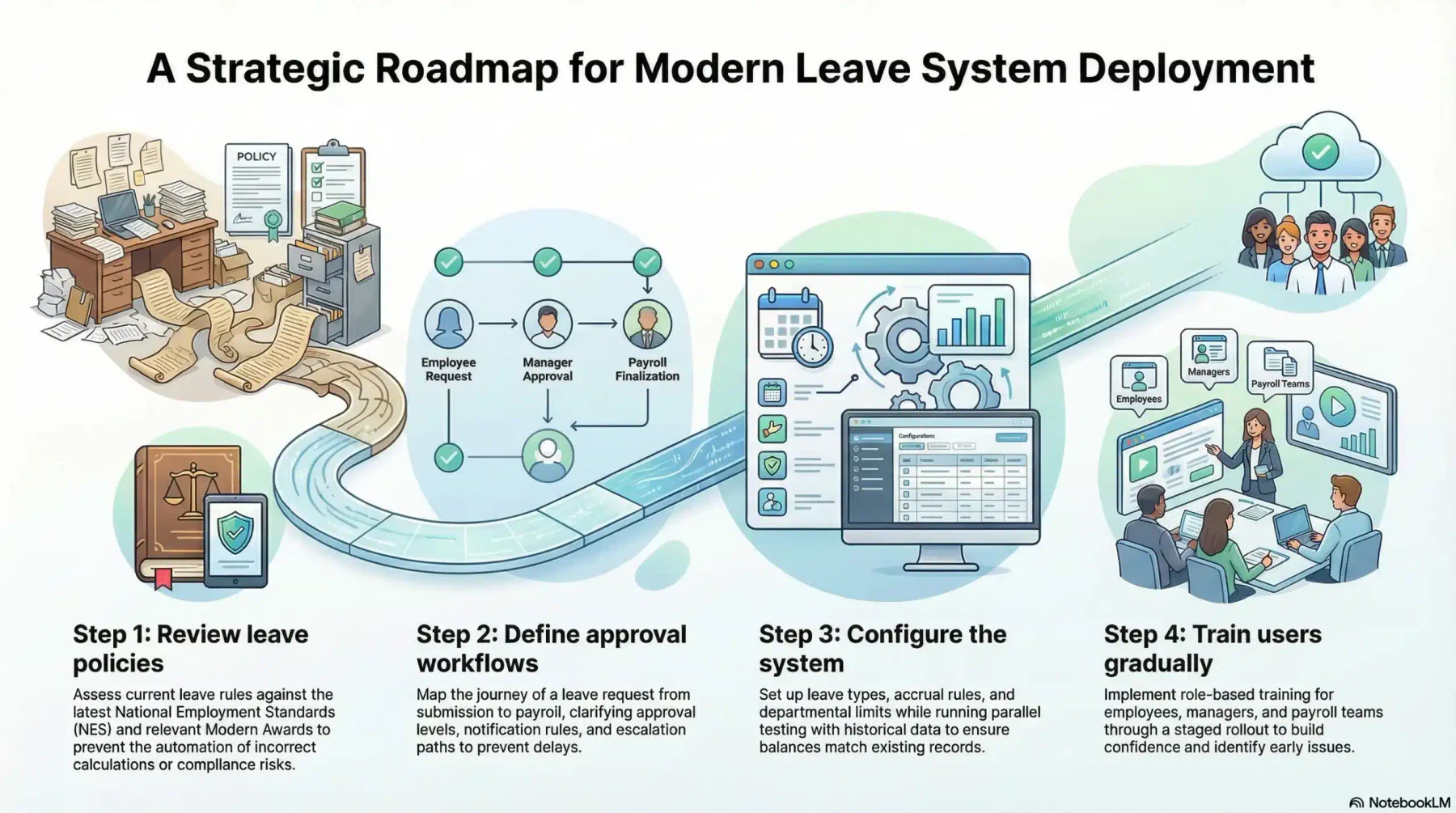
Transitioning from manual processes to a leave automation platform requires careful planning to ensure smooth adoption and minimal disruption. A structured rollout ensures high adoption rates and minimises disruption to daily operations.
Step 1, Review leave policies:
Assess current leave rules against the latest NES and relevant Modern Awards. This ensures the system does not automate incorrect calculations or embed compliance risks into daily operations.
Step 2, Define approval workflows:
Map how leave requests move from submission to payroll processing. Clarify approval levels, notification rules, and escalation paths to avoid delays and confusion.
Step 3, Configure the system:
Set up leave types, accrual rules, blackout periods, and departmental limits. Run parallel testing with historical data to confirm balances and liabilities match existing records.
Step 4, Train users gradually:
Provide role-based training for employees, managers, and payroll teams. A staged rollout helps identify issues early and improves confidence before full deployment.
Common Challenges in Leave Administration
Leave errors often come from outdated processes that cannot keep up with business growth. As headcount increases, small gaps in tracking or approvals quickly turn into recurring payroll and compliance issues.
Manual tracking raises operational risk and increases admin workload across HR and payroll teams. A single spreadsheet error can affect accrual balances, leave payouts, and reporting accuracy, therefore costs escalate fast.
Employment legislation changes regularly, requiring systems and policies to stay current. When updates are ignored or delayed, businesses expose themselves to compliance gaps and unnecessary regulatory risk.
Poor communication around leave rules frustrates employees and managers alike. Without clear policies and visible balances, confusion grows and trust in the process declines.
For growing Australian businesses, these challenges compound as headcount increases. An integrated HR platform connects leave tracking, payroll, and roster management in one system. This is particularly relevant for mid-sized businesses where HR teams are small but compliance obligations are identical to larger organisations.
Advanced Practices in Leave Management
Leave management continues to evolve beyond compliance. Many companies now use it strategically.
Data-led absence planning
Analysing leave patterns helps predict shortages. Managers can then plan rosters more effectively. This reduces disruption during high-risk periods.
Unlimited and flexible leave policies
Some companies offer flexible or unlimited leave. These policies still require oversight to prevent burnout. Minimum legal entitlements must always remain protected.
Integration with holistic wellbeing programs
Systems can flag when employees delay taking leave. This prompts early wellbeing conversations. Encouraging rest supports long-term performance and retention.
Conclusion
Effective leave management protects compliance while supporting daily operations and employee wellbeing. When leave is tracked accurately and handled consistently, companies reduce risk, control costs, and maintain workforce stability.
As leave rules evolve, relying on manual processes increases risk. A structured approach helps businesses stay compliant, plan better, and support employees. You can get free consultation to improve your leave management process.
Frequently Asked Question
A leave management system records, approves, and tracks employee time off while aligning leave data with payroll and staffing needs.
Companies track employee leave through structured processes that record requests, approvals, accruals, and balances in a central system.
Incorrect leave management can lead to payroll errors, compliance breaches, employee disputes, and financial penalties.
Yes. Employment laws require companies to calculate, record, and manage leave entitlements accurately to meet statutory obligations.
Yes. Analysing leave data helps managers anticipate absences, plan workloads, and reduce disruption caused by unplanned leave.