

Businesses face rising operational costs, fragmented data, and inefficient workflows as they grow. Disconnected systems create silos that slow decision-making and increase errors across finance, inventory, HR, and supply chains.
ERP systems solve this by bringing core business processes into one platform. Teams can access the same data and work more efficiently. This guide explains the key benefits of ERP and why many companies rely on it to scale.
Key Takeaways
ERP centralizes operations across finance, HR, inventory, and supply chains, allowing teams to work efficiently from a single database.
Automation reduces repetitive tasks, improves productivity, and lets employees focus on strategic activities
ERP benefits a wide range of industries, including manufacturing, retail, healthcare, professional services, and finance, by streamlining processes and improving efficiency
Advanced technologies such as AI, IoT, and Hyperautomation enhance forecasting, predictive maintenance, and overall decision-making.
What Is ERP?
ERP stands for Enterprise Resource Planning. It is software that helps a business manage and automate core operations in one system. Teams can handle finance, sales, inventory, HR, and supply chain using a shared database.
ERP systems originally evolved from MRP software used by manufacturers to plan materials for production. As business needs grew, these systems expanded to support more functions. Modern ERP platforms use modular designs so companies can choose the features they need.
A key feature of ERP is its centralized database. Instead of separate tools for accounting, inventory, and sales, every team works from the same data. When a sales order is entered, inventory, production, and finance update automatically.
Key Benefits of ERP

Implementing the right business management tools requires time and investment, but the long-term benefits are significant. It improves efficiency, centralises data, and helps teams make better decisions. Below are the key benefits businesses can gain from ERP.
1. Improved data visibility and real-time reporting
ERP provides a central source of data across business functions. Without it, teams often spend time consolidating information from different systems, which can delay reporting and reduce accuracy.
With centralised data, businesses can access key metrics such as revenue, inventory, and operations more efficiently. This improves visibility across departments and supports more consistent decision-making.
2. Increased operational efficiency and productivity
ERP reduces manual tasks such as data entry, invoice matching, and inventory updates. Automation helps minimise errors and improves consistency across routine processes.
By reducing administrative workload, employees can focus more on core responsibilities such as planning, analysis, and customer-related activities. This supports more efficient day to day operations.
3. Better financial management and cost savings
ERP centralises financial data, making it easier to track payables, receivables, and cash flow. This improves reporting accuracy and reduces the risk of inconsistencies.
It also helps businesses monitor spending and identify inefficiencies. With clearer financial visibility, managers can make more informed decisions and maintain better cost control.
4. Enhanced customer service
ERP systems provide access to customer, order, and inventory data in one place. This helps teams respond more quickly and reduce errors in order handling.
With better visibility, businesses can manage expectations more effectively and support more consistent service delivery across channels.
5. Stronger data security and compliance
ERP systems store data in a centralised environment with controlled access. Role-based permissions help limit exposure and reduce the risk of unauthorised use.
They also support compliance by maintaining consistent records and audit trails. This makes it easier to track changes and meet reporting requirements.
6. Scalability and business flexibility
As businesses grow, managing operations across multiple systems can become more complex. ERP helps support expansion by handling increased data, users, and processes within one platform.
Its modular structure allows businesses to add new functions as needed. This supports gradual growth without requiring major system changes.
7. Accurate forecasting and smarter decisions
ERP provides access to historical and real-time data, which supports more structured forecasting. Businesses can analyse trends and plan resources with greater consistency.
This reduces reliance on assumptions and helps improve planning across inventory, operations, and finance.
8. Streamlined supply chain management
ERP improves visibility across supply chain activities, including inventory, orders, and supplier data. This helps reduce delays and improve coordination.
With better tracking and data consistency, businesses can manage stock levels more effectively and support more reliable fulfilment processes.
Types of ERP Systems
As the demand for ERP software for business supervision has grown, vendors now offer various deployment models to fit businesses’ needs, budgets, and IT resources. Choosing the right model affects cost, implementation speed, and system flexibility. The three main options are Cloud, On-Premises, and Hybrid.
- Cloud ERP
Cloud ERP is hosted on remote servers and accessed through a browser. It reduces upfront costs and allows businesses to scale without managing infrastructure.
- On-premises ERP
On-premises ERP is installed on internal servers and managed by the company. It provides full control but requires higher upfront investment and IT resources.
- Hybrid ERP
Hybrid ERP combines cloud and on-premises systems. It allows businesses to modernise gradually while keeping existing infrastructure.
Which Industries Benefit Most from ERP?
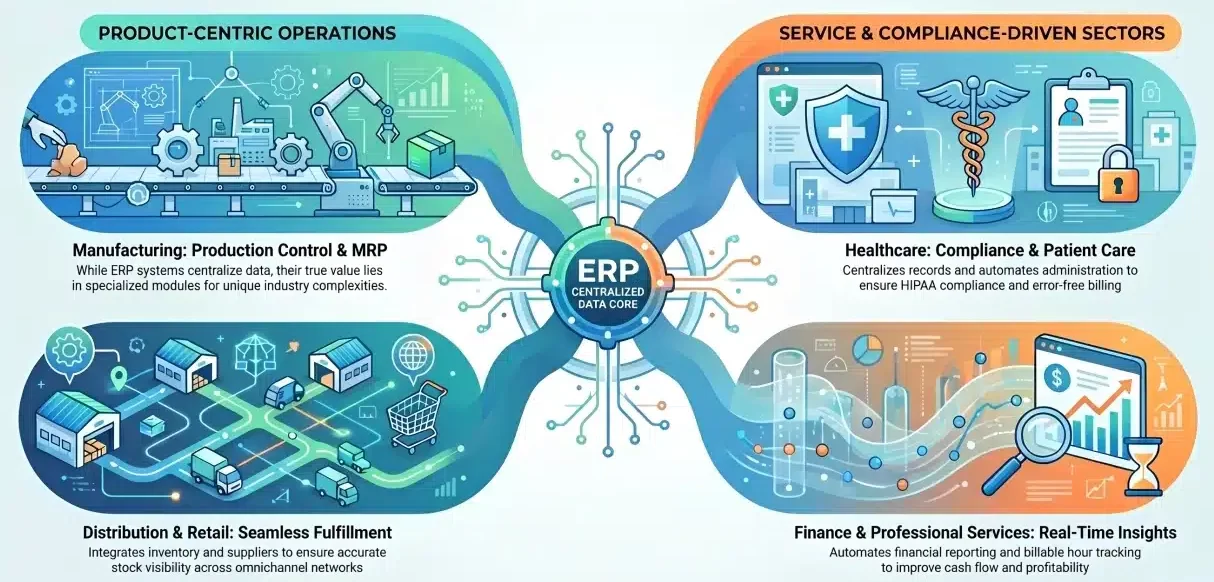
ERP provides core benefits such as data centralisation and process automation, but its application varies by industry. Each sector operates with different workflows, regulatory requirements, and operational priorities, so ERP systems are often configured to match these specific needs.
1. Manufacturing
Manufacturing involves multiple interconnected processes, including material planning, production scheduling, labour management, and quality control. Without integrating the system within ERP ecosystem, these processes can become fragmented and harder to manage.
ERP helps centralise production data and improve coordination across operations. Modules such as bill of materials (BOM) and material requirements planning (MRP) support timely procurement, track work-in-progress, and provide better visibility into production costs.
2. Distribution and retail
Distribution and retail businesses depend on efficient inventory movement and accurate order processing. As customer expectations for speed and availability increase, managing stock and fulfilment becomes more complex.
ERP systems help maintain real-time inventory visibility, support order processing, and connect suppliers with distribution channels. This improves stock accuracy, reduces fulfilment errors, and supports more consistent service delivery.
3. Healthcare
Healthcare organisations operate under strict regulatory requirements while managing patient data, billing, and resource allocation. Administrative complexity can affect both efficiency and compliance.
ERP helps centralise information, manage medical supplies, and automate routine administrative tasks. This supports better data accuracy and allows healthcare providers to manage operations more effectively.
4. Professional services
Professional service firms need to manage projects, resources, and billing across multiple clients. Without a central system, tracking utilisation, costs, and performance can be inconsistent.
ERP helps organise project data, track billable hours, and support invoicing. This improves visibility into project performance and helps teams manage resources more effectively.
5. Finance and banking
Financial institutions handle high transaction volumes, regulatory requirements, and reporting obligations. Manual processes can increase the risk of errors and delays.
ERP helps centralise financial data, automate reporting, and support compliance requirements. This improves visibility into financial performance and supports more consistent decision-making.
Australian Case Study on The Use of ERP
Noumi Limited is an Australian FMCG company producing dairy and plant-based beverages, nutritional products, and functional ingredients. As operational complexity increased, the company invested in ERP to unify systems and improve efficiency across its business units.
In its 2025 Annual Report, Noumi reported ERP implementation costs of A$6.1 million, part of total litigation and transformation expenses of A$14.4 million. This supports a business generating A$595.8 million in net revenue, where integrated systems are critical for control and scalability.
With ERP, Noumi aims to improve data accuracy, streamline processes, and support faster decision-making. This case highlights how ERP benefits, such as integration, real-time visibility, and efficiency, can deliver clear value and enable sustainable growth.
Crucial Steps for a Successful ERP Implementation
Implementing an ERP system is a major business project that requires a clear, structured approach. Companies should follow these key steps:
- Needs assessment: Audit workflows, identify gaps, and define clear business objectives before selecting a system.
- Vendor selection: Evaluate solutions based on scalability, industry fit, and long-term business needs.
- Data cleansing and migration: Clean and transfer legacy data to ensure accuracy in the new system.
- Training and phased go-live: Train users and implement the system gradually to reduce disruption.
Common Pitfalls to Avoid
ERP projects often fail due to execution issues rather than system capability. Poor planning, lack of alignment, and over-complex configurations can reduce the expected benefits.
- Poor change management leading to low user adoption and resistance
- Over-customisation that increases maintenance complexity and limits scalability
- Lack of executive support, causing delays and unclear decision making
- Inadequate training that results in errors and inefficient system use
Advanced ERP Practices for the Future
As ERP systems evolve, businesses are adopting new technologies to improve automation and decision-making.
1. AI and machine learning integration
ERP systems use AI for predictive analytics, demand forecasting, and automated financial checks.
2. IoT-enabled operations
IoT integration supports real-time monitoring and predictive maintenance across assets and equipment.
3. Hyperautomation
Automation tools reduce manual input and streamline workflows, improving accuracy and efficiency.
4. Data-driven decision models
Advanced ERP platforms help businesses analyse trends and simulate scenarios for better planning.
"Implementing an ERP system transformed our workflows, gave us real-time insights, and empowered our team to focus on strategic growth."
Conclusion
ERP systems help businesses centralize operations, automate processes, and make smarter decisions. By improving efficiency, data visibility, and customer service, companies can scale smoothly and reduce costs.
Adopting best practices and advanced technologies like AI and IoT ensures long-term growth and agility. To explore how ERP can transform your business, get a free consultation today.
Frequently Asked Question
Yes, ERP is effective when implemented correctly. It improves efficiency, reduces manual errors, and provides a centralised system for managing business operations.
ERP centralises data from all departments into one system. Teams can access real-time metrics on sales, inventory, and operations, enabling accurate reporting and faster decision-making.
The four pillars of ERP are finance, supply chain, human resources, and customer management. These areas ensure business processes are integrated and aligned.
The biggest benefit of ERP is improved operational visibility. Businesses can track performance in real time, reduce inefficiencies, and make more consistent decisions.
Success depends on clear planning, proper vendor selection, data preparation, user training, and phased rollout. Leadership support and avoiding over-customisation are also critical.