




In today’s retail environment, speed and convenience are expected. Customers want checkout experiences that are quick and seamless, pushing businesses to adopt faster payment methods. Contactless payment has become one of the most widely used solutions.
Transactions can be completed within seconds with a simple tap of a card or transaction using a mobile phone, reducing physical contact during checkout. This helps shorten queues and improve customer experience, especially in busy retail environments.
As digital payments continue to grow, contactless technology is becoming standard across modern businesses. Understanding how it works helps companies improve efficiency and adapt to changing payment behaviour
Key Takeaways
Contactless payments allow businesses to process transactions faster while improving accuracy and customer convenience.
Contactless payments use NFC, tokenisation, and encryption to complete secure transactions within seconds.
Businesses benefit from faster checkout, better customer experience, and improved operational efficiency.
Implementing the right POS system and payment setup ensures smooth and scalable contactless transactions.
What Is Contactless Payment
Contactless payment allows customers to pay by tapping or hovering a card, smartphone, or wearable device near a payment terminal. It removes the need for physical contact, making transactions faster and more convenient.
The system uses short-range wireless communication to process payments securely. This helps businesses speed up checkout while maintaining strong payment security.
Definition and Core Concept
Contactless payment is a type of electronic transaction that allows customers to pay without inserting a card or entering a PIN for smaller purchases. The payment is completed by placing a compatible device near the terminal.
The system works through close-range communication between the payment device and terminal. Because the range is very short, transactions remain secure and intentional.
The Technology Behind Contactless Payments
Contactless payments use technologies such as Near Field Communication (NFC) and RFID to exchange payment data securely between devices. When a card or smartphone is placed near the terminal, the system activates and begins processing the transaction.
Instead of sending actual card details, the system uses encryption and tokenisation to protect sensitive information. Each payment generates a unique code, reducing the risk of fraud or data misuse.
Payment terminals are often connected to a point-of-sale system for business, allowing payment data to sync automatically with sales and reporting systems in real time.
Why Contactless Payments Are Growing in Australia
The rapid growth of contactless payments in Australia is driven by strong payment infrastructure, changing customer habits, and widespread daily usage. These factors have made tap-and-go transactions part of everyday life.
- Early infrastructure adoption: Australian banks and retailers adopted contactless terminals early, making the technology widely available across stores and service businesses.
- COVID-driven behaviour shift: Health concerns accelerated demand for touch-free payments, increasing the use of contactless transactions for everyday purchases.
- Public transport integration: Contactless payments are commonly used across public transport systems, helping consumers become more familiar with digital payment methods.
Today, contactless payments are used across almost every industry, while many businesses continue searching for better POS solutions for Australian retail operations.
Types of Contactless Payments
Contactless payment includes several methods that allow customers to complete transactions without physical contact. While the technology is similar, each method offers different levels of convenience depending on the device used.
- Contactless cards: Debit and credit cards with built-in NFC chips allow users to tap and pay instantly. These are the most commonly used contactless payment method.
- Digital wallets: Platforms such as Apple Pay and Google Pay store payment details securely on smartphones. Transactions are completed using tokenisation and biometric authentication.
- QR code payments: Customers scan QR codes using their phones to complete transactions. This method is widely used in apps and alternative payment platforms.
- Wearables: Smartwatches and wearable devices support tap payments without requiring customers to carry physical wallets or phones.
How Contactless Payment Works
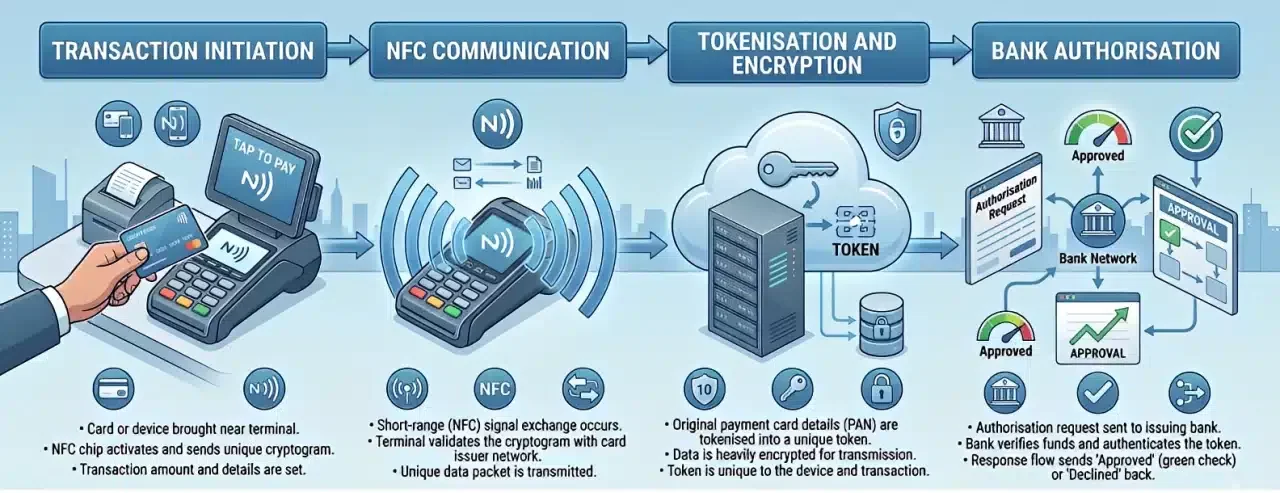
Contactless payments follow a structured process that allows transactions to be completed quickly and securely. Although the payment only takes a few seconds, several systems work together behind the scenes.
Initiating the transaction: After the purchase amount is confirmed, the POS system sends the payment request to the terminal. The terminal then prepares to receive contactless input.
- NFC communication: When the customer taps their card or device, Near Field Communication (NFC) activates. The terminal and payment device exchange data within a very short range.
- Tokenisation and encryption: Sensitive payment details are replaced with secure encrypted tokens. Each transaction generates a unique code that cannot be reused.
- Bank authorisation process: The payment request moves through the banking network to the issuing bank. The bank verifies the transaction and approves or declines it within seconds.
Key Benefits of Contactless Payments for Businesses
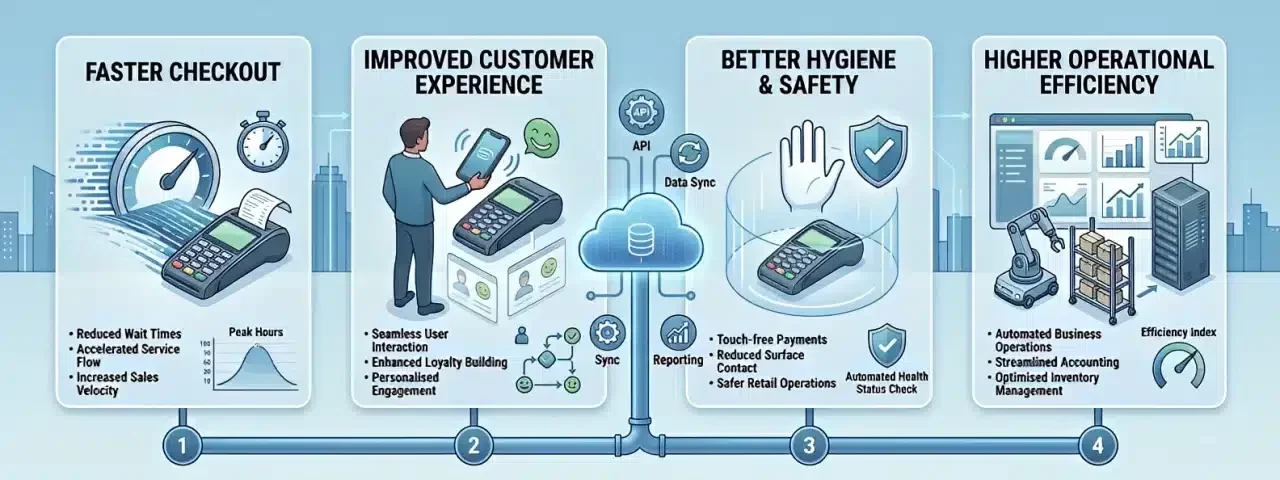
Contactless payments provide practical benefits for businesses by reducing transaction time and simplifying payment processes. Faster transactions help businesses serve customers more efficiently during daily operations.
Faster Checkout
Contactless payments speed up transactions by reducing cash handling and minimising PIN entry for smaller purchases. This allows businesses to process more customers during busy periods.
Faster checkout also helps reduce queues and improves overall service flow, especially in high-traffic retail environments.
Better Customer Experience
Customers increasingly expect fast and convenient payment options. Contactless technology allows transactions to be completed quickly with minimal effort.
This smoother checkout experience can improve customer satisfaction and encourage repeat purchases in retail and service businesses.
Improved Hygiene and Safety
Contactless payments reduce physical interaction with cash and shared terminals. This creates a cleaner payment experience for both staff and customers.
Lower cash handling also helps reduce manual errors, reconciliation issues, and certain security risks.
Higher Operational Efficiency
Automated payment processing reduces administrative work and manual transaction recording. Sales data is captured instantly and synced with connected business systems.
This improves reporting accuracy and allows businesses to focus more on operations and customer service.
"Contactless payments do more than speed up transactions. They connect payment processes with business data, helping companies operate more efficiently and deliver better customer experiences."
Industry Use Cases of Contactless Payments
Contactless payments are widely used across different industries, with each sector adapting the technology to suit operational needs and customer expectations.
Retail and Supermarkets
Retailers and supermarkets use contactless payments to manage high transaction volumes more efficiently. Faster checkout speeds help reduce queues and improve customer flow during busy hours.
The technology also supports self-checkout and mobile POS systems, allowing payments to happen anywhere in the store. Using software for retails supervisors also helps businesses manage operations more efficiently.
Hospitality and Food Service
Restaurants and cafes use contactless payments to improve service speed and increase table turnover. Customers can pay quickly at the counter or directly at the table using portable devices.
This helps reduce waiting time and creates a smoother dining experience during busy operating hours.
Public Transport and Events
Contactless payments are widely used across transport systems and event venues. Customers can tap their card or device without needing physical tickets.
This helps reduce congestion, speed up entry processes, and improve operational efficiency in crowded environments.
Professional Services and Trades
Technicians, contractors, and mobile professionals often use contactless payments to accept payments on-site after completing services.
This improves cash flow, shortens payment collection time, and reduces manual invoicing work.
How to Accept Contactless Payments in Your Business
Implementing contactless payments requires the right technology, payment infrastructure, and staff preparation. A structured setup helps businesses process transactions smoothly from the start.
- Choose a contactless-enabled POS system: Select a POS system that supports modern payment methods and integrates with your operations. Connected systems help reduce manual errors and improve checkout speed.
- Enable NFC payment terminals: Use payment terminals that support Near Field Communication (NFC). These devices allow customers to pay using cards, smartphones, and wearables.
- Integrate with payment gateways: Connect the system with a reliable payment gateway that supports major card providers and digital wallets for secure transaction processing.
- Train staff and monitor transactions: Ensure staff understand how to process contactless payments and manage common payment issues. Reviewing transaction data also helps businesses improve operational performance.
Contactless Payment Costs and Fees
Accepting contactless payments involves processing fees that businesses should understand before implementation. The most common charge is the merchant service fee, which payment providers apply to each transaction.
These fees usually include interchange costs, network charges, and provider margins. Total costs may vary depending on card type, payment method, and provider agreements.
Although digital payments introduce transaction fees, they also reduce cash handling, manual reconciliation work, and payment errors. Understanding the pricing structure helps businesses manage costs more effectively.
Common Pitfalls in Contactless Payment Implementation
Even with modern payment technology, poor implementation can still create operational issues. Understanding common pitfalls helps businesses maintain smoother and more secure payment operations.
Hidden Processing Fees
Many businesses underestimate the total cost of contactless payments. Fees can vary based on card types, transaction methods, and provider pricing structures.
Without reviewing these costs carefully, businesses may face unexpected expenses that reduce profit margins over time.
Lack of POS Integration
Standalone payment terminals without proper POS integration often create inefficiencies. Staff may need to enter payment amounts manually, increasing the risk of mistakes.
Integrated systems automatically sync payment data with sales and accounting records, improving operational accuracy and reducing manual work.
Security and Compliance Gaps
Although contactless payments are generally secure, weak system management can still expose businesses to risk. Outdated software for transaction or poor network security can expose sensitive payment data.
Businesses should follow security standards, apply updates regularly, and maintain strong compliance practices to protect customer information.
Future Trends in Contactless Payments
Contactless payment technology continues to evolve as businesses look for faster, more flexible, and more secure ways to process transactions. These developments are shaping the future of digital payments across industries.
SoftPOS and Tap-to-Pay
SoftPOS allows businesses to accept payments directly through smartphones or tablets without separate payment hardware. This reduces setup costs and makes contactless payments easier to adopt.
The technology also gives businesses more flexibility by allowing payments to be accepted almost anywhere.
Integrated Loyalty Systems
Modern payment systems are increasingly connected with loyalty programs. Customers can automatically collect points or rewards when completing purchases.
This creates a smoother experience by combining payments and customer engagement within the same process.
Biometric Authentication
Biometric technology such as fingerprint scanning and facial recognition is becoming more common in payment verification. These methods improve security by confirming user identity instantly.
They also make payments more convenient by reducing the need for passwords or PINs.
Unattended Retail
Contactless payments are supporting fully automated retail environments. Customers can enter stores, select products, and complete purchases without direct staff interaction.
This model helps businesses improve service speed, reduce labour costs, and create more efficient shopping experiences.
Conclusion
Contactless payment is now a standard part of modern retail, helping businesses process transactions faster and more securely. By reducing cash handling and manual processes, companies can improve efficiency while creating a smoother customer experience.
As adoption continues to grow, contactless technology also improves visibility across sales, inventory, and payment data. This helps businesses respond faster to demand and maintain better control over day-to-day operations.
Businesses looking to modernise payment operations should evaluate solutions based on speed, integration capability, and operational fit. Get free consultation to explore contactless payment systems that support more scalable business operations.
FAQ About Contactless Payment
Yes, contactless payments use encryption and tokenisation to protect sensitive data. Each transaction generates a unique code, making it difficult for information to be reused or intercepted.
Contactless payments can be made using debit or credit cards, smartphones, smartwatches, and other NFC-enabled devices that support tap-and-go functionality.
Yes, payment terminals typically require an internet connection to process transactions and communicate with banking networks for authorisation.
Businesses usually pay merchant service fees, which include interchange fees, network fees, and provider charges. Costs may vary depending on payment methods and providers.
Yes, modern solutions such as mobile POS and SoftPOS allow small businesses to accept contactless payments with minimal hardware and setup costs.