














Warehouse safety helps businesses reduce injuries, protect workers, and meet Australian WHS obligations. In a busy warehouse, risks can appear quickly through forklifts, manual handling, storage racking, loading docks, chemicals, and poor housekeeping.
A strong warehouse safety plan does more than prevent incidents. It also protects productivity, reduces downtime, improves worker confidence, and gives managers clearer evidence during inspections or audits.
Key Takeaways
Understand how warehouse safety protects workers through safer traffic flow, manual handling controls, fire prevention, racking checks, and daily risk management.
Review key Australian WHS duties, SWMS requirements, and state-based safety differences that warehouse managers should check before setting procedures.
Identify major warehouse hazards such as forklift accidents, manual handling injuries, falls, chemical risks, loading dock incidents, and racking collapse.
See how warehouse management software improves stock visibility, task control, inspection records, and compliance evidence across busy warehouse environments.

What Is Warehouse Safety?
Warehouse safety refers to the systems, training, equipment, and daily controls used to keep warehouse workers and visitors safe. It covers everything from forklift traffic and manual handling to fire controls, racking checks, and emergency procedures.
A safe warehouse does not rely on reminders alone. It uses clear work zones, documented procedures, regular inspections, trained staff, and practical risk controls that match the tasks performed on-site.
Why Warehouse Safety Matters in Australia
Warehouses often combine people, vehicles, heavy goods, machinery, storage systems, and time pressure in one space. Therefore, small process gaps can lead to serious injuries or costly disruptions.
Australian businesses also need to meet legal duties under work health and safety laws. If a warehouse fails to manage foreseeable risks, regulators can investigate, issue notices, or take enforcement action.
Good warehouse safety also plays a role in supporting safer operations in warehouse environments while improving efficiency. For example, clear walkways, safe racking, trained forklift drivers, and accurate stock locations help teams move goods faster with fewer delays.
Australian Warehouse Safety Regulations
Warehouse operators must understand the safety rules that apply in their state or territory. The exact law may differ by jurisdiction, but the core duty stays consistent: businesses must provide a workplace that is safe so far as reasonably practicable.
Your duties under the WHS Act 2011
Under harmonised WHS laws, a person conducting a business or undertaking has the primary duty to protect workers and other people affected by the work. This includes employees, contractors, labour hire workers, delivery drivers, and visitors.
In a warehouse, that duty covers safe systems of work, safe plant and structures, training, supervision, and risk controls. Managers should treat WHS as a daily operating requirement, not a document stored for audits.
Safe Work Method Statements (SWMS)
A Safe Work Method Statement is required for high-risk construction work, not every routine warehouse task. However, warehouses may still need SWMS when high-risk work occurs, such as work at height, structural changes, or certain maintenance projects.
For regular warehouse tasks, businesses often use safe work procedures, risk assessments, pre-start checks, and training records. These documents help workers understand hazards and follow approved controls.
State variations: Victoria OHS act vs Harmonised WHS states
Most Australian states and territories use harmonised WHS laws based on the model WHS framework. Victoria has its own system under the Occupational Health and Safety Act 2004 and related regulations.
This means a national warehouse business should not assume one policy automatically fits every site. Instead, it should check local regulator guidance and adapt procedures for each jurisdiction.
Common Warehouse Hazards
Warehouse hazards are easier to control when teams can identify them early. The risks below often appear in distribution centres, manufacturing warehouses, retail storage areas, and logistics facilities.
1. Forklift and vehicle accidents
Forklifts, pallet jacks, trucks, and order pickers can cause serious injuries when traffic routes are unclear. Blind corners, mixed pedestrian zones, and rushed loading activity increase the risk.
Businesses should separate pedestrians from vehicles where possible. They should also use speed limits, marked routes, mirrors, licences, spotters, and traffic management plans.
2. Manual handling injuries
Manual handling injuries can happen when workers lift, push, pull, carry, or twist with heavy goods. Repetitive tasks and awkward postures can also create long-term strain.
Managers should reduce manual handling risks through mechanical aids, team lifts, task rotation, and better storage layout. Training should also show workers how to assess a load before moving it.
3. Falls from height
Falls can occur from mezzanines, ladders, loading docks, racking, trucks, or raised work platforms. Even a short fall can cause serious harm if the worker lands badly.
Warehouses should use edge protection, fall prevention systems, compliant ladders, and safe access equipment. Workers also need training before using elevated platforms or working near open edges.
4. Fire and Chemical hazards
Warehouses may store flammable goods, batteries, aerosols, cleaning chemicals, fuels, packaging materials, or products requiring handling temperature-sensitive goods procedures. Poor segregation and unclear labelling can increase fire and chemical exposure risks.
Businesses should follow storage requirements, maintain fire equipment, and keep emergency exits clear. They should also make safety data sheets available where hazardous chemicals are stored or used.
5. Slips, trips, and falls
Slips, trips, and falls often come from spills, loose packaging, uneven surfaces, trailing cables, or blocked walkways. These incidents may look minor, but they can still cause serious injuries.
Good housekeeping is the simplest control. Teams should clean spills quickly, remove waste, repair damaged flooring, and keep picking lanes clear during every shift.
6. Loading dock accidents
Loading docks combine vehicles, forklifts, workers, height differences, and time pressure. As a result, they need strict controls.
Dock edges, reversing trucks, poor lighting, and unsecured trailers all create risks. Businesses should use barriers, wheel restraints, traffic rules, communication procedures, and trained dock staff.
7. Racking and Storage collapse
Racking can fail when it is overloaded, damaged, poorly installed, or struck by vehicles. A collapse can injure workers and destroy stock.
Warehouses should display safe working load signs, inspect racking regularly, and isolate damaged bays. They should also match aisle width and rack layout to the forklifts used on-site.
Warehouse Safety Tips and Best Practices

Effective warehouse safety comes from consistent habits, not one-off training. The following practices help businesses reduce risk and build safer daily routines.
1. Conduct regular risk assessments
Risk assessments are important tools for risk prevention in warehouse environments, helping managers identify hazards before injuries occur. They should cover forklifts, racking, manual handling, storage areas, loading docks, chemicals, and emergency access.
Review assessments after layout changes, new equipment, incidents, or near misses. Then, update controls so the warehouse reflects actual work conditions.
2. Enforce PPE requirements
Personal protective equipment can include safety boots, high-visibility clothing, gloves, eye protection, helmets, and hearing protection. The required PPE depends on the task and risk level.
Businesses should provide suitable PPE and make sure workers use it correctly. However, PPE should support stronger controls, not replace safer work design.
3. Implement forklift safety protocols
Forklift safety starts with competent operators and clear traffic rules. Businesses should check licences, conduct pre-start inspections, and separate vehicles from pedestrians.
Speed limits, warning lights, exclusion zones, and safe loading practices also reduce risk. Therefore, managers should review forklift routes whenever the warehouse layout changes.
4. Train your team on safety procedures
Training should cover the work people actually perform. Warehouse workers need clear guidance on manual handling, forklift zones, emergency procedures, chemical storage, reporting hazards, and using equipment safely.
Training should not stop after onboarding. Refresher sessions help teams maintain safe habits, especially when new machinery, stock profiles, or shift patterns change the work environment.
5. Maintain clear walkways and Signage
Clear walkways reduce collisions, trips, and blocked emergency access. Signs also help workers understand traffic routes, PPE zones, restricted areas, and hazard locations.
Managers should inspect walkways throughout the day, not only at the end of a shift. This keeps safety controls active during peak picking and dispatch periods.
6. Use Safe Work Method Statements (SWMS)
Use a SWMS when high-risk construction work occurs in or around the warehouse. This may include certain maintenance, structural work, or work at height.
For regular warehouse activity, use safe work procedures and risk controls that suit the task. The goal is to make the safe method clear before workers start.
7. Schedule regular safety inspections
Regular inspections help businesses detect damaged racking, blocked exits, worn equipment, spills, poor lighting, and unsafe storage practices. They also show that the business actively monitors WHS risks.
Assign responsibility for each inspection and record corrective actions. Then, follow up until the issue is closed, not just noted.
Warehouse Safety Checklist
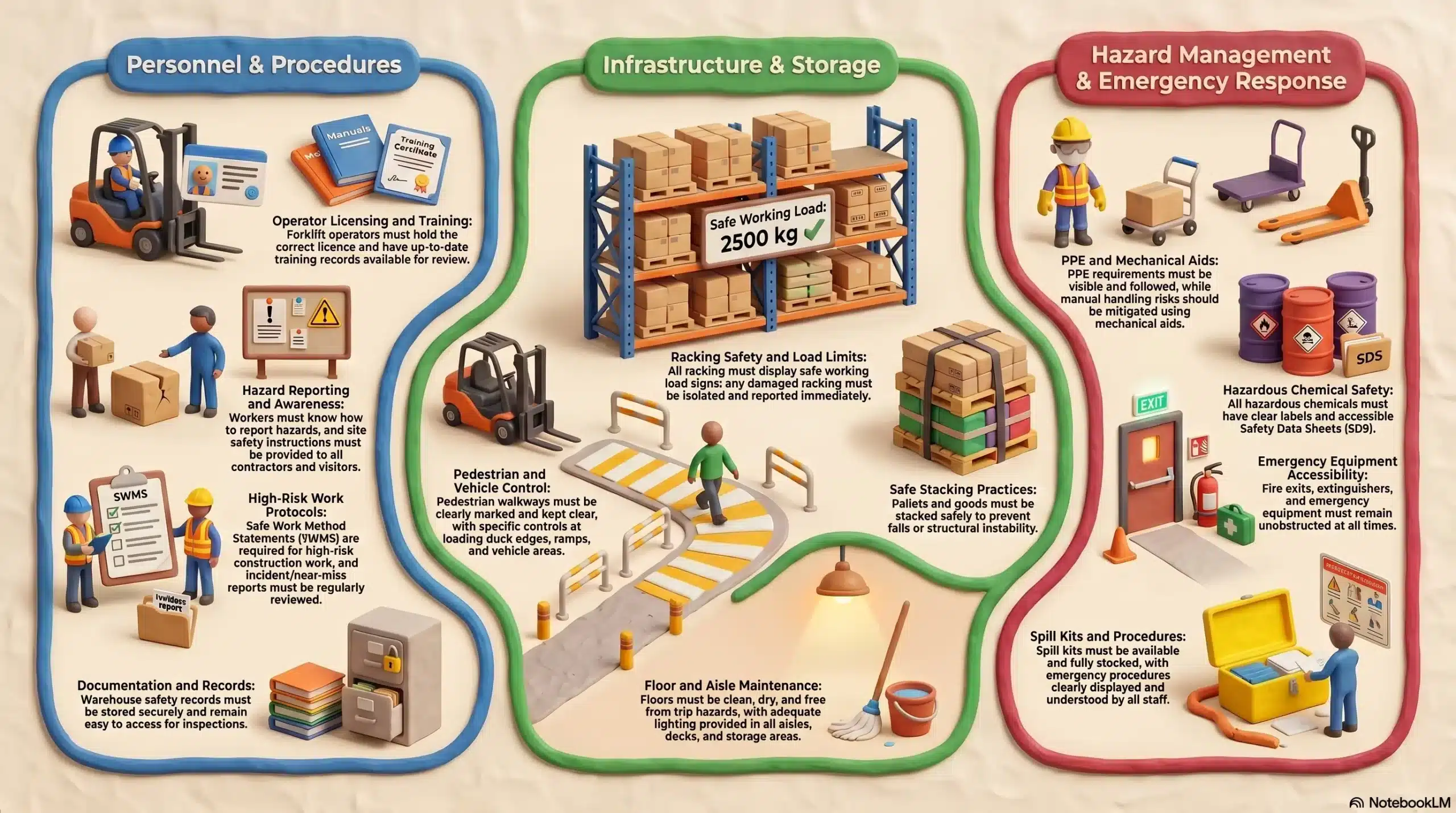
A checklist gives supervisors a practical way to review warehouse conditions. Use it during inspections, shift handovers, audits, and after layout changes.
- Forklift operators hold the correct licence and training records
- Pedestrian walkways are marked and kept clear
- Loading dock edges, ramps, and vehicle areas have controls
- Racking displays safe working load signs
- Damaged racking is isolated and reported
- Fire exits, extinguishers, and emergency equipment remain accessible
- Spill kits are available and stocked
- Hazardous chemicals have labels and safety data sheets
- PPE requirements are visible and followed
- Manual handling risks have mechanical aids or safer methods
- Lighting is adequate in aisles, docks, and storage areas
- Floors are clean, dry, and free from trip hazards
- Pallets and goods are stacked safely
- Emergency procedures are displayed and understood
- Incident and near-miss reports are reviewed
- Safety inspections have assigned corrective actions
- Contractors and visitors receive site safety instructions
- SWMS are used where high-risk construction work applies
- Workers know how to report hazards
- Warehouse safety records are stored and easy to access
This checklist should not replace a full risk assessment. However, it gives teams a simple starting point for everyday warehouse safety compliance while improving warehouse efficiency.
How a WMS Supports Warehouse Safety Compliance

A warehouse management system acts as a platform for inventory tracking and control, improving stock control, task visibility, and operational discipline. It helps teams reduce avoidable hazards caused by poor layout, missing records, or unclear work instructions.
For example, a WMS can assign picking routes, track stock locations, and reduce congestion in busy aisles. It can also help managers identify high-traffic zones and adjust workflows before risks increase.
A WMS also improves record visibility. Businesses can connect inspection tasks, stock movements, incident notes, equipment checks, and corrective actions in one system.
For larger warehouses, this matters because manual spreadsheets often fail at scale. A digital system helps teams track actions, review trends, and prepare evidence for internal audits or regulator enquiries.
Conclusion
Warehouse safety protects workers, improves daily operations, and helps Australian businesses meet WHS duties. A safe warehouse needs clear traffic controls, trained workers, maintained equipment, reliable storage systems, and practical inspection routines.
Regulations set the baseline, but daily habits create the real result. To improve warehouse visibility and support safer operations, book a free consultation today.
Frequently Asked Question
Warehouse safety refers to the systems, procedures, training, equipment, and controls used to protect workers, visitors, stock, and equipment inside a warehouse.
Warehouse safety is important because warehouses often involve forklifts, heavy goods, manual handling, loading docks, racking, and time-sensitive work. Strong safety controls help reduce injuries, downtime, and WHS compliance risks.
Common warehouse hazards include forklift accidents, manual handling injuries, falls from height, fire risks, chemical exposure, slips, trips, loading dock incidents, and racking collapse.
Australian warehouse safety rules are mainly based on WHS duties, state or territory safety laws, risk management requirements, training, supervision, and safe systems of work. Victoria follows its own OHS framework.
A WMS supports warehouse safety by improving stock visibility, task control, picking routes, inspection records, and warehouse movement tracking. This helps managers reduce congestion, errors, and safety blind spots.