














Inventory control is more than counting products. It keeps operations efficient, ensures timely orders, and protects cash flow. Businesses managing many SKUs across channels need accurate systems to avoid mistakes.
Using methods like ABC analysis, EOQ, and demand forecasting helps predict stock needs. Technologies such as RFID, barcodes, and cloud ERPs give real-time visibility. These tools make inventory a strategic asset rather than just a task.
The goal is balance. Enough stock to meet demand without tying up resources is key. Strong control improves profitability, prevents losses, and prepares businesses for growth and market changes.
Key Takeaways
Inventory control impacts cash flow, customer satisfaction, and growth. Accurate management balances supply and demand while freeing capital.
Best practices include data validation, standardized SKUs, cycle counting, and tools like barcodes, RFID, and ERP ensure reliable, real-time inventory visibility.
Essential metrics and kpis include GMROI, turnover, DSI, and use EOQ, ABC, or JIT to optimize stock, reduce costs, and match supply with demand.
Methods for inventory control: VMI, consignment, cross-docking, and AI-driven forecasting reduce losses, improve efficiency, and shift control from reactive to predictive.

What is Inventory Control?
Key Components of Inventory Control

A strong inventory control framework depends on key components. Stock Identification assigns unique SKUs or UPCs to items, ensuring accurate and error-free tracking.
- Location Management specifies exact storage spots, like aisle, rack, and bin, helping staff find items faster and cut labor costs.
- Audit and Verification include cycle counts or annual stock takes to keep digital records aligned with physical inventory.
- Reporting and Analytics provide insights on turnover, aging stock, and demand, helping managers make smarter purchasing decisions and optimize inventory.
How Inventory Control Works
- Purchasing and Receiving. When a purchase order triggers restocking inventory, incoming goods are inspected and officially added to inventory, updating stock levels and asset value.
- Put-away and Storage, where items are placed in their designated locations and recorded for traceability. Misplaced stock can cause duplicate orders or missed sales.
- Production or Order Fulfillment. In manufacturing, raw materials are deducted and finished goods added. In retail, items are picked and removed from inventory to prevent overselling.
- Shipping and Reconciliation completes the cycle. Outgoing goods trigger inventory deductions, shipping documents, and updates to financial records like Cost of Goods Sold.
Methods Used to Control Inventory
There is no single way to control stock; businesses choose methods based on their industry, product type, and capital capacity.
-
EOQ (Economic Order Quantity): Calculates optimal order size to minimize holding and ordering costs.
-
JIT (Just-in-Time): Receives goods only when needed, reducing storage costs but requiring tight supplier coordination.
-
ABC Analysis: Prioritizes inventory, tight control on high-value ‘A’ items, moderate for ‘B,’ lighter for ‘C.’
-
FIFO / LIFO: Guides stock flow and affects financial reporting; FIFO suits perishables, LIFO can aid taxes.
-
VMI (Vendor-Managed Inventory): Suppliers monitor and replenish stock, reducing admin work and improving availability.
-
MOQ & Safety Stock: Set buffers to prevent stock-outs and ensure smooth operations.
Inventory Control System and Technology
The era of paper and spreadsheet inventory is over. Barcode systems let teams scan items instantly, cutting errors and speeding up receiving and picking.
RFID technology goes further, tracking items without line of sight and scanning multiple products at once for better visibility.
ERP systems and an inventory controling app for enterprise link inventory with finance, sales, and procurement, updating stock and triggering replenishment automatically.
IoT sensors monitor item movement and storage conditions, while cloud-based systems allow multi-warehouse management and real-time stock access across channels.








Best Practice for Effective Inventory Control
Effective inventory control does not happen by accident. It requires consistent processes, reliable supplier relationships, and a clear view of which stock is earning its place in the warehouse.
-
Regular Cycle Counting: Count a portion of inventory daily or weekly to catch errors early.
-
Standardized Processes: Follow clear SOPs for receiving, labeling, storing, and transferring stock to ensure consistency.
-
Supplier Relationship Management: Collaborate with reliable suppliers to reduce lead times and safety stock without risking stockouts.
-
SKU Rationalization: Remove slow-moving or obsolete items to free space and focus on high-performing products.
Practical Strategies to Control Inventory
Controlling inventory effectively means addressing problems before they reach the warehouse. The following strategies help businesses reduce waste, respond to disruptions, and maintain stock quality from supplier to shelf.
-
Demand Forecasting: Use sales history, seasonality, and trends to predict stock needs and reduce supply chain disruptions.
-
Batch Tracking & Lot Control: Track groups of products to quickly isolate issues during recalls, protecting finances and reputation.
-
Cross-Docking: Move goods directly from incoming to outbound shipments to cut holding costs and speed fulfillment.
-
Quality Control at the Source: Inspect inventory at the supplier level to prevent defects and ensure sellable stock.

Industry-Specific Inventory Control Strategies
1. Retail: The omnichannel complexity
For brick-and-mortar and omnichannel retailers, inventory control centers on shrinkage and shelf availability. Because products sit on open shelves, the risk of theft, damage, or misplacement is higher than in a warehouse.
Retailers rely on perpetual inventory systems that sync Point of Sale data with stock records in real time.
Buy Online, Pick Up In-Store (BOPIS) adds another layer of pressure. It demands near-perfect accuracy, since “phantom inventory” can ruin the customer experience.
Many retailers now use frequent cycle counts in specific store sections instead of relying on large annual stock takes.
2. E-commerce: speed and decentralization
3. Wholesale and distribution: volume and velocity
Distributors sit between manufacturers and retailers, handling high volumes with thin margins. For them, inventory control focuses on space efficiency and fast turnover, since carrying costs quickly erode profit.
Many rely on slotting strategies within their centralised Warehouse Management Systems to place products based on sales velocity.
Fast-moving items stay close to shipping areas to reduce picking time, while slower items go in less accessible spots. Mistakes such as wrong quantities or damaged goods, can create stock discrepancies that disrupt operations.
How Inventory Platform Helps Automate Inventory Control in the Australian Manufacturing Industry
Australia’s manufacturing industry is one of the largest in the country. According to ABS data, they employed approximately 902,000 people in 2023–24 and contributed A$134.8 billion in industry value added, marking a 1.6% increase from the previous year.
Given its scale, inventory control is evolving beyond efficiency to focus on resilience as well. Companies are prioritising inventory discipline while integrating strategic buffers, multi-sourcing, ERP systems, and advanced planning techniques to manage supply chain risks better.
Inventory software removes the manual effort behind tracking, ordering, and reporting. For Australian manufacturers managing complex supply chains, automation reduces errors and keeps operations running without interruption.
- Real-time stock visibility: The system updates inventory levels instantly as goods are received, moved, or dispatched, giving teams an accurate view of stock across all warehouse locations at any time.
- Automated reorder triggers: When stock falls below a set threshold, the system raises a purchase order automatically, reducing the risk of stockouts without requiring manual monitoring of every SKU.
- Demand forecasting integration: The platform analyses historical sales data and seasonal trends to recommend optimal stock levels, helping manufacturers align procurement with actual production requirements.
- Batch and lot tracking: The system records batch numbers and expiry dates at the point of receipt, enabling manufacturers to trace and isolate affected stock quickly in the event of a recall.
- Compliance with Australian regulations: The platform supports reporting aligned with Australian tax and accounting standards, reducing manual reconciliation at period close.
- Integration with procurement and production: When the inventory system connects directly to purchasing and the production floor, material shortages are flagged before they cause a line-down situation rather than after.
- Audit-ready reporting: The system generates stock movement reports, variance analyses, and cycle count records automatically, keeping documentation current and accessible for internal audits or regulatory review.
Implementing a Robust Control Framework
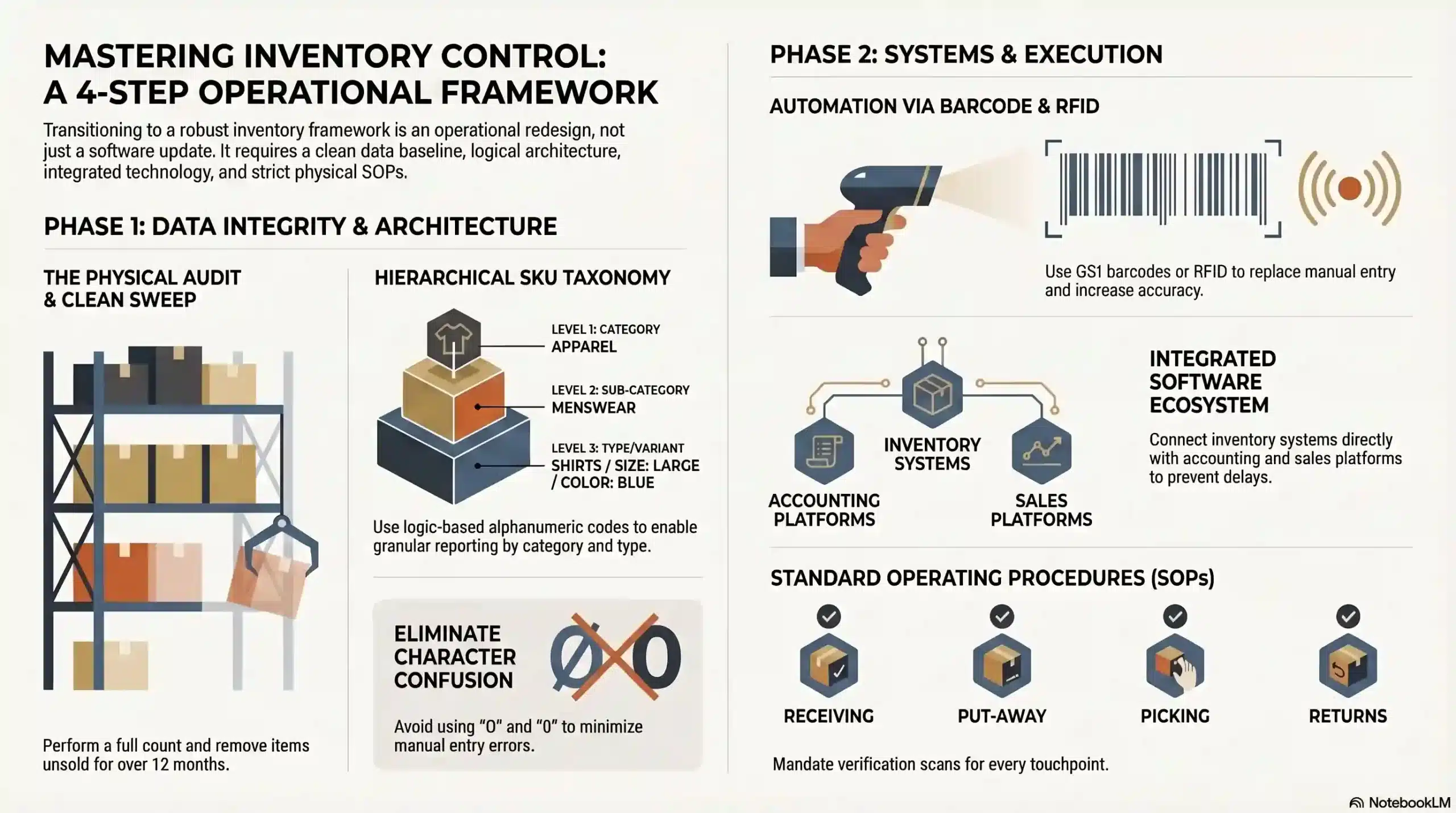
1. The clean sweep and audit
Start with a full physical count to clean up inventory data. Separate obsolete items, especially those unsold for over 12 months, and liquidate, donate, or write them off. Importing inaccurate data into a new system will weaken it from day one, so this step sets the baseline for future accuracy and performance.
2. Defining the taxonomy and SKU architecture
The taxonomy should be hierarchical:
- Category: (e.g., Apparel)
- Sub-Category: (e.g., Menswear)
- Type: (e.g., Shirts)
- Variant: (e.g., Size/Color)
This hierarchy allows for granular reporting. Managers can analyze inventory turns not just by individual item, but by category, helping to identify broader trends in demand.
3. Technology selection and barcoding
Manual entry kills accuracy, so businesses need barcode scanners or RFID readers. Most small to mid-sized companies can rely on GS1-based barcodes, while high-volume or high-value operations benefit from RFID, which scans large quantities quickly without line-of-sight.
Choose software that integrates smoothly. The Inventory Management System must connect directly with accounting and sales platforms. When systems run separately, teams end up exporting data manually, which creates delays and mistakes.
4. Establishing standard operating procedures (SOPs)
Technology fails without process. Strict SOPs must be written for every physical touchpoint of the inventory lifecycle:
- Receiving: All incoming shipments must be verified against the Purchase Order (PO) before being shelved. Blind receiving (where the receiver does not see the expected quantity) is a strong control against laziness.
- Put-away: Items must be scanned into a specific bin location. “Setting it on the floor for now” is strictly prohibited.
- Picking/Packing: Verification scans must occur before a package is sealed to ensure the right item is leaving the building.
- Returns: A quarantine zone must be established for returns so they are not accidentally added back to sellable inventory before quality inspection.
Essential Metrics and KPIs for Inventory Health
To control inventory effectively, one must measure it. However, tracking simple “total value” is insufficient. Advanced KPIs provide the diagnostic tools necessary to understand the efficiency of capital investment in stock.
1. Gross margin return on investment (GMROI)
GMROI is one of the most important metrics in retail and distribution. It answers a simple question: for every dollar invested in inventory, how much profit comes back?
Formula: Gross Margin ÷ Average Inventory Cost
If GMROI is above 1.0, the business earns more than it spends to buy and hold the stock. If it falls below 1.0, the inventory destroys value. Teams use this metric to compare product lines and focus on items that generate cash efficiently, not just those with high margins that move slowly.
2. Inventory turnover ratio
Inventory Turnover shows how often a company sells and replaces its stock within a period. Low turnover signals weak sales or overstocking, while very high turnover may point to stockout risks.
Formula: Cost of Goods Sold (COGS) ÷ Average Inventory
Most industries prefer higher turnover because it reflects better liquidity. However, pushing it too high can raise logistics costs due to frequent small reorders.
3. Days sales of inventory (DSI)
4. Perfect order rate
This compound metric measures the percentage of orders that meet all key criteria: on time, complete, damage-free, and with correct documentation.
Formula: (% On Time) × (% Complete) × (% Damage Free) × (% Correct Documentation)
Inventory control directly affects the “Complete” factor. When records are inaccurate, fill rates drop, the Perfect Order Rate declines, and customer churn increases.
Common Pitfalls and Mitigation Strategies

Even with sophisticated software, inventory control can fail due to human behavior and systemic anomalies. Recognizing these pitfalls is the first step toward prevention.
1. The bullwhip effect
The Bullwhip Effect happens when small changes in retail demand create larger swings upstream across distributors and manufacturers. Companies often trigger it through reactionary ordering, either panic buying during small spikes or slashing orders when demand dips.
To reduce it, use demand forecasting tools that smooth short-term fluctuations. Share point-of-sale data with suppliers so they see real customer demand, not just order patterns. This transparency keeps the supply chain aligned.
2. Phantom inventory
Phantom inventory occurs when the system shows stock on hand, but the shelf is empty. Theft, unrecorded damage, or scanning errors often cause the gap. Even small cashier mistakes can distort records.
The only real fix is regular cycle counting. Count a small portion of inventory each day to catch issues early. Review adjustment logs as well to spot patterns and identify whether a specific employee or process drives the discrepancies.
3. The spreadsheet trap
4. Neglecting reverse logistics
Conclusion
Inventory control directly impacts cash flow, margins, and customer satisfaction. Integrated systems give businesses the visibility needed to respond quickly as supply chains grow more complex.
Structured methods and the right metrics turn inventory into a strategic asset. The goal is balance: meeting demand without locking up excess capital in slow-moving stock. Businesses that maintain this balance strengthen profitability and long-term resilience.
Businesses ready to improve their inventory strategy can consult our expert to identify the right systems and processes. This ensures the approach matches current operational gaps and delivers lasting improvement to overall performance.

Frequently Asked Question
Inventory control focuses on the daily operations of managing stock at the warehouse level, such as receiving, tracking, and warehousing. Inventory management is a broader term that encompasses the entire strategy of sourcing, forecasting demand, and overseeing the supply chain.
EOQ is vital because it helps businesses calculate the ideal order quantity to minimize total inventory costs. It balances the cost of ordering inventory against the cost of holding it, ensuring capital is not wasted on excess stock or frequent small orders.
Effective inventory control frees up working capital by preventing overstocking. Money that would otherwise be tied up in slow-moving goods can be used for other operational needs, while preventing stockouts ensures continuous revenue generation.
Automated systems reduce human error, provide real-time data visibility, and streamline operations. They allow for faster order processing, accurate forecasting, and better integration with other business functions like accounting and sales.
While many businesses perform a full physical count annually, best practice suggests implementing cycle counting. This involves auditing a small portion of inventory daily or weekly, ensuring that the entire inventory is checked several times a year without disrupting operations.