














Performance reviews can either lift a team or drain it, and the difference usually comes down to one thing: the document the manager walks in with. A solid performance review template gives both parties a clear structure, a fair scoring method, and a written record that holds up if a dispute ever reaches Fair Work.
Whether you run annual reviews, probationary check-ins, or 360-degree feedback, using the same well-built template across the team keeps every conversation consistent. It also saves managers hours of preparation each cycle.
This guide walks through what a performance review template should include, the most useful types for Australian businesses, common manager mistakes, and when to move from spreadsheets to HR software. Free templates are included so you can start straight away.

Key Takeaways A performance review template is a structured document that captures role details, ratings, goals, and follow-up actions, giving managers and employees a consistent and defensible framework for every review cycle. Every reliable template needs seven components: employee details, review period, key performance areas, goal tracking, a development plan, and a manager-employee signature block for Fair Work compliance. Annual, team, probationary, 360-degree, and self-evaluation reviews each serve a different purpose, and choosing the right performance evaluation technique for the situation determines how useful the outcome is. When signatures go missing, ratings drift between managers, or documents become hard to retrieve, HR management solutions for employers replace manual processes with audit-ready, automated review workflows.
What Is a Performance Review Template?
A performance review template is a structured document managers use to assess employee performance over a set period. It captures role details, key performance areas, ratings, goals, and follow-up actions in one consistent format.
A good template removes guesswork from the process. Instead of starting from a blank page, managers and employees sit down with the same scoring scale, goal categories, and follow-up sections.
For Australian businesses, a written template also supports compliance. Reviews tied to underperformance, PIPs, or termination need clear documentation under Fair Work Australia, and a template makes that record easy to keep.
What a Performance Review Template Must Include in Australia

The fields below sit at the core of every reliable performance review template. Including each one keeps reviews fair, defensible, and useful for both sides of the table.
1. Employee and role details
Capture the employee’s full name, position title, department, manager, and start date. This information makes every review stand on its own and links cleanly to HR records.
2. Review period and cycle
Mark the exact dates the review covers, plus whether it is annual, six-monthly, quarterly, or probationary. A clear period prevents confusion when reviews are referenced months later.
3. Key performance areas and rating scale
List the core competencies and outcomes for the role, including quality of work, productivity, collaboration, initiative, values alignment, and pair each one with the same rating scale across the business. Common scales are 1-5 or “below / meets / exceeds expectations.
4. Goal setting and achievement section
Track the goals set at the previous review and rate the level of achievement. Then capture the next set of SMART goals with target dates and success measures.
5. Development and training plan
Identify the skills or knowledge gaps surfaced during the review and the training, mentoring, or stretch projects that will close them. A development plan gives the employee a clear path forward.
6. Manager and employee signature block
Most performance review forms also include a dedicated space for employee comments or self-reflection, allowing employees to share their perspective on achievements, challenges, and development goals.
Both parties should sign and date the document at the end. The signature block confirms the review took place, acknowledges that feedback was discussed, and protects everyone if the record is ever disputed.
7. Key achievements and strengths
This section records what the employee delivered well during the review period. Specific examples make the feedback credible and easier to act on.
Recognising strengths also helps managers identify who is ready for expanded responsibilities or a future leadership role.
8. Areas for improvement and challenges
This section captures performance gaps or behaviours that need to change before the next review. Keep each point tied to a measurable outcome, not personal opinion.
Naming the challenge clearly gives the employee a fair chance to respond and sets the foundation for a realistic development plan.
Free Performance Review Templates
Below are five ready-made performance review templates that suit the most common review scenarios. Each one is structured for fast use without losing the depth needed for fair assessment.
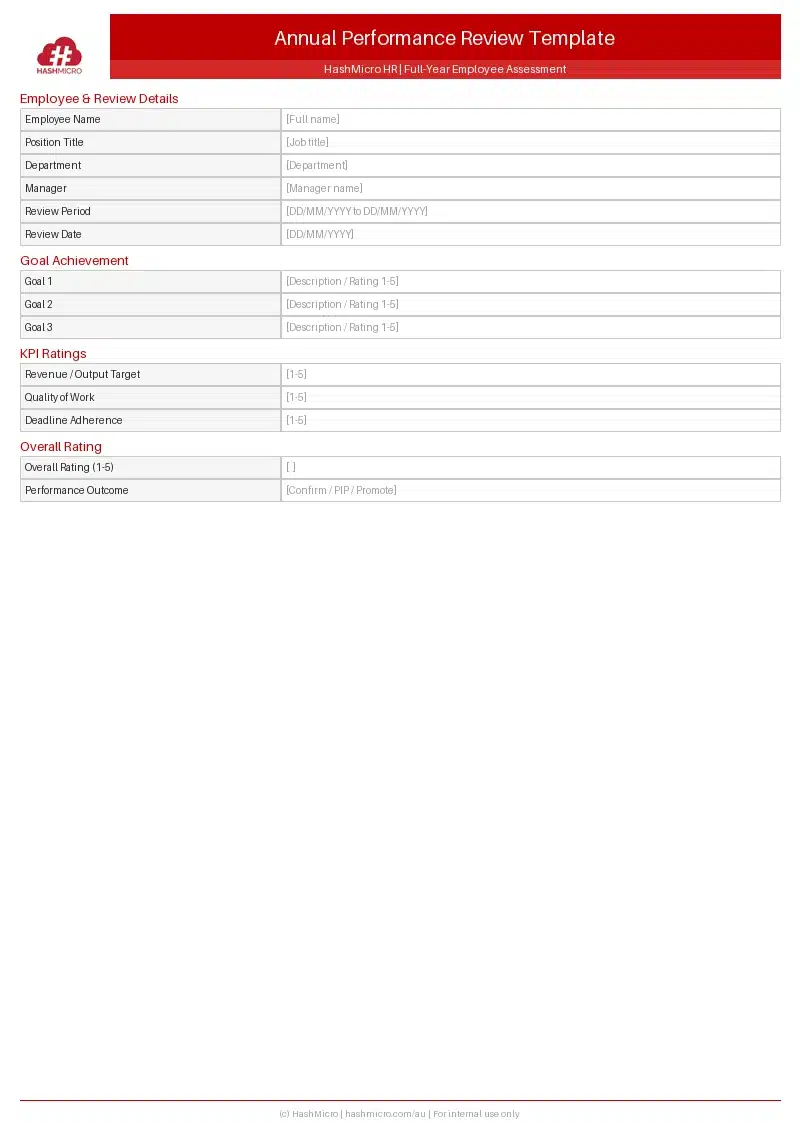
1. Annual performance review template
Designed for a full-year assessment of an employee’s performance. It includes goal achievement, KPI ratings, behavioural feedback, and the next year’s development plan.
Annual performance review template
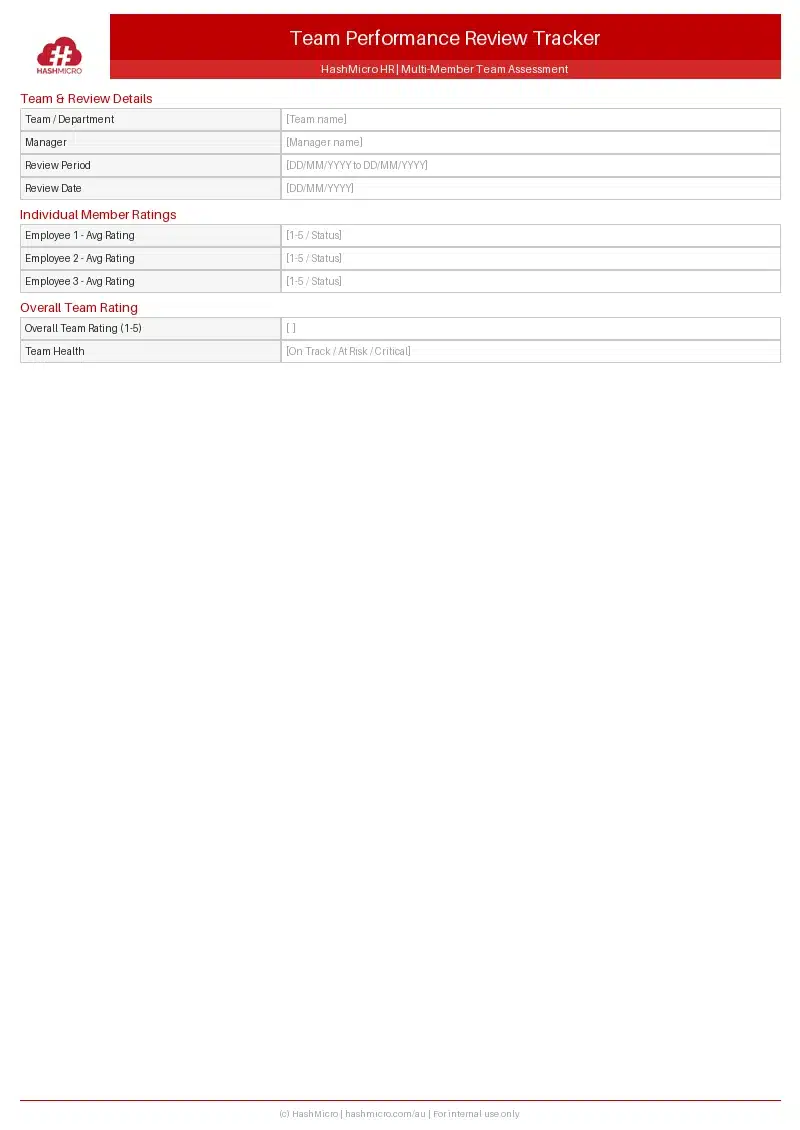
2. Team performance review tracker
Used by managers running multiple reviews at once. The tracker compares scores, ratings, and outstanding actions across an entire team in one view.
Team perfomance review tracker
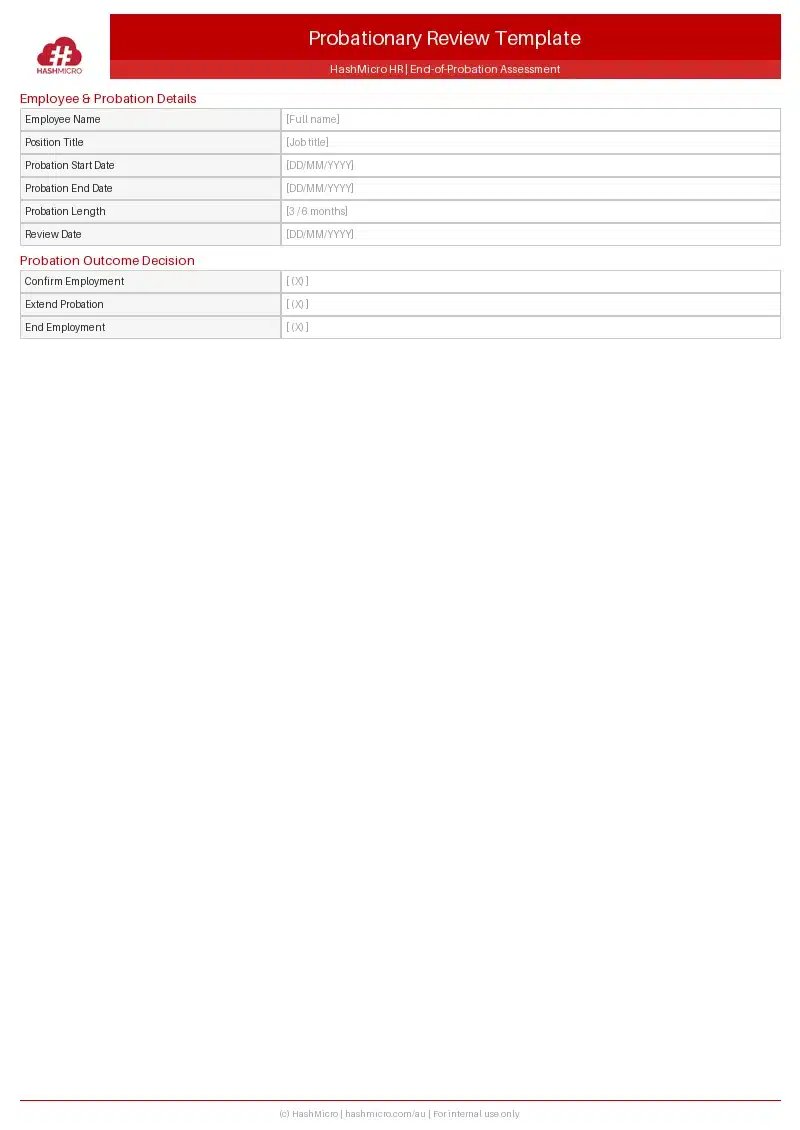
3. Probationary review template
Built for reviews at the end of a 3-month or 6-month probation period. It captures suitability, role fit, and the decision to confirm, extend, or end employment.
Probationary review template
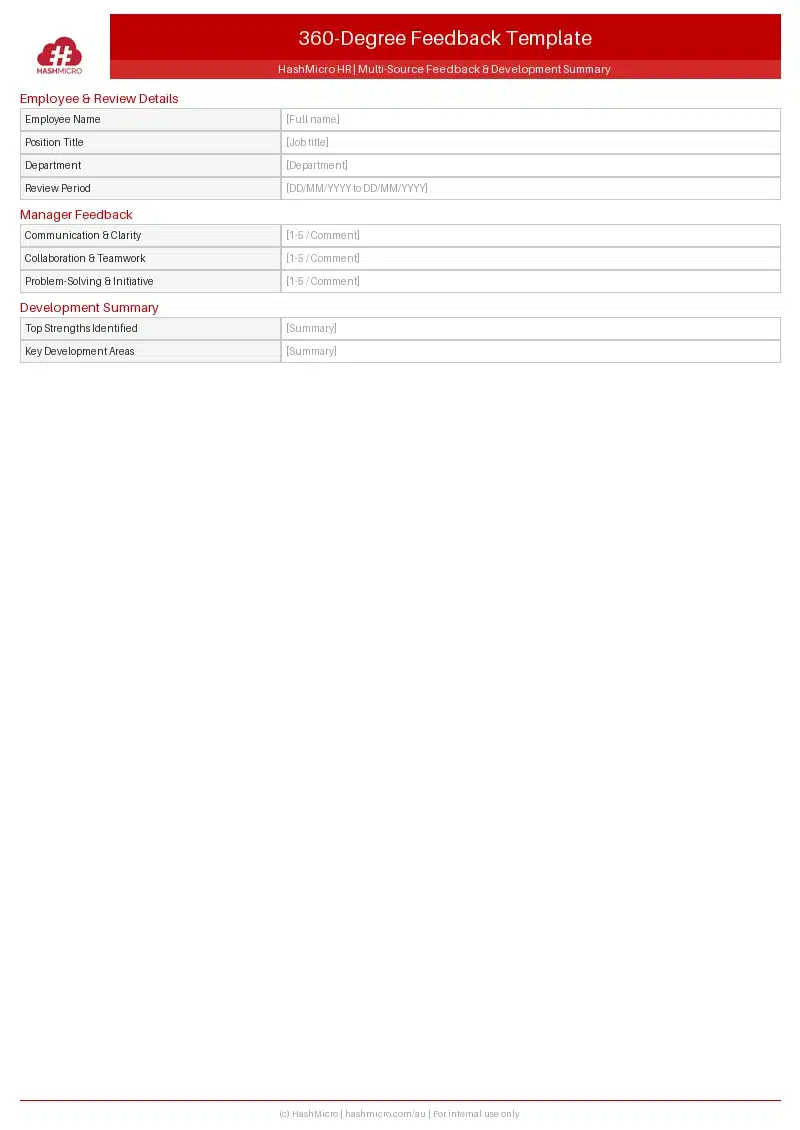
4. 360-degree feedback template
Collects input from managers, peers, direct reports, and sometimes external stakeholders. The template anonymises feedback and rolls it up into a single development summary.
360-degree feedback template
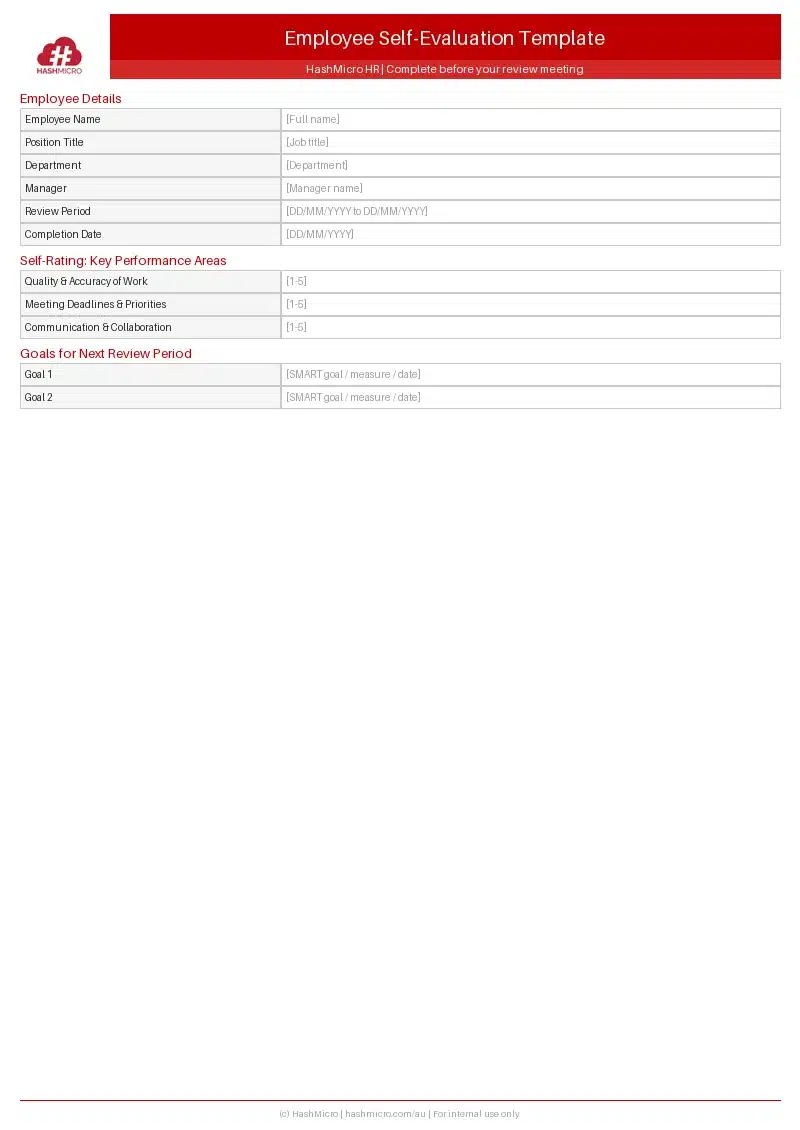
5. Employee self-evaluation template
Filled in by the employee before the review meeting. It surfaces the employee’s view of their own performance, which the manager can then compare with their own assessment.
Employee self-evaluation template
Types of Performance Reviews Used in Australian Businesses
Different review types suit different situations, and using the wrong one can either waste time or miss real issues. Here are the five formats most Australian businesses rely on.
1. Annual performance review
The most common format, run once a year against the previous year’s goals. It works best for established roles where outcomes take time to mature.
2. Team performance review
Looks at how a team has performed against shared targets rather than reviewing each member in isolation. Useful for project teams, sales pods, and ops crews with collective KPIs.
3. Probationary review
A formal check-in at the end of probation, usually 3 or 6 months after the start date. The outcome confirms employment, extends probation, or ends the engagement under Fair Work timelines.
4. 360-degree performance review
Pulls feedback from multiple sources, not just the direct manager. It gives a more rounded view of behaviour, especially for senior roles or cross-functional positions.
5. Employee self-evaluation
Asks the employee to assess their own performance before the meeting. The result is a more open conversation, since both parties walk in with their views written down.
7 Ways to Conduct a Performance Review
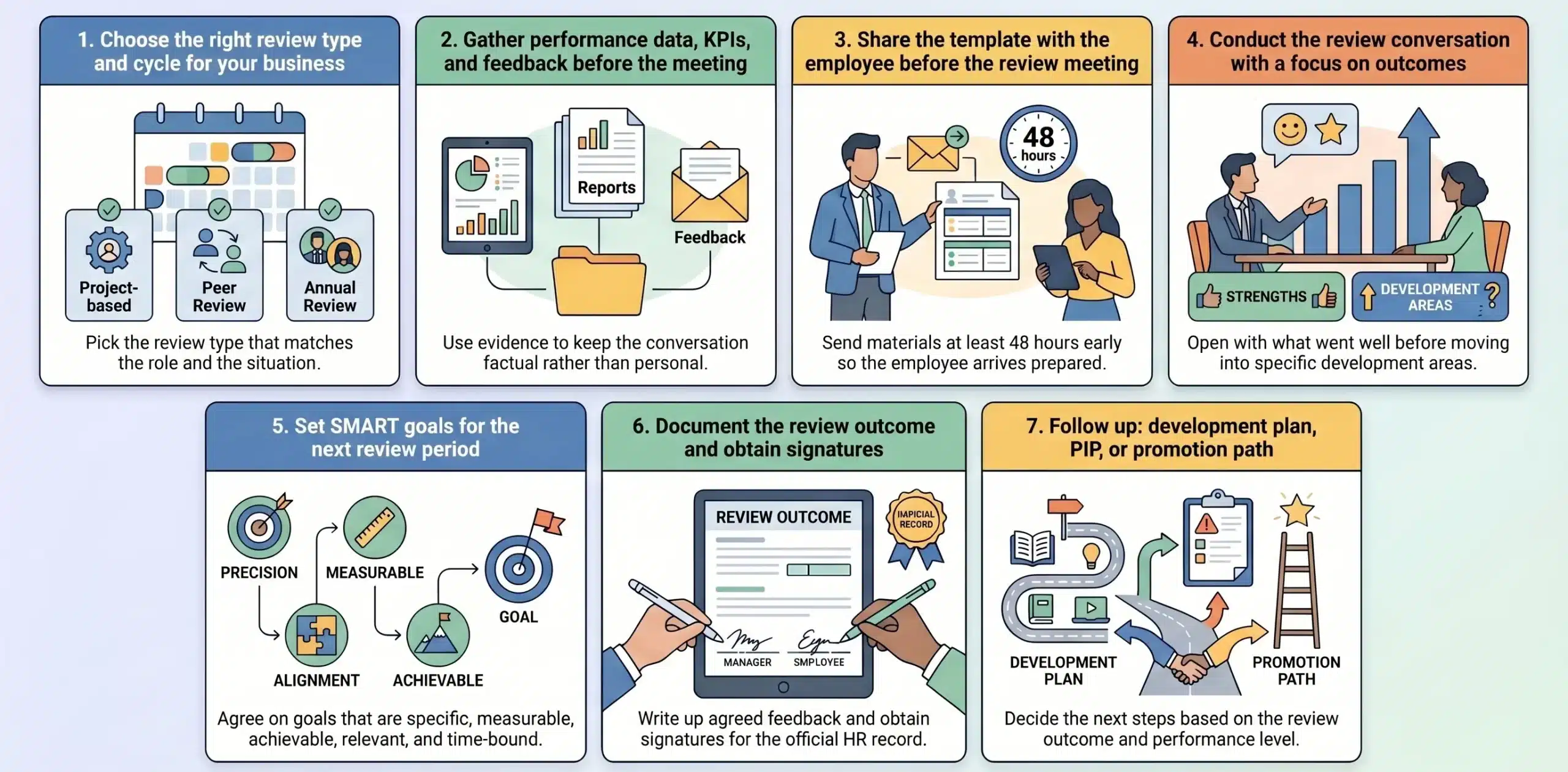
A good template only delivers value if the review meeting itself is run well. The seven actions below take you from preparation to follow-up without losing structure or fairness.
1. Choose the right review type and cycle for your business
Pick the review type that matches the role and the situation. A retail assistant on probation needs a different review to a senior account manager closing the financial year.
2. Gather performance data, KPIs, and feedback before the meeting
Pull the data you need by tracking employee KPIs, customer feedback, and project outcomes before sitting down with the employee. Walking in with evidence keeps the conversation factual rather than personal.
3. Share the template with the employee before the review meeting
Send the template and self-evaluation across at least 48 hours before the meeting. The employee then arrives prepared, which makes the conversation faster and far more productive.
4. Conduct the review conversation with a focus on outcomes
Open with what went well, then move into areas for development with specific examples. Keep the tone respectful and let the employee respond to each point in turn.
5. Set SMART goals for the next review period
Agree on goals that are specific, measurable, achievable, relevant, and time-bound. Each goal should have a clear measure of success and a review date.
6. Document the review outcome and obtain signatures
Write up the agreed feedback, ratings, goals, and actions. Both parties then sign and date the document, which becomes the official record for HR.
7. Follow up: development plan, PIP, or promotion path
Decide what comes next based on the review outcome. Strong performers may move toward promotion, average performers continue with a development plan, and underperformers move into a structured Performance Improvement Plan (PIP).
5 Performance Review Mistakes Australian Managers Make
Even experienced managers slip into bad review habits, and many of those slips create real legal and cultural risks. Here are the five most common mistakes to watch for.
1. Relying on verbal feedback without written documentation
Verbal feedback feels easier in the moment but leaves no record. If a performance dispute later reaches Fair Work, undocumented feedback often carries no weight.
2. Using subjective or vague rating criteria that create discrimination risk
“Attitude” and “professionalism” without clear definitions invite bias. Every rating criterion should be tied to observable behaviours or measurable outcomes.
3. Skipping the employee signature block (Fair Work documentation gap)
A review without a signature is hard to defend in unfair dismissal proceedings. Always close the meeting by getting the document signed by both parties.
4. Conducting reviews without a structured follow-up plan
A review with no follow-up loses momentum within weeks. Lock in the next check-in date, the agreed actions, and who owns each one before the employee leaves the room.
5. Treating all employees the same regardless of employment type
Casual, part-time, full-time, and award-covered employees all have different rights under Fair Work. A one-size-fits-all template can miss those distinctions and create compliance gaps.
When Should You Move from Manual Performance Reviews to HR Software?

Manual templates work fine for small teams, but they hit a ceiling fast as headcount grows. Here are the signs it is time to upgrade and what HR software actually delivers in return.
1. Signs your manual review process is becoming a compliance risk
You cannot find last year’s review documents in under five minutes, signatures go missing, ratings drift between managers, or PIPs sit scattered across local drives. Each one points to growing exposure if a Fair Work claim arises.
2. What HRM tools for performance deliver that spreadsheets and Word docs cannot
Leading HR software solutions store every review against the employee record, lock ratings against approved competency frameworks, automate reminders for cycle dates, integrate with payroll and attendance systems to maintain accurate workforce data, and produce audit-ready reports on demand
Conclusion
A clear performance review template turns subjective conversations into structured, defensible records that protect both the manager and the employee. With consistent ratings, SMART goals, and signature blocks in place, every review cycle delivers fairer outcomes and stronger documentation.
For Australian businesses outgrowing spreadsheets, HR management solutions for employers lock in compliance and link review outcomes to payroll, training, and succession workflows. Consult our experts at HashMicro today to see how the HR module can streamline your performance review process from cycle planning to follow-up.
Frequently Asked Question
A performance review template is a structured document managers use to assess employee performance over a set period. It captures employee details, key performance areas, rating scales, goals, development plans, and signature blocks in one consistent format.
A solid template should include employee and role details, the review period and cycle, key performance areas with a clear rating scale, goal setting records, a development plan, and a signature block for both manager and employee. These fields keep reviews fair and Fair Work-compliant.
Yes, free performance review templates are available for annual reviews, team reviews, probationary reviews, 360-degree feedback, and employee self-evaluations. Each one is designed for fast use without sacrificing the depth needed for a defensible record.
Most Australian businesses run formal annual reviews, but six-monthly or quarterly check-ins are increasingly common. Probationary reviews happen at 3 or 6 months from the start date, with informal one-on-ones every month between cycles.
Move to HR software when review documents go missing, ratings drift between managers, signatures get skipped, or PIPs sit on local drives. These signs point to compliance risk under Fair Work, and HR software locks in audit-ready records automatically.