















Work Health and Safety Act sets the legal framework that defines how businesses protect workers and manage workplace risks. It outlines what must be done to prevent harm while guiding how responsibilities are shared across different roles.
By applying these rules, businesses can identify hazards early, control risks effectively, and maintain safe operations across daily activities. This ensures compliance is not only met but integrated into how work is carried out.
Key Takeaways
Explains the scope of the WHS Act, including key responsibilities, legal framework, and how it applies across business operations.
Outlines the process of identifying hazards, assessing risks, and applying control measures to reduce workplace incidents.
Covers how to implement safety policies, audits, and documentation to ensure consistent workplace safety compliance.
Shows how digital tools help manage reporting, training, and documentation to improve safety tracking and compliance.

What the Work Health and Safety Act Covers
The Work Health and Safety Act establishes the legal foundation for protecting the health, safety, and welfare of workers and others affected by business activities. It applies across industries and covers both physical and psychological risks in the workplace.
Beyond preventing accidents, the Act requires businesses to manage risks proactively. This includes identifying hazards, implementing controls, and ensuring workers are supported through proper training and safe systems of work.
Key Terms in the WHS Act
Understanding key terms in the WHS Act helps clarify responsibilities and how the law applies in real situations. These definitions are intentionally broad to cover modern working arrangements.
What is a worker under the WHS Act
A worker is anyone who performs work for a business, not limited to direct employees. This includes contractors, labour-hire staff, apprentices, volunteers, and students.
The definition ensures that all individuals exposed to workplace risks are protected, regardless of their employment arrangement or contract type.
What counts as a workplace
A workplace includes any location where work is carried out or where a worker is likely to be while working. This extends beyond offices to sites, vehicles, vessels, aircraft, and even home-based work environments.
This broad scope ensures safety obligations apply wherever work activities take place.
What does reasonably practicable mean
Reasonably practicable refers to the level of action a business must take to manage risks based on what is realistic and proportionate. It considers the likelihood of harm, the severity of potential outcomes, and the available ways to control risks.
This concept ensures safety measures are practical while still prioritising worker protection.
Who is a PCBU
A PCBU, or Person Conducting a Business or Undertaking, is the main duty holder under the WHS Act. It can be a company, sole trader, partnership, or government entity.
The PCBU is responsible for ensuring the health and safety of workers and others affected by its operations.
WHS Laws Across States and Jurisdictions
While the WHS Act aims to create a consistent framework, its application varies across states and territories. Understanding these differences is important for businesses operating in multiple locations.
Model WHS laws framework
The model WHS laws were developed to standardise workplace safety regulations across jurisdictions. Most states adopted this framework to create consistent legal obligations for businesses.
This helps simplify compliance for companies operating across different regions.
Differences in Victoria and Western Australia
Not all regions follow the model laws exactly. Victoria operates under its own OHS framework, while Western Australia adopted a version with industry-specific adjustments.
These differences require businesses to adapt their compliance approach based on location.
Commonwealth and state jurisdiction
WHS laws are primarily enforced at the state and territory level, with each regulator overseeing compliance within its region. This means businesses must follow the rules set by the local authority where they operate.
However, some entities fall under Commonwealth jurisdiction, particularly federal agencies and organisations regulated at a national level. Understanding which authority applies is important to ensure correct compliance and reporting.
Who Is Responsible Under the WHS Act
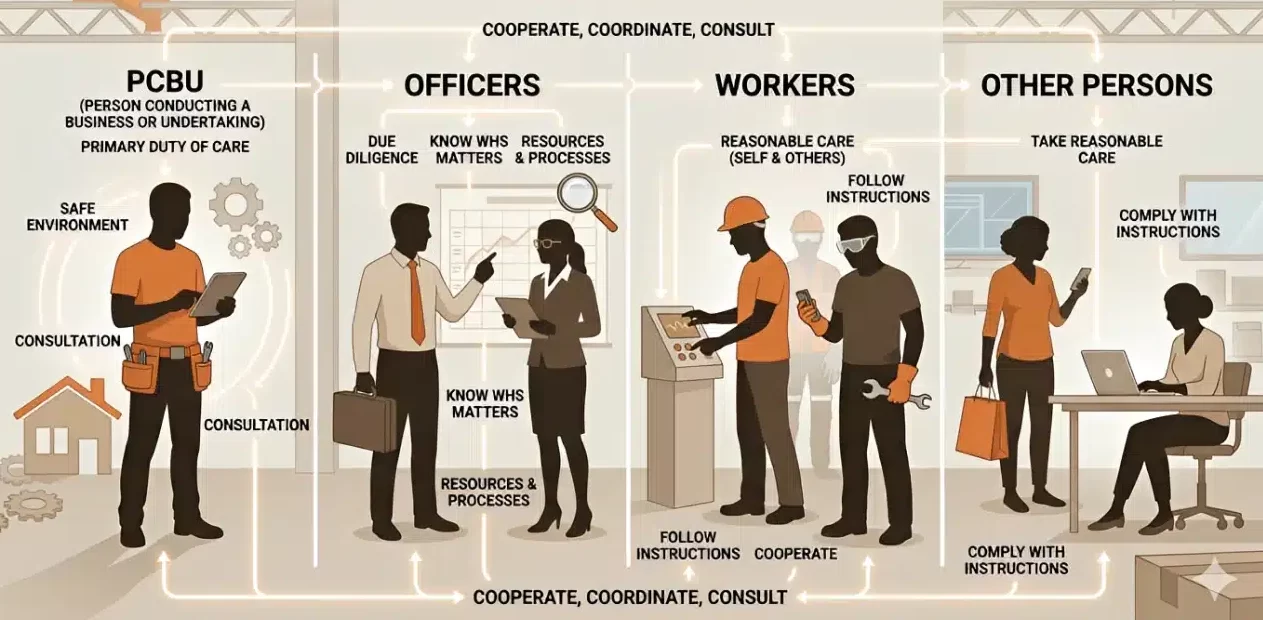
Businesses must understand that WHS responsibilities are shared and cannot be transferred. Each role has specific duties that must be fulfilled.
- PCBU (primary duty holder)
Responsible for ensuring the health and safety of workers and others affected by operations. - Officers (directors and executives)
Must exercise due diligence by staying informed, allocating resources, and ensuring safety systems are implemented. - Workers
Required to take reasonable care of their own safety and follow workplace procedures. - Other persons
Visitors or contractors must comply with safety instructions while on site.
Employer Responsibilities Checklist
To maintain compliance, employers must ensure that core safety obligations are consistently met across operations.
- Provide a safe working environment with proper layout, lighting, and hygiene
- Maintain safe plant, equipment, and structures
- Establish and enforce safe systems of work with compliant HR policies
- Ensure safe handling, storage, and use of hazardous materials
- Provide adequate facilities such as drinking water, rest areas, and sanitation
- Deliver training, instruction, and supervision to workers
- Monitor worker health and workplace conditions
How to Manage Workplace Risks
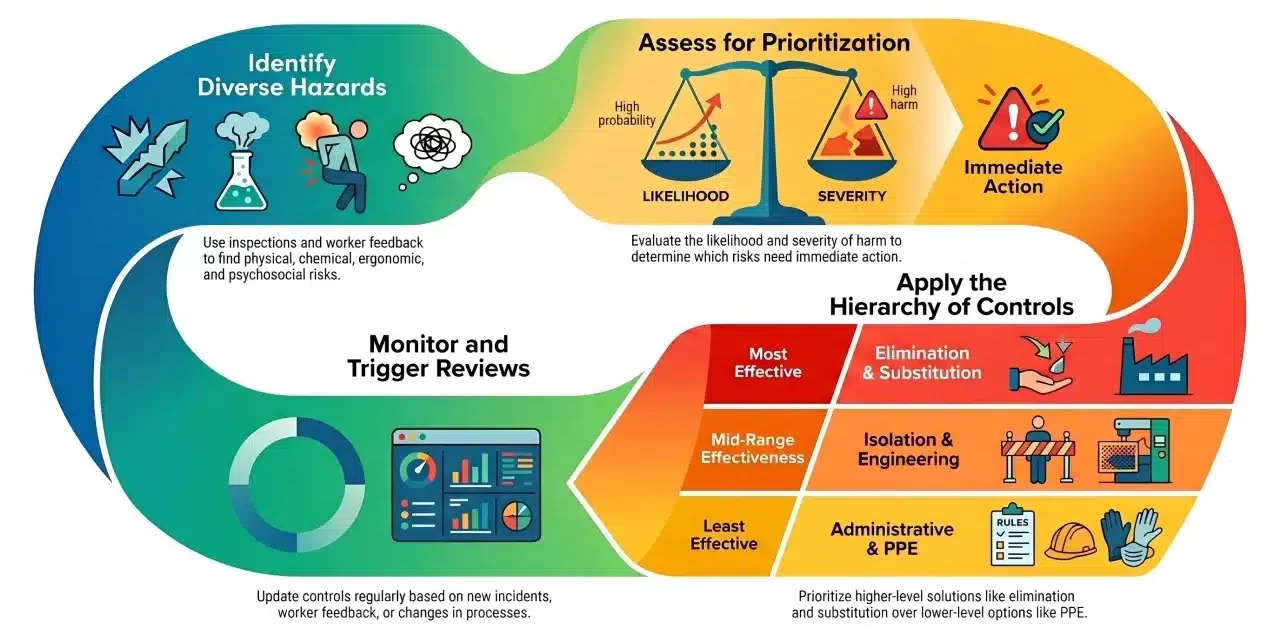
Managing risks under the WHS Act requires a structured and continuous approach. This process helps businesses prevent incidents before they occur.
Identify hazards
The first step is to identify anything that could cause harm. Hazards may include physical, chemical, ergonomic, or psychosocial risks.
This can be done through inspections, worker feedback, and reviewing past incidents.
Assess risks
Once hazards are identified, the next step is to assess how likely they are to cause harm and how severe the impact could be.
This helps prioritise which risks need immediate attention and which can be managed over time.
Apply the hierarchy of controls
Control measures must follow the hierarchy of controls, starting from the most effective solutions. This includes elimination, substitution, isolation, engineering controls, administrative controls, and personal protective equipment.
Higher-level controls should always be prioritised over lower-level ones.
Review and monitor controls
Risk management is ongoing and requires regular review. Controls must be monitored to ensure they remain effective and relevant.
Changes in processes, incidents, or feedback should trigger updates to existing controls.
Building a Safety Management System
A structured safety management system, supported by employee policy management tools, helps integrate WHS practices into daily operations. It ensures that safety processes are consistent, measurable, and continuously improved.
Core components of an SMS
An effective SMS includes a clear safety policy, defined objectives, and structured procedures. It also assigns roles and responsibilities to ensure accountability across the business.
These components create a foundation for managing risks systematically.
WHS audits and consultation
Regular audits help identify gaps between current practices and legal requirements. They ensure that safety processes remain aligned with WHS standards.
Consultation with workers is equally important. It allows businesses to gather insights from those directly exposed to workplace risks.
Documentation and record keeping
Accurate documentation is essential for demonstrating compliance. This includes risk assessments, training records, incident reports, and maintenance logs.
Maintaining organised records supports audits and helps businesses respond effectively to any investigations.
Penalties and Compliance Risks
Failing to comply with the WHS Act can lead to serious legal and financial consequences. Regulators can investigate incidents, enforce corrective actions, and impose penalties on businesses that breach safety obligations.
Penalties may include fines, legal prosecution, and in severe cases, imprisonment. Non-compliance also increases operational risks such as workplace incidents, project delays, and reputational damage.
Benefits of WHS Compliance
Maintaining WHS compliance does more than meet legal requirements. It strengthens operations and creates a safer, more productive working environment.
Reduced injury and liability risks
Effective safety practices lower the likelihood of workplace incidents. This reduces legal exposure and helps protect both workers and the business.
Lower compensation costs
Fewer incidents support fair compensation practices and reduce workers’ compensation claims. Over time, this helps control insurance costs and improves financial stability.
Improved productivity and retention
A safe workplace supports employee well-being. Workers are more engaged, perform better, and are less likely to leave.
Stronger business reputation
Businesses with strong safety records are viewed as more reliable. This can improve client trust and increase opportunities in tenders and partnerships.
How Software Supports WHS Compliance
Managing WHS processes manually can lead to gaps in tracking and reporting. Workplace compliance tools help centralise safety management and ensure compliance activities remain consistent and easier to monitor.
Incident reporting and hazard tracking
Systems allow incidents and hazards to be recorded in real time. This improves visibility and ensures issues are addressed quickly.
Centralised documentation and audit trails
All safety records can be stored in one place. This makes it easier to manage audits and demonstrate compliance when required.
Training and certification tracking
Software helps monitor training and certifications while automating HR process activities.
Real-time dashboards and reporting
Dashboards provide a clear overview of safety performance. This helps management identify trends and make faster, data-driven decisions.

Where to Start with WHS Implementation
Starting WHS implementation can feel complex, but a structured approach helps businesses build a strong foundation.
Conduct a WHS gap assessment
Review current safety practices and identify areas that do not meet WHS requirements. This helps prioritise improvements.
Consult workers and build structure
Engage workers in safety discussions and establish clear roles. This improves awareness and ensures practical input from the field.
Choose a safety management system
Select tools or systems that support risk management, reporting, and compliance tracking. This helps streamline processes.
Train teams and supervisors
Provide training to ensure all employees understand their responsibilities. Strong awareness supports consistent compliance across operations.
Conclusion
The Work Health and Safety Act helps businesses manage risks and protect workers through clear responsibilities. Consistent implementation is key to maintaining safe and compliant operations.
To simplify compliance and improve safety tracking, consider using a centralised system. You can book a free consultation with an expert to find the right solution for your business.
Frequently Asked Questions About WHS Act
-
What is the difference between WHS and OHS?
WHS (Work Health and Safety) is a modern framework adopted across most regions, while OHS (Occupational Health and Safety) is used in jurisdictions with separate legislation. Both aim to ensure workplace safety, but WHS provides a more standardised approach.
-
Does WHS apply to small businesses?
Yes, WHS laws apply to businesses of all sizes, including small businesses and sole traders. All duty holders must ensure, so far as reasonably practicable, the health and safety of workers and others.
-
What should be done after a notifiable incident?
A notifiable incident must be reported to the relevant regulator immediately. The site should be preserved, and records must be documented for investigation and compliance purposes.
-
How often should WHS policies be reviewed?
WHS policies should be reviewed regularly, especially after incidents, operational changes, or updates in regulations. Many businesses review them annually as part of compliance checks.
-
Are volunteers covered under the WHS Act?
Yes, volunteers are considered workers under the WHS Act and must be provided with the same level of protection as other workers.