


 Limited to 100 registrants

The National Employment Standards (NES) are the minimum employment entitlements that apply to employees under Australia’s national workplace system. They form a legal safety net under the Fair Work Act 2009 and set the minimum rights employers must provide.
For Australian employers, understanding the NES is important for managing payroll, leave, contracts, and workplace compliance. While awards and enterprise agreements may offer extra benefits, they cannot provide less than the NES.
Failing to comply with the NES can lead to underpayment claims, penalties, and workplace disputes. Many businesses review their HR processes regularly to stay compliant.
Key Takeaways
Understand the foundational definition and scope of the NES.
Discover why compliance is critical for Australian businesses.
Learn which employees are protected under these regulations.
Explore the core entitlements every employer must provide.

What are the National Employment Standards (NES)?

The National Employment Standards (NES) are legally enforceable minimum employment conditions in Australia’s national workplace system. They apply alongside awards, enterprise agreements, and employment contracts.
The NES cover key rights such as working hours, leave, flexible work requests, termination, redundancy, and workplace information. They help create fairness and consistency across Australian workplaces.
Employers cannot offer terms below the NES minimum standards. If a contract or policy provides less than the NES, the NES will generally apply instead.
Why the National Employment Standards Matter for Australian Businesses
The NES help businesses meet legal obligations, manage staff fairly, and reduce compliance risk. They also create consistency across employment practices.
1. Legal minimum safety net under the Fair Work Act
The NES provide the statutory minimum standards employers must meet under Australian employment law. They operate as a legal foundation for employment relationships and help businesses understand baseline obligations.
2. Consistent rights across states and territories
Because the NES apply nationally in most workplaces, employers operating across multiple locations can apply a more consistent HR and payroll framework.
3. Lower risk of underpayment claims and disputes
When businesses correctly apply NES entitlements, they reduce the likelihood of disputes involving unpaid leave, overtime misunderstandings, termination issues, or redundancy claims.
"For Australian employers, understanding the National Employment Standards is essential for maintaining compliance, reducing workplace risk, and supporting fair employment practices across the business."
Who the National Employment Standards Cover
The NES generally apply to employees covered by Australia’s national workplace relations system, including:
- Full-time employees
- Part-time employees
- Casual employees (with relevant entitlements depending on status)
- Employees covered by modern awards
- Employees under enterprise agreements
- Many salaried employees under common law contracts
Some state public sector and local government workers may fall under different systems depending on jurisdiction.
Because coverage can vary, employers with complex workforce structures should review their legal position carefully.
Key Components of the National Employment Standards
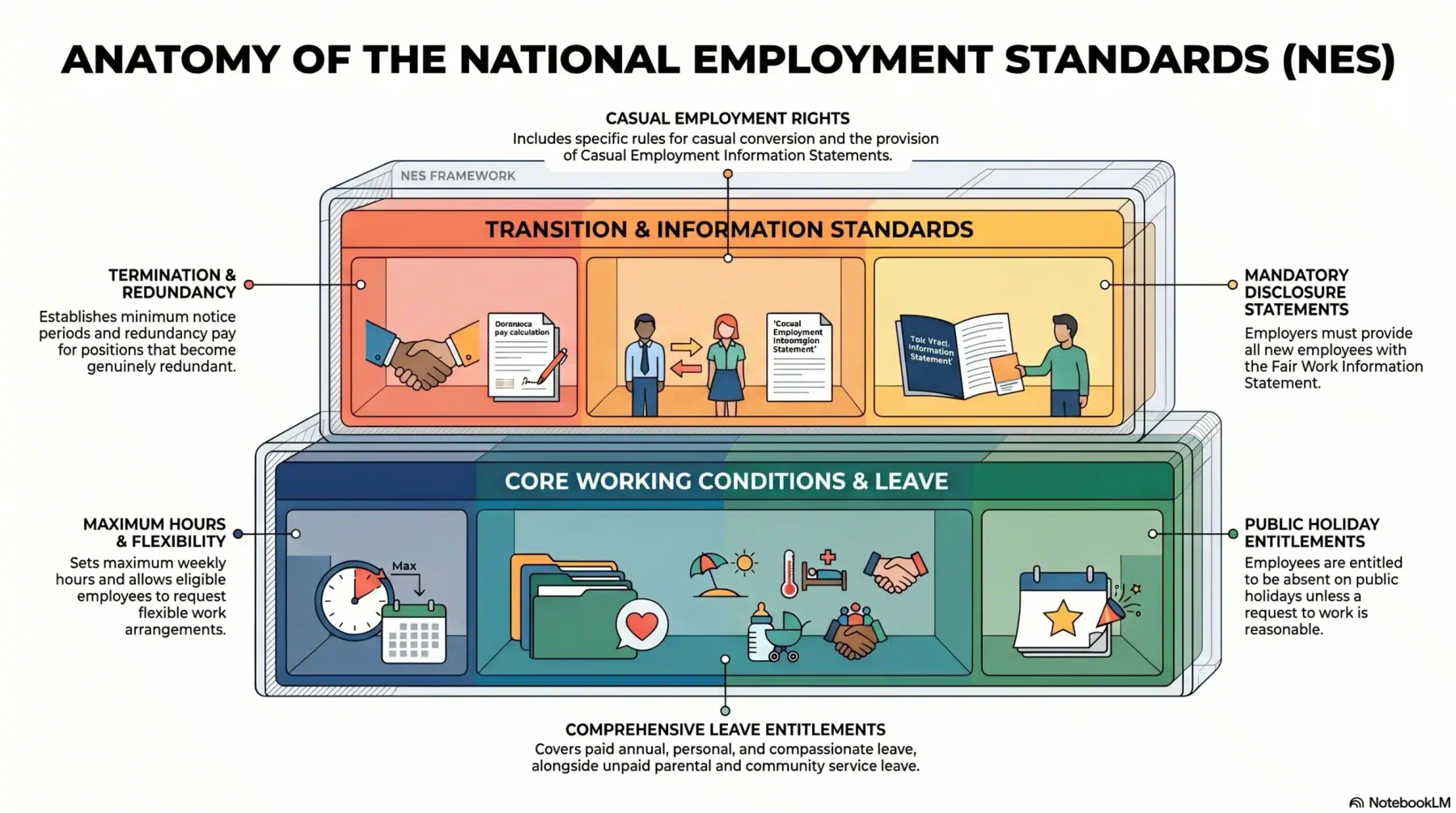
The NES cover a range of minimum employee rights relating to hours of work, leave, termination, redundancy, and workplace information.
1. Maximum weekly hours and flexible work requests
The NES set maximum weekly hours for full-time employees, with additional hours needing to be reasonable. Eligible employees may also request flexible working arrangements in certain circumstances.
2. Annual, personal, and parental leave
The NES provide paid annual leave, paid personal/carer’s leave, compassionate leave, and unpaid parental leave, subject to eligibility rules.
3. Community service and long service leave
Eligible employees may access leave for jury service and certain emergency management activities. Long service leave continues under applicable federal or state arrangements.
4. Public holidays and notice of termination
Employees are generally entitled to be absent on public holidays unless reasonably requested to work. The NES also set minimum notice periods when employment is terminated.
5. Redundancy pay and casual conversion rights
Eligible employees may receive redundancy pay when positions become genuinely redundant. Casual employment rules also provide pathways relating to conversion and casual employment obligations.
6. Fair Work Information Statement and Casual Employment Information Statement
Employers must provide required workplace information statements to new employees, including documents relevant to casual workers where applicable.
How the NES Interacts with Awards and Enterprise Agreements
The NES work alongside modern awards and enterprise agreements. While other instruments may add benefits, they cannot reduce NES minimum standards.
1. The NES as the non-negotiable floor
The NES are the minimum floor of employment rights. No award, agreement, or contract can reduce these standards.
2. Modern awards building on NES entitlements
Modern awards often add industry-specific rules such as penalty rates, allowances, classifications, overtime, and rostering requirements on top of the NES.
3. Enterprise agreements and the Better Off Overall Test
Enterprise agreements must meet legal approval requirements and generally leave employees better off overall compared with the relevant award framework.
How to Apply the NES in Your Workplace
Employers should translate NES obligations into everyday workplace systems, contracts, payroll processes, and management practices.
1. Audit employment contracts against NES entitlements
Review contracts to ensure leave clauses, termination terms, hours of work, and flexibility provisions do not conflict with minimum standards.
2. Align payroll and leave systems with minimum standards
Payroll and attendance tools should correctly accrue leave, calculate balances, and support accurate employee records across every pay cycle.
3. Provide the required workplace information statements
Ensure onboarding processes include mandatory information statements for eligible employees.
4. Train managers on leave and termination rules
Frontline managers should understand leave approvals, flexible work requests, notice periods, and procedural fairness expectations.
How Australian Businesses Across Industries Apply the NES
Different industries apply the NES in different ways depending on workforce structure, rostering needs, and operational demands.
1. Retail and hospitality
Businesses with rotating rosters often focus on public holiday compliance, casual employment management, and leave scheduling.
2. Construction and trades
Employers may need strong controls over hours of work, overtime practices, and redundancy processes.
3. Healthcare and aged care
High workforce demand means leave management, shift coverage, and employee wellbeing obligations are particularly important.
4. Professional services and corporate offices
These employers often focus on flexible work arrangements, parental leave planning, and compliant termination practices.
Common NES Compliance Mistakes to Avoid
Many NES issues come from outdated contracts, poor records, or misunderstanding minimum entitlements. Identifying common mistakes helps reduce risk.
Common issues include:
- Using outdated employment contracts
- Incorrect leave accrual settings
- Misunderstanding casual employee obligations
- Failing to issue required information statements
- Poor records of hours worked
- Incorrect notice or redundancy calculations
- Assuming salary arrangements remove NES obligations
Regular internal reviews can help reduce these risks.
Best Practices for Managing NES Compliance
Strong workplace compliance practices come from regular reviews, accurate systems, staff training, and up-to-date internal policies.
1. Keep accurate records of hours, leave, and entitlements
Reliable records support payroll accuracy and help resolve disputes quickly.
2. Review contracts whenever the Fair Work Commission updates the NES
Legislative and regulatory changes can affect workplace obligations, so periodic review is important.
3. Use HR or ERP software to automate leave accruals and reporting
An HRM system for Australian companies with built-in NES rules helps automate leave accruals, contract templates, and reporting requirements. HR process automation also improves visibility, reduces manual errors, and simplifies audits across payroll and leave.
4. Run regular training on Fair Work updates and obligations
Managers and payroll teams should stay current with workplace law developments.
Conclusion
The National Employment Standards are a key compliance framework for Australian employers. They set the minimum workplace entitlements that support fair and lawful employment practices.
By reviewing contracts, payroll systems, and workplace policies, businesses can reduce risk and improve compliance. Keeping processes current also helps create a more stable workforce.
If your business needs support aligning HR, payroll, or compliance systems with current NES obligations, you can schedule a free consultation with our experts for tailored guidance.
Frequently Asked Question
The National Employment Standards are the minimum employment entitlements that apply to employees in Australia’s national workplace system.
The NES apply to most employees covered by Australia’s national workplace relations system, including full-time, part-time, and many casual employees.
No. An employment contract cannot provide less than the minimum standards set under the NES.
No. The NES are the minimum legal standards, while modern awards may add extra industry-specific conditions.
The NES cover key areas such as maximum weekly hours, leave, public holidays, notice of termination, redundancy pay, and workplace information statements.
Yes. Casual employees receive certain NES entitlements, although some rights differ from permanent employees.
The NES help employers meet legal obligations, reduce compliance risk, and manage employees fairly.