










A supply chain management (SCM) system is software that helps businesses manage sourcing, inventory, production, warehousing, and product deliveries in one system. It improves supply chain visibility, coordination, and operational efficiency across business operations.
Supply chains are a core function for any business that sources materials, manages stock, or delivers goods to customers. When processes fail, businesses face stockouts, delayed shipments, and rising costs.
A supply chain management system addresses these challenges by connecting procurement, inventory, logistics, and fulfilment in a single platform. This gives businesses full visibility over every stage of their supply chain.
This guide covers what a supply chain management system is, why it matters, and how to implement one. It also examines industry use cases, common mistakes, and best practices.
Key Takeaways
A supply chain management system manages the flow of goods, data, and finances from procurement through to final customer delivery
Key components include procurement, inventory, order management, logistics, and demand forecasting
Implementing a supply chain management system requires process mapping, gap analysis, system selection, integration, and phased staff training
Australian businesses use supply chain management systems to manage long shipping lead times, remote logistics, and port-related supply disruptions

What Is a Supply Chain Management System

A supply chain management system manages the flow of goods, data, and finances from the processes. It uses machine learning to analyse demand, predict shortfalls, and auto-generate purchase orders before stock runs short.
It operates across three flows. The physical flow involves the movement and storage of goods. The information flow covers orders, delivery updates, and demand forecasts. The financial flow manages payments and credit terms.
Unlike basic tools, an enterprise SCM system uses machine learning and algorithms to predict operational needs. It can analyse sales history, supplier lead times, and market trends to auto-generate purchase orders before stock runs low.

Why a Supply Chain Management System Matters
Businesses relying on manual processes and spreadsheets cannot keep pace with modern supply chain demands. Implementing an SCM system delivers measurable advantages in cost control, resilience, and service quality.
1. End-to-end visibility across the supply chain
A modern SCM platform acts as supply chain tracking software, giving real-time visibility into every stage, from in-transit materials to delivery locations without manual updates.
This supports leaner inventory management. When managers know exactly what is in transit and when it will arrive, they can reduce safety stock levels without increasing the risk of stockouts.
Visibility also strengthens customer service. Staff can provide accurate, real-time shipment updates immediately. Every movement is logged, making it easier to identify bottlenecks and hold underperforming suppliers accountable.
2. Faster response to disruptions and demand shifts
Supply chains face ongoing risk from supplier delays, trade disruptions, and sudden demand changes. Businesses using manual processes often have no early warning before these issues cause damage to operations.
An SCM system monitors data inputs across the network and alerts managers to emerging risks. If a primary supplier is delayed, the system can identify alternative vendors and calculate cost implications automatically.
Demand spikes are also managed more effectively. If sales data shows a sudden demand increase, the system adjusts production schedules and expedites shipping without waiting for manual intervention from a manager.
3. Lower operational costs through better planning
Poor supply chain management creates hidden costs. Excess inventory, expedited freight, manual data entry errors, and lost sales all generate financial waste that compounds over time across the business.
Advanced forecasting tools allow businesses to maintain precise stock levels, reducing warehousing costs and freeing up working capital. Carrying the right amount of inventory at the right time directly improves cash flow.
Route optimisation within logistics modules reduces transportation expenses. Automation of tasks such as purchase order generation and invoice processing also reduces administrative overhead across procurement and finance teams.
4. Stronger supplier and customer relationships
A supply chain is a network of business relationships. Delayed shipments, inaccurate orders, and late payments damage relationships on both sides. An SCM system reduces the frequency of these failures.
For suppliers, the system provides accurate demand forecasts, helping them plan production more effectively. Automated invoicing ensures payments are processed on time and reduces the risk of billing disputes.
For customers, consistent order accuracy and faster delivery times build trust over time. Businesses that reliably fulfil commitments retain clients and develop stronger long-term commercial partnerships.
Key Components of a Supply Chain Management System
A comprehensive SCM system is built from interconnected modules, each covering a specific phase of the supply chain. While each module handles distinct tasks, data flows automatically between them to create a unified operational view.
1. Procurement and supplier management
The procurement module acts as software for purchasing manager, managing the full sourcing process from requisition to final payment. It centralises all vendor information, including contracts, pricing agreements, and compliance documentation, in a single location.
Supplier relationship management tools within this module track vendor performance against KPIs such as on-time delivery rates, defect rates, and pricing consistency. Scorecards support data-driven decisions during contract reviews.
Automated approval workflows ensure all purchases meet budget limits and company policy requirements. This prevents unauthorised spending and keeps purchasing activity consistent across departments and locations.
2. Inventory and warehouse management
Inventory management software tracks stock levels in real time across multiple locations. ABC analysis categorises items by value and turnover rate, directing closer monitoring to high-priority stock and faster-moving lines.
Warehouse management system (WMS) tools govern the physical movement of goods inside a facility. They optimise storage layout, direct put-away processes, and manage picking strategies to improve labour productivity and reduce fulfilment time.
Integration with barcode scanners, RFID technology, and automated handling equipment reduces human error during receiving and dispatch. This is particularly important for businesses operating across multiple warehouse locations.
3. Order management and fulfilment
The order management module captures orders from all sales channels, including e-commerce platforms, B2B portals, and point-of-sale systems. All orders flow into a centralised dashboard for processing and fulfilment tracking.
Once an order is received, the system checks inventory availability, allocates stock, and routes the fulfilment task to the most appropriate warehouse based on proximity and current stock levels.
This module also manages backorders, split shipments, and drop-shipping arrangements. Reverse logistics for customer returns are handled within the same system, including condition assessment and restocking or disposal processing.
4. Logistics and transportation planning
The transportation management system (TMS) component helps logistics teams select the most cost-effective carriers for each shipment. It evaluates ocean freight, air cargo, rail, and road options based on cost, speed, and reliability.
Route optimisation tools analyse distance, delivery windows, vehicle capacity, and fuel costs to generate efficient delivery routes. This is especially valuable for last-mile delivery, which typically accounts for the largest share of shipping costs.
Real-time GPS tracking lets dispatchers monitor vehicle locations and provide accurate delivery estimates. Freight auditing functions verify that carrier invoices match agreed rates, preventing overpayment for transportation services.
5. Demand forecasting and planning
The forecasting module uses statistical models and machine learning to predict future demand more accurately than manual methods allow. It processes historical sales data, seasonal patterns, promotional schedules, and economic indicators.
Accurate forecasts allow businesses to align procurement, production, and inventory with anticipated market demand. This shifts supply chain planning from reactive to proactive, reducing both stockouts and excess inventory.
Forecasts can be generated at a granular level down to specific products and locations. This precision supports more accurate stocking decisions rather than relying on general estimates that may not reflect actual local demand patterns.
How to Implement a Supply Chain Management System
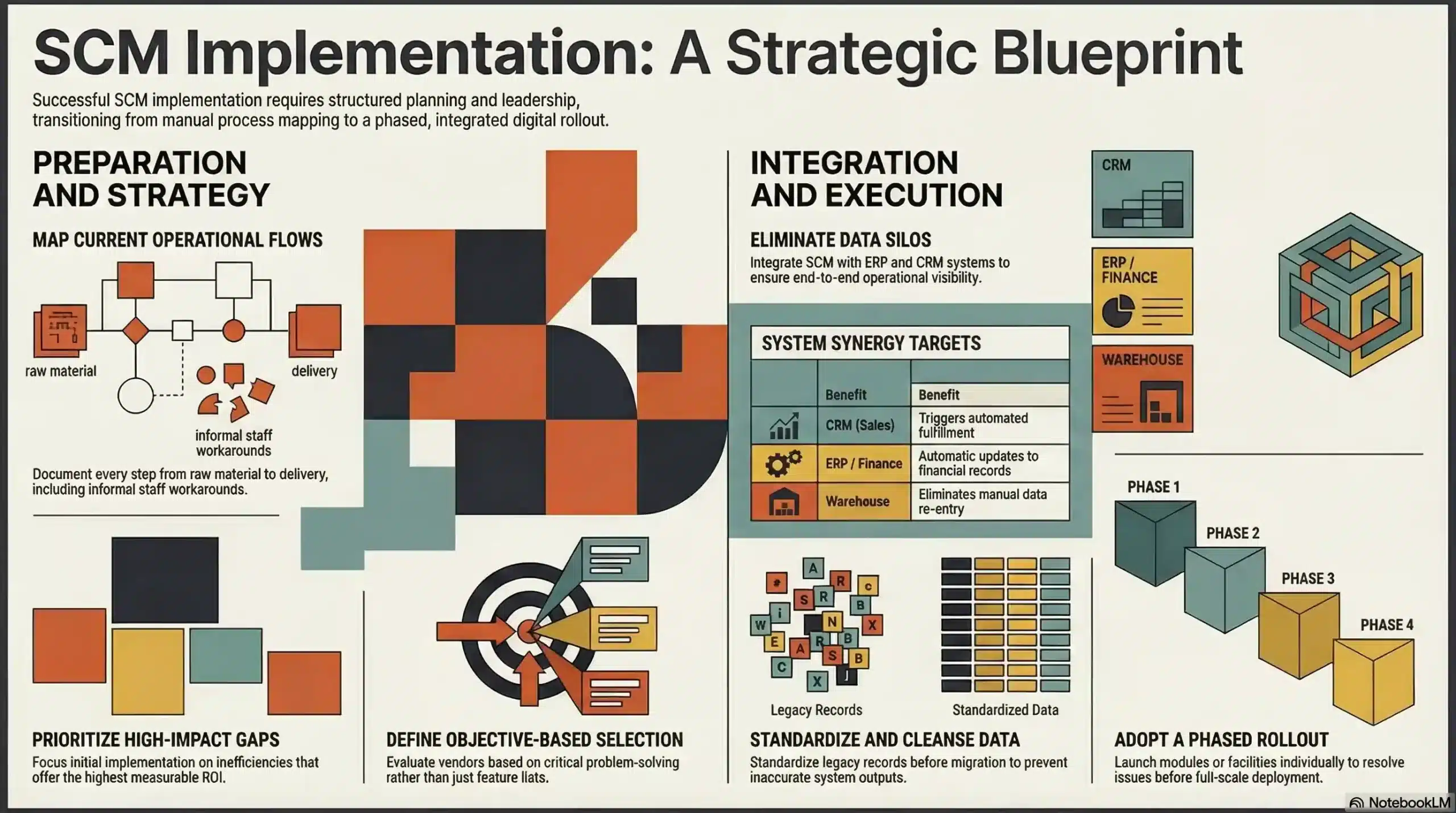
Implementing an SCM system is a major operational undertaking. Success depends on structured planning, cross-functional collaboration, and consistent commitment from leadership throughout each phase of the process.
1. Map your current supply chain processes
Before selecting a system, document how your supply chain currently operates. Track every step a product takes from raw material through to delivery, and identify all stakeholders, tools, and data flows involved.
Focus on how processes actually work in practice. Speak directly with warehouse staff, procurement teams, and logistics coordinators to uncover informal workarounds that do not appear in any official documentation.
Create visual process flowcharts to map the full operation. These provide a clear reference for identifying inefficiencies and communicating the scope of change to both the implementation team and senior leadership.
2. Identify gaps and priority areas
Analyse your mapped processes to identify where delays, errors, or high costs are occurring most frequently. Look for areas with excessive manual data entry, lost visibility, or recurring supplier and fulfilment failures.
Prioritise gaps based on their impact on business performance and profitability. Not all inefficiencies are equally costly. Focus the initial implementation on the areas where the new system will deliver the most measurable value.
Define clear objectives and return on investment expectations before evaluating vendors. This keeps the selection process focused on solving the most critical problems rather than being driven by feature lists alone.
3. Select a system that fits your operations
The SCM software market offers niche tools for specific functions and comprehensive end-to-end enterprise platforms. The right choice depends on your business size, industry, operational complexity, and available budget.
Look for systems with high configurability and scalability to support future growth. Evaluate the user interface carefully, as low adoption rates frequently result from systems that are difficult to navigate in daily operations.
Assess the vendor’s experience in your industry and the level of ongoing support provided after go-live. Post-implementation support quality has a direct impact on how quickly teams reach full productivity with the new platform.
4. Integrate with existing business systems
An SCM system must integrate with your ERP, CRM, and financial accounting platforms to function effectively. Without this integration, data remains siloed, and the system cannot deliver full end-to-end operational visibility.
Integration ensures that sales activity in the CRM triggers fulfilment in the SCM system, and that warehouse receipts automatically update financial records. These automated data flows eliminate manual re-entry and reduce processing errors.
Data migration must be handled carefully during this phase. Legacy data should be cleansed and standardised before being transferred. Importing inaccurate or duplicate records into the new system will undermine its outputs from the start.
5. Train staff and go live in phases
Training should be tailored to each role. A warehouse picker requires different instructions than a procurement manager. All staff should have time to practice in a test environment before the system is launched in a live setting.
A phased rollout reduces implementation risk significantly. Launching one module at a time, or rolling out to a single facility first, allows issues to be identified and resolved before they affect the full operation.
Use early rollout phases to document lessons learned and refine the training process. Applying these improvements to subsequent phases accelerates adoption and reduces disruption across remaining departments and locations.
Supply Chain Management Systems Across Industries
Supply chain challenges vary by industry. While the core functions of an SCM system remain consistent, different sectors require specific configurations to meet their operational, regulatory, and logistical requirements.
1. Retail and FMCG
Retail and fast-moving consumer goods businesses operate on tight margins where operational efficiency determines profitability. SCM systems in this sector must support omnichannel fulfilment across physical stores, e-commerce platforms, and third-party marketplaces.
Demand forecasting is critical given how quickly consumer behavior shifts due to seasons, promotions, and social media. Businesses need to respond to demand spikes rapidly without building excess inventory in the process.
Batch tracking and expiry date management are necessary for perishable goods. FIFO and FEFO inventory methods reduce spoilage losses. High return volumes in e-commerce retail also require robust reverse logistics support within the system.
2. Manufacturing and industrial
Manufacturing supply chains focus on inbound material flow and production floor coordination. SCM platforms in this sector integrate with Material Requirements Planning (MRP) tools to manage Bills of Materials (BOM) across large numbers of components.
Just-in-Time (JIT) manufacturing depends on precise SCM timing to ensure materials arrive when needed. This approach minimises raw material warehousing costs and keeps production lines running without delays caused by late deliveries.
Industrial operations also require spare parts tracking and equipment maintenance scheduling. Downtime caused by unavailable components is expensive, and an SCM system helps maintain the right stock levels to prevent it.
3. Mining and resources
Mining operations are located in remote areas with limited infrastructure, creating complex logistical challenges. SCM in this sector focuses on keeping large equipment operational and maintaining a supply of fuel, parts, and materials.
Spare parts inventory is a high priority. If critical excavation equipment fails and a replacement part is not available, operational losses are significant. The SCM system ensures parts are always stocked to avoid downtime.
Outbound logistics involve moving large volumes of raw materials via rail, heavy-haul trucking, and maritime shipping. Specialised transportation management capabilities are required to coordinate these complex movements at scale.
Common Mistakes in Supply Chain Management
Even with advanced software in place, businesses frequently encounter failures caused by avoidable mistakes. Recognising these patterns is essential for protecting supply chain performance.
1. Poor data quality
Inaccurate historical sales data or supplier lead times produce flawed forecasts and unreliable automated reorder points.
Data accuracy requires ongoing attention beyond the initial setup. Errors that go uncorrected compound over time and affect decisions across the entire supply chain.
2. Lack of cross-functional alignment
SCM systems require active cooperation across procurement, finance, sales, and operations.
When departments operate in isolation and withhold data, end-to-end visibility breaks down. The system cannot perform as intended without consistent input from all teams.
3. Underestimating change management
Frontline staff who do not understand the purpose of a new system often resist using it correctly.
Clear communication and targeted training reduce this risk. Implementations that skip this investment frequently underperform despite having the right technology in place.
4. Selecting a system without scalability
A platform that meets current needs but cannot grow with the business creates new operational constraints within a few years.
Replacing an undersized system is costly and disruptive. Scalability should be evaluated as a core requirement during vendor selection, not treated as a secondary consideration.
Best Practices for Supply Chain Management
Implementing an SCM system is vital, but long-term performance depends on how it is used and maintained. Businesses that follow best practices extract significantly more value from their platforms over time.
1. Maintain clean and consistent data
Data quality is critical for supply chain transparency, as inaccurate stock levels and inconsistent data lead to unreliable forecasts and poor decisions.
Businesses should establish clear data entry standards and assign ownership of data quality to specific roles. Regular audits of supplier records, inventory counts, and product master data prevent any compounding errors.
2. Review supplier performance regularly
Supplier scorecards are only useful if they are reviewed and acted on consistently. Scheduling quarterly performance reviews with key vendors keeps accountability high and surfaces issues before they escalate into supply disruptions.
Performance reviews should cover on-time delivery rates, order accuracy, defect rates, and responsiveness to issues. Suppliers who consistently underperform should be placed on improvement plans or replaced with alternatives.
3. Align supply chain planning with sales and finance teams
Procurement volumes, stock targets, and fulfilment commitments all have direct financial implications. Regular cross-functional planning meetings ensure that the supply chain strategy reflects current forecasts and budget constraints.
When teams share upcoming promotions or expected demand changes with supply chain planners, you can respond faster and better. Their misalignment is a leading cause of excess inventory and missed sales opportunities.
4. Use integrated software to unify supply chain operations
Managing the supply chain across disconnected tools creates data gaps and slows decision-making. Integrated SCM software that connects procurement, inventory, logistics, and financial data in a single platform is the primary solution.
Businesses that consolidate their supply chain operations into one system reduce administrative overhead, improve forecast accuracy, and respond to disruptions faster.
By utilizing a reliable SCM system, staff spend less time reconciling data between tools, and they spend more time on higher-value operational tasks.
How Australian Businesses Are Using Supply Chain Management Systems
Australian businesses face supply chain pressures that differ from those in other markets. Geographic isolation, long international shipping lead times, and reliance on a small number of major ports create operational vulnerabilities.
Retailers sourcing from Southeast Asia must plan more than other continents. Delays at ports can ripple across entire distribution networks. An SCM system provides the lead time visibility needed to manage these risks proactively.
Australian businesses in agriculture, mining, and construction also operate across remote areas where inbound logistics are complex and costly. Without a proper solution, these issues can lead to further costly errors and delays.
Companies in these sectors use SCM platforms to maintain parts availability, coordinate bulk freight, and reduce the cost of emergency procurement when standard supply chains fail to deliver on time.
Conclusion
A SCM system is one of the most impactful investments a business can make. It replaces fragmented processes with a connected platform that improves visibility, reduces costs, and supports more reliable delivery.
The right system provides accurate forecasting, automated procurement, and real-time logistics tracking across every stage of the supply chain. These capabilities compound over time, driving continuous improvements in efficiency and resilience.
Businesses that invest in a well-implemented SCM system are better positioned to manage disruptions and scale efficiently. You can request a free consultation to explore the right approach.
Frequently Asked Question
SAP SCM manages the broader supply chain, including demand planning, logistics, and supplier coordination. SAP MM focuses specifically on materials management and procurement. The right choice depends on the scope of your operational needs.
The five stages of SCM are plan, source, make, deliver, and return. Each stage covers a distinct phase of the supply chain from demand planning through to reverse logistics.
Key skills for SCM include analytical thinking, supplier negotiation, inventory planning, logistics coordination, and proficiency with supply chain management software.