














Vendor Managed Inventory (VMI) is a supply chain strategy where suppliers manage stock levels on behalf of their customers. Instead of the buyer placing orders, the vendor monitors inventory and replenishes it as needed.
For Australian businesses, VMI can improve stock availability, reduce manual ordering, and strengthen supplier relationships. It is commonly used in retail, manufacturing, and distribution industries.
In this guide, you will learn what VMI is, how it works, its benefits and risks, and how to implement it effectively.
Key Takeaways
Understand the core definition and mechanics of VMI.
Discover the step-by-step process and various models of VMI.
Explore the advantages for both buyers and suppliers in Australia.
Penjelasan mendalam mengenai Challenges and Risks of VMI and How to Mitigate Them.

What Is Vendor Managed Inventory (VMI)?

Vendor Managed Inventory (VMI) is an inventory management model where the supplier is responsible for maintaining agreed stock levels at the customer’s location. The supplier uses shared data such as sales and inventory levels to plan replenishment.
This approach reduces the need for manual purchase orders and shifts some inventory responsibility to the supplier. It helps improve efficiency and coordination between both parties.
VMI is often supported by a system for tracking inventory managed by vendor that provide real-time visibility into stock movements and demand.
How Does Vendor Managed Inventory Work?
VMI works through collaboration between the buyer and supplier, supported by shared data and agreed processes. Both parties define responsibilities, stock levels, and replenishment rules.
1. Step-by-Step VMI Process
The supplier receives access to inventory and sales data from the buyer. Based on this data, they monitor stock levels and forecast demand.
When stock reaches a predefined threshold, the supplier automatically replenishes inventory. This ensures continuous availability without manual ordering.
2. Types of VMI Models
Different VMI models exist depending on how inventory is managed and owned. Some models involve supplier-managed stock at the buyer’s location, while others use consignment inventory.
The choice depends on business needs, risk sharing, and how inventory ownership is structured.

Benefits of Vendor Managed Inventory for Australian Businesses
VMI can improve efficiency, stock handling, and strengthen supplier relationships. Both buyers and vendors can benefit from better coordination.
1. Benefits for Buyers (Retailers & Distributors)
Buyers can reduce stockouts and excess inventory through more accurate replenishment. This improves product availability and customer satisfaction.
VMI also reduces administrative workload, as suppliers handle ordering and inventory monitoring.
2. Benefits for Vendors (Suppliers)
Suppliers gain better visibility into customer demand and inventory levels. This allows for improved production planning and more stable order flows.
Stronger partnerships with customers can also lead to long-term contracts and increased sales opportunities.








Challenges and Risks of VMI and How to Mitigate Them
While VMI offers many benefits, it also comes with risks that businesses should manage carefully. Clear agreements and a strong platform for managing inventory can help reduce these risks.
1. Loss of Inventory Control
Buyers may feel they have less direct control over stock levels. This can create concerns if supplier decisions do not align with business priorities.
Setting clear stock policies and approval processes can help maintain control.
2. Data Security and Privacy Concerns
VMI requires sharing sensitive sales and inventory data with suppliers. This can create risks if data is not handled securely.
Using secure systems and clear data agreements can reduce these concerns.
3. Supplier Capability and Data Readiness
Not all suppliers have the systems or expertise to manage inventory effectively. Poor data quality can lead to incorrect replenishment decisions.
Choosing experienced partners and ensuring accurate data is essential.
4. Supplier Dependency and Exit Complexity
Relying heavily on one supplier can create risks if the relationship ends. Transitioning away from VMI may be complex and disruptive.
Having clear exit terms and backup plans can reduce dependency risks.
5. Demand Volatility and Forecast Errors
Unexpected demand changes can lead to overstocking or stock shortages. Forecast errors may affect both parties.
Regular reviews and flexible agreements can help manage demand variability.
VMI in Practice: Industry Examples Relevant to Australia
VMI is used across various industries to improve supply chain efficiency. Its application may vary depending on business needs and product types.
1. Retail and FMCG
Retailers use VMI to ensure shelves are consistently stocked with fast-moving consumer goods.
Suppliers manage inventory based on real-time sales data, enabling an on-demand inventory model that reduces stockouts and improves customer satisfaction.
2. Manufacturing and Automotive
Manufacturers use VMI to ensure critical components are available for production. Suppliers manage inventory to avoid delays in the supply chain.
This supports smoother production processes and reduces downtime.
3. Healthcare and Pharmaceuticals
Healthcare providers use VMI to manage essential medical supplies and pharmaceuticals. Suppliers ensure critical items are always available.
This is important for maintaining service quality and patient care.
4. Wholesale Distribution
Distributors use VMI to manage stock across multiple locations. Suppliers help optimise inventory levels and reduce excess stock.
This improves efficiency and reduces storage costs.
How to Implement VMI: A Step-by-Step Guide for Australian Businesses
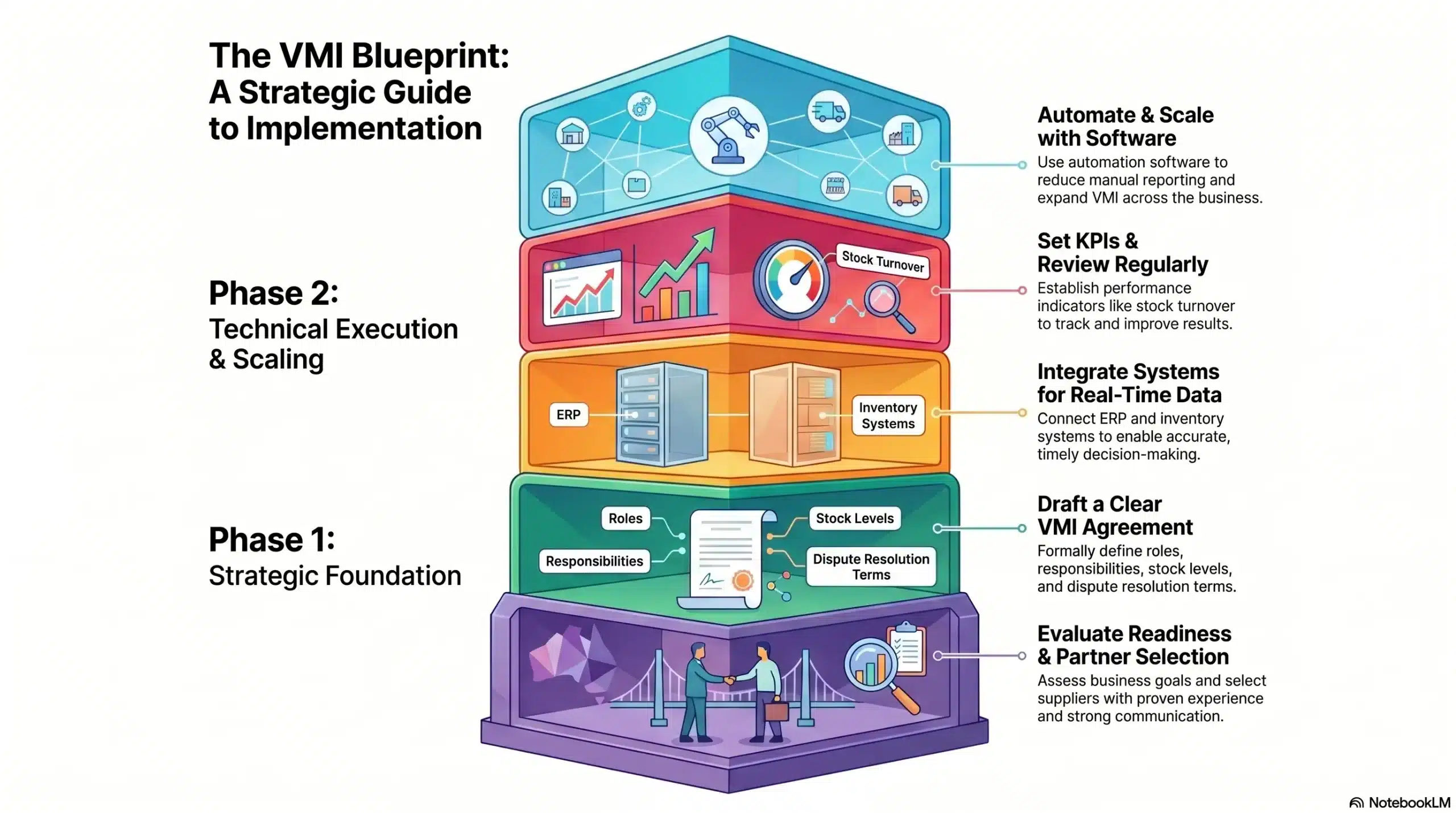
Implementing VMI requires planning, collaboration, and the right systems. A structured approach can help ensure success.
1. Evaluate Whether VMI Is Right for You
Assess your inventory needs, supplier relationships, and business goals. VMI works best for stable demand and strong partnerships.
Understanding your readiness helps avoid implementation issues.
2. Choose the Right Supplier Partner
Select suppliers with strong capabilities, reliable systems, and proven experience. Trust and communication are critical for VMI success.
A good partner will align with your business goals.
3. Draft a Clear VMI Agreement
Define roles, responsibilities, stock levels, and service expectations. Include terms for performance, data sharing, and dispute resolution.
Clear agreements reduce misunderstandings.
4. Integrate Your Systems
Connect inventory, sales, and ERP systems to enable real-time data sharing. Integration ensures accurate and timely information.
This is essential for effective decision-making.
5. Set KPIs and Review Regularly
Establish key performance indicators such as stock availability and turnover. Regular reviews help track performance and identify issues.
Continuous monitoring improves results.
6. Use Software to Automate and Scale
Inventory or ERP software can automate replenishment and reporting, reducing manual work and improving accuracy across the supply chain.
Research on stock managing software comparison before committing to a platform helps businesses identify which solution best fits their operational scale and workflow requirements.
The right tool also makes it significantly easier to expand VMI across the broader business over time.
VMI vs Other Inventory Management Strategies
VMI differs from traditional inventory management where buyers control ordering and stock levels. In VMI, suppliers take a more active role in managing inventory.
Compared to just-in-time (JIT), VMI focuses more on collaboration and shared data rather than minimal inventory. Both aim to improve efficiency but use different approaches.
Choosing the right strategy depends on your business model, supply chain complexity, and level of supplier collaboration.
Conclusion
Vendor Managed Inventory (VMI) is a collaborative approach that helps businesses improve stock management and strengthen supplier relationships.
By allowing suppliers to manage inventory, businesses can reduce manual work and improve efficiency. For Australian businesses, VMI can help reduce stockouts, optimise inventory levels, and improve supply chain visibility.
However, it requires strong partnerships, clear agreements, and reliable systems. As your operations grow, using inventory or ERP software can support VMI implementation and automation.
Book a free consultation with our experts to find the right solution for your business.
Frequently Asked Question
Vendor managed inventory (VMI) is a supply chain model where the supplier monitors and manages inventory levels for the customer based on shared data.
In VMI, the supplier accesses inventory and sales data, tracks stock levels, and automatically replenishes products when they reach a predefined threshold.
VMI helps reduce stockouts, improve inventory efficiency, lower administrative workload, and strengthen supplier relationships.
Risks of VMI include reduced inventory control, data sharing concerns, supplier dependency, and potential forecasting errors.
VMI is not suitable for all businesses and works best for companies with stable demand, strong supplier relationships, and reliable data systems.