














The modern supply chain is increasingly complex, pushing businesses to find smarter ways to manage cash flow and reduce risk. Traditional inventory models require retailers to invest heavily upfront, creating financial pressure and limiting flexibility.
To maintain visibility in these environments, many businesses rely on inventory monitoring software to track stock movement and performance in real time. This model allows suppliers to retain ownership while retailers sell without upfront costs.
Key Takeaways
Explore the fundamental definition and core mechanics of the consignment model.
Compare the consignment approach with traditional wholesale purchasing.
Discover the essential clauses needed in a robust consignment contract.
Follow the step-by-step process of establishing a consignment relationship.

What Is Consignment Inventory?

Consignment inventory is an arrangement where a supplier retains ownership of goods until they are sold by a retailer. The retailer stores and sells the items without making any upfront payment.
Once a sale occurs, the retailer pays the supplier based on agreed terms. This payment structure is typically outlined in a formal consignment agreement. It ensures that suppliers are compensated only when products are successfully sold.
Unsold goods can usually be returned to the supplier, reducing financial risk for the retailer. This makes the model ideal for businesses expanding their product range. As a result, companies can grow their offerings while maintaining better control over cash flow.
Consignment Inventory vs. Traditional Inventory
In traditional inventory models, businesses purchase stock in advance and take full ownership. This means they are responsible for all associated costs and risks, including storage and unsold inventory.
With consignment inventory, businesses only pay for products after they are sold. It allows businesses to maintain a wider product range without committing significant capital, while still maintaining effective stock control across locations.
Because of this flexibility, businesses can respond more quickly to changes in customer demand and market trends. They can adjust stock levels more efficiently without overcommitting resources.

Key Components of a Consignment Inventory Agreement
A clear agreement is essential to ensure both parties understand their roles and responsibilities. Well-defined terms improve transparency and ensure smooth collaboration between suppliers and retailers.
1. Consignor and Consignee Roles
The consignor is the supplier who owns the goods, while the consignee is the retailer who sells them. Each party has distinct responsibilities in the process. The consignor manages supply, while the consignee handles storage, display, and sales activities.
2. Ownership and Payment Terms
Ownership remains with the consignor until products are sold. Payment terms specify when and how the retailer pays for sold items. These terms are typically structured on a periodic basis, such as weekly or monthly settlements.
3. Shipping, Returns, and Liability Clauses
The agreement should define who is responsible for shipping costs and logistics. It should also outline procedures for returning unsold goods. Liability clauses clarify who bears the risk in cases of damage, theft, or loss.
4. Inventory Tracking Responsibilities
Both parties must agree on how inventory is tracked and reported. Accurate tracking ensures transparency and accountability. Using a shared stock management system or regular reporting helps maintain accurate stock records.
How Consignment Inventory Works
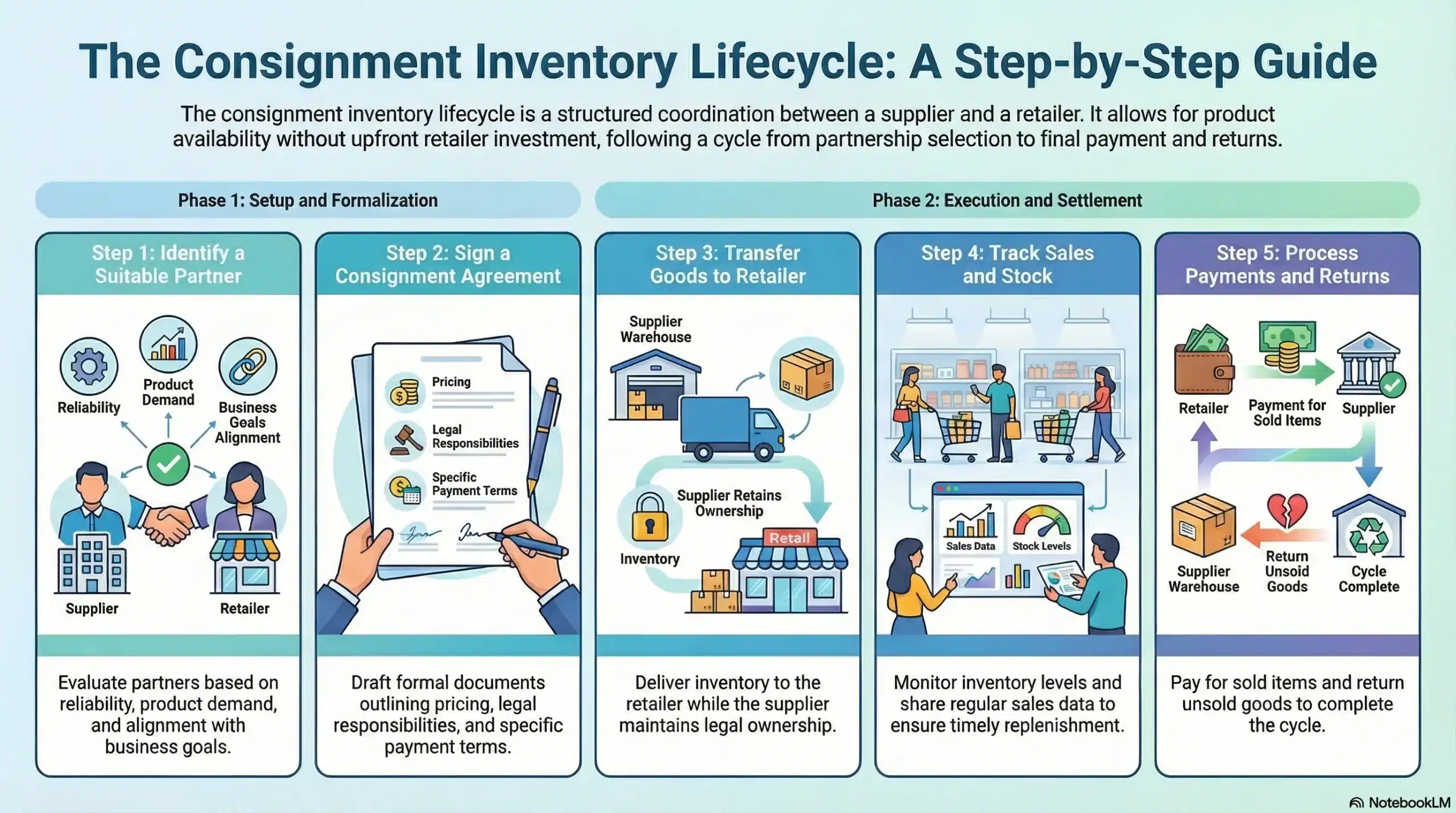
Consignment inventory follows a structured process that ensures smooth coordination between supplier and retailer. Each step plays a critical role in success.
Understanding this workflow helps businesses implement the model effectively.
1. Identify a Suitable Consignment Partner
Businesses must evaluate partners based on reliability, product demand, and alignment with goals. Choosing the right partner is essential. Strong partnerships improve sales performance and reduce operational risks.
2. Draft and Sign a Consignment Agreement
A formal agreement outlines pricing, responsibilities, and payment terms. This document protects both parties legally. Clear agreements reduce misunderstandings and support long-term collaboration.
3. Transfer Goods to the Retailer
The supplier delivers goods to the retailer without transferring ownership. The retailer stores and prepares the products for sale. This step ensures product availability without requiring upfront investment.
4. Track Sales and Manage Stock Levels
The retailer sells the goods while monitoring inventory levels. Sales data is shared with the supplier regularly. Accurate tracking ensures timely replenishment and prevents stock discrepancies.
5. Process Payments and Return Unsold Goods
The retailer pays the supplier for sold items based on agreed terms. Unsold goods are returned if specified in the contract. This step completes the cycle and maintains inventory efficiency.
Advantages and Disadvantages of Consignment Inventory
Consignment inventory offers several benefits but also comes with challenges. Understanding these factors helps in making informed decisions. A balanced approach ensures the model aligns with business goals and capabilities.
1. Advantages for Consignors (Suppliers)
Suppliers can expand market reach without opening new locations. They also retain control over pricing and branding. This model allows testing new markets with lower upfront investment. It also provides opportunities to build stronger relationships with retail partners.
2. Advantages for Consignees (Retailers)
Retailers benefit from reduced upfront costs and lower inventory risk. They can offer more products without large capital investment. This improves cash flow and increases product variety. As a result, retailers can enhance customer satisfaction and competitiveness.
3. Disadvantages for Consignors
Suppliers may experience delayed revenue since payment depends on sales. There is also a risk of unsold or damaged goods. Performance depends heavily on the retailer’s ability to sell. This makes partner selection and monitoring even more critical.
4. Disadvantages for Consignees
Retailers may earn lower margins due to revenue sharing. Managing consigned inventory can also increase administrative work. Disputes may arise if tracking and reporting are not accurate. Without proper systems, these challenges can impact overall efficiency.
Consignment Inventory Across Industries
Consignment inventory is widely used across industries that require flexibility and cost control. It is especially useful where demand is unpredictable. Retail businesses use it for fashion and electronics, while manufacturers use it to ensure steady production supply.
Healthcare and automotive industries also rely on consignment for high-value or critical items, ensuring availability without large upfront costs. This makes the model suitable for various sectors when supported by consignment inventory software in Australia.
Consignment Inventory Accounting
Consignment inventory requires different accounting treatment since ownership remains with the supplier. This affects how assets and revenue are recorded, suppliers keep inventory on their balance sheet until items are sold. Revenue is only recognised after a sale occurs.
Retailers do not record consigned goods as assets. They only recognise revenue for their share of the sale under applicable standards. Proper accounting ensures compliance with regulations and accurate financial reporting.
Common Consignment Inventory Mistakes to Avoid
Many businesses face challenges due to poor implementation or lack of visibility, which can lead to inefficiencies and disputes. Avoiding these issues ensures smoother operations and better outcomes.
- Unclear or Incomplete Agreements
Failing to define terms clearly can lead to misunderstandings and disputes. A well-documented agreement ensures both parties understand their responsibilities. - Poor Inventory Tracking and Reporting
Inaccurate tracking can result in stock discrepancies and financial errors. Reliable systems are essential for maintaining visibility. - Lack of Communication Between Parties
Limited communication can disrupt operations and reduce trust. Regular updates help ensure alignment between consignor and consignee. - Mixing Consigned and Owned Inventory
Combining inventory types can cause confusion and reporting issues. Keeping them separate improves accuracy and control. - Not Using a Centralised Inventory System
Manual processes increase the risk of errors and inefficiencies. A centralised system helps streamline tracking and reporting.








Best Practices for Consignment Inventory Management
Effective management ensures that both suppliers and retailers benefit from the arrangement. Following best practices helps maintain accuracy, transparency, and strong partnerships.
1. Draft a Clear and Comprehensive Contract
A well-written contract defines all responsibilities and expectations. It helps prevent misunderstandings and disputes.cClear documentation ensures smoother operations and accountability.
2. Build a Strong Consignor–Consignee Relationship
Strong communication and trust are essential for success. Both parties must collaborate closely.cRegular updates and transparency improve long-term performance. A healthy relationship also helps resolve challenges more effectively.
3. Track Consigned and Non-Consigned Stock Separately
Separating inventory types reduces errors and confusion. It also improves reporting accuracy. Clear categorisation ensures better stock management and auditing. This practice also simplifies reconciliation and financial reporting.
4. Use an Inventory Management System for Full Control
An inventory system provides real-time visibility into stock and sales. It reduces manual errors and improves efficiency. Automation helps businesses track inventory accurately and make better decisions.
Conclusion
Consignment inventory is a flexible solution that helps businesses reduce financial risk while maintaining product availability. It supports better cash flow and operational efficiency.
With clear agreements and proper tracking, businesses can maximise its benefits. Using the right tools further enhances accuracy and scalability. By adopting best practices, companies can build stronger partnerships and achieve long-term growth.
To identify the right solution for your business, consider booking a no-cost consultation with our team.
Frequently Asked Question
Consignment inventory is when a supplier keeps ownership of products until they are sold. The retailer only pays after making a sale.
It helps reduce upfront costs and lowers the risk of unsold stock. Businesses can also offer more products without spending too much money.
In regular inventory, businesses buy stock before selling it. In consignment, they only pay after the product is sold.